


Brain-Computer Interface Market: Where Should Companies Focus as Neurotechnology Moves Toward Commercialization?
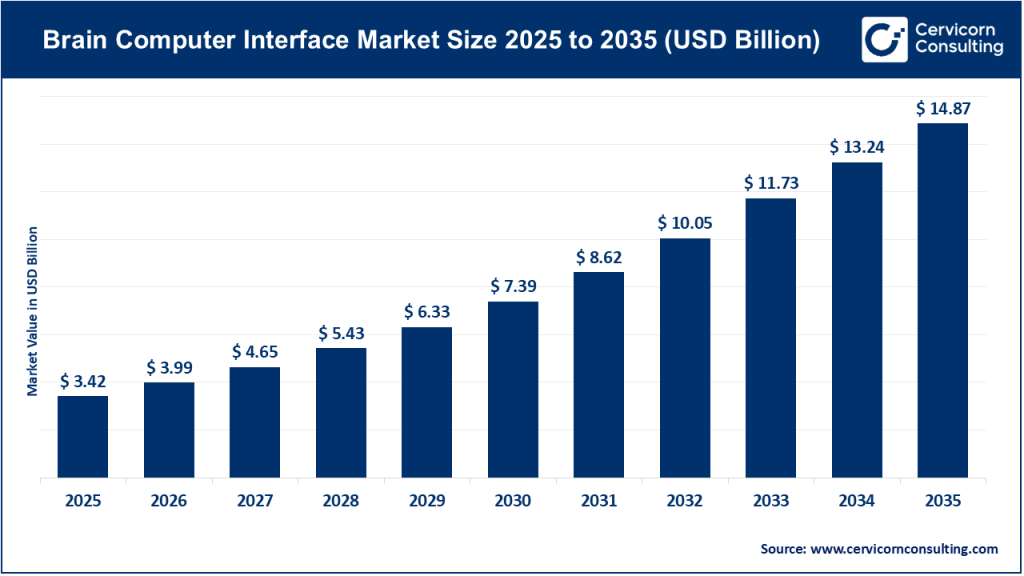
The global brain-computer interface (BCI) market was valued at USD 3.42 billion in 2025 and is projected to reach approximately USD 14.87 billion by 2035, expanding at a CAGR of 15.83% from 2026 to 2035. Growth is supported by advances in neural signal processing, artificial intelligence, wearable technologies, neurorehabilitation, and increasing investment in assistive medical devices. As BCI technologies move beyond laboratory research toward clinical applications and early commercialization, companies face important decisions regarding product development, technology selection, regulatory readiness, and market entry.
The commercial opportunity is expanding, but the market is not developing uniformly. Non-invasive EEG-based systems offer relatively accessible routes into research, rehabilitation, and consumer applications, while invasive and partially invasive systems are attracting attention for restoring movement, communication, and motor control in patients with severe neurological impairments. Companies must therefore distinguish between technologies with established research and diagnostic applications and those still progressing through clinical validation.
Why BCI Companies Need to Reconsider Their Commercialization Strategies
Brain-computer interfaces translate neural activity into commands that allow users to interact with computers, robotic systems, prosthetic devices, and other external equipment. Improvements in electrode design, signal acquisition, machine learning, and real-time processing are increasing the potential applications of these systems.
However, technological progress does not automatically translate into commercial adoption. Companies must demonstrate that their devices deliver consistent performance, meet safety requirements, integrate with existing healthcare or computing infrastructure, and provide measurable benefits to end users.
An important development came in March 2026, when China approved a brain-computer interface medical device for commercial sale for the first time. Developed by Borui Kang Medical Technology, the system is designed to help eligible patients with quadriplegia regain hand-grasping ability through a minimally invasive implant and wireless technology. This regulatory milestone demonstrates that BCI commercialization is progressing beyond experimental research, although broader adoption will still depend on clinical evidence, patient eligibility, and healthcare accessibility.
For medical device manufacturers and neurotechnology developers, the competitive challenge is shifting from demonstrating technical feasibility toward establishing reliable clinical outcomes and scalable product platforms.
Get a Free Sample: https://www.cervicornconsulting.com/sample/2412
Technology Selection Will Determine Long-Term Competitive Positioning
One of the most important decisions for BCI developers is selecting the appropriate interface architecture. The choice between invasive, non-invasive, and partially invasive technologies affects signal quality, patient suitability, development costs, regulatory requirements, and potential applications.
Non-invasive BCI systems
Non-invasive systems primarily use EEG and other external sensing technologies to capture brain activity without surgical implantation. Their relatively accessible deployment makes them relevant to neurological research, rehabilitation, gaming, cognitive monitoring, and assistive applications.
Companies developing these systems should prioritize signal accuracy, noise reduction, wearable comfort, battery performance, and ease of integration. The commercial opportunity is particularly relevant for manufacturers targeting research institutions, rehabilitation centers, and consumer neurotechnology markets.
Invasive BCI systems
Invasive systems use implanted electrodes to capture neural signals with greater spatial resolution and potentially higher information transfer capabilities. They are being developed for applications such as communication restoration, robotic limb control, and movement assistance.
Their development requires greater investment in clinical validation, surgical compatibility, implant reliability, and long-term safety. Companies entering this segment must evaluate clinical partnerships, regulatory pathways, and the availability of specialized healthcare infrastructure before committing to large-scale commercialization.
Partially invasive BCI systems
Partially invasive technologies, including electrocorticography-based approaches, seek to balance signal quality with reduced surgical intervention compared with deeply implanted systems.
This category presents opportunities for developers working on implantable electrodes, flexible materials, wireless transmission, and minimally invasive neurotechnology. Product differentiation will depend on demonstrating meaningful improvements in safety, signal stability, and clinical usability.
The strategic priority is not necessarily to develop the most technically advanced interface. It is to identify the architecture that offers the strongest combination of performance, patient suitability, manufacturing feasibility, and commercial scalability.
Healthcare Applications Are Creating the Strongest Near-Term Commercial Opportunities
Healthcare accounted for 59.10% of global BCI market revenue in 2025, making it the largest application segment. Communication and control represented another 26.70%, while entertainment and gaming accounted for 7%.
These figures indicate that medical and assistive applications remain central to the commercial development of BCI technologies.
For healthcare technology companies, several application areas deserve attention:
- Neurorehabilitation: BCI-enabled rehabilitation systems can support patients recovering from stroke, spinal cord injuries, and other neurological conditions. Companies should assess opportunities in rehabilitation equipment, neural feedback systems, and clinical partnerships.
- Communication restoration: BCI technologies can provide alternative communication channels for individuals with severe motor impairments. Developers should focus on decoding accuracy, response speed, and compatibility with assistive communication platforms.
- Neuroprosthetics: Integration with robotic limbs and external assistive devices creates opportunities for manufacturers developing neural interfaces, control systems, sensors, and prosthetic technologies.
- Motor function restoration: Implantable and minimally invasive systems are being developed to support the restoration of selected motor functions. Clinical outcomes, patient selection, and long-term device reliability will determine commercial potential.
- Neurological research: Research institutions and medical facilities require reliable neural recording and analysis systems, creating opportunities for electrode manufacturers, EEG equipment suppliers, and BCI software developers.
Companies should prioritize applications with clearly defined clinical needs and measurable outcomes rather than spreading development resources across multiple use cases without a validated commercialization pathway.
Hardware and Software Capabilities Will Shape Product Differentiation
Hardware accounted for 63.90% of BCI market revenue in 2025, reflecting the importance of sensors, electrodes, amplifiers, signal acquisition systems, and related components.
However, hardware performance alone will not determine the competitiveness of future BCI platforms. Software capabilities are becoming increasingly important as developers seek to improve neural signal interpretation and real-time interaction.
Companies should consider the following technology priorities:
- High-performance neural sensors: Improved sensitivity, electrode durability, signal stability, and reduced interference are essential for reliable data acquisition.
- AI-powered signal processing: Machine learning can help identify patterns in complex neural signals and improve the translation of brain activity into device commands.
- Real-time decoding: Low-latency processing is particularly important for communication systems, prosthetic control, and rehabilitation applications.
- Wireless connectivity: Wireless data transmission can improve device usability and reduce dependence on complex physical connections.
- Miniaturization and power efficiency: Smaller devices with longer battery life can support broader deployment in wearable and implantable applications.
- Hybrid BCI architectures: Combining EEG with other physiological signals, such as electromyography, can improve functionality in selected applications.
For component suppliers, these developments create opportunities in electrode materials, microelectronics, embedded processors, wireless communication modules, and specialized medical-grade components. Software developers can differentiate through signal-processing algorithms, AI models, neural data visualization, and device integration capabilities.
Regulatory Readiness and Clinical Validation Will Influence Market Entry
Regulatory approval remains one of the most important commercialization barriers for companies developing medical BCI products.
Unlike many conventional consumer electronics products, medical BCI systems must demonstrate safety, reliability, and clinical effectiveness for their intended applications. Implantable technologies also introduce additional considerations involving surgical procedures, biocompatibility, device longevity, and post-implant monitoring.
The March 2026 commercial approval of a BCI medical device in China represents an important development for the industry. However, companies targeting international markets should not assume that regulatory clearance in one country guarantees access to another.
Businesses should evaluate:
- Regulatory requirements across target markets.
- Clinical trial design and patient recruitment requirements.
- Long-term implant safety and performance evidence.
- Biocompatibility and manufacturing quality standards.
- Data protection and patient consent requirements.
- Reimbursement pathways and healthcare procurement processes.
Early regulatory planning can reduce development uncertainty and help companies avoid investing in product configurations that may face significant approval barriers.
Regional Expansion Requires Different Market Entry Strategies
Regional opportunities in the BCI market are influenced by healthcare infrastructure, research funding, technology development, regulatory environments, and investment availability.
North America
North America accounted for 39.7% of global BCI market revenue in 2025. The region benefits from established neuroscience research institutions, medical technology companies, venture investment, and advanced healthcare infrastructure.
Companies should prioritize clinical partnerships, medical device innovation, AI-based neural processing, and collaboration with research institutions. The United States remains particularly important for companies seeking to establish relationships with BCI developers and healthcare technology stakeholders.
Europe
Europe represented 28.7% of global market revenue in 2025. Germany, the United Kingdom, and France offer opportunities through neuroscience research, rehabilitation infrastructure, and medical technology development.
Companies entering the region should assess medical device regulatory requirements, research collaborations, healthcare procurement structures, and opportunities for partnerships with rehabilitation centers.
Asia-Pacific
Asia-Pacific accounted for approximately 22.5% of the global market in 2025, with the regional market valued at USD 0.77 billion. China, Japan, and India represent important opportunities because of their expanding healthcare technology sectors, neuroscience research activities, and increasing interest in assistive technologies.
China’s recent regulatory milestone further strengthens its position as an important market to monitor. Japan offers opportunities in robotics and rehabilitation technologies, while India presents potential for research partnerships, assistive healthcare solutions, and cost-efficient technology development.
For companies planning regional expansion, the decision should extend beyond market size to include clinical infrastructure, local regulatory requirements, distribution partnerships, and the availability of qualified healthcare professionals.
Competitive Positioning Will Depend on Partnerships and Technology Specialization
The BCI market includes established medical technology companies, specialized neurotechnology developers, research-focused organizations, and emerging startups.
Companies such as Medtronic, Natus Medical, g.tec medical engineering, NeuroSky, EMOTIV, Blackrock Neurotech, and Brain Products participate in different areas of the broader neurotechnology ecosystem.
At the same time, developers including Neuralink, Synchron, Precision Neuroscience, and Paradromics are advancing implantable and minimally invasive BCI technologies.
The competitive landscape is creating opportunities for companies that may not manufacture complete BCI systems. Specialized suppliers can participate through electrodes, neural sensors, signal amplifiers, semiconductor components, AI software, wireless connectivity, and clinical research infrastructure.
Strategic partnerships can also reduce development costs and accelerate product validation. Medical device manufacturers can collaborate with neuroscience research institutions, software developers, rehabilitation providers, and component suppliers to strengthen their technology capabilities.
For companies evaluating market entry, identifying underserved technology requirements and potential collaboration opportunities may be more practical than competing directly with established implant developers.
Key Business Decisions for Companies Entering the BCI Market
As the market moves toward commercialization, companies should evaluate several strategic priorities before committing significant resources.
1. Which technology architecture offers the strongest commercial potential?
Businesses must compare invasive, non-invasive, and partially invasive technologies based on intended applications, signal quality, safety requirements, development costs, and market accessibility.
2. Should product development prioritize healthcare or consumer applications?
Healthcare applications currently represent the largest revenue opportunity, but consumer neurotechnology offers alternative commercialization pathways. Companies should assess customer demand, product pricing, regulatory requirements, and adoption timelines before choosing their primary target market.
3. Where should R&D investments be concentrated?
Investment priorities should reflect actual performance limitations. Depending on the product, these may include electrode design, neural signal processing, AI algorithms, wireless communication, miniaturization, or battery efficiency.
4. How can companies reduce clinical and regulatory risks?
Early engagement with clinical institutions, regulatory specialists, and medical device partners can help developers establish appropriate validation strategies and avoid costly delays.
5. Which regional markets should receive investment first?
North America offers established research and commercialization infrastructure, Europe provides opportunities in healthcare and rehabilitation, and Asia-Pacific offers developing opportunities in medical technology and neuroscience research. Market entry strategies should reflect country-level conditions rather than regional growth expectations alone.
6. Which partnerships can accelerate commercialization?
Companies should identify potential collaborators across medical devices, semiconductors, AI software, robotics, neuroscience research, and rehabilitation services. Strategic partnerships can provide access to technical capabilities and clinical infrastructure that would otherwise require substantial internal investment.
Outlook: Moving from Technical Innovation to Scalable Neurotechnology
The brain-computer interface market is entering an important development phase as advances in neural engineering, AI, and medical technology create new opportunities across healthcare, assistive communication, rehabilitation, and consumer electronics.
However, long-term commercial success will depend on more than technological breakthroughs. Companies must establish reliable product performance, demonstrate clinical value, manage regulatory requirements, and build scalable manufacturing and distribution capabilities.
The distinction between research-stage innovation and commercially viable BCI products will become increasingly important. Businesses that align their technology investments with clearly defined applications, clinical requirements, and customer needs will be better positioned to participate in the industry’s development.
For investors, medical device manufacturers, technology suppliers, and emerging neurotechnology companies, understanding market segmentation, competitive positioning, regional opportunities, and commercialization barriers will be essential when determining where to allocate resources.
Strategic market intelligence can help companies evaluate technology opportunities, identify competitive gaps, assess regional expansion potential, and prioritize investments across the evolving brain-computer interface ecosystem.
To Get Detailed Overview, Contact Us: https://www.cervicornconsulting.com/contact-us