


Liquid Handling Systems Market: Strategic Priorities for Laboratory Automation, Precision and Research Efficiency
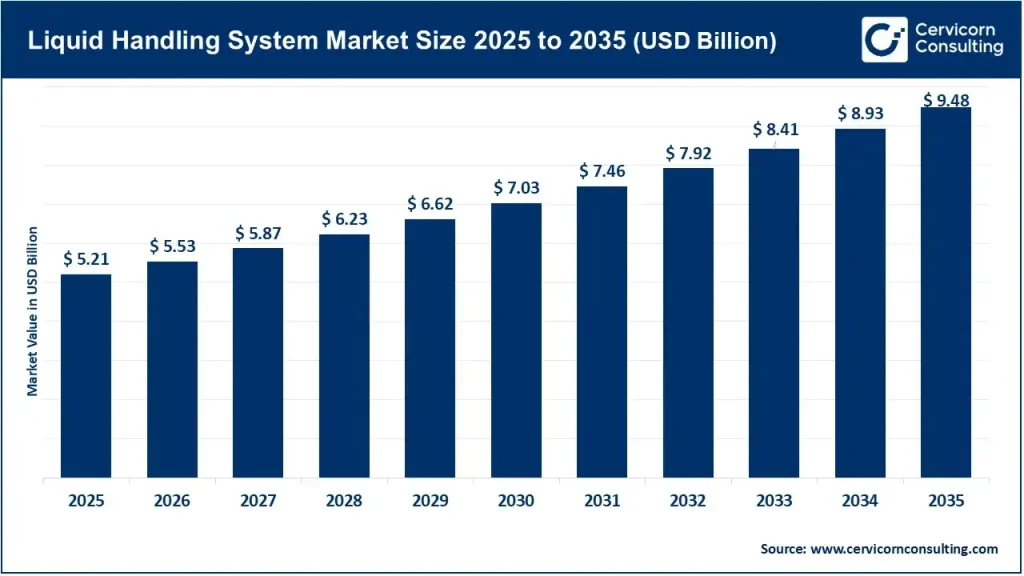
The global liquid handling systems market was valued at USD 5.21 billion in 2025 and is projected to grow from USD 5.53 billion in 2026 to approximately USD 9.48 billion by 2035, registering a compound annual growth rate (CAGR) of 6.2% from 2026 to 2035.
Growth is increasingly linked to pharmaceutical R&D, high-throughput screening, genomics, clinical diagnostics, and the expansion of biotechnology research. As laboratories handle larger sample volumes and more complex experimental workflows, liquid handling is becoming an important investment area for improving accuracy, reproducibility, throughput, and operational efficiency.
However, market expansion does not automatically translate into equal opportunities across all equipment categories. Manufacturers must evaluate where laboratories are prioritizing automation, which applications require greater dispensing precision, and how purchasing decisions are changing between manual, semi-automated, and fully automated platforms.
For equipment manufacturers, laboratory automation providers, consumable suppliers, and life sciences companies, the key opportunity lies in aligning product development and commercial strategies with specific laboratory workflow requirements.
Liquid Handling Systems Market: Size and Growth Outlook
The market outlook indicates that commercial opportunities extend beyond equipment sales to include consumables, software, workflow integration, and application-specific automation.
| Market indicator | 2025 market share |
|---|---|
| Automated liquid handling systems | 42% |
| Liquid handling workstations | 25% |
| Drug discovery & high-throughput screening | 27% |
| Biotechnology & pharmaceutical companies | 36% |
| North America | 39% |
These segments highlight where current demand is concentrated, but future investment decisions should also consider faster-growing applications and customer requirements.
Get a Free Sample: https://www.cervicornconsulting.com/sample/3086
What Is Changing the Liquid Handling Systems Industry?
Several developments are changing how laboratories evaluate liquid handling equipment and automation investments.
1. Laboratory automation is moving beyond repetitive pipetting
Laboratories are increasingly looking for integrated systems capable of handling sample preparation, reagent dispensing, dilution, mixing, and microplate processing. Automated workstations are becoming important because they can coordinate multiple procedures within a single workflow.
For manufacturers, this creates an opportunity to develop platforms that offer modular configurations, application flexibility, and compatibility with existing laboratory equipment.
2. Pharmaceutical R&D is increasing demand for high-throughput processing
Drug discovery and high-throughput screening require laboratories to process large numbers of samples while maintaining consistent experimental conditions. Manual liquid handling can become a bottleneck as testing volumes increase.
Automation providers can benefit by developing systems that support parallel processing, precise reagent dispensing, rapid sample preparation, and reproducible screening workflows.
3. Genomics and advanced therapies are creating specialized requirements
Next-generation sequencing (NGS), cell therapy, gene therapy, and molecular diagnostics involve complex sample preparation procedures. These applications require accurate liquid transfer, controlled reagent volumes, and contamination management.
Recent industry developments demonstrate this shift:
-
In October 2026, Agilent Technologies introduced its NovoStation Sample Preparation System for automated flow cytometry sample preparation.
-
In August 2026, Pillar Biosciences and Hamilton Company announced the commercial release of an automated NGS library preparation method supporting up to 96 libraries in a continuous run.
-
In March 2026, Takara Bio USA and Hamilton Company announced a collaboration to develop automated NGS library preparation workflows.
These developments indicate growing interest in application-specific automation rather than standalone equipment purchases.
4. Digital integration is becoming an equipment selection factor
Laboratories increasingly need liquid handling equipment that can communicate with laboratory information management systems (LIMS), data platforms, and other automated instruments.
Software compatibility, protocol management, workflow monitoring, and data traceability can influence purchasing decisions alongside dispensing accuracy and instrument speed.
Equipment manufacturers that overlook software integration may face difficulties competing for larger laboratory automation projects.
Key Business Decisions for Liquid Handling System Manufacturers and Suppliers
Market growth creates opportunities, but manufacturers need to identify which technologies, applications, and customer groups offer the strongest commercial potential.
1. Should Manufacturers Prioritize Fully Automated or Semi-Automated Systems?
The choice between fully automated and semi-automated equipment depends on laboratory size, sample volumes, workflow complexity, available capital, and expected utilization.
Fully automated platforms are attractive to pharmaceutical companies, large biotechnology laboratories, and high-throughput research facilities. These customers often prioritize processing capacity, repeatability, and reduced manual intervention.
Semi-automated platforms offer a different commercial opportunity. Smaller laboratories, academic institutions, and diagnostic facilities may prefer solutions that improve productivity without requiring significant capital expenditure or extensive workflow redesign.
Business priorities:
-
Develop modular automation platforms that allow customers to expand capacity gradually.
-
Offer semi-automated systems for laboratories transitioning from manual processes.
-
Differentiate fully automated platforms through throughput, precision, software capabilities, and integration.
-
Evaluate total cost of ownership rather than competing exclusively on equipment pricing.
The objective should be to address different automation maturity levels rather than concentrate exclusively on premium equipment.
2. Which Product Categories Offer the Strongest Commercial Opportunities?
Liquid handling workstations accounted for 25% of market revenue in 2025, making them the leading product category in the market.
However, consumables are expected to provide attractive recurring-revenue opportunities as laboratories increase automated sample processing.
Manufacturers should evaluate the commercial potential of the following categories:
-
Liquid handling workstations: Integrated platforms for sample preparation, pipetting, dispensing, and high-throughput processing.
-
Pipettes: Manual, electronic, and multichannel pipettes for accurate liquid transfer across different laboratory workflows.
-
Consumables: Pipette tips, tubes, microplates, and related products required for routine laboratory operations.
-
Reagent dispensers: Equipment supporting consistent reagent distribution in screening and diagnostic applications.
-
Software and services: Workflow management, instrument integration, maintenance, calibration, and technical support.
A key strategic consideration is whether to compete through standalone equipment or build a broader ecosystem of instruments, consumables, and software.
Companies with strong consumable compatibility and service capabilities may have opportunities to generate revenue beyond the initial equipment purchase.
3. Which Applications Should Receive Greater R&D Investment?
Drug discovery and high-throughput screening accounted for 27% of market revenue in 2025. However, manufacturers should not assume that the largest application segment will always provide the strongest future growth.
Cell and gene therapy is expected to be the fastest-growing application segment during 2026–2035.
This creates an opportunity for manufacturers to develop systems designed for more specialized research and production workflows.
Important application priorities include:
-
Drug discovery: High-throughput screening, compound preparation, and automated reagent dispensing.
-
Clinical diagnostics: Consistent sample preparation and high-volume testing workflows.
-
Genomics: NGS library preparation, PCR preparation, and nucleic acid handling.
-
Proteomics: Precise sample preparation and reagent management for protein analysis.
-
Cell and gene therapy: Controlled liquid transfer, standardized processing, and contamination-sensitive workflows.
Manufacturers should prioritize R&D based on application-specific technical requirements, customer investment plans, and the potential for repeat equipment and consumable demand.
4. How Should Companies Address High Equipment Costs?
High initial investment remains a barrier to wider automation adoption, particularly among smaller laboratories and institutions with limited capital budgets.
The actual investment extends beyond the instrument itself. Software licensing, installation, staff training, maintenance, calibration, and compatible consumables can significantly increase ownership costs.
Manufacturers should consider:
-
Modular equipment configurations with upgrade options.
-
Leasing and financing arrangements for capital-constrained customers.
-
Lower-cost systems targeting smaller research and diagnostic laboratories.
-
Service contracts that improve equipment uptime.
-
Demonstrable productivity and consumable savings to support customer ROI calculations.
A strong commercial strategy should communicate the operational value of automation, not simply the technical specifications of the equipment.
5. How Important Is Software and Instrument Compatibility?
As laboratories move toward connected workflows, equipment compatibility can become a significant competitive differentiator.
A liquid handling system that operates independently may not deliver the same operational value as one integrated with laboratory robotics, sample tracking, analytical instruments, and LIMS platforms.
Manufacturers should evaluate investments in:
-
Open software architecture and integration capabilities.
-
Automated protocol development and management.
-
Real-time instrument monitoring.
-
Data recording and workflow traceability.
-
Compatibility with laboratory robotics and third-party equipment.
Software integration can also help manufacturers build longer-term customer relationships through upgrades, technical support, and recurring software-related services.
Regional Market Opportunities: Where Should Companies Expand?
Regional expansion strategies should reflect differences in laboratory infrastructure, pharmaceutical investment, research capabilities, and automation adoption.
REGIONAL MARKET OUTLOOK · 2025–2035
USD 2.03B
2025 market size
Projected to reach USD 3.70 billion by 2035. Established pharmaceutical companies, biotechnology research, and advanced laboratory infrastructure support demand.
Business priority: Premium automation, integrated workstations, and software-enabled solutions.
USD 1.41B
2025 market size
Expected to exceed USD 2.56 billion by 2035. Expanding pharmaceutical manufacturing, genomics research, diagnostics, and healthcare infrastructure are supporting demand.
Business priority: Cost-effective automation, local distribution, and application-specific systems.
USD 1.35B
2025 market size
Projected to reach USD 2.46 billion by 2035. Pharmaceutical research, precision medicine, and established scientific infrastructure support market development.
Business priority: Precision equipment, workflow standardization, and advanced research applications.
Why Asia-Pacific Deserves Greater Attention
Asia-Pacific represents an important expansion opportunity for liquid handling system manufacturers.
India, China, Japan, and South Korea have established pharmaceutical, biotechnology, healthcare, and research ecosystems. Increasing investments in diagnostics, genomics, and advanced therapies are creating opportunities for laboratory equipment suppliers.
India also offers a developing opportunity through government-supported research infrastructure.
For example, the Genome India initiative released research data from more than 10,000 sequenced Indian genomes in January 2025. This supports the broader development of genomics and precision medicine research, which requires reliable sample preparation and liquid handling capabilities.
For international manufacturers, potential priorities include:
-
Establishing partnerships with local laboratory equipment distributors.
-
Developing affordable systems for academic and research institutions.
-
Expanding consumable availability and technical service networks.
-
Targeting pharmaceutical R&D facilities and contract research organizations.
-
Building application-specific solutions for genomics and molecular diagnostics.
Competitive Landscape: What Should Manufacturers Monitor?
Competition in the liquid handling systems market involves more than instrument performance. Companies are increasingly competing through automation capabilities, workflow integration, application expertise, consumable ecosystems, and technical support.
Some of the prominent companies operating in the market include:
-
Danaher Corporation: Laboratory technologies and life sciences automation.
-
Tecan Group: Automated laboratory instruments and liquid handling platforms.
-
Hamilton Company: Automated liquid handling and laboratory automation solutions.
-
Agilent Technologies: Analytical instruments, laboratory technologies, and automated sample preparation.
-
Eppendorf: Laboratory instruments, pipettes, and liquid handling equipment.
-
Revvity: Life sciences technologies, laboratory automation, and research solutions.
-
Sartorius: Bioprocessing technologies and laboratory equipment.
-
Mettler-Toledo: Laboratory instruments and precision measurement technologies.
-
QIAGEN: Molecular biology technologies and automated sample preparation.
For competitive positioning, manufacturers should monitor product launches, application-specific collaborations, distribution agreements, automation partnerships, and investments in software capabilities.
The recent collaborations involving Hamilton Company and the developments announced by Agilent also indicate that application-specific workflow automation is an important area of competitive activity.
Five Strategic Priorities for Companies Entering or Expanding in This Market
Based on market growth, segment performance, and changing laboratory requirements, companies should consider five priorities:
1. Build application-focused product portfolios.
Rather than developing generic liquid handling equipment, manufacturers should target specific workflows in genomics, drug discovery, clinical diagnostics, and cell and gene therapy.
2. Develop recurring-revenue opportunities.
Consumables, maintenance, calibration, software, and technical support can provide revenue opportunities beyond initial equipment sales.
3. Target laboratories at different automation stages.
Semi-automated systems can address cost-sensitive customers, while fully automated platforms can target high-throughput research and pharmaceutical facilities.
4. Strengthen regional distribution and service capabilities.
Local technical support, training, equipment availability, and customer relationships can influence purchasing decisions, particularly in emerging markets.
5. Invest in integrated laboratory automation.
Compatibility with LIMS, robotics, analytical instruments, and digital laboratory platforms can strengthen product differentiation and customer retention.
Conclusion: Where Will the Next Commercial Opportunities Emerge?
The liquid handling systems market is moving toward more integrated, precise, and application-specific laboratory automation. Although pharmaceutical and biotechnology companies currently represent the largest end-user segment, opportunities are also emerging across contract research organizations, diagnostic laboratories, genomics research, and advanced therapy development.
The projected expansion from USD 5.21 billion in 2025 to USD 9.48 billion by 2035 reflects the growing importance of automated fluid management in modern laboratory operations.
For manufacturers, the next phase of competition will depend on their ability to balance equipment performance, affordability, workflow compatibility, and recurring revenue opportunities.
Companies evaluating investments in this market should examine not only overall market growth but also segment-level demand, regional purchasing patterns, competitive product positioning, and application-specific technology requirements.
The most important strategic question is no longer simply how much laboratory automation will grow, but which customer workflows, product categories, and regional markets will generate sustainable commercial opportunities.
To Get Detailed Overview, Contact Us: https://www.cervicornconsulting.com/contact-us