


Blockchain in Healthcare Market: Where Should Healthcare Businesses Invest as Trusted Data Infrastructure Scales?
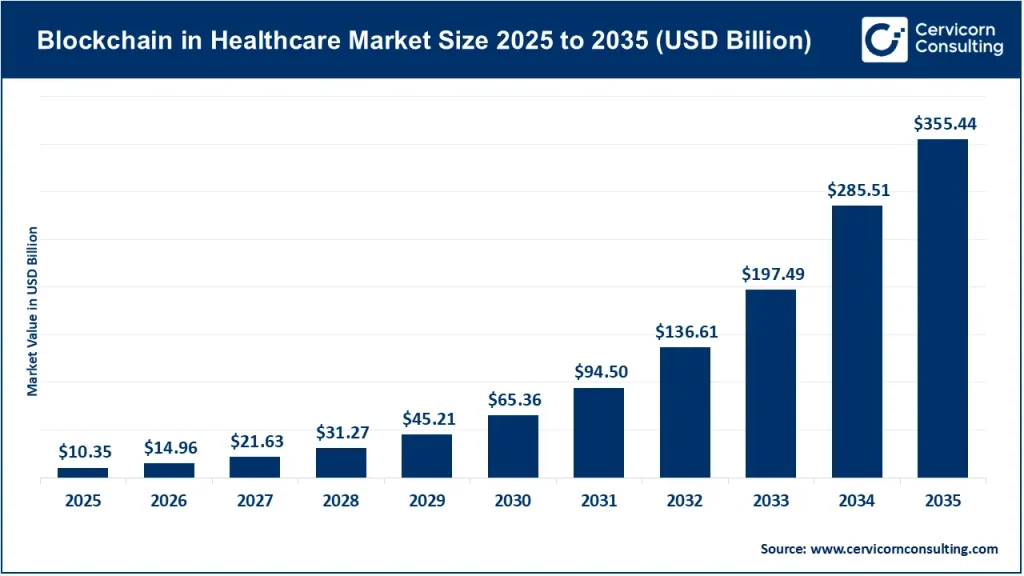
The global blockchain in healthcare market was valued at approximately USD 10.35 billion in 2025 and is projected to reach USD 355.44 billion by 2035, expanding at a 42.42% CAGR. North America accounted for the largest regional share in 2024, while Asia-Pacific is expected to record the fastest growth through the forecast period.
But the more important business question is not simply how quickly the blockchain in healthcare market is growing. It is where blockchain can create measurable value within increasingly complex healthcare data and supply-chain environments.
Healthcare organizations are simultaneously dealing with fragmented electronic health records, stricter data governance, cross-organizational data exchange, pharmaceutical traceability requirements, clinical research complexity, and growing AI adoption. This is creating a stronger case for infrastructure that can establish trusted records and verifiable transactions across organizations.
Healthcare Is Moving From Digital Records Toward Interoperable Data
The next phase of healthcare digitization is increasingly focused on connecting systems rather than simply digitizing individual processes.
India provides a useful example. In May 2026, the government reported that more than 100 crore health records had been linked with Ayushman Bharat Health Accounts (ABHA), reflecting the scale at which interoperable digital health infrastructure is developing. The country’s Unified Health Interface also provides an interoperable service layer designed to allow patients and providers to connect across different digital platforms.
This creates an opportunity for blockchain-based architectures where multiple parties need to establish trust without necessarily operating on the same internal systems.
For healthcare businesses, the investment question therefore shifts from “Should we adopt blockchain?” to:
Which data or transaction requires an immutable, shared and auditable record that conventional databases cannot efficiently provide?
That distinction can prevent organizations from investing in blockchain simply because it is technologically attractive.
Get a Free Sample: https://www.cervicornconsulting.com/sample/2781
Medical Records Could Become an Important Use Case—but Architecture Matters
Medical records remain one of the most discussed applications of blockchain because healthcare information is distributed across hospitals, laboratories, pharmacies, insurers and other providers.
However, storing complete medical records directly on a blockchain is generally not the most practical architecture. Sensitive clinical information can require high storage capacity, rapid access, privacy controls and the ability to accommodate regulatory requirements.
A more commercially relevant model is to use blockchain as a trust and verification layer, while sensitive clinical information remains in appropriate off-chain systems.
This approach can provide:
- Verifiable records of data access and changes
- Patient-controlled authorization mechanisms
- Audit trails across organizations
- Greater confidence in data provenance
- Improved coordination between healthcare stakeholders
A 2026 systematic review of blockchain applications in healthcare identified interoperability, data standardization, scalability, cybersecurity and technical expertise among the major barriers facing healthcare information systems. The research also found that permissioned blockchain architectures can support data integrity and regulated interoperability, although regulatory compliance and organizational readiness remain significant challenges.
For hospitals and health-tech companies, this makes interoperability infrastructure a more attractive investment area than simply deploying blockchain as a standalone database.
Pharmaceutical Traceability May Offer a More Direct Business Case
The pharmaceutical supply chain provides another area where blockchain can have a clearer commercial rationale.
Manufacturers, distributors, pharmacies and regulators need visibility across complex supply chains, particularly for high-value medicines, biologics and temperature-sensitive products. Counterfeit products, fragmented records and limited visibility between supply-chain participants can increase both financial and patient-safety risks.
The U.S. Drug Supply Chain Security Act has encouraged the development of electronic, interoperable capabilities for tracing and verifying prescription drugs throughout the distribution system. The FDA’s pilot program evaluated different technologies and approaches for improving product tracing and verification.
Recent research is also examining scalable blockchain architectures specifically for pharmaceutical drug tracking, including Layer-2 approaches and decentralized storage to address blockchain performance limitations.
This creates a potential investment opportunity around blockchain-enabled supply-chain platforms, serialization, product authentication and cross-company traceability, rather than blockchain infrastructure in isolation.
AI Could Increase the Value of Trusted Healthcare Data
AI is creating another reason for healthcare companies to reconsider data architecture.
AI models require reliable and well-governed data. Yet healthcare data is often fragmented across organizations and systems, with uncertainty around provenance, permissions and data modifications.
Blockchain does not solve healthcare AI by itself, but it can potentially provide a verifiable layer for:
- Data provenance
- Consent management
- Access authorization
- Model-input verification
- Research data integrity
- Auditability of data transactions
This becomes particularly relevant as healthcare moves toward AI-assisted diagnosis, clinical decision support and automated workflows.
The U.S. Office of the National Coordinator’s 2026 interoperability initiatives illustrate the broader direction of the market. Its Leading Edge Acceleration Projects include work on patient-controlled data environments and cryptographically verifiable AI routing, demonstrating increasing attention toward trustworthy and interoperable data infrastructure.
For technology vendors, this suggests that the strongest opportunity may sit at the intersection of blockchain + AI + interoperability, rather than blockchain as an isolated technology category.
Clinical Trials Could Become Another Strategic Opportunity
Clinical research involves multiple parties—including sponsors, CROs, investigators, laboratories and regulators—while generating large quantities of sensitive data.
Blockchain can potentially provide an immutable audit layer for selected trial activities, including data provenance, protocol-related events, consent records and access histories.
The commercial opportunity is particularly relevant for trials involving:
- Multi-site research
- Personalized medicine
- Cell and gene therapies
- Rare diseases
- Real-world evidence
- Cross-border clinical research
However, companies evaluating this opportunity need to consider integration with existing clinical trial management systems rather than treating blockchain as a replacement for established infrastructure.
Claims and Billing Require a Different Investment Thesis
Healthcare payers and providers face another opportunity through smart-contract-based automation.
Claims processing involves repeated verification between providers, payers and patients. Blockchain-based systems could potentially establish shared transaction records and automate selected verification or settlement processes.
The opportunity is strongest where several organizations repeatedly exchange the same information and where disputes, reconciliation and fraud create measurable administrative costs.
However, implementation depends heavily on integration with existing payer and provider systems, regulatory requirements and transaction volumes.
Therefore, healthcare businesses should evaluate specific high-friction workflows rather than attempting to place the entire claims ecosystem on blockchain.
Where Is Investment Likely to Be Most Attractive?
Cervicorn’s market segmentation highlights medical records management, supply-chain management, clinical trials, claims and billing, drug traceability and regulatory compliance as major application areas.
From a business perspective, these opportunities can be prioritized differently:
| Investment Area | Strategic Potential | What Businesses Should Evaluate |
|---|---|---|
| Drug traceability | High | Product authentication, serialization and supply-chain visibility |
| Healthcare interoperability | High | Cross-platform data exchange and verification |
| Clinical data integrity | High | Provenance, consent and auditability |
| Clinical trials | High | Multi-party data integrity and research transparency |
| AI data governance | Emerging/High | Data provenance, authorization and audit trails |
| Claims automation | Emerging | Reconciliation, fraud detection and settlement |
| Medical records | High but complex | Privacy, architecture and interoperability |
| Regulatory compliance | High | Automated audit trails and verifiable records |
The key consideration is not blockchain adoption alone. The strongest opportunities are likely to emerge where multiple organizations need to trust the same transaction or data record.
Asia-Pacific Could Become an Important Growth Market
North America currently represents the largest regional opportunity, supported by healthcare technology adoption, R&D activity and enterprise investment. Cervicorn estimates North America’s blockchain in healthcare market at approximately USD 2.81 billion in 2024, with the market projected to reach around USD 111.92 billion by 2034.
Asia-Pacific, however, presents a different opportunity profile.
India, China, Japan, South Korea and other markets are investing heavily in digital healthcare infrastructure. India’s ABDM development is particularly relevant because the ecosystem already includes large-scale digital identities, healthcare registries and interoperable data exchange.
By July 2026, India had created 94.87 crore ABHA IDs, with more than 5.36 lakh healthcare facilities and 10.09 lakh healthcare professionals registered under ABDM.
For blockchain companies, this creates a potentially significant environment for solutions focused on identity, consent, data provenance, interoperability and trusted healthcare transactions.
What Should Healthcare Companies Evaluate Before Investing?
Blockchain investment should not begin with technology selection.
A more practical evaluation framework is:
1. Identify the transaction.
Determine where multiple organizations repeatedly exchange information and where trust or reconciliation is expensive.
2. Measure the existing friction.
Quantify administrative costs, data errors, fraud exposure, reconciliation time, delays and compliance requirements.
3. Determine whether decentralization is necessary.
If one organization can efficiently control the database, conventional infrastructure may remain more economical.
4. Separate sensitive data from verification data.
A hybrid architecture may provide better scalability and privacy than storing clinical information directly on-chain.
5. Evaluate interoperability first.
Blockchain systems that cannot communicate with EHRs, laboratory systems, pharmaceutical platforms or payer infrastructure may struggle to generate enterprise value.
6. Assess regulatory exposure.
Healthcare blockchain deployments must account for privacy, consent, data residency, cybersecurity and sector-specific regulations across markets.
7. Start with measurable workflows.
Drug traceability, clinical-data provenance or claims reconciliation may provide a clearer return-on-investment case than a broad enterprise blockchain deployment.
The Market Opportunity Is Shifting From Blockchain Adoption to Healthcare Infrastructure
The next stage of blockchain in healthcare is unlikely to be defined simply by the number of hospitals or pharmaceutical companies deploying blockchain.
The more important shift is toward trusted digital infrastructure connecting healthcare organizations, patients, researchers, pharmaceutical supply chains and AI systems.
Healthcare companies evaluating the market should therefore look beyond blockchain platforms and examine adjacent opportunities in interoperability, digital identity, data governance, drug traceability, clinical research infrastructure and AI-enabled healthcare systems.
For technology providers, pharmaceutical companies, hospitals, insurers and investors, the commercial opportunity will increasingly depend on identifying where trusted, auditable and interoperable data can reduce friction across the healthcare value chain.
The companies that identify those high-value workflows early may have a stronger position than those treating blockchain as a technology deployment exercise alone.
To Get Detailed Overview, Contact Us: https://www.cervicornconsulting.com/contact-us
Read Report: Lab-on-a-Chip Market: Where Will the Next Wave of Diagnostic Adoption Come From?