


Table of Contents
ToggleAutomotive Telematics Market Size
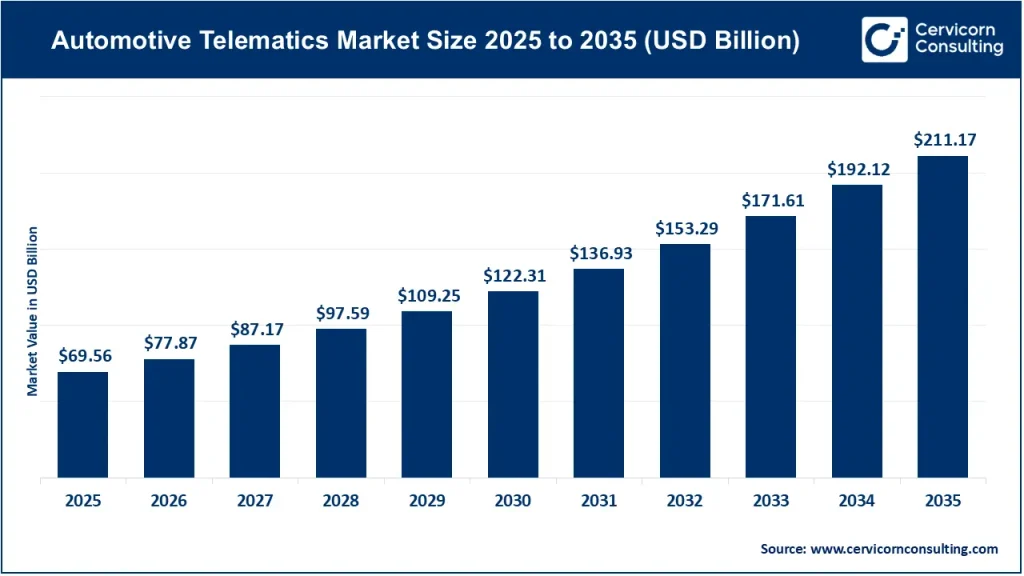
The global automotive telematics market was valued at approximately USD 69.56 billion in 2025 and is projected to reach nearly USD 211.17 billion by 2035, growing at a CAGR of 11.74%.
Automotive Telematics Market Growth Factors
The automotive telematics market is experiencing significant growth due to the rapid adoption of connected vehicles, increasing government mandates for vehicle safety and emergency response systems, rising demand for fleet management solutions, expansion of electric and autonomous vehicles, integration of artificial intelligence (AI) and Internet of Things (IoT) technologies, widespread deployment of 5G communication networks, growing consumer demand for in-car connectivity and infotainment services, increasing insurance telematics adoption, predictive vehicle maintenance solutions, cybersecurity advancements, cloud-based vehicle data analytics, smart transportation initiatives, and continuous investments by automotive manufacturers in software-defined vehicles and digital mobility ecosystems.
Get a Free Sample: https://www.cervicornconsulting.com/sample/2697
What is the Automotive Telematics Market?
Automotive telematics refers to the integration of telecommunications, vehicle electronics, GPS technology, wireless communication, cloud computing, and onboard diagnostics (OBD) to collect, transmit, and analyze vehicle data in real time.
The automotive telematics market includes hardware, software, communication services, cloud platforms, and analytics solutions that enable continuous connectivity between vehicles, drivers, manufacturers, insurers, service providers, and fleet operators.
Modern telematics systems perform numerous functions, including:
- Real-time vehicle tracking
- Driver behavior monitoring
- Fleet optimization
- Predictive maintenance
- Vehicle diagnostics
- Emergency assistance (eCall)
- Insurance telematics
- Remote vehicle control
- Over-the-air (OTA) software updates
- Connected infotainment
- Navigation services
- Vehicle cybersecurity monitoring
Telematics has become one of the foundational technologies supporting connected mobility and intelligent transportation systems worldwide.
Why is the Automotive Telematics Market Important?
Automotive telematics is transforming transportation by enabling vehicles to become intelligent, connected platforms capable of sharing data continuously with external systems.
Its importance continues to increase because it provides:
Improved Road Safety
Real-time accident detection, automatic emergency calling, driver assistance, and predictive alerts significantly reduce accident severity.
Lower Fleet Operating Costs
Fleet operators use telematics to optimize fuel consumption, reduce idle time, improve routing, and minimize maintenance expenses.
Enhanced Customer Experience
Consumers enjoy connected infotainment, smartphone integration, remote diagnostics, navigation assistance, and personalized driving experiences.
Better Insurance Models
Usage-based insurance (UBI) enables insurers to calculate premiums based on actual driving behavior rather than generalized risk profiles.
Predictive Maintenance
Continuous monitoring identifies potential mechanical failures before breakdowns occur, reducing repair costs and downtime.
Support for Autonomous Driving
Autonomous vehicles rely heavily on telematics for communication with cloud infrastructure, traffic systems, and other vehicles.
Smart City Integration
Connected vehicles contribute valuable traffic data that improves urban planning and intelligent transportation management.
Major Companies Shaping the Automotive Telematics Market
| Company | Specialization | Key Focus Areas | Notable Features | 2025 Revenue (Approx.) | Market Share* | Global Presence |
|---|---|---|---|---|---|---|
| Ford Motor Company | Connected Vehicles | FordPass, Fleet Telematics, OTA Updates | BlueCruise, Ford Pro Intelligence | ~$185 Billion | Strong North American presence | North America, Europe, Asia-Pacific, Latin America |
| Toyota Motor Corporation | Connected Mobility | Toyota Connected Services, Safety, AI | Toyota Connected Platform | ~$320 Billion | One of the largest global automakers | More than 170 countries |
| Mercedes-Benz AG | Premium Connected Vehicles | Digital Cockpit, Luxury Connectivity | Mercedes me Connect | ~$165 Billion | Premium vehicle leader | Europe, North America, Asia-Pacific, Middle East |
| Volkswagen AG | Connected Mobility Ecosystem | CARIAD Software, Connected Cars | Volkswagen We Connect | ~$360 Billion | Global automotive leader | More than 150 countries |
| General Motors Company | Smart Mobility | OnStar, Super Cruise, Connected Services | Industry-leading telematics platform | ~$185 Billion | Major North American OEM | Global operations across six continents |
Key Components of Automotive Telematics
The market consists of several integrated technologies.
Hardware
- GPS modules
- Sensors
- On-board diagnostics (OBD)
- Embedded SIM
- Vehicle gateways
- Cameras
- Radar systems
Software
- Fleet management platforms
- Vehicle health monitoring
- AI analytics
- Navigation software
- Cybersecurity software
- Driver assistance applications
Connectivity
- 4G LTE
- 5G
- Satellite communication
- Wi-Fi
- Bluetooth
- Vehicle-to-Everything (V2X)
Cloud Services
- Data storage
- Predictive analytics
- Remote diagnostics
- OTA software updates
- AI-driven vehicle insights
Leading Trends Transforming the Automotive Telematics Market
AI-Powered Vehicle Intelligence
Artificial intelligence is enabling smarter telematics systems capable of detecting driving patterns, predicting maintenance needs, identifying unsafe behaviors, and optimizing routes.
Impact
- Reduced accidents
- Improved fuel efficiency
- Better predictive maintenance
- Higher customer satisfaction
Software-Defined Vehicles
Automakers are shifting toward software-defined vehicle architectures where new features are delivered through software updates instead of hardware replacements.
Impact
- Continuous feature improvements
- Extended vehicle lifespan
- Lower maintenance costs
- New subscription revenue models
Over-the-Air Software Updates
OTA technology enables manufacturers to update vehicle software remotely.
Examples include:
- Battery optimization
- Infotainment upgrades
- Security patches
- ADAS improvements
Impact
- Lower recall costs
- Improved cybersecurity
- Faster innovation cycles
Usage-Based Insurance (UBI)
Insurance companies increasingly rely on telematics data to assess driving habits.
Parameters include:
- Speed
- Braking
- Cornering
- Mileage
- Night driving
- Phone distraction
Impact
- Fair insurance premiums
- Lower fraud
- Better driver behavior
Electric Vehicle Connectivity
Electric vehicles generate significantly larger amounts of operational data than traditional vehicles.
Telematics helps monitor:
- Battery health
- Charging status
- Energy efficiency
- Route planning
- Charging station availability
Impact
- Improved EV ownership experience
- Longer battery life
- Optimized charging
5G Connectivity
5G dramatically reduces communication latency between vehicles and cloud infrastructure.
Applications include:
- Autonomous driving
- Remote diagnostics
- HD map updates
- Vehicle-to-vehicle communication
Impact
- Real-time responsiveness
- Safer autonomous operations
- Better infotainment
Vehicle Cybersecurity
Connected vehicles face increasing cyber threats.
Manufacturers now integrate:
- Encryption
- Secure gateways
- Threat detection
- Real-time security monitoring
Impact
- Data protection
- Reduced hacking risks
- Improved consumer trust
Successful Examples of Automotive Telematics Around the World
General Motors OnStar
General Motors transformed vehicle connectivity through OnStar.
Features include:
- Automatic crash response
- Emergency assistance
- Vehicle diagnostics
- Remote vehicle unlocking
- Navigation
Millions of connected vehicles worldwide rely on OnStar services.
Tesla Connected Vehicle Platform
Tesla uses one of the world’s most advanced telematics ecosystems.
Capabilities include:
- OTA software updates
- Battery monitoring
- Autopilot improvements
- Fleet learning
- Remote diagnostics
Tesla continuously enhances vehicle performance after purchase.
Mercedes me Connect
Mercedes-Benz offers a premium telematics platform enabling:
- Remote vehicle control
- Digital keys
- Predictive maintenance
- Personalized driver settings
- Live traffic services
Luxury vehicle owners receive highly connected experiences.
Toyota Connected
Toyota integrates cloud-based mobility services that support:
- Vehicle health reports
- Connected safety
- AI-based analytics
- Smart navigation
- Emergency support
Toyota continues expanding connected services globally.
Ford Pro Fleet Telematics
Ford provides enterprise fleet operators with:
- Fuel optimization
- Driver monitoring
- Predictive maintenance
- Vehicle tracking
- Productivity analytics
Large commercial fleets have achieved measurable operational savings.
Volvo Connected Services
Volvo combines telematics with safety technologies.
Applications include:
- Fleet management
- Driver coaching
- Vehicle diagnostics
- Accident response
- Remote monitoring
The system improves fleet efficiency and driver safety.
Global Regional Analysis of the Automotive Telematics Market
North America
North America represents one of the most mature automotive telematics markets due to widespread connected vehicle adoption, strong cloud infrastructure, and significant investments in autonomous driving technologies.
The United States leads the regional market with advanced telematics deployments across passenger vehicles, commercial fleets, logistics, and insurance sectors.
Growing electric vehicle adoption and software-defined vehicle development continue driving demand.
Government Initiatives and Policies
- National Highway Traffic Safety Administration (NHTSA) promotes connected vehicle safety standards.
- Federal investments support intelligent transportation systems (ITS).
- Vehicle cybersecurity guidelines encourage secure connected vehicle ecosystems.
- Smart infrastructure funding accelerates V2X deployment.
- Federal support for EV charging infrastructure strengthens connected mobility.
Europe
Europe remains a major automotive telematics hub due to stringent vehicle safety regulations, advanced automotive manufacturing, and high consumer demand for connected mobility.
Germany, France, Italy, the United Kingdom, and Sweden lead adoption.
The mandatory eCall emergency response system has significantly increased embedded telematics installations.
Premium automotive manufacturers continue introducing sophisticated connected services.
Government Initiatives and Policies
- European Union mandatory eCall regulation.
- General Data Protection Regulation (GDPR) governing vehicle data privacy.
- Green Deal initiatives supporting connected electric mobility.
- Connected and Automated Mobility (CAM) programs.
- Funding for smart transportation corridors across member states.
Asia-Pacific
Asia-Pacific is the fastest-growing automotive telematics market driven by rising vehicle production, rapid urbanization, increasing smartphone penetration, expanding EV adoption, and strong government support for smart transportation.
China dominates regional demand, followed by Japan, South Korea, and India.
Automakers increasingly integrate embedded connectivity into new vehicles.
Fleet digitization is accelerating across logistics and e-commerce sectors.
Government Initiatives and Policies
China
- Intelligent Connected Vehicle (ICV) development strategy.
- Smart highway pilot projects.
- Massive 5G infrastructure investments.
- New Energy Vehicle (NEV) promotion.
Japan
- Society 5.0 initiative.
- Connected mobility research.
- Autonomous vehicle testing support.
South Korea
- Smart mobility innovation programs.
- National 5G deployment.
- Vehicle connectivity R&D funding.
India
- Vehicle tracking systems for public transportation.
- AIS-140 standards promoting GPS-based tracking.
- Digital India initiatives encouraging connected mobility.
- Electric mobility policies supporting smart vehicle technologies.
Latin America
Latin America is steadily adopting automotive telematics across commercial transportation, insurance, mining, logistics, and fleet operations.
Brazil and Mexico account for the majority of regional demand.
Commercial fleet tracking continues to dominate market growth.
Insurance telematics adoption is gradually increasing.
Government Initiatives and Policies
- Intelligent transportation investments.
- Digital infrastructure modernization.
- Fleet safety regulations.
- Smart logistics development programs.
- Public transportation monitoring initiatives.
Middle East & Africa
The Middle East & Africa market is expanding due to investments in smart cities, digital transportation infrastructure, connected logistics, and autonomous mobility projects.
The UAE and Saudi Arabia are leading connected mobility initiatives.
Fleet management adoption is particularly strong in logistics, oil & gas, and commercial transportation sectors.
Government Initiatives and Policies
United Arab Emirates
- Dubai Smart City initiatives.
- Autonomous transportation strategy.
- AI-driven mobility investments.
Saudi Arabia
- Vision 2030 smart mobility transformation.
- Connected transportation infrastructure.
- Intelligent logistics modernization.
South Africa
- Commercial fleet digitalization.
- Connected insurance adoption.
- Smart transport infrastructure improvements.
Future Opportunities in the Automotive Telematics Market
Several emerging opportunities are expected to shape the next phase of market expansion:
- Vehicle-to-Everything (V2X) communication
- Autonomous vehicle data ecosystems
- AI-powered predictive maintenance
- Connected electric vehicle charging networks
- Subscription-based digital vehicle services
- Fleet-as-a-Service (FaaS) platforms
- Advanced driver monitoring systems
- Blockchain-based vehicle identity management
- Edge computing for real-time vehicle analytics
- Digital twins for connected vehicle performance optimization
As automakers continue transitioning from hardware-centric manufacturing to software-driven mobility solutions, automotive telematics will remain a core technology enabling safer, smarter, and more sustainable transportation worldwide.
To Get Detailed Overview, Contact Us: https://www.cervicornconsulting.com/contact-us
Read Report: Water Treatment Chemicals Market Revenue, Trends, and Strategic Insights by 2035