


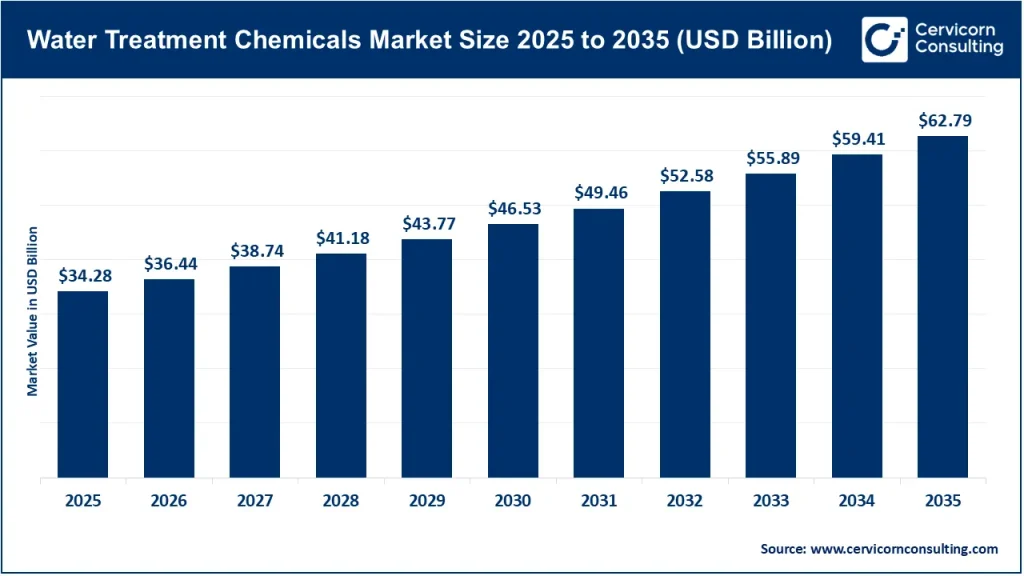
Water Treatment Chemicals Market Size
The global water treatment chemicals market was valued at approximately USD 34.28 billion in 2025 and is projected to reach nearly USD 62.79 billion by 2035, growing at a CAGR of 6.24%.
Water Treatment Chemicals Market Growth Factors
The global water treatment chemicals market is experiencing robust growth due to increasing concerns over freshwater scarcity, rapid industrialization, stricter environmental regulations, expanding urban populations, and rising investments in wastewater treatment infrastructure. Governments worldwide are implementing stringent discharge standards for industrial effluents, encouraging industries to adopt advanced chemical treatment solutions.
Growing demand from power generation, oil & gas, food & beverages, pharmaceuticals, pulp & paper, mining, and municipal water utilities is further accelerating market expansion. Technological advancements in specialty chemicals, digital water management, membrane treatment, and smart dosing systems are improving treatment efficiency while reducing operational costs. Additionally, increasing awareness regarding water reuse, circular economy initiatives, and sustainable industrial operations is driving continuous innovation in eco-friendly and biodegradable water treatment chemicals, making the market one of the fastest-evolving segments within the specialty chemicals industry.
Get a Free Sample: https://www.cervicornconsulting.com/sample/2687
What is the Water Treatment Chemicals Market?
The water treatment chemicals market comprises specialty chemical products designed to improve water quality by removing contaminants, controlling biological growth, preventing corrosion, minimizing scaling, and optimizing industrial and municipal water treatment processes.
These chemicals are used throughout the water purification cycle—from raw water treatment to wastewater recycling—and play an essential role in ensuring water safety, operational efficiency, and regulatory compliance.
Major categories include:
- Coagulants and flocculants
- Corrosion inhibitors
- Scale inhibitors
- Biocides and disinfectants
- pH adjusters
- Defoamers
- Chelating agents
- Oxidizing chemicals
- Activated carbon treatment additives
- Membrane cleaning chemicals
The market serves both municipal utilities and industrial sectors where clean water is fundamental for manufacturing, cooling systems, boilers, food processing, pharmaceutical production, and energy generation.
Why is the Water Treatment Chemicals Market Important?
Water has become one of the world’s most valuable resources. Population growth, climate change, industrial pollution, and declining freshwater availability have significantly increased pressure on water infrastructure.
Water treatment chemicals are critical because they:
- Protect public health by ensuring safe drinking water.
- Enable industries to meet environmental regulations.
- Increase equipment life by preventing corrosion and scaling.
- Improve efficiency of industrial cooling and boiler systems.
- Support wastewater recycling and reuse.
- Reduce operational costs through optimized treatment.
- Minimize environmental pollution.
- Help countries achieve sustainability and water conservation goals.
Without effective treatment chemicals, municipal systems would struggle to provide safe drinking water, while industries would experience increased maintenance costs, equipment failures, and regulatory penalties.
Competitive Landscape
| Company | Specialization | Key Focus Areas | Notable Features | 2025 Revenue* | Approx. Market Position | Global Presence |
|---|---|---|---|---|---|---|
| SUEZ | Water and wastewater solutions | Municipal water, industrial treatment, desalination | Integrated digital water management and chemical solutions | ~€9–10 Billion* | Leading global water solutions provider | Europe, North America, Asia-Pacific, Middle East, Latin America |
| BASF SE | Specialty chemicals | Water treatment additives, dispersants, polymers | Broad specialty chemical portfolio supporting industrial water treatment | €59.7 Billion | Major specialty chemicals supplier | More than 90 countries |
| Baker Hughes Company | Industrial process chemicals | Oil & gas water treatment, industrial chemicals | Strong expertise in energy-sector water management | US$27.7 Billion | Strong industrial water treatment supplier | More than 120 countries |
| Dow | Advanced materials and chemicals | Water purification, membranes, ion exchange technologies | Global leader in water purification technologies | ~US$43 Billion* | Leading water technology supplier | More than 160 countries |
| Ecolab | Water, hygiene and infection prevention | Industrial water management, digital monitoring | AI-enabled water optimization and sustainability solutions | ~US$16–17 Billion* | One of the largest industrial water treatment companies | More than 170 countries |
*Revenues represent overall company revenues rather than water treatment chemicals revenue. Market share estimates vary by product segment because the industry is highly fragmented. BASF and Baker Hughes 2025 revenues are based on company-reported results.
Leading Trends Transforming the Water Treatment Chemicals Market
1. Sustainable and Green Water Treatment Chemicals
Environmental concerns are encouraging manufacturers to replace conventional chemicals with biodegradable, phosphate-free, and environmentally friendly formulations.
Benefits include:
- Lower environmental impact
- Reduced sludge generation
- Easier regulatory compliance
- Improved sustainability reporting
Many industrial customers now prioritize chemicals that support ESG initiatives.
2. Digital Water Management
Artificial intelligence, IoT sensors, cloud analytics, and predictive maintenance are transforming water treatment operations.
Modern facilities can now:
- Monitor water quality continuously
- Optimize chemical dosing automatically
- Detect contamination early
- Reduce chemical consumption
- Lower operating expenses
Digital water treatment is becoming a major competitive differentiator.
3. Rising Water Reuse Projects
Freshwater shortages are pushing governments and industries toward wastewater recycling.
Industries increasingly recycle process water rather than relying solely on freshwater supplies.
This creates higher demand for:
- Coagulants
- Antiscalants
- Membrane cleaners
- Biocides
- Corrosion inhibitors
4. Growing Demand from Semiconductor Manufacturing
Semiconductor fabrication requires ultra-pure water.
With global semiconductor investments accelerating, demand for high-performance treatment chemicals continues to rise.
Ultra-pure water systems require advanced:
- Membrane chemicals
- Ion exchange resins
- Specialty cleaning chemicals
- Microbial control agents
5. Increased Investment in Desalination
Countries facing severe water shortages are rapidly expanding desalination capacity.
Desalination plants consume large volumes of:
- Antiscalants
- Membrane cleaners
- Corrosion inhibitors
- Biocides
This represents one of the fastest-growing application areas.
6. Shift Toward Circular Water Economy
Governments and industries are increasingly focusing on maximizing water reuse.
Instead of disposing wastewater, facilities now recover and recycle water multiple times, significantly increasing chemical demand throughout the treatment cycle.
Impact of These Trends
These trends are reshaping the industry by:
- Increasing demand for specialty chemicals
- Encouraging innovation in sustainable formulations
- Expanding recurring revenue from digital monitoring services
- Improving operational efficiency
- Reducing environmental footprints
- Supporting long-term industrial sustainability
- Creating premium pricing opportunities for advanced treatment technologies
Successful Examples of the Water Treatment Chemicals Market Around the World
Singapore’s NEWater Program
Singapore has become a global leader in water reuse.
Using advanced membrane technology, UV treatment, and specialty water treatment chemicals, NEWater supplies high-quality reclaimed water for industrial applications and drinking water reservoirs.
The project demonstrates how advanced chemistry can significantly reduce dependence on imported freshwater.
Israel’s National Water Recycling System
Israel recycles a large proportion of its municipal wastewater for agriculture.
Advanced chemical treatment combined with biological purification has enabled the country to overcome severe water scarcity while supporting agricultural productivity.
United Arab Emirates Desalination Projects
The UAE has invested heavily in large-scale desalination facilities.
These plants rely extensively on:
- Antiscalants
- Membrane cleaning chemicals
- Corrosion inhibitors
- Biofouling control chemicals
The country’s experience highlights the importance of specialty chemicals in maintaining plant efficiency under challenging operating conditions.
United States Industrial Water Treatment
Major industries including power generation, pharmaceuticals, food processing, and petrochemicals increasingly deploy advanced chemical treatment programs.
Digital monitoring integrated with specialty chemicals has significantly reduced:
- Water consumption
- Maintenance costs
- Energy usage
- Equipment downtime
China’s Municipal Wastewater Expansion
China has invested billions of dollars in wastewater infrastructure.
Large municipal treatment plants use advanced coagulants, disinfectants, polymers, and sludge conditioning chemicals to improve treatment efficiency and comply with increasingly stringent environmental regulations.
Global Regional Analysis
North America
North America represents one of the most technologically advanced water treatment chemicals markets.
Market Drivers
- Aging water infrastructure
- Strict EPA regulations
- Industrial wastewater treatment
- Digital water management
- High adoption of smart monitoring
Major end users include:
- Oil & gas
- Power generation
- Chemicals
- Pharmaceuticals
- Food processing
Government Initiatives and Policies
The United States continues investing in drinking water modernization, wastewater infrastructure, PFAS remediation, and industrial discharge control through federal funding programs and Environmental Protection Agency (EPA) regulations. Canada is also strengthening municipal wastewater standards and encouraging sustainable water reuse initiatives.
Europe
Europe remains a mature but innovation-driven market.
The region emphasizes:
- Sustainability
- Circular economy
- Green chemicals
- Industrial water reuse
- Carbon reduction
Countries including Germany, France, the Netherlands, and the Nordic nations continue adopting environmentally friendly treatment chemicals.
Government Policies
The European Union promotes water conservation through the Water Framework Directive, Urban Waste Water Treatment Directive updates, Industrial Emissions Directive, and chemicals regulation under REACH, encouraging higher treatment standards and more sustainable chemical use.
Asia-Pacific
Asia-Pacific is projected to remain the fastest-growing regional market.
Growth is driven by:
- Rapid urbanization
- Industrial expansion
- Manufacturing investments
- Population growth
- Rising municipal water demand
China, India, Japan, South Korea, and Southeast Asian countries continue investing heavily in water infrastructure.
Government Initiatives
China has strengthened wastewater discharge regulations while investing in smart water infrastructure.
India’s Jal Jeevan Mission, Namami Gange Programme, and wastewater reuse initiatives are accelerating demand for treatment chemicals.
Japan continues investing in advanced industrial water recycling technologies.
Australia supports water conservation through desalination and reuse programs.
Latin America
Growing industrial activity and expanding municipal infrastructure are creating new growth opportunities.
Brazil and Mexico dominate regional demand.
Key industries include:
- Mining
- Food processing
- Oil & gas
- Municipal water utilities
Government Support
Governments are modernizing wastewater systems, strengthening environmental enforcement, and encouraging private investment in water infrastructure through public-private partnerships.
Middle East & Africa
Water scarcity makes this region strategically important.
Countries are investing heavily in:
- Desalination
- Water recycling
- Smart irrigation
- Industrial water reuse
Saudi Arabia, UAE, Qatar, and Israel remain major adopters of advanced treatment chemicals.
Government Policies
National water security strategies such as Saudi Vision 2030 and large desalination investment programs across the Gulf Cooperation Council prioritize efficient water use, wastewater recycling, and advanced treatment technologies. Several African countries are also expanding urban water and sanitation infrastructure with support from multilateral development agencies.
Market Opportunities Across End-Use Industries
Power Generation
Power plants require treated water for boilers and cooling towers.
Demand continues rising for:
- Corrosion inhibitors
- Oxygen scavengers
- Scale inhibitors
- Biocides
Food & Beverage
Food manufacturers require exceptionally high water quality.
Treatment chemicals ensure:
- Product safety
- Regulatory compliance
- Equipment hygiene
- Reduced contamination risks
Pharmaceuticals
Pharmaceutical production requires purified water with extremely low impurity levels.
Advanced treatment chemicals help maintain:
- Sterility
- Regulatory compliance
- Product consistency
Oil & Gas
Produced water management remains one of the largest industrial applications.
Specialty chemicals are used for:
- Separation
- Corrosion prevention
- Scale control
- Microbial management
Municipal Water Utilities
Population growth continues increasing municipal demand.
Cities worldwide require chemicals for:
- Drinking water treatment
- Wastewater treatment
- Sludge management
- Odor control
- Disinfection
Future Outlook
The water treatment chemicals market is expected to witness sustained long-term growth as governments, municipalities, and industries prioritize water security, environmental compliance, and sustainable resource management. Increasing adoption of digital water technologies, stricter wastewater regulations, rising investments in desalination, industrial recycling, and circular water economy initiatives will continue driving demand for advanced specialty chemicals. Companies capable of delivering high-performance, environmentally responsible, and digitally integrated treatment solutions are likely to strengthen their competitive position as global demand for clean and reusable water continues to expand.
To Get Detailed Overview, Contact Us: https://www.cervicornconsulting.com/contact-us
Read Report: Next-Generation Sequencing in Precision Medicine Market Revenue, Trends, and Strategic Insights by 2035