


Automotive Semiconductor Market: Where Should Companies Prioritize Their Next Technology Investments?
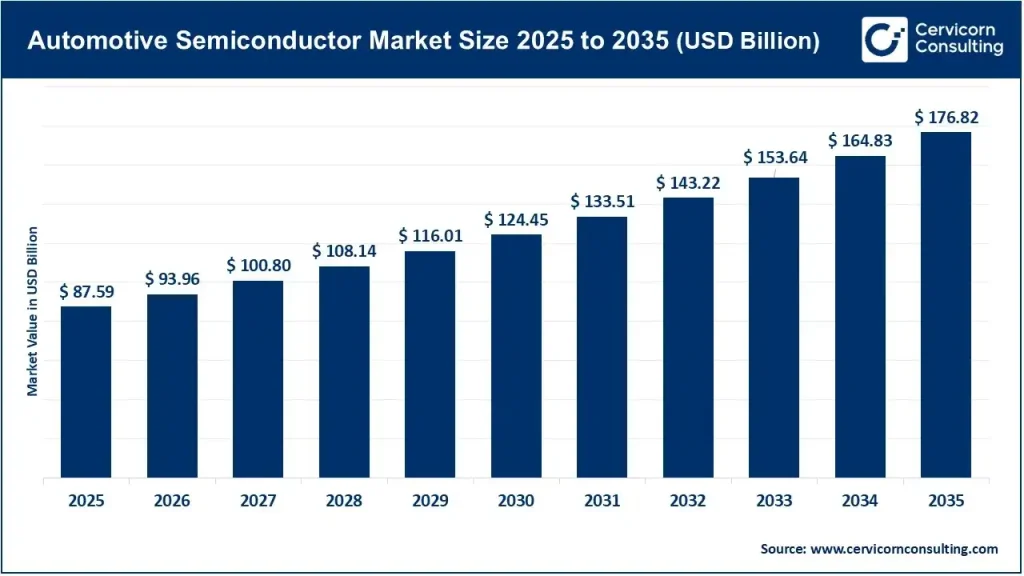
The global automotive semiconductor market was valued at USD 87.59 billion in 2025 and is projected to reach approximately USD 176.82 billion by 2035, growing at a compound annual growth rate (CAGR) of 7.3% from 2026 to 2035. The market is expected to reach USD 93.96 billion in 2026.
Growth is being driven by increasing semiconductor content per vehicle, electric vehicle adoption, advanced driver-assistance systems (ADAS), and the transition toward software-defined vehicles. However, the next phase of market expansion will not depend solely on vehicle production volumes. It will increasingly depend on which semiconductor technologies automakers adopt, how efficiently suppliers manage component availability, and how manufacturers position themselves across emerging vehicle architectures.
For automotive OEMs and semiconductor suppliers, these developments create several strategic decisions involving technology investments, sourcing arrangements, manufacturing capabilities, and product portfolios.
Automotive Semiconductor Market: Growth Is Shifting Toward Higher-Value Components
The automotive semiconductor industry is undergoing a structural transition. Conventional vehicles already depend on microcontrollers, power management ICs, sensors, and control systems. However, electric powertrains, advanced driver assistance, digital cockpits, and centralized computing are increasing the complexity and value of semiconductor integration.
According to the market segmentation, processors accounted for 28% of automotive semiconductor revenue in 2025, making them the largest component category. Memory devices are expected to register strong growth as vehicles generate and process increasing volumes of data.
This shift has important implications for semiconductor manufacturers.
- Processors and high-performance computing: Increasing adoption of centralized computing, ADAS, and intelligent cockpit systems is creating opportunities for automotive-grade processors and systems-on-chip (SoCs).
- Memory devices: Higher data processing requirements are increasing demand for automotive DRAM, NOR Flash, and other memory solutions.
- Power semiconductors: EV powertrains require efficient components for battery management, motor control, power conversion, and charging systems.
- Microcontrollers: Increasing electronic integration continues to support demand for reliable control and vehicle management components.
The opportunity is therefore not distributed equally across semiconductor categories. Suppliers need to evaluate where rising vehicle complexity is translating into higher component demand and stronger commercial opportunities.
Get a Free Sample: https://www.cervicornconsulting.com/sample/3085
1. Should Semiconductor Manufacturers Prioritize EV Power Electronics or Conventional Automotive Applications?
Electrification is creating new opportunities for power semiconductor manufacturers, particularly those developing silicon carbide (SiC) and gallium nitride (GaN) technologies.
However, the transition toward electric mobility does not eliminate the importance of conventional automotive semiconductor applications.
In 2025, internal combustion engine (ICE) vehicles accounted for 55% of automotive semiconductor market revenue, compared with 45% for electric vehicles. This demonstrates that conventional vehicle platforms continue to represent a substantial demand base.
At the same time, EVs require additional semiconductor integration across battery management systems, inverters, onboard chargers, DC-DC converters, and electric motor control.
Companies should evaluate their investment priorities across three areas:
- SiC technologies: Particularly relevant for high-voltage power conversion, traction inverters, and applications requiring improved energy efficiency.
- GaN technologies: Offer opportunities in compact, high-frequency power conversion and selected charging applications.
- Silicon-based power devices: Continue to serve established automotive applications and remain important across conventional and electric vehicle platforms.
The strategic decision is not simply whether to invest in EV semiconductor technologies. Manufacturers must determine which vehicle platforms, voltage architectures, and power electronics applications offer the strongest long-term commercial potential.
2. Can ADAS and Software-Defined Vehicles Create New Competitive Advantages for Semiconductor Suppliers?
Advanced driver-assistance systems and software-defined vehicles are changing the semiconductor requirements of modern automobiles.
ADAS technologies such as adaptive cruise control, automatic emergency braking, lane-keeping assistance, and collision avoidance depend on processors, radar systems, cameras, sensors, and memory components.
The safety and ADAS application segment accounted for 28% of automotive semiconductor revenue in 2025. Its importance is expected to increase as advanced safety technologies expand across vehicle categories.
Meanwhile, software-defined vehicles are encouraging automakers to move away from traditional distributed electronic control architectures toward domain-based and centralized computing systems.
This transition creates opportunities for suppliers offering:
- High-performance automotive processors and SoCs.
- Automotive Ethernet and high-speed networking solutions.
- Radar and advanced sensing semiconductors.
- Automotive-grade memory devices.
- Microcontrollers and system-control components.
For semiconductor companies, the competitive opportunity extends beyond supplying individual chips. Developing integrated semiconductor solutions that support vehicle computing, connectivity, and functional safety can strengthen relationships with OEMs and Tier 1 suppliers.
Companies should also assess their ability to meet automotive qualification requirements, cybersecurity expectations, and long-term product lifecycle commitments before entering these applications.
3. Is Memory Becoming a Critical Supply Chain Risk for Automotive Manufacturers?
As vehicles become more software-intensive, memory availability is emerging as an important consideration in automotive semiconductor procurement.
Advanced infotainment, ADAS, digital cockpit systems, and centralized computing architectures require increasing memory capacity and performance. This is creating stronger demand for automotive DRAM, Flash memory, and other storage technologies.
The challenge is that automotive manufacturers are competing for semiconductor supply with other industries, particularly AI infrastructure and consumer electronics.
In July 2026, Micron signed long-term agreements with Qualcomm, Harman, and automotive suppliers to support the supply of memory and storage components for AI-enabled vehicles. The agreements highlight the increasing importance of supply visibility and longer-term commercial arrangements.
Automotive manufacturers should consider several sourcing priorities:
- Supplier diversification: Evaluate alternative qualified suppliers for critical memory and semiconductor categories.
- Long-term supply agreements: Assess whether strategic purchasing arrangements can improve supply visibility and price stability.
- Component standardization: Reduce unnecessary component variations across vehicle platforms wherever technically feasible.
- Inventory planning: Align procurement strategies with vehicle production schedules and semiconductor lead times.
- Technology roadmaps: Evaluate memory requirements alongside future vehicle computing and software architectures.
For semiconductor suppliers, the opportunity lies in developing automotive-qualified memory products and establishing stronger relationships with vehicle manufacturers.
4. Where Should Companies Expand Their Regional Manufacturing and Supply Chain Presence?
Regional positioning is becoming increasingly important as governments and automotive manufacturers seek more resilient semiconductor supply chains.
Asia Pacific accounted for 40% of global automotive semiconductor market revenue in 2025, supported by its established semiconductor ecosystem and large automotive manufacturing base. The regional market was valued at USD 35.04 billion and is projected to reach USD 70.73 billion by 2035.
Europe is another important market, with demand supported by automotive electrification, advanced vehicle technologies, and investments in semiconductor capabilities. Its automotive semiconductor market was valued at USD 21.90 billion in 2025 and is projected to reach USD 44.21 billion by 2035.
For companies evaluating regional expansion, the investment decision should consider more than market size.
Key considerations include:
- Proximity to automotive OEMs and Tier 1 suppliers.
- Availability of semiconductor manufacturing and advanced packaging capabilities.
- Access to automotive engineering and research talent.
- Government incentives and semiconductor development programs.
- Regional demand for EVs, ADAS, and connected vehicle technologies.
- Supply chain exposure to geopolitical and trade-related disruptions.
India is also becoming increasingly relevant to semiconductor ecosystem development. The government’s Semicon 2.0 initiative, approved in July 2026 with an outlay of ₹1,27,500 crore, emphasizes chip design, manufacturing, advanced packaging, equipment, materials, and research and development.
For semiconductor companies, these developments create opportunities to evaluate India not only as an automotive demand market but also as a potential location for design, engineering, packaging, and supply chain partnerships.
5. How Should Semiconductor Suppliers Position Themselves Against Established Competitors?
Competition in automotive semiconductors is increasingly determined by technological capabilities, automotive-grade reliability, customer relationships, and the ability to support long product development cycles.
Established suppliers such as Infineon Technologies, NXP Semiconductors, Renesas Electronics, STMicroelectronics, Texas Instruments, Analog Devices, and onsemi have capabilities across multiple automotive semiconductor categories.
Infineon retained its position as the world’s leading automotive semiconductor supplier for the sixth consecutive year in 2026, according to the market page’s cited industry analysis. Its reported 36% share of automotive microcontrollers also illustrates the importance of established positions in critical component categories.
Recent developments further demonstrate how competition is evolving:
- In January 2026, Texas Instruments introduced automotive technologies covering high-performance computing SoCs, 4D imaging radar, and automotive Ethernet.
- In April 2026, Infineon reported maintaining its leadership position in automotive semiconductors.
- In August 2026, Infineon and MediaTek announced collaboration on future automotive smart cockpit solutions, including automotive-grade NOR Flash for MediaTek’s Dimensity Auto Cockpit platform.
For companies competing in this market, strategic positioning requires evaluating both current market share and future technology capabilities.
Potential priorities include expanding automotive-grade product portfolios, developing partnerships with OEMs and Tier 1 suppliers, strengthening functional safety capabilities, and investing in emerging semiconductor technologies.
Smaller and specialized suppliers may also find opportunities by focusing on specific applications such as automotive radar, power management, battery electronics, automotive networking, and memory solutions.
6. What Should Automotive Semiconductor Companies Prioritize Between 2026 and 2030?
The automotive semiconductor industry’s next growth phase will require companies to balance established demand with emerging technology requirements.
Rather than distributing investments equally across all semiconductor categories, manufacturers should align their strategies with vehicle electrification, computing requirements, regional demand, and customer development programs.
The following priorities deserve attention:
- Expand automotive-grade power semiconductor capabilities: Evaluate SiC and GaN opportunities alongside established silicon-based technologies.
- Strengthen computing and memory portfolios: Address increasing requirements for ADAS, centralized computing, and software-defined vehicles.
- Build strategic OEM relationships: Participate earlier in vehicle platform development and semiconductor qualification processes.
- Improve supply chain resilience: Assess supplier concentration, manufacturing dependencies, and long-term sourcing arrangements.
- Evaluate regional expansion: Identify markets offering attractive combinations of automotive demand, manufacturing capabilities, and government support.
- Invest in integrated solutions: Develop complementary capabilities across processors, networking, sensing, memory, and power management.
The ability to connect technology investments with actual vehicle platform requirements will become an important differentiator for semiconductor suppliers.
Conclusion
The automotive semiconductor market is moving beyond traditional vehicle electronics toward a more complex ecosystem built around electrification, advanced computing, connectivity, and intelligent vehicle systems.
With the global market projected to reach USD 176.82 billion by 2035, opportunities will emerge across processors, memory devices, power semiconductors, ADAS components, and automotive networking technologies.
However, market growth alone does not determine which investments will generate the strongest returns. Companies must understand which semiconductor categories are gaining value, where supply constraints could affect production, which regional markets offer sustainable opportunities, and how competitive positioning is changing.
For automotive OEMs, semiconductor manufacturers, and Tier 1 suppliers, informed decisions about technology portfolios, sourcing strategies, capacity investments, and customer partnerships will be essential to capturing the next phase of industry growth.
To Get Detailed Overview, Contact Us: https://www.cervicornconsulting.com/contact-us