


AI Data Centre Market: Strategic Decisions for Scaling AI Infrastructure in a Power-Constrained Environment
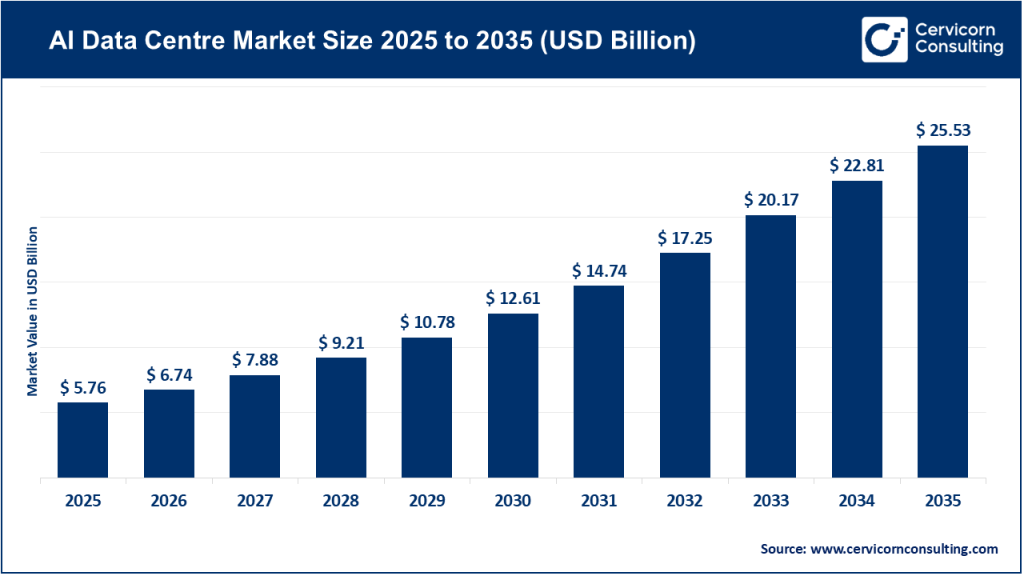
The global AI data centre market was valued at USD 5.76 billion in 2025 and is projected to reach USD 25.53 billion by 2035, expanding at a CAGR of 40.1% from 2026 to 2035.
The rapid expansion of generative AI, large language models, machine learning, and enterprise AI applications is changing the economics of data centre development. Companies are moving beyond conventional cloud infrastructure toward high-performance computing environments equipped with GPU clusters, high-speed networking, advanced storage, and specialized cooling systems.
However, building AI-ready infrastructure involves more than increasing server capacity. Electricity availability, rack power density, cooling efficiency, semiconductor supply, and network performance are becoming critical factors influencing project feasibility and long-term returns.
For data centre operators, hyperscalers, infrastructure investors, equipment manufacturers, and technology providers, the next phase of market growth will depend on how effectively they address these interconnected infrastructure requirements.
Why AI data centre expansion is becoming an infrastructure investment priority
AI data centres differ from conventional facilities because their infrastructure must support computationally intensive workloads that require substantial processing power, high-speed data transfers, and continuous thermal management.
Three developments are accelerating investment:
-
Generative AI and large-scale model training: Increasing deployment of large language models and multimodal AI systems is creating demand for GPU-intensive computing clusters. Technology companies are investing in dedicated infrastructure to improve model training capacity and inference performance.
-
Enterprise AI adoption: Financial institutions, healthcare companies, manufacturers, retailers, and telecommunications providers are integrating AI into business operations. This is increasing demand for scalable computing resources, secure data environments, and low-latency processing.
-
Hyperscaler infrastructure expansion: Amazon, Microsoft, Google, and other technology providers are expanding their data centre footprints to secure computing capacity and strengthen their cloud and AI service offerings.
The scale of investment reflects this shift. According to the International Energy Agency (IEA), hyperscalers are expected to spend more than USD 700 billion in capital expenditure in 2026, primarily on new data centre development. However, electricity availability and supply-chain constraints are increasingly influencing how quickly these projects can move forward.
For infrastructure developers, this changes the investment equation. Securing land and financing is no longer sufficient. Projects must also demonstrate access to reliable power, appropriate cooling infrastructure, network connectivity, and a viable long-term operating model.
Get a Free Sample: https://www.cervicornconsulting.com/sample/2409
Infrastructure priorities that will determine project competitiveness
1. Power availability is becoming a primary site-selection criterion
Electricity access is emerging as one of the most important considerations in AI data centre development. GPU-intensive workloads require substantial and continuous power, while high-density computing clusters create additional pressure on local electricity networks.
The IEA estimates that power density in AI servers increased elevenfold between 2020 and 2025 and could increase another fourfold by 2027. This creates additional requirements for transformers, substations, power distribution equipment, backup systems, and grid connectivity.
For developers and investors, the implications extend beyond electricity prices.
Key considerations include:
-
Availability of grid connections and the time required to secure additional capacity.
-
Access to renewable energy through power purchase agreements and dedicated generation.
-
Deployment of battery energy storage and backup power infrastructure.
-
Redundancy requirements to maintain uptime during grid disruptions.
-
Long-term electricity costs and exposure to regional energy price volatility.
Business decision: Developers should evaluate locations based on secured and scalable power capacity rather than relying exclusively on land costs, tax incentives, or proximity to major technology markets.
Power availability can determine whether a proposed project becomes operational on schedule or faces prolonged development delays.
2. Cooling investments must align with future rack density
AI computing generates substantially more heat than conventional enterprise workloads. As GPU clusters become denser, traditional air-cooling infrastructure may not provide sufficient thermal management for every deployment.
According to the Cervicorn Consulting market analysis, air cooling accounted for 61% of the AI data centre cooling infrastructure segment in 2025. However, increasing rack densities are creating opportunities for direct-to-chip liquid cooling, immersion cooling, and hybrid thermal management systems.
liquid cooling presents several investment considerations:
-
Direct-to-chip cooling: Suitable for high-density GPU environments where heat must be removed directly from processors.
-
Immersion cooling: Offers opportunities for specialized high-performance computing environments, although deployment economics and operational compatibility require evaluation.
-
Hybrid cooling: Allows operators to combine air and liquid cooling according to workload density and facility requirements.
-
Thermal infrastructure integration: Pumps, heat exchangers, coolant distribution units, piping, and monitoring systems must be designed as part of the overall facility architecture.
Business decision: Equipment manufacturers and data centre operators should evaluate cooling investments against projected rack density over the facility’s operating life, rather than designing systems exclusively around current server configurations.
A cooling architecture that meets today’s requirements but cannot accommodate next-generation GPU deployments could increase retrofit costs and limit future capacity expansion.
3. GPU and networking strategies must support evolving AI workloads
The performance of an AI data centre depends on more than the number of installed GPUs. Processing capacity, memory bandwidth, storage performance, and interconnect speeds collectively determine how efficiently computing resources operate.
Large-scale AI training requires thousands of accelerators to exchange data with minimal communication bottlenecks. Consequently, high-speed Ethernet, InfiniBand, optical interconnects, and advanced switching technologies are becoming important components of AI infrastructure.
The shift toward 800G networking and increasingly sophisticated GPU-to-GPU communication is creating opportunities across optical transceivers, high-speed switches, semiconductor components, and network equipment.
Companies supplying AI infrastructure should assess:
-
GPU and accelerator availability across different computing architectures.
-
High-bandwidth memory requirements and semiconductor supply constraints.
-
400G and 800G optical connectivity adoption.
-
Network scalability and interconnect performance.
-
Storage architecture for large datasets and continuous inference workloads.
Business decision: Infrastructure providers should avoid relying on a single hardware configuration or accelerator supplier. A flexible architecture can reduce technology obsolescence risks and provide greater freedom to accommodate future AI workloads.
4. Inference demand will influence the next generation of facility design
AI infrastructure requirements are evolving from predominantly model-training environments toward a combination of training and inference workloads.
Training requires substantial computing resources to develop and optimize models. Inference involves running trained models to generate predictions, recommendations, responses, and other outputs.
As enterprises integrate AI into customer-facing applications and internal workflows, inference demand is expected to become increasingly important.
This transition has several implications:
-
Training facilities may prioritize concentrated GPU clusters and high-bandwidth interconnects.
-
Inference infrastructure may require geographically distributed capacity to reduce latency.
-
Edge data centres could become more relevant for industrial automation, autonomous systems, and real-time applications.
-
Operators may need flexible computing configurations to accommodate changing workload patterns.
JLL’s 2026 Global Data Center Outlook identifies the expected transition toward inference-led demand as an important development for infrastructure deployment and the growth of specialized AI cloud providers.
Business decision: Operators should assess whether their facilities are optimized for centralized model training, distributed inference, or both. This distinction affects location strategy, hardware selection, networking investments, and customer acquisition priorities.
5. Financing and infrastructure partnerships will shape expansion opportunities
AI data centre development involves substantial upfront investment across land acquisition, construction, electrical infrastructure, cooling systems, servers, and network equipment.
The financial requirements are becoming more complex as projects increase in size and computing capacity. Developers must also manage construction timelines, equipment procurement, power agreements, and customer commitments.
Potential financing and partnership structures include:
-
Joint ventures between infrastructure developers and technology companies.
-
Long-term capacity agreements with hyperscalers and cloud providers.
-
Partnerships with utilities and renewable energy developers.
-
Colocation agreements with GPU cloud providers.
-
Infrastructure funds and institutional investment.
-
Equipment financing and strategic supplier agreements.
For investors, the central question is not simply how much computing capacity a project can accommodate. It is whether that capacity can be delivered, contracted, utilized, and operated profitably.
Business decision: Investment assessments should incorporate power availability, construction costs, equipment lead times, customer commitments, utilization assumptions, and operating expenses before capital is allocated.
Regional opportunities are shifting toward markets with scalable infrastructure
North America currently leads the global AI data centre market, accounting for 39.4% of revenue in 2025. Its established hyperscaler ecosystem, advanced semiconductor infrastructure, cloud computing networks, and early adoption of GPU-based computing support its leading position.
However, Asia-Pacific is becoming increasingly important as governments and technology companies invest in domestic computing infrastructure, cloud capacity, and digital sovereignty.
North America
North America accounted for 39.4% of global AI data centre market revenue in 2025. The United States remains a major investment destination because of its established cloud infrastructure, technology ecosystem, and concentration of AI developers.
For equipment suppliers and infrastructure developers, opportunities extend across GPU servers, advanced networking, power management, liquid cooling, and data centre construction.
Asia-Pacific
Asia-Pacific accounted for 25.2% of market revenue in 2025 and is projected to become an increasingly important AI infrastructure investment destination.
China, Japan, South Korea, India, and Singapore are investing in computing capacity to support domestic AI development, cloud services, and enterprise digital transformation.
India is particularly important because of its expanding digital economy and growing hyperscaler investments. According to JLL’s August 2026 India data centre report, the country’s operational capacity is expected to increase from approximately 1.6 GW in mid-2026 to 6 GW by 2029, with around USD 110 billion in investment requirements. These figures cover the broader data centre industry, rather than AI facilities alone.
For companies evaluating market entry, India offers opportunities across data centre construction, electrical equipment, cooling technologies, power infrastructure, and AI computing services.
Europe
Europe accounted for 21.5% of global AI data centre market revenue in 2025. Demand is supported by enterprise AI adoption, cloud infrastructure development, data sovereignty requirements, and sustainability objectives.
Germany, the United Kingdom, and France remain important markets for AI infrastructure investment. Companies entering the region must also consider electricity costs, environmental requirements, and regulatory obligations relating to data processing.
LAMEA
Latin America, the Middle East, and Africa accounted for 13.9% of market revenue in 2025.
The Middle East is attracting investment through sovereign AI initiatives, access to energy resources, and partnerships with international technology providers. Saudi Arabia and the UAE are positioning themselves as important destinations for large-scale AI infrastructure.
Latin America is also developing opportunities around cloud services, regional data processing, and hyperscale infrastructure, particularly in Brazil.
Market segments offering different investment opportunities
The AI data centre market is not a single infrastructure opportunity. Investment potential varies considerably across components, facility types, technologies, and workload requirements.
The 2025 market segmentation highlights several important areas:
| Market segment | Leading category | 2025 revenue share |
|---|---|---|
| Component | Hardware | 59% |
| Data centre type | Hyperscale | 52% |
| Technology | Machine learning | 36% |
| Deployment model | Cloud-based | 53% |
| AI workload | Training | 44% |
| Cooling infrastructure | Air cooling | 61% |
| Power capacity | 20–50 MW | 37% |
| End-user | Technology and cloud providers | 40% |
Source: Cervicorn Consulting AI Data Centre Market analysis.
These segment shares offer several strategic insights.
-
Hardware manufacturers: The 59% hardware share highlights the importance of GPU servers, processors, memory, storage, and networking equipment. Suppliers should evaluate opportunities in high-performance computing components and next-generation infrastructure.
-
Hyperscale operators: With 52% market share, hyperscale facilities represent the largest data centre type. Developers should assess the economics of large-capacity projects and long-term customer commitments.
-
Cloud providers: Cloud-based deployment accounted for 53% of the market, highlighting the importance of scalable AI computing services and infrastructure-as-a-service models.
-
Cooling technology suppliers: Although air cooling remains dominant, increasing rack density creates opportunities for liquid cooling and advanced thermal management.
-
Power infrastructure companies: Rising electricity requirements create demand for transformers, switchgear, power distribution systems, backup solutions, and energy storage.
For companies evaluating expansion opportunities, these differences are important. A supplier of power distribution equipment may find stronger opportunities in electrical infrastructure investment, while a semiconductor manufacturer may prioritize GPU architecture, memory, and networking requirements.
Competitive landscape: Companies shaping AI data centre infrastructure
Competition in the AI data centre market extends across semiconductor manufacturing, cloud infrastructure, server systems, networking, and enterprise technology.
The major companies include:
-
NVIDIA: GPU accelerators, AI computing platforms, and high-performance networking technologies.
-
Intel: Data centre processors and computing infrastructure.
-
Advanced Micro Devices (AMD): Data centre CPUs and AI accelerators.
-
Microsoft: Azure cloud infrastructure and AI data centre investments.
-
Amazon Web Services: Hyperscale cloud infrastructure and specialized AI computing services.
-
Google: AI infrastructure, cloud services, and specialized AI processors.
-
Dell Technologies: AI servers, storage, and integrated infrastructure.
-
Hewlett Packard Enterprise: High-performance computing systems and AI infrastructure.
-
Cisco Systems: Data centre networking and connectivity solutions.
-
IBM: Enterprise infrastructure, AI platforms, and hybrid cloud solutions.
Other important participants include Oracle, Alibaba Cloud, Baidu, Tencent Cloud, and Fujitsu.
The competitive environment is also expanding beyond traditional hyperscalers. Specialized AI infrastructure providers and GPU cloud companies are creating additional opportunities for server manufacturers, networking suppliers, and infrastructure developers.
For established companies, competitive positioning increasingly depends on the ability to deliver integrated infrastructure solutions rather than individual products. For emerging suppliers, specialization in cooling, power management, optical networking, and high-performance computing components can provide opportunities to enter the expanding supply chain.
What companies should prioritize before making their next investment
The growth of AI data centres creates opportunities across several industries, but market expansion alone does not guarantee commercial success.
Companies should align investment decisions with the specific infrastructure requirements and competitive conditions of their target markets.
The following priorities can help translate market growth into actionable business strategies:
-
Infrastructure developers: Evaluate locations based on electricity availability, grid connectivity, cooling water requirements, construction costs, and customer demand.
-
Equipment manufacturers: Identify the components experiencing the strongest demand growth, particularly GPU servers, power distribution, high-speed networking, and liquid cooling.
-
Cloud service providers: Assess the economics of GPU-as-a-service offerings, workload utilization, customer acquisition, and long-term computing contracts.
-
Energy companies: Evaluate opportunities in renewable energy integration, battery storage, backup power, and dedicated electricity supply agreements.
-
Technology investors: Compare regional market growth, infrastructure readiness, competitive intensity, capital requirements, and potential returns before entering new markets.
-
Emerging suppliers: Identify underserved infrastructure requirements where specialized products and engineering capabilities can create differentiation.
A particularly important consideration is the relationship between capacity expansion and utilization. Building a large AI data centre does not automatically create attractive returns. Operators must ensure that computing capacity can be supported by reliable power, competitive operating costs, and sufficient demand from AI developers and enterprise customers.
Conclusion
The AI data centre market is entering a period of substantial infrastructure expansion, supported by generative AI adoption, enterprise computing requirements, and hyperscaler investment. With the global market projected to grow from USD 5.76 billion in 2025 to USD 25.53 billion by 2035, opportunities are emerging across hardware, cloud infrastructure, cooling, networking, and power management.
However, the competitive landscape is changing. Electricity availability, rack density, cooling performance, semiconductor supply, and workload utilization are becoming increasingly important in determining project economics.
Companies planning investments should therefore look beyond overall market growth and evaluate where demand is emerging, which infrastructure technologies are gaining adoption, and how regional conditions influence commercial opportunities.
The most important investment decisions will be those that connect AI infrastructure demand with practical deployment capabilities, cost efficiency, and long-term scalability.
To Get Detailed Overview, Contact Us: https://www.cervicornconsulting.com/contact-us