


Automotive Power Inductor Market: 6 Decisions Companies Should Make to Strengthen Product Performance, Secure Supply Chains, and Capture EV Growth
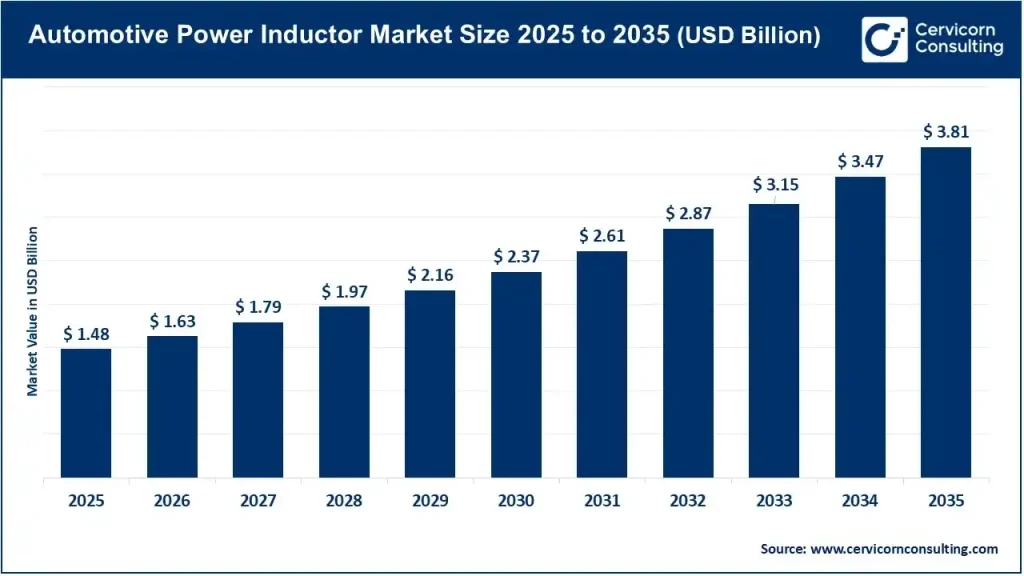
The global automotive power inductor market was valued at USD 1.48 billion in 2025 and is projected to reach approximately USD 3.81 billion by 2035, growing at a compound annual growth rate (CAGR) of 9.9% from 2026 to 2035. This growth reflects the increasing electronic content of modern vehicles, expanding electric vehicle (EV) production, and rising demand for efficient power conversion across battery management systems, onboard chargers, powertrain controls, and advanced driver-assistance systems (ADAS). Asia-Pacific accounted for 44% of global market revenue in 2025, supported by its automotive manufacturing base and electronics supply chain.
For automotive component manufacturers, semiconductor suppliers, magnetic component producers, and procurement teams, the opportunity extends beyond higher component volumes. Vehicle electrification and the transition toward more integrated electronic architectures are changing requirements for current handling, thermal stability, electromagnetic interference (EMI) suppression, component miniaturization, and long-term reliability. These changes make power inductor selection a strategic engineering and sourcing decision rather than a routine component purchase.
Companies seeking to participate in this market should focus on six decisions: which automotive applications to prioritize, which inductor technologies to develop, how to meet qualification requirements, where to strengthen supply chains, how to balance cost and performance, and which regional markets offer the best opportunities for expansion.
1. Which Automotive Applications Should Companies Prioritize?
The first decision is where to concentrate product development and commercial resources. Automotive power inductors serve several applications, but their electrical requirements, qualification expectations, and growth drivers differ considerably.
In 2025, powertrain and engine control accounted for 28% of automotive power inductor market revenue, followed by DC-DC converters and onboard chargers at 24%, battery management systems at 20%, infotainment and body electronics at 15%, and ADAS at 13%. These segments represent different entry points for component suppliers.
- Powertrain and engine control: Prioritize stable current regulation, high-temperature performance, vibration resistance, and dependable operation over long vehicle lifecycles. Suppliers serving both conventional and electrified powertrains should distinguish between the requirements of low-voltage control electronics and more demanding power-conversion circuits.
- DC-DC converters and onboard chargers: Focus on current capacity, conversion efficiency, thermal performance, and compact packaging. The move toward higher-voltage EV architectures increases the importance of designing components for the specific switching frequencies, voltage-conversion stages, and thermal conditions of the target system.
- Battery management systems (BMS): Develop solutions for efficient voltage regulation, monitoring electronics, and compact control modules. As battery systems become more sophisticated, component suppliers need to understand the power requirements of both centralized and distributed BMS designs.
- ADAS and vehicle computing: Emphasize low electromagnetic emissions, stable power delivery, and compact footprints for radar, camera, sensor, and processing modules. Reliability and noise control can be as important as nominal electrical performance.
- Infotainment and body electronics: Compete through size, cost, integration, and consistent performance across high-volume applications such as displays, lighting, connectivity, and electronic control units.
Business decision: Allocate development resources according to customer design pipelines, technical differentiation, qualification lead times, and expected production volumes. A supplier with strong high-current manufacturing capabilities may be better positioned in power conversion, while a company specializing in compact, low-noise components may find a stronger fit in ADAS and vehicle computing.
Get a Free Sample: https://www.cervicornconsulting.com/sample/3070
2. Should Companies Prioritize Shielded, Wire-Wound, or Multilayer Inductors?
Technology selection determines product cost, performance, manufacturability, and suitability for different automotive applications. Companies should avoid treating all power inductors as interchangeable components.
Shielded power inductors held approximately 34% of the market in 2025, reflecting their usefulness in applications where electromagnetic interference must be controlled. Ferrite-core inductors accounted for 48% of market revenue by core material, supported by established manufacturing capabilities and their use in automotive power circuits.
However, the most appropriate technology depends on the operating environment and design constraints.
- Shielded power inductors: Consider these for compact electronic assemblies where magnetic-field containment and EMI management are important. Their suitability depends on the shielding structure, current requirements, frequency, and thermal design.
- Wire-wound power inductors: Evaluate these for applications requiring high current handling, low DC resistance, and efficient energy conversion. Winding geometry, core selection, and construction influence saturation behavior, losses, and heat generation.
- Multilayer power inductors: Assess these for space-constrained electronic modules and applications that require compact component integration. Confirm that the selected design meets the circuit’s current, loss, and temperature requirements rather than prioritizing size alone.
- Ferrite-core designs: Evaluate these where magnetic losses and operating frequency favor ferrite materials. The performance of a specific formulation depends on frequency, flux density, temperature, and the component’s construction.
- Metal-composite and powdered-iron designs: Consider these when saturation current, compactness, and high-current operation are key requirements. Material composition, core losses, and temperature-dependent characteristics must be compared at the intended operating point.
The market’s reported technology shares provide a useful starting point, but they should not dictate product strategy. A segment with a large existing share may be highly competitive, while a smaller application may offer better margins if customer requirements are difficult to meet.
Business decision: Build a product roadmap around measurable advantages such as lower losses, improved saturation performance, reduced EMI, greater thermal stability, or smaller footprints. Validate these advantages against competing components under representative operating conditions before committing to large-scale production.
To Get Detailed Overview, Contact Us: https://www.cervicornconsulting.com/contact-us