


AI in Transportation Market: 6 Decisions Companies Should Make to Improve Efficiency, Safety, and Commercial Returns
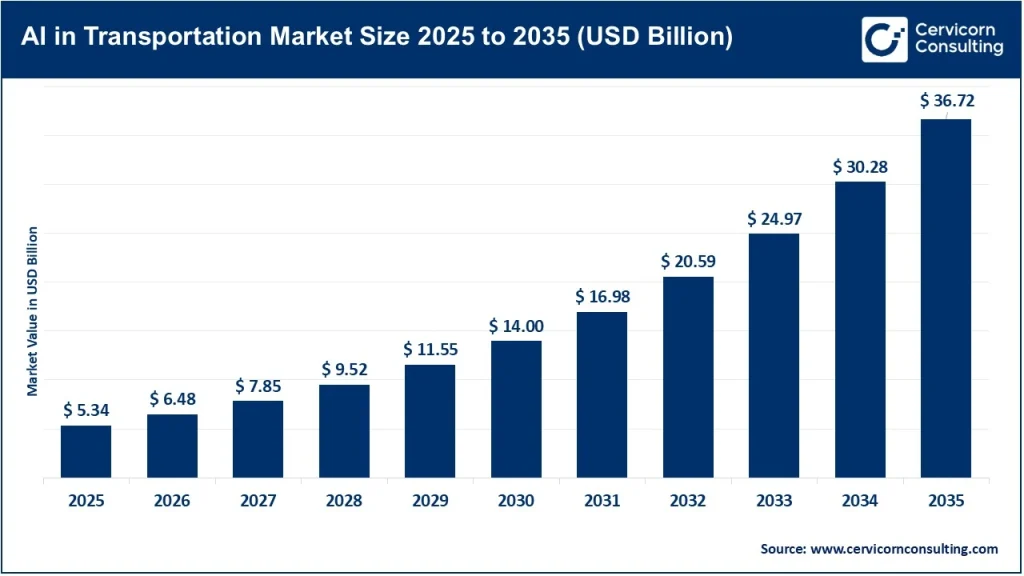
The global AI in transportation market was valued at USD 5.34 billion in 2025 and is projected to reach approximately USD 36.72 billion by 2035, growing at a compound annual growth rate (CAGR) of 21.3% from 2026 to 2035. Growth is being driven by the need to reduce traffic congestion, improve fleet productivity, strengthen transportation safety, and automate increasingly complex mobility operations. Autonomous vehicles, intelligent traffic management, predictive maintenance, and AI-powered logistics are creating new opportunities across road, rail, air, and maritime transportation.
However, market growth does not automatically translate into profitable adoption. Transportation companies must determine which applications solve their most expensive operational problems, whether existing infrastructure can support AI deployment, and how to demonstrate measurable returns before scaling investments.
1. Prioritize AI Applications Based on Measurable Operational Problems
AI in transportation covers a wide range of applications, from autonomous driving and traffic management to predictive maintenance and freight optimization. The challenge for decision-makers is identifying where AI can deliver the greatest operational improvement rather than adopting technology simply because competitors are investing in it.
For fleet operators, excessive fuel consumption, underutilized vehicles, delayed deliveries, and inefficient routing may offer more immediate opportunities than autonomous vehicle deployment. Rail operators may prioritize equipment reliability, while urban transportation authorities may focus on congestion, traffic signal coordination, and passenger flow.
Key decisions companies should make:
- Identify the operational problems responsible for the highest costs, delays, and service disruptions.
- Compare AI applications according to expected savings, implementation complexity, and time to measurable results.
- Establish baseline performance indicators before deploying a solution.
- Prioritize use cases that can be tested without disrupting essential transportation services.
For example, a logistics company experiencing frequent delivery delays could initially deploy AI-based route optimization using traffic, weather, vehicle, and delivery data. The resulting improvements in delivery reliability and vehicle utilization can help establish a business case for broader automation.
Get a Free Sample: https://www.cervicornconsulting.com/sample/2968
2. Choose Between Hardware Investment, Software Deployment, and Integrated Solutions
AI-powered transportation depends on sensors, cameras, radar, LiDAR, connected devices, computing infrastructure, and analytical software. Selecting the appropriate technology architecture directly affects deployment costs, system performance, and long-term scalability.
Hardware accounted for 46.2% of the AI in transportation market in 2025, reflecting the importance of data collection and real-time processing. However, software capabilities are becoming increasingly important as transportation companies seek to improve forecasting, automation, fleet visibility, and operational decision-making.
Companies must decide whether to upgrade existing infrastructure, purchase integrated solutions, or develop proprietary AI capabilities. Building a system internally may provide greater control, but it can require specialized talent, substantial testing, and ongoing maintenance. Integrated solutions can accelerate deployment, although they may create vendor dependency or limit customization.
Key decisions companies should make:
- Assess whether current vehicles, sensors, communication networks, and enterprise systems can support AI applications.
- Compare the total cost of ownership of hardware upgrades, software subscriptions, and integrated platforms.
- Evaluate interoperability with existing fleet management, transport management, and maintenance systems.
- Determine which capabilities should be developed internally and which should be sourced from technology partners.
The objective is not to invest in the most advanced technology available. It is to select an architecture that meets performance requirements without creating unnecessary capital expenditure or operational complexity.
3. Evaluate Autonomous Transportation Through Commercial Viability, Not Technical Capability Alone
Autonomous vehicles are a major application within the AI in transportation market, accounting for an estimated 28.7% share in 2025. Advances in computer vision, machine learning, sensor fusion, and real-time decision-making are expanding the potential for autonomous passenger services, commercial trucking, and delivery operations.
Nevertheless, a technically capable autonomous system may not be commercially viable across every operating environment. Vehicle utilization, route predictability, safety validation, insurance, regulatory approval, maintenance, and remote assistance requirements all influence deployment economics.
Companies considering autonomous transportation should distinguish between controlled environments, such as industrial sites and dedicated routes, and complex public-road operations. More predictable operating conditions can provide a practical starting point for evaluating autonomous systems.
Key decisions companies should make:
- Identify routes and operating environments where automation can deliver a clear economic advantage.
- Compare autonomous solutions with existing operations on a total-cost-per-trip or cost-per-kilometer basis.
- Assess safety performance, liability exposure, insurance requirements, and local regulatory conditions.
- Define the operational thresholds that must be met before expanding beyond pilot projects.
For vehicle manufacturers and autonomous technology providers, commercialization depends on demonstrating repeatable performance under real-world conditions. For fleet operators, the central question is whether automation improves productivity and safety sufficiently to justify the additional cost and risk.
4. Turn Predictive Maintenance Into a Fleet Reliability Strategy
Unplanned vehicle and infrastructure failures can cause missed deliveries, service interruptions, expensive repairs, and reduced asset utilization. AI-based predictive maintenance helps transportation companies analyze equipment data, identify abnormal operating patterns, and estimate when intervention may be necessary.
The value of predictive maintenance, however, depends on the quality of underlying data and the ability to act on model-generated warnings. A system that identifies potential failures but cannot connect with maintenance scheduling, spare-parts planning, or technician workflows may deliver limited benefits.
Transportation businesses should evaluate predictive maintenance as an operational process rather than a standalone software installation.
Key decisions companies should make:
- Identify high-value assets where unexpected failures create the greatest financial or service impact.
- Assess the availability and quality of sensor readings, inspection records, repair histories, and operating data.
- Integrate AI alerts with maintenance schedules, inventory management, and workforce planning.
- Track unplanned downtime, maintenance cost per asset, repeat failures, and false alerts.
Rail networks, commercial fleets, aviation operators, and maritime companies may benefit from different maintenance models because their assets, safety requirements, and operating cycles vary significantly. Deployment priorities should therefore reflect asset criticality and the consequences of failure, rather than applying the same model across an entire network.
5. Address Data Integration, Cybersecurity, and Safety Before Scaling
AI transportation systems rely on information from vehicles, traffic cameras, GPS devices, infrastructure sensors, logistics platforms, and connected networks. When these systems operate independently, organizations may struggle to build accurate predictions or coordinate decisions across multiple operational functions.
Connectivity also expands the potential attack surface. Compromised data, unauthorized system access, model failures, or communication disruptions can affect service reliability and, in safety-critical environments, physical safety.
Companies should address these risks before expanding from a limited pilot to a network-wide deployment.
Key decisions companies should make:
- Establish data ownership, access permissions, quality standards, and integration protocols.
- Evaluate cybersecurity protections for connected vehicles, sensors, cloud platforms, and operational technology.
- Define human oversight and fallback procedures for safety-critical AI decisions.
- Test model performance across different weather conditions, traffic patterns, routes, and operating environments.
- Establish procedures for monitoring model drift, investigating incidents, and updating systems.
Transportation companies should also consider whether latency, network coverage, and service availability justify processing data at the vehicle or roadside edge rather than relying entirely on centralized cloud infrastructure.
The ability to maintain safe and reliable operations during system failures is as important as the accuracy of the AI model itself.
6. Select Markets and Business Models That Support Scalable Returns
AI adoption varies across transportation modes, regions, and customer segments. A solution that performs well in a technologically advanced urban network may require substantial adaptation for a smaller city, a rural freight corridor, or a market with limited digital infrastructure.
North America accounted for an estimated 38.5% of the global AI in transportation market in 2025, while road transportation represented approximately 67.5% of market revenue. These figures indicate the importance of established mobility ecosystems and road-based applications, but they do not mean every company should concentrate exclusively on these segments.
Technology providers must assess customer readiness, procurement cycles, infrastructure requirements, regulatory conditions, and competitive intensity before selecting target markets.
Key decisions companies should make:
- Identify customer segments with urgent operational needs and sufficient budgets for AI deployment.
- Compare regional opportunities based on infrastructure readiness, policy support, and commercialization timelines.
- Determine whether to sell software licenses, usage-based services, integrated systems, or recurring optimization solutions.
- Evaluate partnerships with vehicle manufacturers, logistics operators, infrastructure providers, and public transportation authorities.
- Measure customer acquisition costs, recurring revenue potential, implementation expenses, and customer retention.
For technology suppliers, a focused entry strategy may be more effective than pursuing multiple transportation modes simultaneously. For established operators, partnerships can reduce implementation complexity and provide access to specialized capabilities without requiring every technology component to be developed internally.
What Should Companies Measure Before Expanding AI Investments?
A successful AI deployment should demonstrate improvements in business performance, not just model accuracy or the number of automated processes.
The following indicators can help decision-makers evaluate whether a project is ready to scale:
| Business objective | Indicators to monitor |
|---|---|
| Reduce operating costs | Cost per kilometer, fuel or energy consumption, maintenance expenditure |
| Improve service reliability | On-time delivery, schedule adherence, unplanned downtime |
| Increase asset utilization | Vehicle utilization, empty miles, asset availability |
| Strengthen safety | Incident rates, near misses, intervention frequency |
| Improve traffic performance | Average travel time, queue length, intersection throughput |
| Validate financial returns | Total cost of ownership, payback period, return on investment |
Targets should be established against a reliable baseline and adjusted for operating conditions, route characteristics, seasonality, and changes in service demand. Companies should also account for integration costs, training, system maintenance, and ongoing model monitoring when calculating financial returns.
Conclusion: Make AI Investments Around Business Outcomes
The expansion of the AI in transportation market is creating opportunities across autonomous mobility, intelligent traffic management, predictive maintenance, fleet optimization, and connected transportation. Yet long-term competitive advantage will depend less on the number of AI tools deployed and more on how effectively companies connect technology investments to operational and commercial priorities.
Decision-makers should begin with measurable business problems, select technology architectures that fit existing infrastructure, validate autonomous and predictive systems under real operating conditions, and establish clear standards for safety, cybersecurity, and financial performance.
Companies that combine targeted deployment with disciplined evaluation will be better positioned to scale successful applications, avoid underperforming investments, and build transportation systems that are more efficient, reliable, and commercially sustainable.
To Get Detailed Overview, Contact Us: https://www.cervicornconsulting.com/contact-us
Read Report: Stem Cell Therapy Market Outlook: Clinical Advances, Manufacturing Challenges, and Emerging Growth Opportunities