


Why grid modernization is driving the global On-Grid Battery Energy Storage Systems Market
Electricity grids are being asked to do something they were not originally designed to do: manage rapidly changing generation and demand while maintaining reliability. Solar and wind power are expanding, electricity consumption is increasing, data centers and electrification are creating new concentrated loads, and aging transmission and distribution infrastructure is facing greater pressure. At the same time, renewable generation does not always occur when electricity demand is highest. Solar production can peak around midday while demand rises later in the day, while wind output can fluctuate within hours. The result is a growing need for flexibility—the ability to store electricity when it is available and release it when the grid needs it.
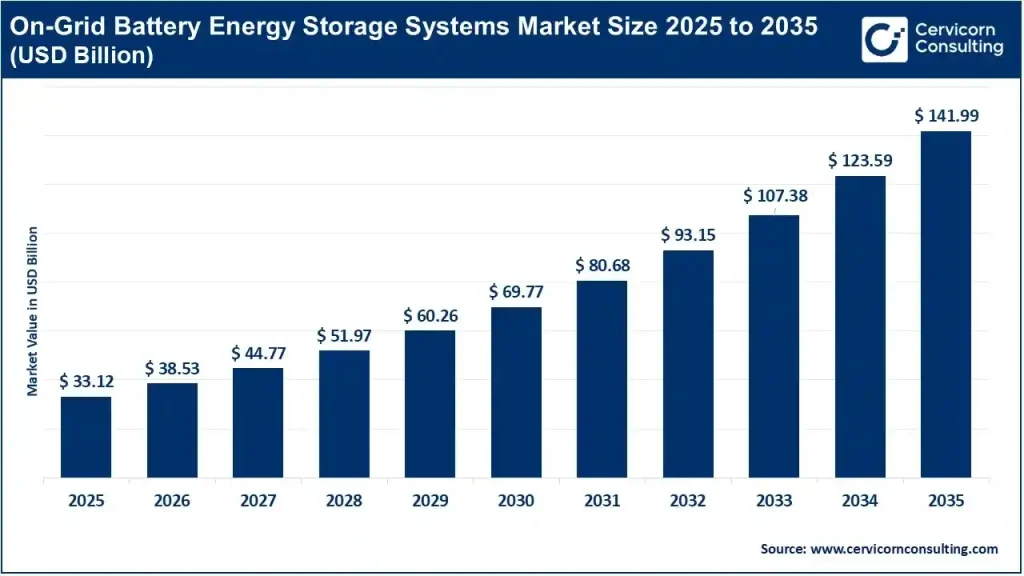
This is the problem creating the opportunity for the on-grid battery energy storage systems market. Cervicorn Consulting identifies on-grid systems as the largest connection segment of the broader battery energy storage system market, accounting for approximately 58% of market share in 2025. The broader BESS market was valued at USD 33.12 billion in 2025 and is projected to exceed USD 141.99 billion by 2035, reflecting the expanding role of storage in modern electricity infrastructure.
The electricity grid is becoming harder to balance
For decades, electricity systems largely followed a relatively straightforward model: power plants generated electricity, transmission networks moved it, distribution networks delivered it, and consumers used it. Generation could be scheduled around expected demand.
Renewable energy changes that equation.
Solar and wind generation depend on weather conditions rather than electricity demand. When renewable generation is high but demand is low, electricity can become difficult to use immediately. When renewable output falls while demand remains high, the grid needs another source of electricity. Meanwhile, electrification, electric vehicles, heat pumps, industrial loads and data centers are creating new demand patterns.
The International Energy Agency reported in 2026 that grid capacity is increasingly becoming a bottleneck for connecting new generation, storage and demand, with grid connection queues reaching record levels worldwide.
This creates several connected problems: supply-demand imbalance, peak-load pressure, congestion, renewable curtailment, power-quality requirements and the need for faster grid response. Simply constructing more generation and transmission capacity can help, but these projects often require substantial capital, planning, permitting and years of development.
The industry therefore needs assets that can respond much faster.
Why conventional infrastructure alone is not enough
Traditional power infrastructure remains essential, but it is not optimized for every new flexibility requirement. A transmission line can move electricity, but it cannot store electricity for later. A conventional power plant can provide dependable generation, but changing output may be slower or less economically attractive than using a battery for short-duration balancing.
Grid upgrades also take time. A renewable project may be ready for construction while its grid connection requires additional infrastructure. In such circumstances, storage can provide a flexible resource that helps manage electricity flows and reduce pressure on existing infrastructure.
This does not mean batteries replace transmission, generation or other grid assets. Instead, they increasingly work alongside them.
That distinction is important for understanding the On-Grid Battery Energy Storage Systems Market: the commercial opportunity is not simply about selling batteries. It is about providing flexibility to a power system that is becoming more dynamic.
Get a Free Sample: https://www.cervicornconsulting.com/sample/3043
How on-grid BESS turns the problem into an opportunity
An on-grid battery energy storage system is connected directly to the electricity network and can charge when electricity is available and discharge when it is more valuable or needed.
Consider a solar plant producing more electricity at midday than the grid can immediately absorb. Instead of curtailing some of that production, a battery can store the excess. Later, when solar generation falls and demand increases, the battery can discharge.
The same system can provide several services simultaneously or at different times:
- Peak shifting: storing electricity during lower-demand periods and releasing it during peak demand.
- Renewable integration: reducing the mismatch between renewable generation and consumption.
- Frequency regulation: responding rapidly to changes in grid frequency.
- Ancillary services: supporting system reliability through fast-response capabilities.
- Energy arbitrage: charging when electricity prices are lower and discharging when prices are higher.
- Grid resilience: providing additional flexibility during disruptions.
- Congestion management: helping manage localized grid constraints.
- Curtailment reduction: capturing renewable electricity that might otherwise be wasted.
The IEA describes batteries as one of the most versatile tools for short-term power-system flexibility because they can respond rapidly, shift renewable generation and potentially defer some network upgrades.
This explains why storage is moving from an optional renewable-energy accessory toward a strategic grid asset.
Growth factors: the problem is getting bigger
The On-Grid Battery Energy Storage Systems Market is expanding because the problems that storage addresses are expanding simultaneously: increasing solar and wind deployment creates greater intermittency; rising electricity consumption increases peak-demand pressure; grid congestion creates a need for flexible resources; grid modernization requires faster-response assets; energy-security concerns encourage countries to develop domestic flexibility; and declining battery costs improve project economics. Cervicorn Consulting reports that on-grid BESS represented around 58% of the broader BESS market in 2025, while front-of-the-meter systems accounted for about 80%, demonstrating the importance of grid-connected, utility-scale storage.
2026: BESS is moving from individual projects to infrastructure
The market is increasingly characterized by larger projects, renewable-plus-storage developments and utility-scale deployment.
The IEA estimates that 108 GW of new battery storage capacity was deployed globally in 2025, 40% more than in 2024. Around 80% of new capacity was utility-scale, while LFP batteries represented approximately 90% of deployments. China accounted for about 60% of global additions, followed by the United States and Europe.
The scale of projects is also increasing. In Germany, a 1,000 MW/4,000 MWh project being developed by LEAG and Fluence is expected to become Europe’s largest battery storage project. Australia is expanding the Eraring battery system toward 700 MW/2,800 MWh, while Saudi Arabia commissioned a 500 MW/2,000 MWh BESS in Bisha in 2025.
These projects demonstrate an important shift: batteries are increasingly being planned as part of national and regional electricity infrastructure rather than simply as individual renewable-energy components.
The technology race is about solving different grid problems
LFP batteries are becoming particularly important for utility-scale applications because they combine relatively low cost, long cycle life and safety characteristics suited to frequent cycling. Their growing adoption is directly connected to the economics of grid storage. The IEA estimates that LFP represented around 90% of global battery-storage deployments in 2025.
NMC batteries offer higher energy density, which can be valuable where space constraints make energy density important. However, utility-scale stationary storage does not always require the same energy-density priorities as electric vehicles.
Flow batteries address a different challenge: duration. Their architecture can make longer-duration applications attractive where the objective is to discharge energy for extended periods rather than simply provide short bursts of flexibility.
Sodium-ion batteries are attracting attention because they can diversify battery chemistry and potentially reduce dependence on some constrained materials. Their commercial role in large-scale storage is still developing.
The bigger opportunity is therefore not one universal battery chemistry. It is matching technology, duration and system design to the grid problem.
At the same time, software is becoming increasingly important. AI-enabled energy-management systems can improve forecasting, optimize charging and discharging, participate in electricity markets and coordinate batteries with solar, wind and other flexible resources.
Companies are competing across the storage ecosystem
The competitive landscape includes battery manufacturers, system integrators, power-electronics companies and energy-management providers.
Tesla combines battery storage with its energy-management and software ecosystem. BYD and CATL have significant battery manufacturing capabilities, while Fluence focuses strongly on grid-scale storage systems and software.
Wärtsilä provides energy-storage and power-generation solutions, while LG Energy Solution, Samsung SDI and Panasonic participate in the battery supply chain.
Power and grid-technology companies including ABB, Siemens, Schneider Electric and GE Vernova address areas such as grid integration, power management, controls, electrification and infrastructure.
Company-level BESS revenue and market-share figures are not consistently disclosed on a comparable basis, so BESS-specific market shares should not be inferred from overall corporate revenue. The competitive question is instead: which part of the grid-flexibility value chain does each company control?
Where is the money going?
Investment is increasingly moving toward battery manufacturing, utility-scale projects, renewable-plus-storage developments, grid infrastructure, software and project financing.
The rationale is straightforward. Battery manufacturers are responding to growing demand. Utilities and developers need storage to manage renewable generation and peak demand. Technology companies are building the control systems needed to operate increasingly complex electricity assets. Investors are looking for revenue opportunities across energy arbitrage, capacity services, ancillary services and other electricity-market mechanisms.
The falling cost of storage has strengthened this investment case. The IEA reports that utility-scale battery-storage project costs fell by about 40% in 2024 to approximately USD 150/kWh, while lithium-ion battery pack prices declined again in 2025.
However, investment is not risk-free. Connection delays, permitting, safety requirements, uncertain revenue structures and financing conditions can affect project economics.
Where are the biggest business opportunities?
The largest opportunity is not limited to battery-cell manufacturing.
Utility-scale BESS can monetize grid flexibility, capacity and energy-market services. Renewable-plus-storage allows developers to better align renewable generation with demand. Energy arbitrage and ancillary services create additional revenue streams where market structures support them.
Commercial and industrial storage can address demand management and power reliability. Data-center infrastructure is another emerging opportunity because large digital loads require increasingly reliable electricity systems.
Virtual power plants can aggregate distributed batteries and coordinate them as flexible grid resources. Long-duration storage addresses the need to shift renewable electricity over longer periods. Battery recycling and second-life systems create opportunities around resource recovery and lifecycle management.
For investors and new entrants, the commercial model is therefore becoming broader: the problem is grid flexibility, while the monetizable opportunity may be hardware, software, financing, project development, operations or services.
What does it take to enter the market?
Entering the on-grid BESS industry requires more than manufacturing batteries.
Companies need to understand grid interconnection requirements, battery safety, thermal management, power conversion, energy-management software, project financing, utility procurement and electricity-market participation. They also need dependable component supply chains and long-term maintenance capabilities.
Battery selection is equally important. A system designed for frequent short-duration cycling may require different economics from one designed for several hours of discharge. Companies therefore need to start with the grid application rather than selecting a battery technology first.
Recycling and end-of-life management are also becoming strategically important as installed battery fleets expand. The IEA notes that recycling can support future critical-mineral supply and battery supply-chain resilience, although the contribution of end-of-life batteries remains limited compared with manufacturing scrap today.
Governments are trying to solve the same grid problem
Government policy is increasingly focused on making storage economically and technically viable.
In India, the Ministry of New and Renewable Energy lists policies covering viability-gap funding for BESS, amendments to those guidelines, inter-state transmission-charge waivers for energy storage and guidance on co-locating storage with solar projects. India is therefore using financial and regulatory mechanisms to reduce barriers to storage deployment.
In China, the government issued a 2025–2027 action plan for large-scale development of new energy storage. By the first quarter of 2026, China’s National Energy Administration reported that installed new-energy-storage capacity had exceeded 140 GW, while policy work increasingly focused on allowing storage to participate in electricity and ancillary-service markets.
China also introduced a 2026 mechanism establishing a grid-side independent new-energy-storage capacity-pricing framework, linking compensation to factors such as discharge duration and peak contribution.
Across North America, storage deployment is being driven by renewable integration, grid reliability, capacity needs and regional market structures. Europe is addressing energy security, renewable integration and grid flexibility, while Australia and the Middle East are rapidly expanding utility-scale storage as renewable penetration increases. The IEA identifies Australia and parts of the Middle East among markets where battery deployment expanded strongly in 2025.
In Latin America and Africa, opportunities are emerging around renewable integration, grid reliability, energy diversification and solar-plus-storage infrastructure, although market structures and project economics vary substantially between countries.
Real-world deployments show where the market is heading
The strongest evidence of BESS commercialization is the rapid growth of large projects.
Saudi Arabia’s 500 MW/2,000 MWh Bisha project demonstrates how storage is becoming part of large-scale electricity infrastructure. Germany’s planned 1,000 MW/4,000 MWh project demonstrates the growing importance of duration and scale in European power markets. Australia’s Eraring expansion illustrates how storage can be integrated into an evolving electricity system as conventional generation changes.
Meanwhile, the IEA estimates that around 24 GW of utility-scale battery additions in 2025 were directly co-located with renewable generation, showing that renewable-plus-storage remains an important deployment model even as market structures evolve.
What is changing next?
The next stage of the On-Grid Battery Energy Storage Systems Market will be shaped by larger projects, longer durations, smarter controls and greater integration with renewable generation. LFP is likely to remain highly important for many utility applications, while sodium-ion and other chemistries can contribute to supply-chain diversification. Long-duration storage will become more relevant as renewable penetration rises and electricity systems need to shift larger quantities of energy across longer periods.
AI-driven optimization will increasingly connect batteries to electricity forecasting and market participation. Virtual power plants can turn distributed storage into coordinated grid resources. Recycling and second-life applications can extend the value chain beyond initial deployment.
The underlying direction is clear: storage is moving from a device that stores electricity toward an infrastructure platform that manages when electricity is generated, consumed and traded.
The opportunity ahead
The On-Grid Battery Energy Storage Systems Market is ultimately being created by a mismatch between how modern electricity is generated and how electricity infrastructure was traditionally designed to operate. More renewable generation, rising electricity demand, data centers, electrification and grid constraints are increasing the value of flexibility.
That is why the commercial opportunity extends well beyond battery cells. Utilities need grid-scale storage. Renewable developers need dispatchable flexibility. Manufacturers need production capacity and secure supply chains. Technology companies need intelligent energy-management systems. Investors need viable revenue models. Governments need policies that make storage economically deployable.
The market is therefore evolving from battery deployment toward grid-flexibility infrastructure. Businesses evaluating this opportunity should monitor project pipelines, battery costs, storage duration, electricity-market reforms, grid-connection queues, renewable-plus-storage development, manufacturing localization and emerging revenue mechanisms.
The central business question is no longer simply how much battery capacity can be manufactured. It is which electricity problem can be solved with storage, where that problem is most valuable, and which part of the resulting infrastructure value chain a company can capture.
To Get Detailed Overview, Contact Us: https://www.cervicornconsulting.com/contact-us
Read Report: AI in Supply Chain Market Revenue, Trends, and Strategic Insights by 2035