


Asset Lifecycle Management Market: How Should Companies Improve Asset Utilization and Long-Term Returns?
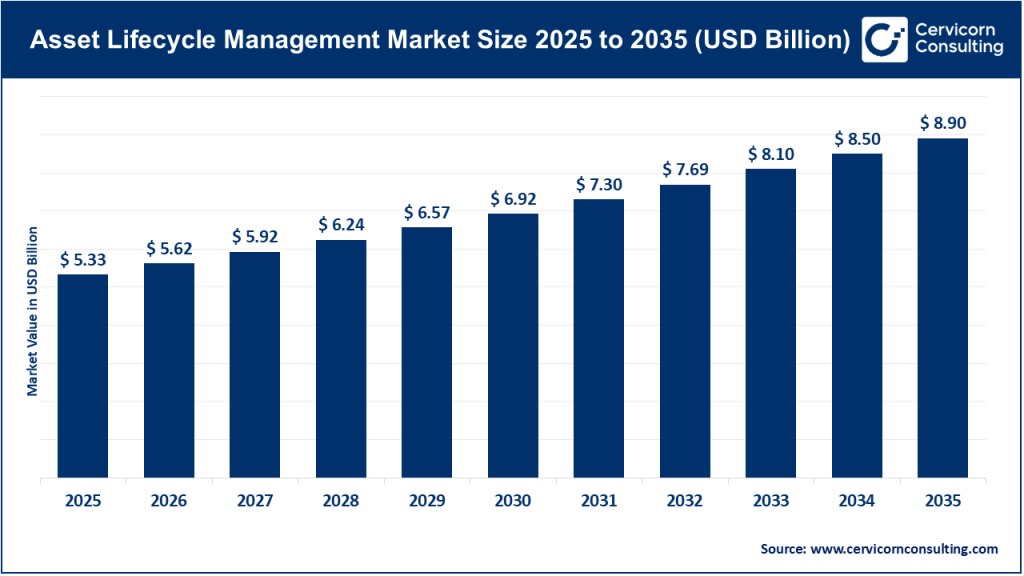
The global asset lifecycle management market was valued at USD 5.33 billion in 2025 and is projected to reach approximately USD 8.90 billion by 2035, expanding at a CAGR of 5.26% from 2026 to 2035. The market is estimated to reach USD 5.62 billion in 2026.
For companies operating in manufacturing, energy and utilities, transportation, oil and gas, and infrastructure, asset lifecycle management is becoming an important part of long-term operational planning. Rising equipment costs, aging infrastructure, maintenance requirements, and pressure to improve capital efficiency are encouraging businesses to reconsider how they manage physical assets throughout their useful lives.
However, the business case for asset lifecycle management extends beyond equipment monitoring and maintenance scheduling. Companies must determine whether existing assets should be maintained, upgraded, replaced, or retired, how much capital should be allocated to each decision, and which technologies can deliver measurable improvements in asset performance.
These decisions are becoming more important as organizations integrate Internet of Things (IoT) sensors, artificial intelligence (AI), predictive maintenance, cloud-based platforms, and digital twins into their asset management strategies.
Asset Lifecycle Management Market Size and Growth
The global asset lifecycle management market is expected to experience steady growth as businesses prioritize asset reliability, operational continuity, and cost optimization.
The market’s expansion is supported by increasing industrial automation, infrastructure modernization, growing adoption of connected asset monitoring, and the need to improve visibility across asset-related expenditures.
Asia-Pacific accounted for approximately 48.3% of global market revenue in 2025, making it the leading regional market. North America represented approximately 25.8%, supported by established industrial infrastructure and investments in digital asset management technologies.
This regional distribution presents different opportunities for solution providers. Asia-Pacific offers opportunities associated with industrial expansion, infrastructure development, and modernization, while North America presents demand for advanced asset analytics, predictive maintenance, and integration with existing enterprise systems.
For technology providers, the opportunity is not limited to selling asset management software. Consulting, implementation, system integration, and managed services can also become important revenue streams as organizations modernize their asset management infrastructure.
Get a Free Sample: https://www.cervicornconsulting.com/sample/2411
Why Are Companies Reconsidering Their Asset Lifecycle Strategies?
Asset-intensive businesses frequently manage equipment across multiple facilities, operating environments, and geographical locations. However, asset information is often distributed across maintenance systems, procurement databases, engineering platforms, and financial applications.
This fragmentation makes it difficult to establish the actual cost and performance of an asset throughout its useful life.
Several developments are increasing the need for integrated lifecycle management.
1. Rising maintenance costs and aging equipment
Companies operating manufacturing plants, power infrastructure, transportation networks, and industrial facilities must balance maintenance expenditures against the cost of equipment replacement.
Reactive maintenance can result in unexpected production interruptions, emergency repair expenses, and inefficient spare-parts procurement.
An integrated asset lifecycle strategy allows companies to evaluate equipment condition, maintenance history, operating costs, and expected remaining useful life before making investment decisions.
2. Increasing adoption of predictive maintenance
Traditional preventive maintenance generally follows predefined schedules, regardless of the actual condition of equipment. Predictive maintenance uses asset performance data to identify potential failures and determine when intervention is necessary.
Sensors monitoring vibration, temperature, pressure, and operating conditions can help maintenance teams identify abnormal performance before equipment failure occurs.
According to Brightly Software’s 2026 Asset Lifecycle Report, 68% of respondents said their organizations were focused on implementing IoT technologies, while 56% were integrating AI capabilities into their workflows. Another 55% reported using digital mapping or digital twins to monitor asset health and failures.
This indicates that businesses are increasingly exploring connected asset management, although the ability to translate technology adoption into measurable operational improvements remains an important consideration.
3. Pressure to improve capital expenditure decisions
Asset replacement represents a substantial financial commitment for businesses managing high-value industrial equipment and infrastructure.
Replacing equipment too early can increase unnecessary capital expenditure, while delaying replacement can increase maintenance costs and operational risks.
Lifecycle cost analysis helps organizations compare acquisition costs, installation expenses, maintenance requirements, energy consumption, downtime exposure, and disposal costs.
This creates a more comprehensive basis for deciding whether to extend an asset’s operating life or invest in replacement.
4. Sustainability and regulatory requirements
Organizations are increasingly evaluating asset management decisions through the lens of energy efficiency, resource utilization, emissions reduction, and environmental compliance.
Extending equipment life, improving energy performance, reducing material waste, and planning responsible asset disposal can contribute to broader sustainability objectives.
Asset lifecycle management can therefore connect operational planning with environmental and financial performance.
Strategic Decisions Companies Should Make When Investing in Asset Lifecycle Management
Market expansion does not automatically translate into successful technology adoption. Companies need to identify the operational problems they want to solve before selecting an asset lifecycle management platform or investing in new infrastructure.
The following decisions can help organizations prioritize investments and improve implementation outcomes.
1. Should Companies Invest in Predictive Maintenance or Upgrade Existing Maintenance Systems?
One of the first decisions is determining whether existing maintenance processes are sufficient or whether more advanced predictive capabilities are required.
Companies with relatively stable equipment and predictable maintenance requirements may benefit from improving preventive maintenance schedules, work order management, and asset documentation before introducing complex AI-based systems.
However, businesses operating critical equipment, where unexpected failures create substantial financial or safety consequences, may benefit from predictive maintenance investments.
Before implementation, companies should evaluate:
- Historical equipment failure rates and maintenance expenditure.
- Availability and reliability of operational data.
- Cost of unplanned downtime across facilities.
- Sensor installation and connectivity requirements.
- Availability of skilled maintenance and data analytics personnel.
- Expected savings from improved failure prediction.
The investment decision should be based on the financial impact of avoidable failures rather than the number of AI features offered by a technology provider.
2. Should Organizations Choose Cloud-Based or On-Premise ALM Solutions?
Deployment architecture is another important consideration, particularly for organizations managing geographically distributed assets.
Cloud-based platforms offer centralized asset information, remote monitoring, scalability, and easier access across multiple facilities. They can also reduce the need for organizations to maintain extensive internal IT infrastructure.
On-premise platforms may remain suitable for companies with strict data governance requirements, sensitive operational information, legacy infrastructure, or specific cybersecurity constraints.
Organizations should compare both deployment approaches based on:
- Total cost of ownership over the implementation period.
- Data security and regulatory requirements.
- Integration with existing ERP, maintenance, and operational systems.
- Scalability across facilities and business units.
- System availability and disaster recovery requirements.
- Vendor support and long-term upgrade costs.
Hybrid deployment can also be considered when operational technology environments require local control while enterprise management teams need centralized reporting.
3. How Should Companies Prioritize Asset Replacement and Lifecycle Extension?
Asset replacement decisions should not depend exclusively on equipment age.
An older asset may continue operating efficiently with appropriate maintenance, while relatively new equipment may require replacement because of reliability problems, energy inefficiency, or changing production requirements.
Companies should evaluate assets using a combination of:
- Remaining useful life.
- Maintenance and repair costs.
- Failure frequency and operational criticality.
- Energy consumption and operating efficiency.
- Availability of replacement components.
- Safety and regulatory exposure.
- Expected return on replacement investment.
A structured asset prioritization model helps organizations direct capital toward assets that create the greatest operational or financial risk.
For example, a manufacturing company may find that replacing one critical production machine delivers greater value than upgrading several lower-priority assets. Similarly, a utility operator may prioritize infrastructure with higher failure consequences rather than replacing equipment according to age alone.
4. Can Digital Twins and IoT Improve Asset Performance Across Facilities?
IoT and digital twin technologies are expanding the capabilities of asset lifecycle management platforms.
IoT sensors provide information about actual operating conditions, while digital twins create digital representations of physical assets or systems. These technologies can support equipment monitoring, performance simulation, failure analysis, and maintenance planning.
However, companies should identify where these technologies provide sufficient operational value to justify their implementation costs.
Potential applications include:
- Monitoring equipment performance across manufacturing facilities.
- Simulating operating conditions in power generation infrastructure.
- Identifying performance deviations in industrial machinery.
- Evaluating maintenance requirements for transportation assets.
- Monitoring infrastructure conditions in large construction projects.
Organizations should prioritize assets with high operational importance, measurable data availability, and significant failure or maintenance costs rather than attempting to create digital twins for every asset.
5. How Should Companies Integrate ALM With Existing Enterprise Systems?
Asset lifecycle management becomes more valuable when asset information is connected with procurement, finance, inventory, engineering, and maintenance systems.
For example, maintenance teams may identify recurring equipment failures, while procurement teams manage spare-parts availability and finance departments track asset depreciation and replacement budgets.
Without integration, these departments may operate with different asset records and inconsistent information.
Companies should evaluate whether an ALM platform can integrate with:
- Enterprise resource planning (ERP) systems.
- Enterprise asset management (EAM) platforms.
- Computerized maintenance management systems (CMMS).
- Manufacturing execution systems (MES).
- Industrial IoT platforms.
- Financial and procurement applications.
The objective should be to establish a consistent asset information framework that supports both operational and financial decisions.
Technology Trends Reshaping the Asset Lifecycle Management Market
Technology innovation is changing how organizations monitor, maintain, and evaluate their physical assets.
AI-powered asset analytics: AI and machine learning can analyze equipment performance, identify abnormal operating patterns, and support predictive maintenance decisions. Their value increasingly depends on data quality, explainability, and integration with existing maintenance workflows.
IoT-enabled asset monitoring: Connected sensors allow companies to collect operational data continuously. This improves visibility into equipment health and helps maintenance teams respond to emerging problems.
Digital twins: Digital representations of physical assets can support performance simulation, condition monitoring, and lifecycle planning. Adoption is particularly relevant for complex infrastructure and capital-intensive industrial operations.
Cloud-based asset management: Cloud platforms enable centralized asset information, remote accessibility, and easier coordination between geographically distributed facilities.
Mobile asset management: Mobile applications allow field technicians to access equipment records, update work orders, record inspections, and receive maintenance alerts without relying entirely on centralized office systems.
For technology providers, differentiation will increasingly depend on the ability to combine these capabilities into integrated solutions that deliver measurable improvements in asset availability, maintenance efficiency, and lifecycle costs.
Industry Opportunities: Where Is Demand for Asset Lifecycle Management Increasing?
Demand for asset lifecycle management solutions varies according to the complexity, value, and operational importance of assets within each industry.
Manufacturing: Manufacturers need to improve machinery utilization, reduce production interruptions, and manage equipment replacement. Predictive maintenance, asset tracking, and spare-parts optimization are important application areas.
Energy and utilities: Power generation, transmission, and distribution companies manage extensive infrastructure that requires continuous monitoring and maintenance. Grid modernization, renewable energy integration, and infrastructure resilience are creating additional requirements for connected asset management.
Transportation and logistics: Fleet operators, rail networks, and logistics companies require better visibility into vehicle condition, maintenance schedules, and equipment utilization. Lifecycle management can support fleet availability and reduce unexpected repair expenditure.
Oil and gas: Exploration, production, refining, and distribution operations depend on high-value equipment operating under demanding conditions. Asset lifecycle management supports reliability planning, safety compliance, maintenance optimization, and equipment replacement decisions.
Healthcare: Hospitals and healthcare providers must maintain medical equipment, diagnostic systems, and facility infrastructure. Asset tracking, maintenance scheduling, equipment availability, and compliance management are important applications.
Construction: Construction companies manage heavy machinery, vehicles, and other capital-intensive equipment. Monitoring utilization, maintenance requirements, and equipment availability can help control project costs and improve operational planning.
These industry differences create opportunities for specialized ALM solutions rather than relying exclusively on standardized platforms.
What Should Asset Lifecycle Management Solution Providers Prioritize?
For software vendors, technology developers, and service providers, market growth creates opportunities across multiple customer requirements. However, competing only on the number of software features may not be sufficient.
Four areas deserve particular attention.
Industry-specific solutions: Manufacturing, utilities, healthcare, and transportation have different asset requirements, compliance obligations, and operating environments. Providers that develop specialized workflows and industry-focused capabilities can address more clearly defined customer problems.
Integration and interoperability: Compatibility with existing ERP, EAM, CMMS, and industrial systems is essential. Providers should prioritize integration capabilities that reduce implementation complexity and prevent fragmented asset information.
AI and predictive capabilities: Buyers are increasingly evaluating predictive analytics and AI-enabled maintenance. Providers need to demonstrate how these capabilities improve failure identification, maintenance planning, and equipment availability.
Services and implementation support: Organizations often require assistance with asset data migration, system configuration, integration, employee training, and ongoing technical support. This creates opportunities for service providers alongside software sales.
The ability to demonstrate measurable financial and operational outcomes will be important for winning enterprise customers.
Competitive Landscape: Which Companies Are Shaping the Market?
The asset lifecycle management market includes established enterprise software providers, industrial automation companies, engineering technology developers, and specialized asset management solution providers.
Important companies operating in this market include:
- IBM Corporation: Focuses on enterprise asset management, asset performance, and AI-enabled maintenance through its Maximo portfolio.
- SAP SE: Provides enterprise asset management capabilities integrated with broader ERP and business processes.
- Oracle Corporation: Offers enterprise asset management and maintenance capabilities through its enterprise cloud applications.
- Siemens AG: Combines industrial automation, engineering software, and asset-related digital solutions.
- Schneider Electric: Focuses on industrial automation, energy management, and connected asset performance.
- ABB Ltd.: Provides industrial automation, electrification, and asset performance-related solutions.
- Hexagon AB: Offers industrial asset management, engineering, and digital reality technologies.
- Bentley Systems: Specializes in infrastructure engineering software and digital twin capabilities.
- IFS AB: Provides enterprise asset management, field service, and industrial AI capabilities.
- AVEVA Group: Focuses on industrial software, engineering, operations, and asset performance management.
Competition is increasingly influenced by platform integration, industry specialization, cloud capabilities, AI adoption, and the ability to support asset-intensive operations throughout the asset lifecycle.
For companies evaluating technology investments, vendor selection should consider not only product functionality but also implementation experience, integration capabilities, industry expertise, and long-term support.
What Will Determine the Next Phase of Asset Lifecycle Management Market Growth?
The next phase of market development will depend on how effectively organizations translate digital asset management investments into measurable operational improvements.
The growing adoption of IoT, AI, cloud computing, and digital twins is expanding the capabilities available to asset-intensive businesses. However, implementation challenges remain.
Legacy infrastructure, inconsistent asset records, cybersecurity concerns, integration costs, and shortages of skilled professionals can delay adoption.
The financial justification for ALM investments will therefore remain important. Companies will increasingly evaluate technology based on its ability to reduce unplanned downtime, improve equipment utilization, optimize maintenance expenditure, and support better capital allocation.
For solution providers, the opportunity lies in addressing these operational challenges through integrated, scalable, and industry-specific offerings.
As businesses continue modernizing their infrastructure, asset lifecycle management is expected to become an increasingly important part of long-term operational and investment planning.
To Get Detailed Overview, Contact Us: https://www.cervicornconsulting.com/contact-us