


Aseptic Packaging Market: How Should Manufacturers Balance Shelf Life, Material Innovation, and Production Costs?
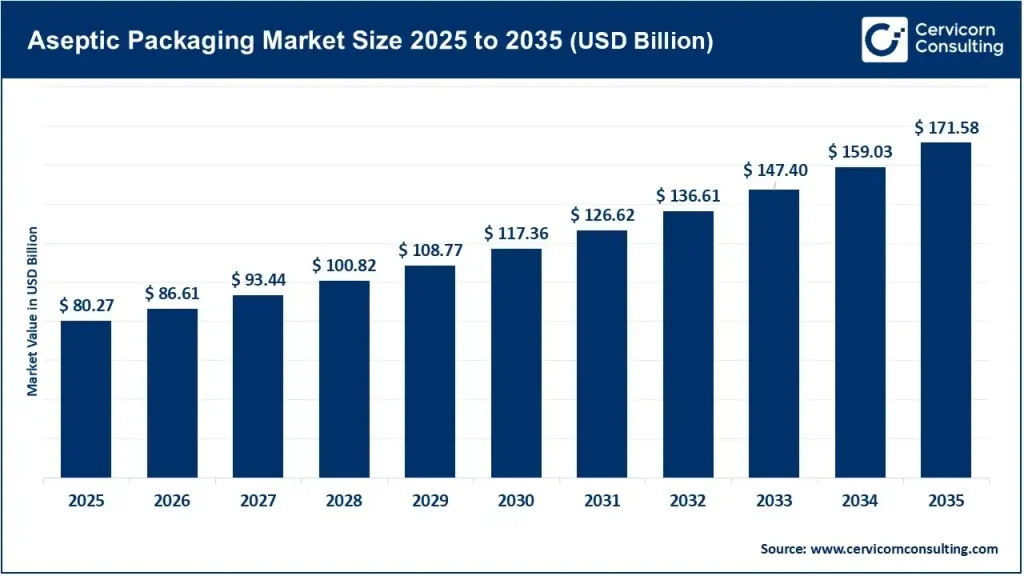
The global aseptic packaging marketwas valued at USD 80.27 billion in 2025 and is projected to grow from USD 86.61 billion in 2026 to approximately USD 171.58 billion by 2035, registering a CAGR of 7.9% from 2026 to 2035.
Growth is being driven by increasing demand for shelf-stable food and beverages, expanding consumption of dairy and plant-based products, rising pharmaceutical manufacturing, and the need to distribute sensitive products without continuous refrigeration.
However, market expansion does not automatically translate into attractive investment returns for every packaging manufacturer. Companies must evaluate whether to invest in new aseptic filling capacity, upgrade existing production lines, develop alternative barrier materials, or expand into pharmaceutical packaging. These decisions require a closer assessment of application-specific demand, production economics, regulatory requirements, and customer adoption.
Aseptic Packaging Is Becoming a Production and Supply Chain Investment
Aseptic packaging is increasingly important for manufacturers looking to extend product shelf life while reducing dependence on refrigerated distribution. Unlike conventional packaging, aseptic systems involve separately sterilizing the product and packaging material before filling and sealing under controlled sterile conditions.
This approach creates opportunities across dairy products, juices, plant-based beverages, nutritional drinks, soups, sauces, and pharmaceutical products.
For food and beverage manufacturers, the primary commercial advantage is the ability to distribute products across wider geographic markets without relying on uninterrupted cold-chain infrastructure. This can improve distribution flexibility, reduce logistics complexity, and support entry into markets where refrigerated retail networks remain limited.
For pharmaceutical manufacturers, the value proposition is different. Sterile packaging must maintain product integrity and minimize contamination risks throughout filling, sealing, storage, and distribution.
Consequently, packaging companies need to assess demand by application rather than treating aseptic packaging as a single homogeneous market.
Get a Free Sample: https://www.cervicornconsulting.com/sample/3084
Production Capacity Expansion Requires More Than Demand Forecasting
The expansion of aseptic packaging manufacturing capacity is creating opportunities for packaging suppliers and equipment manufacturers. However, the commercial viability of new production facilities depends on customer proximity, utilization rates, raw material availability, and the ability to secure long-term supply agreements.
India provides an important example of this investment activity.
SIG opened its first aseptic carton manufacturing plant in Ahmedabad in February 2025 through an investment of approximately EUR 90 million. The facility has an initial annual production capacity of up to 4 billion aseptic carton packs and is designed to support dairy and non-carbonated beverage manufacturers in India and neighboring markets.
This development highlights the importance of regional manufacturing capabilities in markets with expanding dairy production and packaged beverage consumption.
For companies evaluating similar investments, several considerations deserve attention:
- Capacity utilization: Assess whether projected demand can support sufficient production volumes before committing to additional filling or converting capacity.
- Customer concentration: Evaluate dependence on a limited number of large beverage or dairy customers and the risks associated with contract renewals.
- Regional manufacturing: Compare the economics of local production against imports, including transportation costs, delivery lead times, and currency exposure.
- Equipment flexibility: Determine whether production lines can accommodate different package sizes, formats, and product categories without expensive modifications.
- Supply chain resilience: Assess access to paperboard, polymers, barrier films, aluminum, coatings, adhesives, and other critical inputs.
For packaging manufacturers, the opportunity is not simply to increase output but to establish production capacity that remains commercially viable across changing customer requirements.
Material Innovation Is Becoming a Competitive Differentiator
Material selection is one of the most important decisions in aseptic packaging development. Packaging structures must provide sufficient protection against oxygen, moisture, light, and external contamination while maintaining mechanical strength and compatibility with filling equipment.
Plastic accounted for approximately 45% of the aseptic packaging market revenue in 2025, reflecting its versatility across bottles, pouches, closures, and multilayer packaging structures. Paper and paperboard also remain important, particularly in carton-based applications.
However, sustainability requirements are encouraging manufacturers to reconsider conventional multilayer structures.
Paper-based barrier technologies, lightweight packaging, recyclable materials, and alternative barrier coatings are receiving increasing attention. These innovations aim to reduce dependence on conventional materials without compromising the shelf life and product protection required for aseptic applications.
For packaging developers, the decision involves several commercial and technical trade-offs:
- Barrier performance: Can the alternative material provide the required protection throughout the intended shelf life?
- Filling compatibility: Will the material work with existing sterilization, filling, and sealing equipment?
- Material economics: Does the proposed structure offer a competitive total cost after accounting for material usage, processing, and conversion?
- Recyclability: Can the packaging be collected, sorted, and processed through the recycling infrastructure available in its target markets?
- Customer acceptance: Are food and beverage manufacturers willing to qualify new materials and potentially modify their existing packaging specifications?
A material that performs well in laboratory testing may not necessarily deliver equivalent economics or operational performance at commercial production volumes. Manufacturers should therefore evaluate new structures through industrial trials and complete lifecycle assessments.
Regulatory Changes Are Influencing Packaging Design Decisions
Packaging regulations are increasingly influencing material selection, product development, and investment planning.
The European Union’s Packaging and Packaging Waste Regulation (PPWR), which began applying on August 12, 2026, establishes requirements covering packaging composition, recyclability, waste reduction, and the use of recycled materials. It also introduces restrictions concerning certain substances in food-contact packaging.
For manufacturers supplying European markets, these requirements increase the importance of evaluating packaging structures before launching new products or committing to long-term production arrangements.
In India, the Food Safety and Standards Authority of India (FSSAI) has also introduced amendments to its packaging regulations, including provisions concerning recycled plastics in food packaging.
These developments create several priorities for packaging companies:
- Review material composition and food-contact safety requirements across target markets.
- Evaluate the implications of recyclability requirements for multilayer packaging structures.
- Assess the availability and suitability of recycled and alternative materials.
- Establish traceability and documentation systems for packaging inputs.
- Include future regulatory requirements in product development and capital expenditure planning.
Companies exporting packaging or packaged products should avoid assuming that compliance in one market automatically establishes compliance in another. Regulatory requirements, testing procedures, and acceptable materials can differ across jurisdictions.
Cartons Remain Important, but Alternative Formats Create New Opportunities
Cartons accounted for approximately 41% of the aseptic packaging market revenue in 2025, supported by their established use in dairy products, juices, and other shelf-stable beverages.
Their lightweight construction, compatibility with high-volume filling systems, and suitability for ambient distribution make them an established option for large-scale food and beverage manufacturers.
However, bags and pouches, bottles and cans, vials and ampoules, and prefilled syringes address different product requirements and customer segments.
For manufacturers, choosing the right format requires evaluating the relationship between product characteristics, packaging costs, filling infrastructure, and consumer preferences.
For example:
- Cartons: Suitable for high-volume dairy, juice, and plant-based beverage applications where established filling infrastructure and ambient distribution are important.
- Bags and pouches: Offer opportunities in flexible, lightweight packaging for liquid foods, beverages, sauces, and other applications requiring convenient handling.
- Bottles and cans: Provide format flexibility for ready-to-drink beverages, dairy drinks, and nutritional products.
- Vials and ampoules: Serve pharmaceutical applications requiring sterile product containment and protection.
- Prefilled syringes: Address specialized drug-delivery requirements, particularly in injectable pharmaceutical applications.
The commercial opportunity for manufacturers lies in identifying application-specific demand rather than expanding into every packaging format simultaneously.
Pharmaceutical Applications Could Diversify Revenue Beyond Food and Beverages
Food and beverage manufacturers currently represent the largest application base for aseptic packaging. However, pharmaceutical applications provide another growth opportunity as production of sterile drugs, biologics, and injectable formulations expands.
Pharmaceutical packaging requirements differ significantly from conventional beverage packaging. Manufacturers must consider material compatibility, sterility assurance, container integrity, validation procedures, and product stability.
This creates opportunities for suppliers specializing in pharmaceutical-grade containers, vials, ampoules, prefilled syringes, and associated sterile packaging technologies.
For companies considering entry into this segment, the investment decision should account for:
- Qualification requirements from pharmaceutical customers.
- Validation and quality-control capabilities.
- Regulatory compliance and documentation requirements.
- Specialized manufacturing and sterilization infrastructure.
- Long-term supply agreements and customer qualification cycles.
Although pharmaceutical packaging can provide access to specialized applications, entering this market requires capabilities that may not be readily transferable from conventional food and beverage packaging operations.
Regional Expansion Should Follow Customer Demand and Manufacturing Economics
Asia Pacific accounted for approximately 40% of the global aseptic packaging market revenue in 2025, supported by expanding food processing activities, packaged beverage consumption, urbanization, and manufacturing investments.
The region offers opportunities for packaging suppliers serving dairy, juice, plant-based beverage, and pharmaceutical manufacturers.
Europe represents an important market for companies developing sustainable packaging structures and advanced barrier technologies. Regulatory changes are also increasing the importance of recyclable and lower-impact packaging solutions.
North America offers opportunities across established food processing, ready-to-drink beverages, and pharmaceutical manufacturing industries.
For companies planning regional expansion, market attractiveness should be assessed using more than overall market size. Important factors include:
- Local production volumes across target applications.
- Existing aseptic filling infrastructure.
- Availability of packaging materials and equipment.
- Import dependence and transportation economics.
- Customer concentration and competitive intensity.
- Regulatory barriers and sustainability requirements.
A region with strong demand growth may still present investment challenges if manufacturing costs, customer access, or infrastructure availability are unfavorable.
Strategic Priorities for Aseptic Packaging Manufacturers
The next phase of market development will require companies to balance production scale, material innovation, regulatory readiness, and application diversification.
The following priorities can help manufacturers align investment decisions with commercial opportunities:
1. Prioritize applications with sustainable demand potential
Evaluate dairy, ready-to-drink beverages, plant-based products, liquid foods, and pharmaceutical packaging separately. Identify where customer demand, product characteristics, and distribution requirements create a clear need for aseptic solutions.
2. Improve production flexibility
Invest in equipment and manufacturing capabilities that can accommodate changing package sizes, product categories, and customer specifications. Flexible production can help reduce dependence on individual product categories.
3. Accelerate sustainable material development
Evaluate paper-based barriers, alternative coatings, recyclable structures, and lightweight packaging. Prioritize innovations that can demonstrate commercial-scale performance rather than relying exclusively on sustainability positioning.
4. Strengthen regulatory preparedness
Integrate packaging compliance into material sourcing, product development, and manufacturing decisions. Companies serving multiple geographic markets should assess regulatory differences before introducing new packaging structures.
5. Evaluate opportunities in pharmaceutical packaging
Assess the commercial potential of sterile pharmaceutical formats while accounting for the higher technical, validation, and qualification requirements associated with these applications.
6. Make regional expansion customer-led
Prioritize locations where production investments can be supported by accessible customers, favorable manufacturing economics, and reliable raw material supply.
Conclusion
The aseptic packaging market is evolving beyond its traditional role in extending the shelf life of food and beverages. Increasing demand for ambient distribution, pharmaceutical manufacturing, sustainable materials, and advanced filling technologies is creating new opportunities across the packaging value chain.
However, long-term competitiveness will depend on how effectively manufacturers translate these opportunities into commercially viable investments.
Companies that align filling capacity with customer demand, develop materials that balance barrier performance and sustainability, and strengthen their capabilities across specialized applications will be better positioned to capture future growth.
The critical decision is not simply how much additional capacity to build, but which packaging formats, materials, technologies, and end-use markets offer the strongest long-term commercial potential.
To Get Detailed Overview, Contact Us: https://www.cervicornconsulting.com/contact-us