


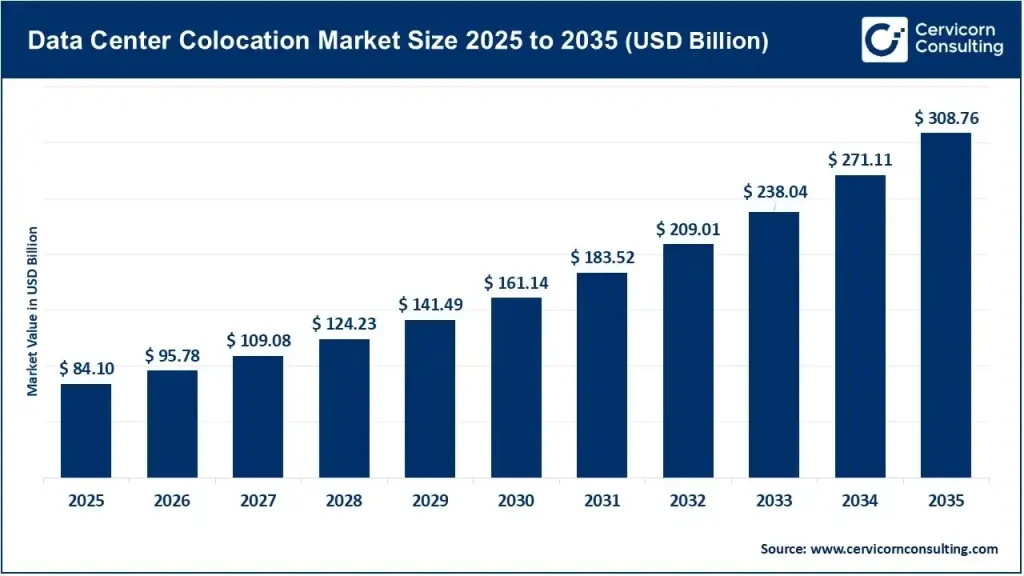
Data Center Colocation Market Size and Growth
The global data center colocation market was valued at USD 84.10 billion in 2025 and is projected to grow from USD 95.78 billion in 2026 to USD 308.76 billion by 2035, registering a compound annual growth rate (CAGR) of 13.90% from 2026 to 2035.
Market expansion is being driven by increasing cloud adoption, enterprise digitalization, artificial intelligence (AI), high-performance computing (HPC), and the growing need for scalable, secure, and reliable IT infrastructure.
As organizations generate larger volumes of data and deploy increasingly demanding digital applications, colocation is becoming an important alternative to building and operating dedicated data centers. It enables businesses to access power, cooling, connectivity, physical security, and infrastructure management without assuming the entire capital and operational burden of facility ownership.
However, the next phase of market growth presents a more complex decision-making environment. Companies must evaluate whether existing colocation facilities can support AI workloads, how much power capacity they will require, which locations offer long-term expansion opportunities, and whether infrastructure providers can deliver the necessary connectivity and operational reliability.
What Is Changing in the Data Center Colocation Market?
The colocation market is moving beyond conventional rack and server hosting toward more specialized infrastructure designed for increasingly diverse workloads.
Several developments are influencing investment and procurement decisions.
1. AI workloads are changing infrastructure requirements
Generative AI, machine learning, and HPC applications require greater computing power, higher rack densities, and advanced cooling infrastructure. Traditional colocation environments may not be suitable for every AI deployment.
Providers are increasingly developing AI-ready facilities with high-density power distribution, liquid cooling capabilities, and scalable infrastructure.
2. Hyperscale expansion is increasing demand for large-capacity facilities
Cloud service providers and hyperscalers require substantial space, power, and connectivity to support expanding digital platforms. This is increasing demand for facilities with above 20 MW capacity and infrastructure that can accommodate large-scale deployments.
3. Interconnection is becoming an important selection criterion
Businesses operating hybrid and multi-cloud environments need reliable connections to cloud platforms, telecommunications networks, internet exchanges, and other digital infrastructure providers.
Carrier-neutral facilities and interconnection services can provide greater network flexibility and reduce dependence on individual connectivity providers.
4. Energy efficiency is influencing facility investments
Electricity consumption, cooling requirements, and power availability are becoming important considerations in colocation economics.
Operators are increasingly evaluating renewable electricity procurement, energy-efficient cooling, and infrastructure optimization to manage operating expenses and meet sustainability objectives.
5. Edge colocation is supporting distributed computing
Applications involving IoT, 5G, content delivery, and real-time processing require infrastructure closer to end users and data sources.
This is creating opportunities for modular and edge colocation facilities that can support localized computing requirements.
Get a Free Sample: https://www.cervicornconsulting.com/sample/3081
Strategic Decisions Companies Should Prioritize
1. Build an In-House Data Center or Choose Colocation?
One of the first decisions organizations must make is whether to invest in dedicated data center infrastructure or outsource facility requirements to a colocation provider.
Building an in-house facility provides greater control over infrastructure design, security policies, equipment configuration, and long-term capacity planning. However, it also requires substantial capital investment in land, buildings, power infrastructure, cooling systems, physical security, and ongoing maintenance.
Colocation offers an alternative by allowing companies to lease rack space, private suites, cages, or larger capacity according to their requirements.
The decision should depend on:
- Capital availability: Organizations with limited infrastructure budgets may prefer colocation to avoid substantial upfront construction expenses.
- Workload predictability: Businesses with changing computing requirements can benefit from flexible capacity arrangements.
- Operational capabilities: Companies without dedicated data center engineering teams may benefit from professionally managed facility operations.
- Infrastructure control: Organizations with specialized equipment, security, or regulatory requirements should evaluate whether available colocation arrangements provide sufficient control.
- Expansion requirements: Businesses anticipating rapid growth should assess whether providers can deliver additional power and space without major deployment delays.
Business implication: Companies should compare the total cost of ownership of dedicated infrastructure against the complete colocation contract cost, including power charges, connectivity, cross-connects, remote hands, security, and future expansion expenses.
2. Select the Right Colocation Model for Future Workloads
The choice between retail, wholesale, and hybrid or hyperscale colocation directly affects infrastructure flexibility and investment requirements.
Retail colocation accounted for 73% of global market revenue in 2025, reflecting demand from businesses seeking shared infrastructure, flexible space, and dependable connectivity.
Wholesale colocation is more suitable for organizations requiring larger dedicated capacity, while hybrid and hyperscale models are gaining importance as AI and cloud workloads expand.
Companies should consider:
- Retail colocation: Suitable for enterprises requiring smaller deployments, flexible rack space, and access to shared infrastructure.
- Wholesale colocation: Relevant for businesses requiring larger dedicated spaces, greater power allocations, and more control over infrastructure deployment.
- Hybrid colocation: Useful for organizations combining private infrastructure with cloud-based and shared resources.
- Hyperscale colocation: Relevant for large-scale computing requirements involving substantial power, storage, and processing capacity.
Business implication: Infrastructure procurement teams should avoid selecting colocation models solely on current rack requirements. They should evaluate expected workload growth, power density, equipment ownership, and expansion flexibility over the contract period.
3. Evaluate Power Capacity Before Committing to a Facility
Power availability is becoming one of the most important factors influencing colocation investments.
The market’s power capacity segment of 5–10 MW held the leading position in 2025, supported by enterprise and cloud computing requirements. However, facilities with above 20 MW capacity are expected to grow rapidly through 2035 as hyperscale infrastructure and AI workloads expand.
This shift creates different requirements for traditional enterprise customers and AI infrastructure operators.
Organizations should assess:
- Current and future IT load requirements.
- Available power capacity and committed power allocation.
- Redundancy configurations and backup power systems.
- Electricity pricing and contractual escalation provisions.
- Availability of additional capacity within the same facility or campus.
- Time required to secure additional grid power and commission new infrastructure.
For AI and HPC deployments, power density per rack deserves particular attention. A facility with sufficient total power may still be unsuitable if its rack-level power distribution and cooling systems cannot support the required computing configuration.
Business implication: Companies should evaluate both present power availability and the provider’s ability to deliver additional capacity. Power commitments, expansion timelines, and electricity pricing should be assessed before signing long-term agreements.
4. Prioritize Cooling Infrastructure for AI and HPC Deployments
Increasing computing density is changing cooling requirements across colocation facilities.
Traditional air-cooling infrastructure can support many conventional enterprise applications, but high-performance computing and GPU-intensive AI workloads can require more advanced thermal management.
Liquid cooling is gaining attention as operators prepare facilities for higher rack densities and greater heat generation.
Before selecting a provider, companies should evaluate:
- Whether the facility supports air cooling, liquid cooling, or hybrid configurations.
- Maximum supported rack density.
- Cooling capacity and redundancy.
- Compatibility with GPU servers and high-performance computing equipment.
- Infrastructure upgrade requirements.
- Cooling efficiency and associated operating costs.
Business implication: Organizations planning AI infrastructure deployments should evaluate cooling compatibility during the facility selection process rather than treating it as a future upgrade. Retrofitting an existing facility can introduce additional costs and operational complexity.
5. Choose Locations Based on Connectivity, Power, and Expansion Potential
Geographic selection has become a strategic infrastructure decision rather than simply a real estate consideration.
North America accounted for 41% of global data center colocation market revenue in 2025, supported by established digital infrastructure, cloud adoption, hyperscaler activity, and significant data center investments.
Meanwhile, Asia Pacific is expected to experience rapid growth through 2035, driven by digitalization, AI investments, cloud adoption, and infrastructure expansion.
The regional market was valued at:
- North America: USD 34.48 billion in 2025, projected to reach USD 126.59 billion by 2035.
- Asia Pacific: USD 19.34 billion in 2025, projected to reach USD 71.01 billion by 2035.
For companies evaluating new colocation locations, the following factors deserve consideration:
- Proximity to enterprise customers and end users.
- Access to telecommunications networks and cloud connectivity.
- Availability of reliable electricity and expansion capacity.
- Land availability and infrastructure development costs.
- Regulatory and data protection requirements.
- Availability of renewable energy.
- Disaster recovery and geographic redundancy requirements.
Business implication: Companies expanding across multiple regions should evaluate colocation locations as part of their broader infrastructure strategy. A lower-cost facility may not deliver the best long-term value if connectivity, power availability, or expansion opportunities are limited.
6. Assess Carrier-Neutral Connectivity and Interconnection Capabilities
As businesses adopt hybrid cloud and multi-cloud architectures, connectivity is becoming an important differentiator among colocation providers.
Carrier-neutral facilities allow customers to select from multiple network providers rather than depending on a single telecommunications operator.
Interconnection capabilities also support direct connections between enterprises, cloud platforms, service providers, and other infrastructure participants.
Companies should evaluate:
- Availability of multiple telecommunications carriers.
- Direct cloud connectivity options.
- Access to internet exchanges.
- Cross-connect availability and associated costs.
- Network redundancy and route diversity.
- Latency requirements for business-critical applications.
- Network scalability as workloads expand.
Business implication: Organizations should evaluate connectivity ecosystems alongside space and power availability. A facility with strong interconnection capabilities can provide greater flexibility for hybrid cloud deployments and geographically distributed IT operations.
7. Evaluate Managed Colocation and Operational Support Requirements
Traditional colocation accounted for 67% of market revenue in 2025, reflecting continued demand for physical infrastructure, power, cooling, and connectivity.
However, managed colocation is expected to grow rapidly as businesses seek technical assistance, infrastructure monitoring, and managed IT operations.
This creates an important decision for enterprises: whether to retain responsibility for infrastructure management or outsource selected operational activities.
Managed colocation may be relevant for companies that require:
- Infrastructure monitoring and management.
- Remote hands and technical support.
- Equipment installation and maintenance.
- Backup and disaster recovery services.
- Security and operational monitoring.
- Support for distributed IT environments.
Organizations should compare service-level agreements, incident response processes, maintenance responsibilities, and escalation procedures before selecting a managed colocation provider.
Business implication: Companies should distinguish between facility-level services and IT-level managed services. A provider offering power, cooling, and physical security may not necessarily deliver the technical support required to manage complex IT environments.
8. Strengthen Security, Compliance, and Business Continuity
Colocation facilities host infrastructure belonging to multiple customers, making security and operational resilience essential considerations.
Organizations must evaluate both physical and digital security capabilities, particularly when hosting sensitive financial, healthcare, government, or enterprise information.
Important assessment areas include:
- Physical access controls and surveillance.
- Equipment-level security arrangements.
- Network protection and monitoring.
- Data protection and regulatory compliance requirements.
- Power and cooling redundancy.
- Backup and disaster recovery capabilities.
- Incident management and business continuity procedures.
Business implication: Security and compliance requirements should be incorporated into the initial vendor evaluation process. Companies should verify which responsibilities remain with the customer and which are covered by the colocation provider.
Regional Opportunities: Where Should Companies Expand?
North America: Established Infrastructure and Hyperscale Demand
North America remains the largest regional market, accounting for 41% of global revenue in 2025.
The region benefits from established data center infrastructure, strong cloud adoption, major technology companies, and a mature colocation ecosystem.
For colocation providers, opportunities are associated with hyperscale expansion, AI-ready infrastructure, interconnection services, and high-capacity facilities.
For enterprise customers, the region offers access to established connectivity ecosystems and infrastructure providers. However, power availability, electricity costs, and land constraints should remain important considerations when evaluating new locations.
Asia Pacific: Expanding Digital Infrastructure and AI Investments
Asia Pacific is emerging as an important growth market due to expanding digital economies, cloud adoption, increasing data consumption, and AI infrastructure investments.
China, Japan, Singapore, Australia, and India are among the markets contributing to regional infrastructure development.
Recent developments highlighted in the market include:
- In April 2026, Equinix launched its fourth International Business Exchange data center in Mumbai, featuring liquid-cooling capabilities to support AI, cloud, and HPC workloads.
- In February 2026, STT GDC India announced the launch of its fourth data center in Chennai as part of its multi-campus expansion.
- In April 2026, Digital Realty announced plans for nearly S$7 billion in total investment in Singapore, including new data center developments and infrastructure.
For companies evaluating Asia Pacific expansion, market selection should account for local power infrastructure, connectivity, regulatory requirements, customer proximity, and the availability of future capacity.
Competitive Landscape: What Should Companies Evaluate When Selecting a Provider?
The data center colocation market includes global infrastructure operators and specialized regional providers competing through facility availability, connectivity, operational reliability, power capacity, and managed services.
Key companies operating in the market include:
- Equinix Inc.: A major colocation and interconnection provider serving enterprises, cloud platforms, and network operators.
- Digital Realty Trust Inc.: Focuses on data center infrastructure, colocation, connectivity, and hyperscale requirements.
- NTT Global Data Centers: Provides global data center infrastructure and colocation services for enterprise and hyperscale customers.
- CyrusOne Inc.: Focuses on enterprise and hyperscale data center infrastructure.
- QTS Realty Trust: Provides data center infrastructure and colocation solutions for enterprise and large-scale customers.
- Vantage Data Centers: Specializes in hyperscale data center campuses and large-capacity infrastructure.
- KDDI Corporation (Telehouse): Offers carrier-neutral data center and connectivity services.
- China Telecom Corporation Limited: Provides data center and telecommunications infrastructure services.
- Iron Mountain Data Centers: Offers colocation infrastructure with an emphasis on secure and scalable facilities.
- CoreSite Realty Corporation: Focuses on interconnected data center facilities and enterprise connectivity.
- Global Switch Limited: Operates large-scale data center facilities across major international markets.
- Cologix Inc.: Provides colocation and interconnection services.
- Flexential Corp.: Offers colocation, connectivity, and managed infrastructure services.
- STACK Infrastructure: Focuses on large-scale data center infrastructure and hyperscale capacity.
- EdgeConneX Inc.: Develops data center infrastructure supporting hyperscale and edge computing requirements.
- Aligned Data Centers: Focuses on scalable data center infrastructure and energy-efficient facility design.
- Switch Inc.: Provides data center infrastructure and colocation solutions.
- GDS Holdings Limited: Focuses on data center infrastructure in the Asia Pacific market.
- Rackspace Technology Inc.: Provides managed cloud and IT infrastructure services.
For procurement teams and infrastructure investors, competitive evaluation should extend beyond facility size and geographic presence.
Important comparison parameters include power availability, expansion timelines, cooling capabilities, connectivity options, service-level commitments, energy procurement, pricing structures, and the provider’s ability to accommodate specialized workloads.
Government Initiatives and Infrastructure Development
Government policies are increasingly influencing data center investments through power availability, land development, regulatory facilitation, and sustainability requirements.
Several initiatives highlighted in the market reflect these priorities.
- India, September 2026: A government CEO roundtable focused on improving the ease of doing business in the data center sector, with discussions around reliable power, ready-to-use land, and streamlined approvals.
- India, August 2026: Government measures highlighted sustainable data center development through energy-efficient and clean-energy approaches, particularly in response to AI and HPC infrastructure requirements.
- India, March 2026: Government discussions highlighted the need for adequate electricity and water resources, alongside advanced cooling technologies, to support expanding data center infrastructure.
- Singapore, December 2025: The Economic Development Board (EDB) and Infocomm Media Development Authority (IMDA) launched the second Data Centre Call for Application to encourage sustainable data center development and green energy pathways.
These developments indicate that infrastructure investment decisions will increasingly depend on the availability of power, land, water, regulatory approvals, and sustainable energy solutions.
Key Risks That Could Affect Colocation Investment Decisions
Despite favorable market growth, companies entering or expanding in the colocation ecosystem must account for several operational and financial risks.
Power constraints: Limited grid availability can delay facility development, restrict capacity expansion, and increase electricity costs.
High infrastructure investment: Building or upgrading facilities to support AI workloads, advanced cooling, and higher power density requires significant capital expenditure.
Land availability: Competition for strategically located sites near power and connectivity infrastructure can increase development costs.
Technology compatibility: Existing facilities may not support future GPU-intensive workloads without substantial modifications to power distribution and cooling systems.
Operational complexity: Maintaining uptime, security, cooling efficiency, and redundancy across multiple customer environments requires specialized capabilities.
Capacity planning risks: Overestimating demand can result in underutilized infrastructure, while insufficient capacity can restrict customer acquisition and revenue growth.
For operators, these risks make phased development, accurate demand forecasting, infrastructure flexibility, and disciplined capital allocation increasingly important.
What Should Data Center Companies Prioritize Through 2035?
The next phase of colocation market development will require companies to align infrastructure investments with changing customer requirements.
The following priorities can help guide strategic planning:
| Strategic Priority | Business Focus |
|---|---|
| AI-ready infrastructure | Invest in high-density power distribution and advanced cooling capabilities. |
| Hyperscale capacity | Evaluate large-capacity campuses and phased infrastructure expansion. |
| Power availability | Secure reliable electricity and assess long-term power procurement strategies. |
| Connectivity | Strengthen carrier-neutral ecosystems and direct cloud interconnection. |
| Managed services | Expand infrastructure monitoring, technical support, and managed operations. |
| Energy efficiency | Integrate renewable energy and efficient cooling technologies. |
| Regional expansion | Prioritize markets with strong digital demand and infrastructure readiness. |
| Security and resilience | Strengthen physical security, redundancy, and disaster recovery capabilities. |
For enterprises, the emphasis should be on selecting providers that can accommodate changing workloads without creating unnecessary infrastructure costs or operational dependencies.
For colocation operators, the priority is to develop facilities that balance power availability, cooling efficiency, connectivity, and expansion flexibility while maintaining attractive utilization and operating economics.
Conclusion
The data center colocation market is entering a period of infrastructure transformation as cloud adoption, AI workloads, hyperscale computing, and enterprise digitalization increase demand for reliable and scalable facilities.
With the global market projected to reach USD 308.76 billion by 2035, companies have significant opportunities to expand their infrastructure capabilities and strengthen their competitive positioning.
However, market growth alone does not guarantee successful investment outcomes. Decisions involving facility development, power capacity, cooling technologies, geographic expansion, connectivity, and managed services will determine how effectively businesses respond to changing infrastructure requirements.
Organizations that align their colocation strategies with long-term workload demand, power availability, technology compatibility, and operational economics will be better positioned to manage infrastructure expansion and capture emerging opportunities.
To Get Detailed Overview, Contact Us: https://www.cervicornconsulting.com/contact-us