


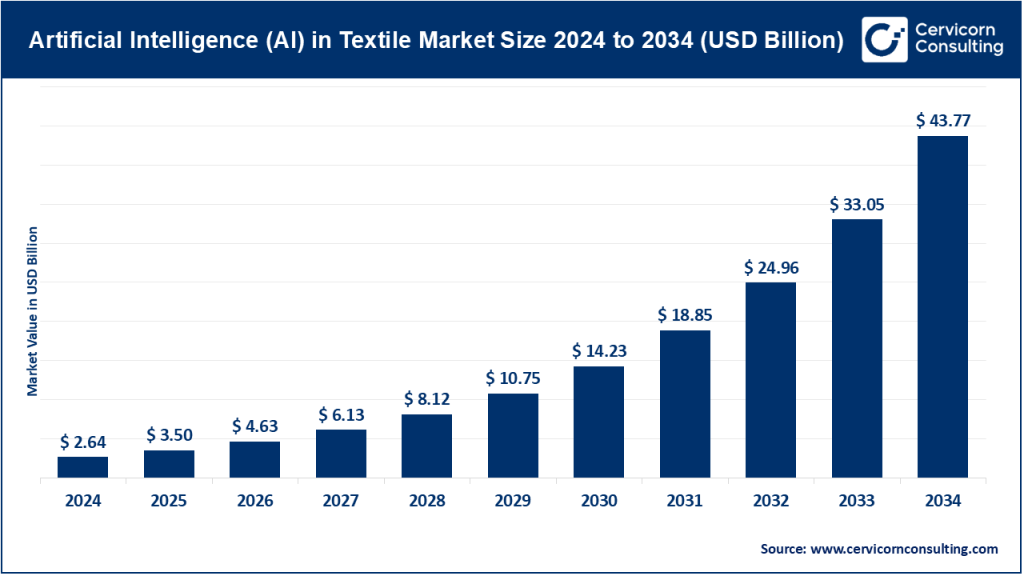
Artificial Intelligence (AI) in Textile Market Size
The global artificial intelligence (AI) in textile market size was worth USD 2.64 billion in 2024 and is anticipated to expand to around USD 43.77 billion by 2034, registering a compound annual growth rate (CAGR) of 32.42% from 2026 to 2035.
Artificial Intelligence (AI) in Textile Market – Growth Factors
The growth of artificial intelligence in the textile market is driven by increasing automation needs in labor-intensive manufacturing processes, rising demand for customized and personalized textile products, growing adoption of smart and wearable textiles, and mounting pressure to improve sustainability and reduce environmental impact. AI-enabled quality inspection systems minimize fabric defects and production losses, while predictive analytics enhance demand forecasting and inventory optimization. The expansion of e-commerce and fast fashion has accelerated the need for intelligent supply chain management, while advances in cloud computing and affordable AI platforms have lowered adoption barriers for small and mid-sized textile enterprises. Additionally, government initiatives promoting digital manufacturing, smart factories, and AI research are accelerating market growth across major textile-producing regions.
What Is Artificial Intelligence (AI) in the Textile Market?
Artificial intelligence in the textile market refers to the application of advanced computational technologies that enable machines and systems to mimic human intelligence across textile-related operations. These AI systems analyze large volumes of data from production equipment, sensors, supply chains, and consumer behavior to automate tasks, detect patterns, predict outcomes, and optimize processes.
In textile manufacturing, AI is used for fabric inspection, yarn quality analysis, automated cutting and sewing, and predictive maintenance of machinery. In fashion and apparel, AI supports trend forecasting, design generation, demand planning, and customer personalization. AI also plays a key role in supply chain optimization by improving logistics planning, reducing lead times, and minimizing inventory waste. Overall, AI acts as an intelligence layer that enhances productivity, accuracy, speed, and adaptability across the textile value chain.
Get a Free Sample: https://www.cervicornconsulting.com/sample/2729
Why Is Artificial Intelligence in the Textile Market Important?
AI is critically important to the textile industry because it addresses some of the sector’s most persistent challenges—high operational costs, inconsistent quality, supply chain inefficiencies, and environmental impact. Manual inspection and decision-making are prone to error and variability, while AI systems deliver consistent, real-time insights with high precision.
From a manufacturing perspective, AI improves operational efficiency by reducing machine downtime, optimizing workflows, and enabling predictive maintenance. In quality control, AI-powered vision systems can identify defects invisible to the human eye, ensuring higher product standards. For brands and retailers, AI enables accurate demand forecasting, reducing overproduction and unsold inventory. AI-driven personalization enhances customer satisfaction and brand loyalty, while sustainability benefits arise from reduced waste, energy consumption, and water usage. Collectively, these advantages make AI a strategic enabler of competitiveness and long-term growth in the textile market.
Key Companies Driving AI Adoption in the Textile Market
Microsoft Corporation
Specialization:
Enterprise AI platforms, cloud computing, data analytics, digital transformation
Key Focus Areas:
Microsoft supports textile companies through cloud-based AI services that enable demand forecasting, production optimization, inventory analytics, and supply chain intelligence. Its AI platforms integrate seamlessly with enterprise systems to support smart manufacturing initiatives.
Notable Features:
-
Advanced machine learning tools
-
Cloud scalability for global textile operations
-
Integration with ERP and analytics platforms
2024 Revenue:
Approximately USD 245+ billion
Market Share (AI in Textile – Estimated):
12–14%
Global Presence:
Strong operations across North America, Europe, Asia Pacific, Latin America, and the Middle East
IBM Corporation
Specialization:
Enterprise AI software, hybrid cloud, advanced analytics
Key Focus Areas:
IBM provides AI-driven solutions for textile quality inspection, supply chain optimization, predictive maintenance, and sustainability analytics. Its platforms support large-scale industrial deployments.
Notable Features:
-
Advanced data analytics and AI modeling
-
Hybrid cloud architecture
-
Industry 4.0 integration capabilities
2024 Revenue:
Approximately USD 62–63 billion
Market Share (AI in Textile – Estimated):
7–9%
Global Presence:
North America, Europe, Asia Pacific, and emerging markets
Google LLC
Specialization:
Cloud AI, machine learning, data analytics
Key Focus Areas:
Google supports textile and fashion brands with AI solutions for demand prediction, visual search, customer personalization, and retail analytics. Its AI tools are widely used for trend analysis and e-commerce optimization.
Notable Features:
-
Advanced AI model development platforms
-
Visual recognition and recommendation engines
-
Scalable cloud infrastructure
2024 Revenue:
Approximately USD 350+ billion
Market Share (AI in Textile – Estimated):
10–12%
Global Presence:
Extensive global reach across all major regions
Amazon Web Services
Specialization:
Cloud computing, AI and machine learning services
Key Focus Areas:
AWS enables textile manufacturers to deploy AI-powered demand forecasting, inventory optimization, and real-time supply chain monitoring through scalable cloud infrastructure.
Notable Features:
-
Predictive analytics tools
-
Real-time data processing
-
High scalability and flexibility
2024 Revenue:
Approximately USD 107–108 billion
Market Share (AI in Textile – Estimated):
8–10%
Global Presence:
Worldwide data center network supporting textile companies globally
SAP SE
Specialization:
Enterprise resource planning (ERP), supply chain intelligence
Key Focus Areas:
SAP integrates AI into textile ERP systems to improve production scheduling, procurement planning, inventory management, and demand forecasting.
Notable Features:
-
AI-driven ERP platforms
-
End-to-end supply chain visibility
-
Cloud-based enterprise integration
2024 Revenue:
Approximately USD 32–35 billion
Market Share (AI in Textile – Estimated):
5–6%
Global Presence:
Strong presence in Europe, North America, Asia Pacific, and emerging markets
Leading Trends in Artificial Intelligence in the Textile Market and Their Impact
One of the most significant trends is the widespread adoption of computer vision systems for automated fabric inspection. These systems detect defects in real time, reducing material waste and improving overall product quality. Predictive maintenance powered by AI is minimizing machine downtime by identifying equipment failures before they occur, enhancing factory productivity.
Another key trend is AI-driven design and trend forecasting, where algorithms analyze global fashion data to generate insights and assist designers in creating market-relevant products faster. Robotics and intelligent automation are increasingly being deployed in cutting, stitching, and finishing processes, improving speed and precision.
Sustainability-focused AI solutions are gaining traction as textile companies seek to reduce water usage, chemical discharge, and energy consumption. AI-enabled supply chain optimization is also transforming inventory management, logistics planning, and demand forecasting, helping companies remain agile in volatile markets.
Successful Examples of Artificial Intelligence in the Textile Market Worldwide
Several global textile and apparel companies have successfully implemented AI to transform operations. Apparel manufacturers have adopted AI-powered laser finishing technologies to improve design accuracy while significantly reducing water and chemical usage. Sportswear brands have introduced AI-driven automated factories that enable faster production cycles and localized manufacturing.
Textile mills across Europe and Asia are using AI-based computer vision systems to inspect fabrics in real time, dramatically reducing defects and production losses. In the sustainability domain, AI-powered textile recycling systems are enabling efficient sorting of mixed fabrics, supporting circular economy initiatives and reducing landfill waste.
These real-world applications demonstrate how AI delivers measurable benefits in efficiency, quality, sustainability, and responsiveness across the global textile market.
Global Regional Analysis with Government Initiatives and Policies
Asia Pacific
Asia Pacific represents the largest share of the AI in textile market, driven by its dominant textile manufacturing base. Countries such as China, India, Bangladesh, and Vietnam are rapidly integrating AI into textile production. Government programs promoting smart manufacturing, industrial automation, and digital factories are accelerating adoption. National strategies focused on AI innovation and manufacturing modernization are positioning the region as a global leader.
North America
North America is a high-growth region supported by advanced AI infrastructure, strong R&D investments, and innovation-focused government initiatives. Public-private partnerships and funding programs encourage AI adoption across manufacturing sectors, including textiles. Smart textiles, automation, and sustainable manufacturing are key focus areas.
Europe
Europe’s AI in textile market is shaped by Industry 4.0 initiatives and strong regulatory emphasis on sustainability and ethical AI. Governments support AI research through funding programs and digital transformation strategies. Textile producers in Western and Central Europe are leveraging AI to enhance quality control, energy efficiency, and supply chain transparency.
Latin America
Latin America is an emerging market for AI in textiles, with growing adoption in countries such as Brazil and Mexico. Government-supported industrial modernization programs and increasing export demand are driving investments in AI-enabled manufacturing and digital supply chains.
Middle East & Africa
The Middle East and Africa region is gradually embracing AI in textiles as governments invest in digital infrastructure and smart manufacturing. Countries in the Gulf region are exploring AI for automation, fashion analytics, and customized textile production, while Africa is seeing early-stage adoption supported by industrial development initiatives.
To Get Detailed Overview, Contact Us: https://www.cervicornconsulting.com/contact-us
Read Report: Data Center Infrastructure Market Revenue, Global Presence, and Strategic Insights by 2035