


Stem Cell Therapy Market: 6 Decisions Companies Should Make to Improve Clinical Readiness, Manufacturing Scale, and Commercial Potential
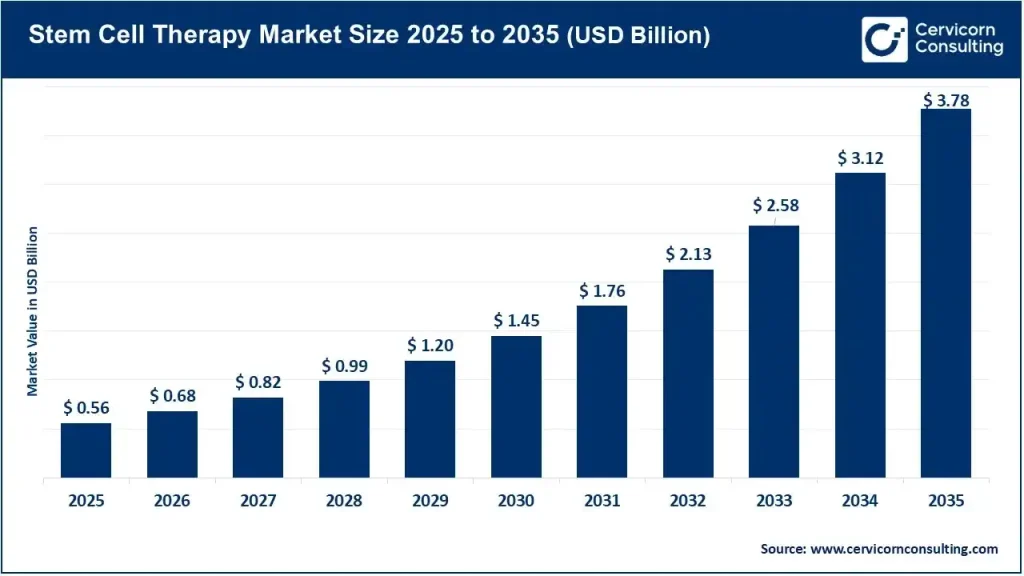
The global stem cell therapy market was valued at USD 0.56 billion in 2025 and is projected to reach USD 3.78 billion by 2035, growing at a CAGR of 21% from 2026 to 2035. Advances in regenerative medicine, cell-based treatments, and induced pluripotent stem cell (iPSC) research are creating new opportunities for biotechnology companies, pharmaceutical developers, and healthcare providers.
However, market growth alone does not guarantee commercial success. Companies must navigate clinical uncertainty, manufacturing complexity, regulatory requirements, and the challenge of delivering consistent treatment outcomes. Decisions made during early development can influence production costs, commercialization timelines, and long-term competitiveness.
Here are six strategic decisions that can help companies strengthen their position in the evolving stem cell therapy market.
1. Which Cell Type Offers the Strongest Development Opportunity?
Stem cell types differ in their therapeutic potential, manufacturing requirements, clinical maturity, and development risks. Selecting a cell platform should therefore depend on the intended application and the evidence supporting its use, rather than scientific novelty alone.
In 2025, adult stem cells accounted for 35% of stem cell therapy market revenue, followed by mesenchymal stem cells (MSCs) at 32%. Induced pluripotent stem cells (iPSCs) are also attracting attention for their potential in disease modelling, drug development, and regenerative treatments.
Companies should evaluate:
- Clinical evidence: Which cell types have demonstrated credible safety and efficacy for the intended indication?
- Manufacturing consistency: Can the selected cells maintain the required characteristics across production batches?
- Development complexity: What additional testing, differentiation, or quality-control steps will be necessary?
- Competitive differentiation: Does the platform offer a meaningful advantage over existing treatments or competing development programmes?
Decision implication: Prioritize cell types that align with the target indication, available clinical evidence, manufacturing capabilities, and realistic development milestones. A promising biological mechanism is not sufficient without a viable path to clinical validation.
Get a Free Sample: https://www.cervicornconsulting.com/sample/3064
2. Should Companies Prioritize Autologous or Allogeneic Therapies?
The choice between autologous and allogeneic stem cell therapy has direct implications for production planning, treatment delivery, cost structures, and scalability.
Autologous therapies use cells obtained from the patient, potentially reducing certain immune compatibility concerns. However, they require patient-specific processing, coordination, and quality controls. Allogeneic therapies use donor-derived cells and may enable standardized, larger-scale production, although immune compatibility, donor variability, and other product-specific risks remain important.
Autologous therapies represented 59% of market revenue in 2025, while allogeneic approaches offer opportunities for standardized, potentially off-the-shelf treatments.
Before committing to either model, companies should assess:
- Whether the treatment requires patient-specific cells or can use donor-derived products.
- The cost and turnaround time associated with collection, processing, testing, and delivery.
- The feasibility of scaling production without compromising product quality.
- The storage, cryopreservation, distribution, and inventory requirements.
- The clinical and regulatory evidence needed to support the selected approach.
Decision implication: Autologous production may be appropriate when patient-specific characteristics are central to the therapy, whereas allogeneic development may offer advantages where repeatable production and broader patient access are achievable. The choice should be supported by a total-cost and operational feasibility assessment.
3. How Should Companies Allocate Investment Across Therapeutic Applications?
Not every clinical application offers the same level of development readiness or commercial potential. Companies must balance unmet medical needs against the availability of clinical evidence, competition, regulatory complexity, and the resources required to establish a viable treatment pathway.
Cancer and hematological disorders accounted for 28% of stem cell therapy market revenue in 2025. Other areas attracting research attention include neurological disorders, cardiovascular diseases, musculoskeletal conditions, wound healing, and broader regenerative medicine applications.
A disciplined opportunity assessment should consider:
- Unmet medical need: How significant is the clinical problem, and what limitations affect existing treatments?
- Clinical maturity: How far have competing therapies progressed through clinical development?
- Patient identification: Can eligible patients be identified and referred to suitable treatment centres?
- Commercial feasibility: What evidence exists regarding treatment costs, reimbursement, and provider readiness?
- Competitive intensity: Are established therapies or well-funded developers likely to influence adoption?
Companies should also distinguish between applications supported by established clinical use and those that remain experimental. Research interest, early-stage findings, and commercial claims do not independently establish treatment effectiveness.
Decision implication: Direct investment toward indications where scientific rationale, clinical development feasibility, patient need, and potential adoption align. A smaller, evidence-supported opportunity may be more attractive than a larger theoretical market with substantial scientific uncertainty.
4. When Should Manufacturing Capacity Be Expanded?
Manufacturing is a critical consideration in stem cell therapy because product quality depends on controlled biological processes. Variations in starting materials, cell expansion, handling, storage, and transportation can affect the consistency of the final product.
Expanding capacity too early can increase fixed costs and create underutilized facilities. Expanding too late can constrain clinical supply, delay development programmes, and limit the ability to meet future demand.
Companies should evaluate the following before making major manufacturing investments:
- Process scalability: Can production volume increase while maintaining critical quality attributes?
- Quality assurance: Are testing, contamination controls, batch-release procedures, and traceability systems adequate?
- Facility strategy: Is internal manufacturing justified, or would a qualified contract development and manufacturing organization (CDMO) provide greater flexibility?
- Supply-chain resilience: Are critical raw materials, specialized equipment, and qualified suppliers sufficiently reliable?
- Cost structure: How will production costs change as batch volumes, automation, and facility utilization increase?
The International Society for Cell & Gene Therapy’s 2026 Global Regulatory Report highlights continued activity across the clinical pipeline, reinforcing the importance of development and manufacturing readiness. In parallel, the U.S. FDA issued guidance in May 2026 addressing chemistry, manufacturing, and controls flexibilities for certain cellular and gene therapy products seeking biologics licence applications.
Decision implication: Scale manufacturing against defined clinical and commercial milestones. Companies should establish clear capacity triggers based on trial requirements, process validation, expected demand, and regulatory readiness rather than relying exclusively on long-term market forecasts.
5. How Should Companies Prepare for Regulatory Requirements Across Markets?
Regulatory strategy influences development timelines, manufacturing investments, clinical trial design, and market-entry decisions. Requirements differ across countries, and a pathway that works in one jurisdiction may not translate directly to another.
In the United States, the FDA oversees regulated stem cell products under applicable federal requirements. In Europe, relevant products may fall under the advanced therapy medicinal product framework. In India, the Central Drugs Standard Control Organization (CDSCO) oversees applicable requirements for stem cell-derived products.
India also strengthened its regulatory framework in July 2026 by expanding the Centrally License Approving Authority framework to include cell- or stem cell-derived products and other advanced therapies.
Companies should make regulatory planning an early development priority by assessing:
- The product classification and applicable approval pathway in each target market.
- Clinical evidence and safety data required to support development and authorization.
- Manufacturing documentation, quality systems, and product characterization requirements.
- The feasibility of running multicountry clinical programmes.
- Post-approval obligations, pharmacovigilance, and product traceability requirements.
Decision implication: Build regulatory requirements into the development plan before committing to clinical milestones or geographic expansion. Early engagement with relevant authorities and experienced regulatory specialists can help identify evidence gaps and reduce avoidable rework.
6. What Will Make Commercialization Economically Sustainable?
Clinical progress does not automatically translate into widespread adoption. Stem cell therapies can involve specialized treatment facilities, highly trained personnel, complex logistics, substantial production costs, and demanding quality controls. These factors can influence the affordability of treatment and the commercial viability of the therapy.
Companies need to assess the complete delivery model, not just the potential selling price of the product.
Key questions include:
- What are the expected costs across development, manufacturing, testing, storage, and distribution?
- Which hospitals, specialty clinics, or treatment centres have the infrastructure to administer the therapy?
- What reimbursement pathways or funding mechanisms could support patient access?
- How will the company demonstrate value relative to existing treatment options?
- Which partnerships could improve patient identification, treatment delivery, or geographic reach?
Companies should also evaluate the operational implications of scaling patient access. A therapy may demonstrate clinical promise but still face adoption barriers if treatment centres lack appropriate infrastructure or if the total cost of care remains difficult to sustain.
Decision implication: Develop a commercialization model that connects clinical value with manufacturing economics, treatment-centre readiness, reimbursement feasibility, and patient access. These factors should influence investment decisions well before regulatory approval.
Conclusion: Growth Must Be Matched by Execution
The stem cell therapy market is entering a period of opportunity, supported by advances in regenerative medicine, cell engineering, and clinical development. Yet the ability to convert scientific progress into sustainable commercial outcomes will depend on more than the number of therapies entering the pipeline.
Companies must make six connected decisions: selecting the right cell platform, choosing an appropriate therapy model, prioritizing clinical applications, planning manufacturing capacity, preparing for regulatory requirements, and building a commercially viable delivery model.
These decisions are interdependent. A change in cell type can affect manufacturing complexity; manufacturing choices can influence costs and regulatory documentation; and the resulting cost structure can determine how widely a therapy can be adopted.
For biotechnology companies, pharmaceutical developers, investors, and healthcare providers, the priority is to identify opportunities where scientific feasibility, clinical evidence, operational readiness, and commercial potential reinforce one another. Disciplined investment decisions at each stage can help reduce execution risks and support more sustainable growth as the market develops.
To Get Detailed Overview, Contact Us: https://www.cervicornconsulting.com/contact-us
Read Report: Ethanol Market: 6 Business Decisions That Can Improve Profitability and Reduce Investment Risk