


AI in Protein Engineering Market: 6 Decisions Companies Should Make to Turn AI-Designed Proteins into Commercial Opportunities
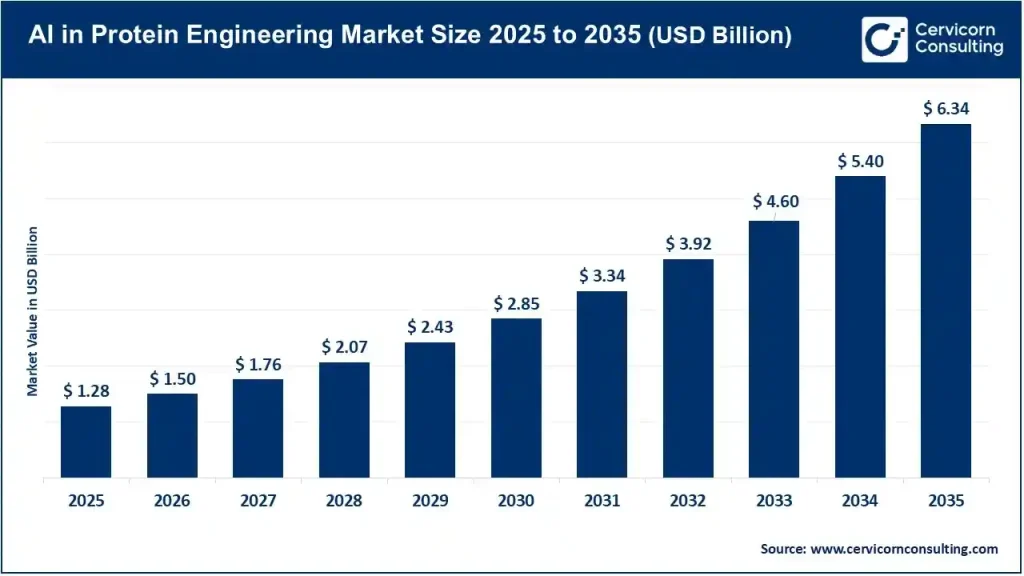
The global AI in protein engineering marketwas valued at USD 1.28 billion in 2025 and is projected to reach USD 6.34 billion by 2035, growing at a CAGR of 17.4% from 2026 to 2035. This growth reflects increasing investment in computational protein design, generative AI, protein language models, and AI-assisted optimization of enzymes, antibodies, and therapeutic proteins.
For biotechnology and pharmaceutical companies, however, the strategic question is not simply whether AI can design a protein. It is whether an AI-generated candidate can deliver the required biological function, remain stable under relevant conditions, be manufactured consistently, and meet the commercial requirements of its intended application.
AI is expanding the range of protein sequences researchers can explore, but computational predictions do not automatically translate into experimentally validated performance. Companies must therefore evaluate AI protein engineering as an integrated discovery, validation, and commercialization capability rather than an isolated software investment.
Six decisions can help organizations prioritize investments, reduce avoidable development risks, and identify where AI-generated proteins offer the strongest business potential.
1. Should the Company Build an Internal AI Platform or Partner with a Specialized Provider?
The first decision is how to access AI protein engineering capabilities without creating unnecessary technology costs or operational complexity.
Building an internal platform can offer greater control over proprietary datasets, model development, intellectual property, and integration with existing research workflows. However, it requires specialized talent across computational biology, machine learning, structural biology, data engineering, and experimental validation. Infrastructure and ongoing model maintenance can also increase the total cost of ownership.
Partnerships with AI-native biotechnology companies and protein design platform providers can offer faster access to established models and specialized expertise. This approach may be particularly attractive for companies testing AI-driven discovery before committing to a dedicated internal team.
The decision should depend on the strategic importance of protein design to the company’s long-term business model.
- Build internally when protein engineering is a core competitive capability, proprietary data provides a meaningful advantage, and the organization has sufficient scientific and computational resources.
- Partner with a specialist when the objective is to validate a specific target, improve an existing candidate, or explore a new protein class without developing an entire platform.
- Adopt a hybrid model when the company needs external design expertise but wants to retain control over experimental data, candidate selection, and commercially important intellectual property.
Before signing a platform agreement, companies should examine data ownership, model-training rights, restrictions on commercial use, intellectual property ownership, exportability of results, and the cost of switching providers.
Business implication: The lowest initial software cost may not produce the lowest overall development cost. Companies should compare total program economics, including model access, data preparation, laboratory validation, integration, and ongoing support.
Get a Free Sample: https://www.cervicornconsulting.com/sample/3068
2. Which Protein Categories Offer the Strongest Commercial Opportunity?
AI protein engineering can support several markets, but each presents different development timelines, technical requirements, customer expectations, and commercialization risks.
Enzymes can be relevant to industrial biotechnology, food processing, specialty chemicals, detergents, and bio-based manufacturing. Antibodies and therapeutic proteins can offer substantial pharmaceutical opportunities but generally require more extensive biological characterization, safety evaluation, and regulatory development. Peptides, vaccine antigens, and other engineered proteins present different technical and market requirements.
Companies should avoid selecting an application solely because AI tools perform well on a particular design benchmark. Commercial attractiveness also depends on the cost of current solutions, the value of improved performance, the availability of validation methods, and the ability to scale production.
Three questions can help narrow the opportunity:
- What performance improvement would customers pay for? Examples include greater enzyme activity, improved thermal stability, higher antibody binding affinity, reduced aggregation, or better performance at industrial operating conditions.
- How difficult is experimental validation? A design workflow that generates many candidates may offer limited commercial value if each candidate requires expensive, lengthy, or specialized testing.
- Can the improvement translate into measurable economics? Industrial customers may prioritize higher process yield or lower operating costs, while therapeutic developers may place greater emphasis on potency, developability, safety, and differentiation from competing treatments.
For example, an industrial enzyme manufacturer could prioritize proteins that maintain activity at higher temperatures or in challenging chemical environments. A biopharmaceutical company might instead focus on improving antibody stability, specificity, expression, or manufacturability.
The appropriate application is the one where improved protein properties create a defensible advantage over existing alternatives.
Business implication: Prioritize opportunities by combining technical feasibility, customer value, validation requirements, and commercialization potential—not by the number of candidate sequences an AI model can generate.
3. How Should Companies Select AI Technologies and Models?
The AI protein engineering landscape includes machine learning and deep learning, generative AI, protein language models, structure-prediction systems, and hybrid approaches combining computational predictions with physics-based methods.
These technologies address overlapping but distinct challenges. Structure prediction can help researchers investigate molecular conformations and interactions. Protein language models can identify sequence patterns and support candidate prioritization. Generative models can propose new sequences or structural designs, while specialized prediction systems can estimate properties such as stability, function, or binding.
The strategic challenge is selecting a model that addresses the specific scientific problem rather than adopting a technology because it is receiving attention across the industry.
Companies should evaluate candidate models against four criteria:
- Task-specific accuracy: Does the model predict the property that matters to the development program, rather than only producing favorable general benchmark results?
- Generalization: Does it perform reliably on the company’s target proteins, sequence families, and experimental conditions?
- Experimental hit rate: What proportion of generated or prioritized candidates meet predefined laboratory success criteria?
- Workflow compatibility: Can the model integrate with existing sequence databases, structural analysis tools, laboratory information systems, and screening workflows?
A model that generates novel proteins may be useful for exploring previously inaccessible design space. However, a more targeted optimization model could be the better choice when the company already has a functional protein and needs to improve one or two measurable properties.
Model evaluation should therefore use a defined baseline. Teams can compare AI-assisted design against conventional directed evolution, rational design, existing computational methods, or the company’s current candidate-selection process.
Business implication: Model selection should be based on demonstrated performance in the intended application, not model size, novelty, or headline benchmark scores.
4. How Can Companies Reduce the Gap Between AI Predictions and Laboratory Results?
The transition from computational design to experimental validation is one of the most important operational challenges in AI protein engineering.
A protein sequence may appear promising computationally but fail to express efficiently, fold correctly, maintain stability, or demonstrate the desired biological activity. Performance can also change with pH, temperature, solvent conditions, cellular environments, binding partners, and manufacturing processes.
Companies should establish a systematic design-build-test-learn (DBTL) workflow that connects computational predictions with experimental evidence.
A practical workflow includes:
- Define success criteria before generating candidates. Establish acceptable thresholds for activity, stability, binding, expression, specificity, or other relevant properties.
- Generate and prioritize candidates. Use AI models and complementary computational methods to identify a manageable set of promising sequences.
- Validate experimentally. Test expression, folding, functional activity, and other relevant properties using assays appropriate to the intended application.
- Feed results back into the design process. Use experimental outcomes to refine model predictions and guide subsequent design rounds.
- Confirm reproducibility. Verify that promising results hold across repeated experiments and relevant operating conditions.
Automation and high-throughput screening can increase the number of candidates tested, but additional screening capacity does not automatically improve decision quality. Poor assay design, inconsistent data, and insufficient experimental controls can undermine the entire workflow.
Companies should track metrics such as experimental hit rate, cost per validated candidate, time between design and testing, reproducibility, and the number of design cycles required to reach the target performance.
Business implication: The commercial value of AI protein engineering depends on the quality and speed of the complete experimental feedback loop, not just the speed of computational design.
5. What Should Companies Evaluate Before Scaling AI-Designed Proteins?
A candidate that performs well in a laboratory may still be unsuitable for commercial production. Scale-up can introduce challenges related to expression yield, purification, aggregation, stability, formulation, process consistency, and manufacturing economics.
These considerations differ across applications. Therapeutic proteins require extensive characterization and appropriate safety and regulatory assessment. Industrial enzymes must meet performance and cost requirements under actual process conditions. Proteins intended for food, agricultural, or other specialized uses must satisfy the applicable product-specific standards.
Companies should assess manufacturability and application-specific requirements early enough to prevent expensive redesigns later in development.
Key evaluation areas include:
- Expression and yield: Can the protein be produced at a commercially practical yield in the selected expression system?
- Stability and formulation: Does the protein retain its properties during storage, transport, and use?
- Purification and process compatibility: Can the protein be recovered consistently without excessive processing costs?
- Quality and reproducibility: Can production deliver consistent performance across batches?
- Regulatory and safety requirements: What evidence is needed for the intended use, and which development milestones must be completed before commercialization?
- Cost of goods: Does the expected production cost support the target price and business model?
AI models can help prioritize sequences with potentially favorable developability characteristics, but these predictions must be confirmed experimentally.
For example, an antibody candidate with strong target binding may still be unattractive if it aggregates readily or requires an expensive manufacturing process. Similarly, an enzyme with excellent activity under ideal laboratory conditions may not deliver value if it loses performance at the customer’s operating temperature or pH.
Business implication: Protein performance, manufacturability, and cost should be assessed together. The strongest candidate is not necessarily the one with the highest laboratory activity, but the one that satisfies the full set of technical and commercial requirements.
6. How Should Companies Measure ROI and Build a Defensible Competitive Position?
Investment decisions should distinguish between the ability to generate promising designs and the ability to create commercially valuable products.
AI protein engineering may improve candidate prioritization, reduce unnecessary experiments, accelerate optimization, or expand the range of proteins that can be explored. However, these benefits depend on the application, the quality of available data, the validation process, and the maturity of the organization’s existing capabilities.
Companies should establish a baseline before investing in a new platform or expanding an existing program.
Useful performance indicators include:
- R&D efficiency: Cost and time required to identify a validated candidate compared with the current workflow.
- Candidate quality: Percentage of experimentally tested candidates that meet predefined performance thresholds.
- Development productivity: Number of candidates reaching relevant development milestones within a defined budget and period.
- Manufacturing economics: Improvements in yield, stability, production cost, or process performance.
- Commercial progress: Licensing opportunities, partnership milestones, product-development progress, or revenue potential attributable to the program.
The measurement framework should account for the full cost of implementation, including licensing, computing, scientific personnel, data infrastructure, laboratory experiments, automation, and downstream development.
Companies should also consider how they will protect their competitive position. Potential sources of differentiation include proprietary experimental datasets, specialized models, optimized laboratory workflows, validated protein candidates, manufacturing expertise, and application-specific know-how.
Access to a general-purpose AI model alone may provide limited long-term differentiation if competitors can use similar tools. Proprietary experimental feedback and the ability to repeatedly translate predictions into validated, manufacturable products can be more difficult to replicate.
A staged investment approach can help manage uncertainty. Organizations can begin with a narrowly defined protein-engineering challenge, establish technical and economic milestones, and expand only when the evidence supports a larger commitment.
Business implication: AI investment should be judged by measurable improvements in validated candidate development and commercial outcomes—not by model usage, sequence-generation volume, or the number of experiments initiated.
What Do These Decisions Mean for the AI in Protein Engineering Market?
The expansion of the AI in protein engineering market reflects growing interest in applying computational intelligence to protein discovery, optimization, and development. The market is projected to grow from USD 1.28 billion in 2025 to USD 6.34 billion by 2035, at a CAGR of 17.4%.
For biotechnology companies, pharmaceutical developers, platform providers, and industrial enzyme manufacturers, this creates opportunities to improve research productivity and develop proteins with more targeted properties. It also raises important questions about platform selection, data ownership, validation capacity, and the economics of commercialization.
Three priorities stand out:
- For pharmaceutical and biotechnology companies: Integrate AI into defined discovery and optimization programs, with clear criteria for candidate advancement and experimental validation.
- For AI platform providers and research service organizations: Differentiate through reliable experimental outcomes, workflow integration, specialized applications, and measurable customer value.
- For industrial biotechnology companies: Focus on protein improvements that translate into better process performance, lower production costs, or reduced resource consumption.
The next stage of market development will depend not only on advances in protein-generation models but also on the ability to connect computational design with reliable experiments, scalable manufacturing, and commercially relevant outcomes.
Companies that align their technology investments with specific biological problems and measurable business objectives will be better positioned to evaluate where AI protein engineering can create a sustainable advantage.
Frequently Asked Questions
What is the AI in protein engineering market size?
The global AI in protein engineering market was valued at USD 1.28 billion in 2025 and is projected to reach USD 6.34 billion by 2035, growing at a CAGR of 17.4% from 2026 to 2035, according to Cervicorn Consulting.
Which industries can benefit from AI protein engineering?
Pharmaceuticals, biotechnology, industrial biotechnology, specialty chemicals, food processing, and other sectors that rely on engineered proteins can benefit from AI-assisted protein design and optimization. The value depends on the protein’s intended function and the ability to validate and manufacture it economically.
What are the main challenges in AI protein engineering?
Key challenges include limited high-quality experimental data, model generalization, uncertainty in predicted protein properties, laboratory validation costs, manufacturability, and the translation of computational results into reproducible commercial performance.
How should companies evaluate AI protein engineering platforms?
Companies should assess task-specific accuracy, experimental hit rates, data ownership, integration requirements, total cost of ownership, intellectual property terms, laboratory compatibility, and the ability to improve measurable R&D or manufacturing outcomes.
Can AI replace traditional protein engineering methods?
AI can complement and improve conventional approaches, including rational design and directed evolution, but it does not eliminate the need for experimental testing. Combining computational design with laboratory evidence is often essential to establishing protein function, stability, safety, and manufacturability.
To Get Detailed Overview, Contact Us: https://www.cervicornconsulting.com/contact-us
Read Report: Precision Farming Market Outlook: Technology Adoption, Investment Priorities, and Emerging Growth Opportunities