


Precision Farming Market: 6 Strategic Decisions Companies Should Make to Improve Agricultural Productivity and Resource Efficiency
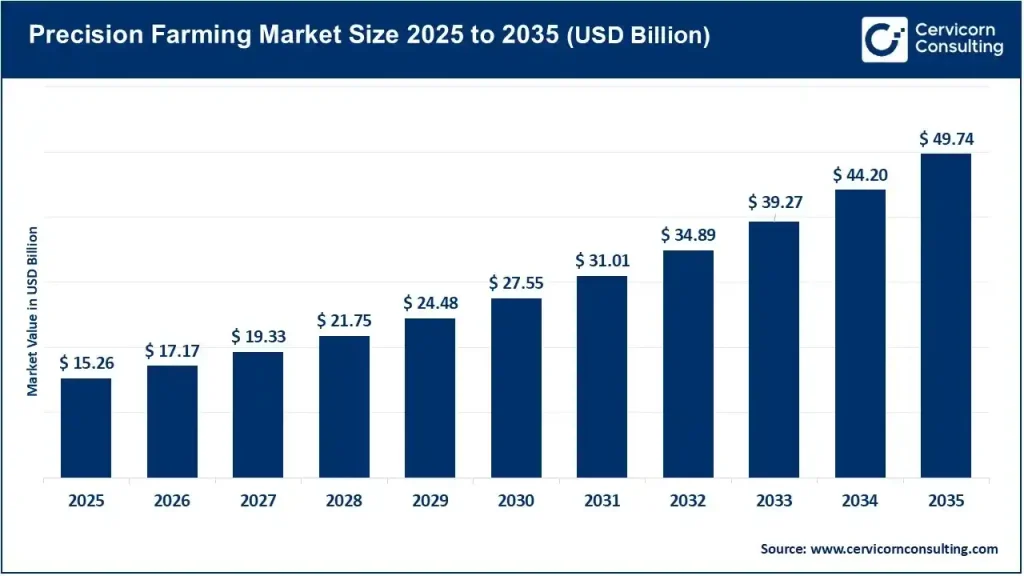
The global precision farming market was valued at USD 15.26 billion in 2025 and is projected to reach USD 49.74 billion by 2035, expanding at a CAGR of 12.5% from 2026 to 2035. The market is gaining momentum as agricultural businesses adopt GPS guidance, remote sensing, drones, connected sensors, artificial intelligence (AI), and variable-rate application technologies to improve farm productivity and resource utilization.
However, market growth alone does not guarantee commercial success. Technology providers, agricultural equipment manufacturers, agri-tech startups, and farm management solution companies must determine which technologies offer the strongest commercial opportunities, which customer segments are ready to invest, and how solutions can demonstrate measurable economic benefits.
For companies competing in this evolving market, the key question is not simply which precision farming technologies to develop, but where to invest, how to differentiate, and how to build commercially viable solutions.
1. Which Precision Farming Technologies Should Companies Prioritize?
Precision farming encompasses several technologies, including guidance systems, remote sensing, variable-rate application, yield monitoring, soil mapping, and weather forecasting. Each addresses different agricultural requirements and presents distinct opportunities for technology providers.
In 2025, guidance technology accounted for approximately 25% of global market revenue, while hardware represented 67% of the market. These figures indicate the importance of established navigation systems and physical equipment, even as software and analytics become increasingly important to farm management decisions.
Companies should evaluate technologies based on customer demand, implementation costs, scalability, and the ability to demonstrate measurable improvements.
Key decisions:
- Prioritize proven applications: GPS guidance, yield monitoring, and precision irrigation may offer practical entry points where customers already recognize the operational benefits.
- Assess emerging opportunities: AI-based crop monitoring, autonomous machinery, and predictive analytics may create opportunities for differentiation.
- Evaluate software potential: Farm management platforms that combine equipment, weather, soil, and crop data can support recurring revenue beyond hardware sales.
- Avoid fragmented development: Ensure new products integrate with existing machinery, sensors, and agricultural software.
The objective is to select technologies based on their commercial potential and customer adoption readiness rather than pursuing every emerging innovation.
Get a Free Sample: https://www.cervicornconsulting.com/sample/3065
2. Which Customer Segments Offer the Strongest Growth Opportunities?
The economics of precision farming vary significantly according to farm size, crop type, geography, and access to agricultural infrastructure. Large commercial farms may justify substantial investment in automated machinery and advanced analytics, while smaller farms may require affordable, modular, or service-based solutions.
Companies must therefore determine which customer segments offer the best balance between market size, purchasing power, adoption potential, and customer acquisition costs.
Key decisions:
- Target large farms: Evaluate demand for integrated equipment, automated field operations, high-resolution monitoring, and enterprise farm management systems.
- Develop solutions for smaller farms: Consider subscription-based software, shared drone services, equipment leasing, and pay-per-acre models.
- Segment by agricultural application: Identify crops and farming systems where accurate irrigation, input management, or disease detection can address significant operating challenges.
- Adapt to local conditions: Account for farm fragmentation, connectivity, equipment availability, and farmer training requirements when entering emerging markets.
For companies expanding internationally, a solution designed for large mechanized farms may not translate directly into markets dominated by smallholders. Localization and distribution partnerships can be as important as the underlying technology.
3. How Can Companies Demonstrate a Measurable Return on Investment?
High initial costs remain a barrier to precision farming adoption, particularly for customers with limited capital and uncertain returns. Technology providers must demonstrate how their solutions affect operating costs, resource consumption, crop performance, and farm profitability.
The business case should extend beyond equipment specifications or the volume of data collected. Customers need evidence that a technology can improve decisions and generate benefits under real operating conditions.
Key decisions:
- Quantify input savings: Measure changes in fertilizer, pesticide, fuel, water, and labor requirements.
- Evaluate yield performance: Compare crop productivity across treated and untreated fields while accounting for weather, soil, and crop differences.
- Calculate total ownership costs: Include installation, maintenance, software subscriptions, connectivity, training, and equipment upgrades.
- Validate results through pilots: Conduct field trials across different crops, soil conditions, and farm sizes before scaling commercial deployment.
Companies should develop ROI models for specific customer segments rather than relying on a single headline estimate. Clear evidence of payback periods and operating improvements can strengthen sales discussions and reduce adoption uncertainty.
4. How Should Companies Integrate AI, Sensors, Drones, and Farm Management Software?
Precision farming increasingly depends on combining data from multiple sources. Satellite imagery, drones, soil sensors, weather forecasts, machinery, and historical crop records can provide complementary information, but disconnected systems may limit their practical value.
The commercial opportunity lies in converting these inputs into actionable recommendations that help farmers decide when to irrigate, apply nutrients, detect crop stress, or adjust field operations.
Key decisions:
- Build interoperable platforms: Ensure solutions can exchange data with existing machinery, sensors, and farm management systems.
- Prioritize actionable insights: Focus on recommendations that support specific farming decisions instead of overwhelming users with dashboards.
- Design for connectivity constraints: Consider offline functionality, low-bandwidth data transfer, and mobile-first interfaces.
- Establish data governance: Define data ownership, access permissions, cybersecurity requirements, and rules for sharing information with third parties.
Companies should also distinguish between collecting agricultural data and delivering reliable decision support. A technically advanced platform may struggle commercially if recommendations are difficult to interpret, poorly localized, or disconnected from everyday farm operations.
5. Which Geographic Markets Should Companies Target First?
Regional expansion requires more than identifying markets with large agricultural sectors. Adoption depends on farm economics, digital infrastructure, government initiatives, machinery availability, local partnerships, and the willingness of farmers to invest in new technology.
North America accounted for approximately 41% of global precision farming market revenue in 2025, supported by large-scale agricultural operations and established technology adoption. Asia-Pacific offers a different opportunity, with agricultural modernization and localized digital farming solutions supporting market development.
India is particularly relevant for companies evaluating emerging-market strategies. The government’s Digital Agriculture Mission has an approved outlay of ₹2,817 crore, supporting the development of digital agricultural infrastructure and data-driven services. <Cite refs={[“turn533449search6”]}/>
Key decisions:
- Strengthen established markets: Assess opportunities to expand product capabilities, integrate with agricultural machinery, and serve existing precision farming users.
- Localize emerging-market offerings: Develop solutions suited to smaller landholdings, local crops, regional languages, and varying levels of digital connectivity.
- Evaluate policy alignment: Monitor agricultural digitization programs, drone initiatives, and technology-support schemes that may influence adoption.
- Select distribution partners carefully: Work with agricultural equipment dealers, cooperatives, agronomists, service providers, and local technology partners where appropriate.
A phased market-entry strategy can help companies test demand, establish distribution, and refine pricing before committing significant resources to a new geography.
6. How Can Companies Build a Sustainable Competitive Advantage?
As precision farming technologies become more widely available, competition may shift from individual hardware features toward integrated solutions, service quality, data interpretation, and measurable customer outcomes.
Companies that compete only on equipment pricing may face margin pressure, while providers offering reliable support and clear operational benefits can create stronger customer relationships.
Key decisions:
- Differentiate through outcomes: Demonstrate improvements in resource efficiency, operational consistency, and farm management decisions.
- Develop recurring revenue streams: Evaluate software subscriptions, analytics services, equipment maintenance, and precision agriculture-as-a-service models.
- Strengthen ecosystem partnerships: Collaborate with machinery manufacturers, sensor providers, agricultural input companies, and software developers.
- Invest in customer support: Provide onboarding, training, technical assistance, and continuing agronomic guidance where needed.
- Protect long-term customer value: Ensure that data portability, system compatibility, and transparent pricing support continued adoption.
The strongest competitive position may come from combining reliable technology with practical implementation and customer support, rather than relying on innovation alone.
What Should Companies Monitor Next in the Precision Farming Market?
Several developments deserve attention as businesses refine their investment and expansion strategies:
- AI-driven farm management: Assess whether predictive crop monitoring and automated recommendations can improve customer outcomes at commercially viable costs.
- Variable-rate application: Monitor demand for site-specific fertilizer, pesticide, seed, and water application.
- Autonomous agricultural equipment: Evaluate labor availability, equipment economics, and the readiness of farms for higher levels of automation.
- Digital agriculture infrastructure: Track public investment, agricultural data platforms, and policies that may improve technology access.
- Affordable precision farming services: Assess opportunities to serve smaller farms through shared equipment, subscription software, and pay-per-use models.
- Interoperability and data security: Monitor customer expectations around connected equipment, data ownership, and integration with existing systems.
Companies should connect these developments to specific investment decisions, customer segments, and measurable commercial milestones instead of treating every technology trend as an immediate opportunity.
Conclusion
The precision farming market is expanding as agricultural businesses seek better productivity, more efficient resource use, and data-driven decision-making. However, capturing this opportunity requires companies to balance technological innovation with customer economics, regional requirements, integration challenges, and commercial scalability.
The six decisions outlined above provide a practical framework for evaluating technology investments, selecting target customers, demonstrating ROI, planning geographic expansion, and building a competitive position.
For decision-makers, the priority is to identify where precision farming can solve a clearly defined agricultural problem and deliver measurable value at a cost customers are willing to pay. Companies that align product development and market-entry strategies with these requirements will be better positioned to convert growing interest in precision agriculture into sustainable business opportunities.
To Get Detailed Overview, Contact Us: https://www.cervicornconsulting.com/contact-us
Read Report: Hyperscale Data Centers: 6 Investment Decisions That Can Improve Returns and Reduce Infrastructure Risk