


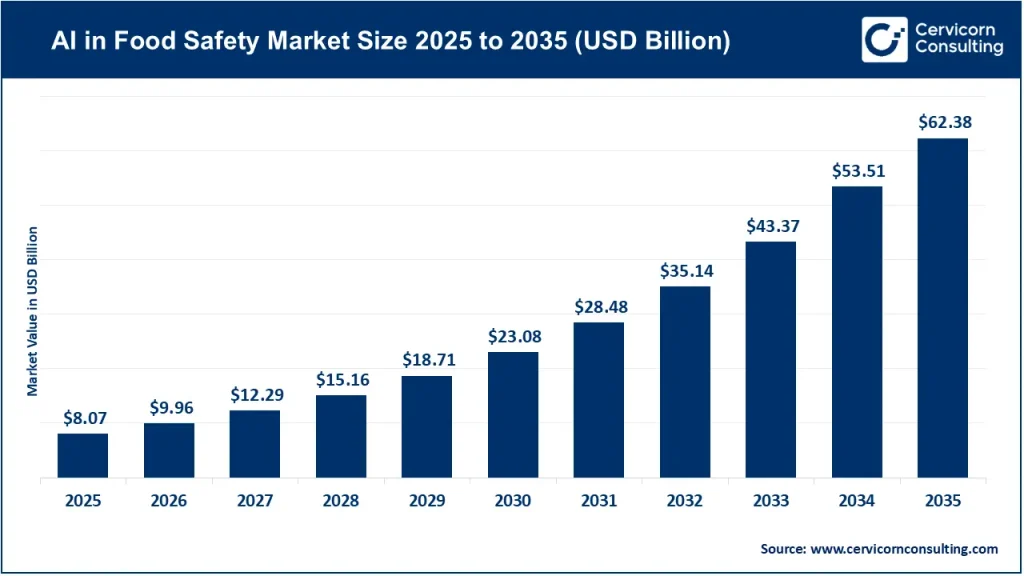
AI in Food Safety Market Size
The global AI in food safety market was valued at approximately USD 8.07 billion in 2025 and is projected to reach USD 62.38 billion by 2035, expanding at a CAGR of 22.69% during the forecast period.
AI in Food Safety Market Growth Factors
The AI in food safety market is gaining momentum as food manufacturers, retailers, regulators, laboratories, and supply-chain operators increasingly adopt artificial intelligence to move from reactive food-safety management toward predictive and risk-based systems. Key growth factors include the rising complexity of global food supply chains, increasing requirements for traceability, growing foodborne contamination risks, stricter regulatory oversight, rising demand for real-time quality monitoring, and the increasing availability of IoT sensors, computer vision systems, cloud computing, machine learning, and advanced analytics.
AI can process large volumes of laboratory, inspection, environmental, production, logistics, and consumer data to identify patterns that are difficult to detect through conventional manual processes. Research indicates that AI applications are expanding across contamination detection, outbreak prediction, allergen and spoilage monitoring, food fraud identification, supply-chain traceability, quality control, shelf-life prediction, and risk mitigation.
The availability of high-performance cloud infrastructure is also supporting deployment, while government agencies are increasingly exploring AI-assisted inspection, surveillance, risk assessment, and incident management. The FAO has specifically highlighted AI’s potential to make food-safety management more anticipatory and data-driven, while emphasizing data quality, ethics, transparency, and human judgment.
Get a Free Sample: https://www.cervicornconsulting.com/sample/2723
What Is the AI in Food Safety Market?
The AI in food safety market refers to the ecosystem of technologies, software, platforms, analytics tools, sensors, and services that use artificial intelligence to detect, predict, monitor, prevent, and manage food-safety risks across the food supply chain.
AI technologies used in food safety include machine learning, deep learning, computer vision, natural language processing, predictive analytics, anomaly detection, generative AI, and AI-enabled robotics. These technologies can be applied from farm production and food processing to transportation, retail, restaurants, laboratories, regulatory inspections, and consumer-facing applications.
For example, computer vision can examine food products for visible defects or contamination indicators, while machine-learning algorithms can analyze historical inspection and laboratory information to identify establishments or processes with higher potential risk. Predictive models can also combine environmental, production, and supply-chain information to provide early warnings of potential contamination events.
The market therefore extends beyond a single software category. It includes AI-powered food inspection, predictive food-safety analytics, intelligent quality-control systems, AI-enabled traceability, pathogen detection, food authenticity analysis, risk assessment platforms, and automated compliance management.
Recent research describes AI as a component of a broader “Food Safety 4.0” approach, in which AI is combined with IoT, blockchain, genomics, sensors, and other digital technologies to create more connected and responsive food-safety systems.
Why Is AI Important for Food Safety?
Food safety involves enormous volumes of information generated by laboratories, manufacturing plants, farms, logistics providers, retailers, regulators, and consumers. Traditional systems often depend heavily on periodic inspections, manual documentation, laboratory testing, and retrospective investigations. Although these methods remain essential, they can make it difficult to identify emerging risks quickly.
AI provides an opportunity to analyze information continuously and identify relationships between multiple variables. This can help organizations detect anomalies earlier, prioritize inspections, identify potential contamination pathways, and improve recall responses.
AI can also support predictive food safety. Instead of asking only whether a contamination event has already occurred, organizations can use historical and real-time information to estimate where risks are likely to emerge.
The technology is particularly important for:
- Pathogen and contaminant detection
- Foodborne outbreak prediction
- Risk-based inspection
- Food authenticity and fraud detection
- Allergen identification
- Shelf-life prediction
- Environmental monitoring
- Cold-chain monitoring
- Supplier risk assessment
- Food recall management
- Automated quality inspection
- Traceability and compliance
- Production-process optimization
A 2025 European Commission knowledge review identified AI applications in pathogen detection, blockchain-enabled traceability, and predictive outbreak forecasting, while also highlighting infrastructure disparities that can limit adoption in lower-resource countries.
Leading Companies in the AI in Food Safety Market
The competitive landscape is broader than the five technology companies below, but IBM, Microsoft, Google, Amazon Web Services, and SAP are important infrastructure and enterprise-technology participants because their AI, cloud, analytics, data-management, and enterprise platforms can support food-safety applications.
| Company | Specialization | Key Focus Areas | Notable Features | 2025 Revenue | Market Share | Global Presence |
|---|---|---|---|---|---|---|
| IBM Corporation | Enterprise AI, hybrid cloud, data analytics | Predictive analytics, AI decision support, supply-chain intelligence, risk management | watsonx, hybrid-cloud capabilities, enterprise analytics | $67.54B | Not separately disclosed for AI food safety | Global |
| Microsoft Corporation | Cloud computing, enterprise AI, data platforms | Azure AI, predictive analytics, supply-chain intelligence, compliance and workflow automation | Azure, Microsoft Fabric, Copilot, AI services | $281.72B | Not separately disclosed for AI food safety | Global |
| Google LLC (Alphabet Inc.) | AI, cloud computing, machine learning, data analytics | AI/ML, computer vision, predictive analytics, cloud-based food and supply-chain applications | Google Cloud AI, Vertex AI, advanced ML infrastructure | $402.84B | Not separately disclosed for AI food safety | Global |
| Amazon Web Services (AWS) | Cloud infrastructure and AI services | Machine learning, IoT, analytics, computer vision, scalable data processing | AWS AI/ML services, cloud infrastructure, IoT capabilities | $128.70B AWS sales | Not separately disclosed for AI food safety | Global |
| SAP SE | Enterprise software, ERP, supply-chain management | Food traceability, supply-chain analytics, quality management, AI-enabled enterprise workflows | SAP Business AI, cloud ERP, supply-chain and data platforms | €36.80B | Not separately disclosed for AI food safety | Global |
IBM Corporation
IBM is positioned around enterprise AI, hybrid cloud, data management, and analytics. These capabilities are relevant to food safety because organizations need to combine information from laboratories, manufacturing operations, suppliers, inspections, and supply chains. IBM’s AI portfolio can support predictive analytics and decision-making workflows where food companies need to identify operational and compliance risks. IBM reported $67.535 billion in 2025 revenue, up 7.6% from 2024.
Microsoft Corporation
Microsoft is a major AI and cloud infrastructure provider through Azure, Microsoft Fabric, Copilot, and related enterprise services. In food safety, these technologies can support centralized data management, AI-assisted analytics, workflow automation, computer vision, and predictive models. Microsoft’s fiscal 2025 revenue reached $281.724 billion, with Microsoft Cloud revenue of $168.9 billion.
Google LLC (Alphabet Inc.)
Google contributes AI and machine-learning capabilities through Google Cloud and its broader AI ecosystem. Food companies can potentially use cloud AI for computer vision, predictive analytics, data processing, and model development. Alphabet generated $402.836 billion in 2025 revenue, while Google Cloud revenue reached $58.705 billion.
Amazon Web Services (AWS)
AWS provides scalable cloud infrastructure and AI services that can be used to collect, process, and analyze food-safety data. Its capabilities are particularly relevant where companies need to connect IoT devices, production systems, sensors, logistics information, and analytics applications. AWS sales increased 20% in 2025 to $128.7 billion.
SAP SE
SAP has a strong position in enterprise resource planning, supply-chain management, procurement, manufacturing, and business analytics. These capabilities make SAP particularly relevant to food companies attempting to connect quality, supplier, manufacturing, logistics, and compliance information. SAP reported €36.8 billion in 2025 total revenue, with cloud and software revenue accounting for €32.538 billion.
Important market-share note: The five companies above do not publicly report a dedicated “AI in food safety” revenue segment or market-share percentage. Their reported 2025 revenues represent total company or business-segment revenue rather than food-safety AI revenue. Therefore, assigning precise food-safety market shares to these companies would create unsupported figures.
Leading Trends and Their Impact on the Market
1. Shift From Reactive to Predictive Food Safety
One of the most important trends is the movement from responding to contamination after it occurs toward predicting potential risks before they become incidents. Machine-learning models can evaluate historical inspection records, environmental conditions, laboratory results, production parameters, and supply-chain information.
Impact: This approach can improve risk prioritization, reduce response times, and enable regulators and food manufacturers to allocate resources toward higher-risk locations and processes.
2. AI-Powered Computer Vision
Computer vision is becoming increasingly important for automated inspection. Cameras and AI models can analyze products, packaging, production lines, and processing environments to identify defects, irregularities, foreign materials, and other visible quality issues.
Impact: Computer vision can increase inspection consistency and speed while reducing dependence on repetitive manual visual checks.
3. Integration of AI With IoT Sensors
Connected sensors can continuously monitor temperature, humidity, pressure, storage conditions, equipment performance, and other variables. AI can analyze this stream of data to identify abnormal conditions.
Impact: The combination can strengthen cold-chain monitoring and help identify conditions that could increase food-safety risks before products reach consumers.
4. Generative AI for Food-Safety Documentation
Generative AI is emerging as a tool for analyzing documents, summarizing inspection findings, preparing reports, supporting audits, and helping employees access internal food-safety information.
Impact: It can reduce administrative workloads, but human review remains essential because errors or hallucinations in safety-related documentation can have serious consequences.
5. AI-Based Traceability
Global supply chains involve multiple suppliers, processors, distributors, warehouses, and retailers. AI can help connect information across these stages and identify unusual patterns in movement, sourcing, or product records.
Impact: Better traceability can make recalls more targeted and potentially reduce the time needed to identify affected products.
6. Food Fraud and Authenticity Detection
AI can analyze chemical, spectral, visual, textual, and supply-chain data to identify potential food adulteration or authenticity issues.
Impact: This creates opportunities for regulators and manufacturers to move beyond conventional random testing toward more targeted fraud detection.
7. Human-in-the-Loop AI
The food-safety sector is increasingly emphasizing that AI should support, rather than replace, scientific and regulatory judgment. FAO discussions have stressed the importance of responsible AI, data quality, transparency, and human judgment.
Impact: Human oversight can improve accountability and reduce the risks associated with opaque or poorly validated algorithms.
Successful Examples of AI in Food Safety Around the World
The global adoption of AI in food safety is still developing, but several regulatory and research programs demonstrate how the technology is being applied.
United States
The United States is one of the most active markets for AI research and commercialization across food systems. U.S. food-safety authorities are exploring AI and advanced analytics for inspection, surveillance, risk assessment, and regulatory decision-making. FAO has highlighted the U.S. Food and Drug Administration among authorities presenting practical AI applications in food-safety management.
The U.S. research ecosystem also includes the AI Institute for Next Generation Food Systems, which focuses on AI applications spanning agricultural production, food processing and distribution, nutrition, and foundational AI. Its objectives include improving food quality, safety, traceability, resource efficiency, and food-waste management.
United Kingdom
The UK Food Standards Agency has investigated how AI is being used across the food system and has identified applications spanning supply, production, processing, consumption, and waste. The FSA’s research found significant global activity in AI and food systems, although it also identified gaps between research and large-scale implementation.
In 2026, the FSA announced plans to pilot AI-enabled tools within priority official controls, audits, and food-incident management, with the objective of improving risk assessment, intelligence analysis, evidence handling, and reporting.
Italy
Italy has been involved in AI-supported food inspection and regulatory research. FAO has cited the Italian Istituto Zooprofilattico Sperimentale among authorities showcasing AI applications in food-safety management.
Recent research has also examined machine-learning and Bayesian-network approaches to support official controls in food industries, demonstrating the growing interest in AI-assisted risk-based inspection.
Singapore
Singapore is another country included among the emerging real-world examples identified by FAO. Its highly digitalized regulatory and food ecosystem provides an environment where data analytics, automation, and AI can support food-safety surveillance and risk management. FAO’s global review specifically identifies Singapore among countries with practical AI-related food-safety applications.
India
India is building the digital infrastructure needed for more advanced AI-driven food-safety systems. The Food Safety and Standards Authority of India (FSSAI) operates the Food Safety Compliance System (FoSCoS) and maintains digital systems for licensing, registration, inspections, compliance, and food-safety administration.
FSSAI has also identified AI, blockchain, and IoT as technologies being explored to strengthen food-safety monitoring. Its digital risk-assessment infrastructure provides a foundation for future AI-enabled prioritization and surveillance applications.
Global Regional Analysis
North America
North America is one of the most advanced regions for AI in food safety, supported by strong technology ecosystems, large food-processing industries, sophisticated cloud infrastructure, and extensive regulatory databases. The United States is particularly important because of its combination of AI research, food manufacturing, biotechnology, cloud computing, and regulatory analytics.
The FDA and other agencies are increasingly interested in data-driven approaches to inspection and risk management. At the industry level, food manufacturers can deploy AI for predictive maintenance, contamination monitoring, computer vision, supplier risk assessment, and automated quality control.
Canada also offers opportunities because of its developed food-processing industry, agricultural technology ecosystem, and regulatory emphasis on traceability and food safety.
Europe
Europe is a major region for AI food-safety development because food safety is closely connected with scientific risk assessment, traceability, sustainability, and consumer protection. The European research ecosystem is examining AI for pathogen detection, outbreak prediction, food authenticity, traceability, and risk assessment.
The region’s regulatory environment places strong emphasis on trustworthy AI, transparency, data governance, and accountability. This creates both opportunities and compliance requirements for companies deploying AI in food-safety applications.
The UK is separately emerging as an important research and policy market. The FSA’s ongoing work demonstrates that regulators are considering how AI can strengthen official controls while maintaining consumer protection.
Asia-Pacific
Asia-Pacific is expected to become an increasingly important market as food manufacturing, agricultural production, technology adoption, and digital supply chains expand. China, Japan, South Korea, Singapore, India, and Australia are important technology and food-system markets.
The region’s opportunities are particularly strong in automated inspection, smart manufacturing, traceability, cold-chain monitoring, food fraud detection, and AI-enabled agriculture. The scale of food production and distribution creates large volumes of data that can be used to train predictive systems.
India represents a significant long-term opportunity because of its enormous food ecosystem and expanding digital regulatory infrastructure. FSSAI’s development of centralized compliance and risk-management systems provides an important foundation for future AI adoption.
Latin America
Latin America presents opportunities for AI in food safety through agricultural digitization, export-oriented food production, traceability, quality assurance, and supply-chain monitoring. Countries with large meat, seafood, fruit, beverage, and processed-food industries can benefit from AI-based inspection and predictive analytics.
However, adoption may be constrained by uneven digital infrastructure, limited access to high-quality datasets, investment requirements, and shortages of specialized AI talent. Partnerships among governments, universities, technology companies, and food producers can help address these barriers.
Middle East & Africa
The Middle East & Africa region is an emerging opportunity for AI-driven food safety. Food-import dependence in several countries increases the importance of supplier verification, product traceability, storage monitoring, and risk assessment.
AI can help authorities prioritize inspections, identify anomalies in imported products, monitor cold chains, and strengthen food-authenticity controls. However, differences in digital infrastructure and data availability remain important challenges.
The global evidence base also shows why equitable infrastructure development matters. A European Commission review reported that 78% of low- and middle-income countries lacked the necessary cloud infrastructure for AI deployment, illustrating the digital divide that can affect adoption of AI-based food-safety technologies.
Government Initiatives and Policies Shaping the Market
United States
U.S. policy is increasingly focused on risk-based and context-dependent AI governance. Food-safety authorities such as the FDA can use AI for contamination detection, predictive risk modelling, compliance monitoring, and surveillance, while broader federal AI policy emphasizes safety, innovation, consumer protection, privacy, and responsible AI.
European Union
The EU is shaping the market through its broader AI governance framework and its emphasis on trustworthy, transparent, and risk-aware AI. For food safety, this means AI developers and food companies increasingly need to consider explainability, data governance, validation, accountability, and human oversight alongside technical performance.
United Kingdom
The UK’s Food Standards Agency is taking a particularly direct approach to AI in food safety. Its current strategy includes piloting AI-enabled tools for official controls, audits, food-incident management, risk assessment, and intelligence analysis. The agency aims to use AI to target regulatory resources where risks to consumers are greatest.
The FSA has also established dedicated scientific work examining AI applications in food safety and authenticity, including potential applications in manufactured-food compliance evaluation and third-party certification processes.
India
India’s FSSAI is expanding digital food-safety infrastructure through FoSCoS, risk assessment, inspections, laboratory systems, and traceability initiatives. FSSAI has also stated that it is exploring AI, blockchain, and IoT for food-safety monitoring.
The agency’s risk-assessment framework collects information relating to contaminants, adulterants, compliance, laboratory analysis, standards, and epidemiological surveillance. Such structured datasets can become increasingly valuable inputs for AI-assisted food-safety decision-making.
International and FAO/WHO-Level Direction
International organizations are increasingly emphasizing responsible AI adoption rather than technology deployment alone. FAO’s 2025 work reviewed 141 scientific papers and examined real-world applications and governance frameworks across countries. It stressed the importance of trustworthy AI, high-quality datasets, transparency, ethics, and human oversight.
This international policy direction is likely to shape the future AI in food safety market by encouraging common principles around validation, data quality, cybersecurity, explainability, privacy, accountability, and human supervision. As AI becomes embedded in food inspection and quality systems, the competitive advantage will increasingly depend not simply on model accuracy but also on whether the technology can demonstrate reliable performance within regulated food-safety environments.
To Get Detailed Overview, Contact Us: https://www.cervicornconsulting.com/contact-us
Read Report: Wire and Cable Market Revenue, Trends, and Strategic Insights by 2035