


AI Data Center Power Infrastructure Market: Strategic Priorities for Scaling AI Computing Capacity
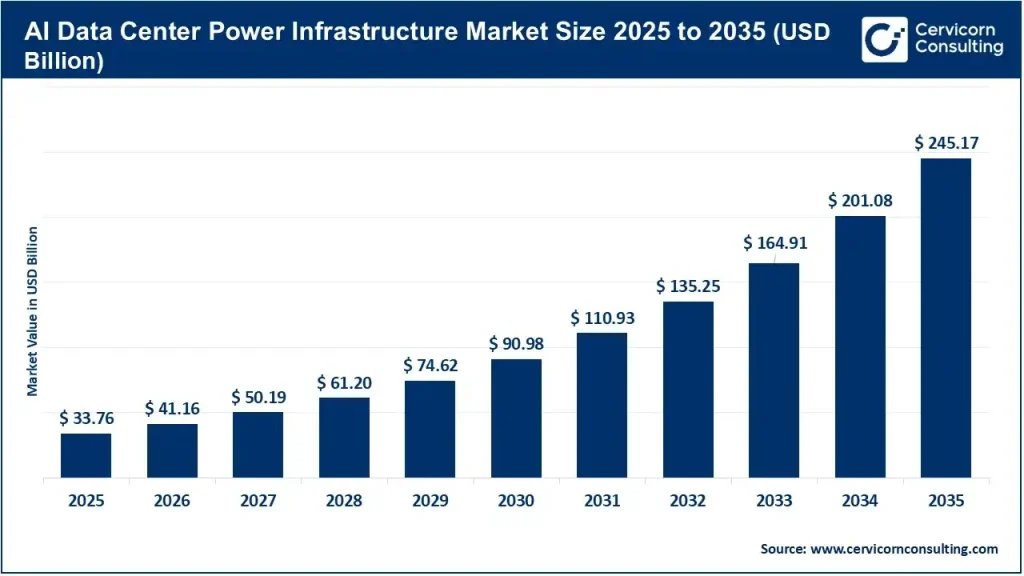
The global AI data center power infrastructure market was valued at USD 33.76 billion in 2025 and is projected to reach approximately USD 245.17 billion by 2035, expanding at a CAGR of 22% from 2026 to 2035. The market is estimated to reach USD 41.16 billion in 2026. Growth is driven by rising electricity requirements from GPU-intensive workloads, increasing rack power density, hyperscale data center investments, and the need for reliable power distribution and backup systems.
However, the expansion of AI computing capacity is increasingly dependent on whether developers can secure sufficient electricity, establish reliable grid connections, and deploy power infrastructure before commissioning deadlines. According to the International Energy Agency (IEA), global data center electricity consumption is projected to increase from approximately 485 TWh in 2025 to 950 TWh by 2030. Meanwhile, hyperscalers are expected to spend more than USD 700 billion in capital expenditure during 2026, intensifying demand for electrical equipment and supporting infrastructure.
For companies operating across the data center value chain, this creates a shift in investment priorities. Power infrastructure decisions must increasingly be made alongside server procurement, cooling architecture, facility design, and long-term energy sourcing rather than treated as a separate construction-stage activity.
Why power infrastructure is becoming a critical investment decision
AI data centers have fundamentally different power requirements from conventional enterprise facilities. GPU clusters, high-performance computing systems and advanced networking equipment create concentrated electricity demand, while liquid cooling and supporting infrastructure add further electrical loads.
The IEA estimates that power density in AI servers increased approximately 11-fold between 2020 and 2025. By 2027, it could increase another fourfold. An individual advanced AI server rack could have peak power demand equivalent to that of 65 households.
This changes how operators should evaluate infrastructure investments.
Three challenges are becoming particularly important:
-
Power availability: Grid connection delays, limited transmission capacity and substation constraints can postpone commissioning even when land, financing and server procurement are secured.
-
Power density: Existing electrical distribution systems may not support the requirements of next-generation GPU racks without substantial upgrades.
-
Power reliability: Even short interruptions can disrupt expensive AI workloads, making UPS systems, backup generation and energy storage essential.
For developers, the financial impact extends beyond electricity bills. Delayed commissioning can postpone revenue generation, increase construction costs and leave expensive computing equipment underutilized.
Consequently, securing power capacity and designing an appropriate electrical architecture should be among the earliest decisions in a data center development strategy.
Get a Free Sample: https://www.cervicornconsulting.com/sample/3088
Investment priorities across the AI data center power infrastructure value chain
The market opportunity extends beyond traditional UPS and backup generator installations. It includes the complete electrical infrastructure required to deliver, distribute, convert, monitor and store electricity.
The following areas deserve particular attention from technology suppliers and infrastructure investors.
1. UPS systems and backup power: Reliability remains non-negotiable
Uninterruptible power supply (UPS) systems represented the leading component segment in 2025. Their importance is increasing as AI facilities accommodate expensive GPU infrastructure and workloads that require continuous operation.
However, operators should not evaluate UPS procurement solely on initial equipment costs.
Important investment considerations include:
-
Modular UPS systems that allow capacity to increase alongside IT demand.
-
Higher-efficiency systems that reduce electrical losses.
-
Battery technologies offering appropriate backup duration and lifecycle economics.
-
Redundant configurations that minimize single points of failure.
-
Integration with backup generators and facility-wide power management.
Backup generation also requires a longer-term assessment. Diesel generators remain established solutions, but natural gas generation, alternative fuels and hybrid power systems are gaining attention as operators evaluate reliability, emissions and operating costs.
Business decision: UPS and generator suppliers should prioritize modular products, higher efficiency, integration capabilities and support for high-density AI facilities rather than competing only on installed capacity.
2. Intelligent power distribution: Rack density is changing equipment requirements
Power distribution units (PDUs), switchgear, circuit breakers, busways and rack-level distribution systems are becoming increasingly important.
Traditional data center electrical architectures were designed around relatively predictable IT loads. AI infrastructure introduces higher rack power requirements and more demanding power distribution needs.
According to the market assessment, power distribution units are expected to be the fastest-growing component segment during 2026–2035.
Intelligent and metered PDUs are particularly relevant because they enable operators to monitor power consumption at individual racks and improve capacity planning.
Manufacturers should consider investment in:
-
High-capacity intelligent PDUs.
-
Advanced circuit protection and monitoring.
-
Modular busway and busbar systems.
-
Higher-voltage power distribution technologies.
-
Real-time load monitoring and remote management.
Business decision: Electrical equipment manufacturers should identify whether their current product portfolios can support next-generation rack configurations. Compatibility with higher power densities, monitoring systems and modular facility designs will increasingly influence supplier selection.
3. Transformers and grid infrastructure: The opportunity begins outside the data center
One of the biggest constraints on AI infrastructure expansion is the availability of electricity at the required location.
Even when a developer has secured a suitable site, the local electricity network may not have sufficient capacity. New substations, transformers, transmission upgrades and utility connections can introduce significant project complexity.
The IEA identifies grid connection queues, limited network capacity and shortages across energy equipment supply chains as important constraints on data center development.
This creates opportunities for manufacturers of:
-
Power transformers.
-
Medium- and low-voltage switchgear.
-
High-voltage electrical equipment.
-
Substation automation systems.
-
Grid monitoring and protection technologies.
-
Power electronics and voltage conversion systems.
Recent industry developments reinforce this opportunity. In September 2026, Reuters reported that suppliers including HD Hyundai Electric and Jinpan Smart Technology were benefiting from rising orders associated with data center power demand, while transformer and generator lead times remained an infrastructure bottleneck.
Business decision: Manufacturers should evaluate demand by geography, transformer capacity, voltage class, delivery lead times and customer project pipelines. Expanding production capacity without understanding regional demand and procurement cycles could create unnecessary capital exposure.
4. Battery energy storage: Moving beyond conventional backup applications
Battery energy storage systems (BESS) are becoming an important part of AI data center power strategies.
Their role extends beyond providing backup electricity. Storage can help manage peak demand, integrate renewable energy, support grid flexibility and reduce exposure to certain power interruptions.
The IEA estimates that approximately 20–25 GW of battery storage could be installed in data centers globally by 2030. It also highlights the potential for these systems to support electricity grids when appropriate commercial arrangements are available.
For operators, investment decisions should consider:
-
Battery chemistry and lifecycle performance.
-
Required discharge duration.
-
Integration with UPS and backup generation.
-
Energy management software.
-
Grid-interactive operating capabilities.
-
Safety, thermal management and replacement costs.
For battery manufacturers and energy storage companies, the opportunity lies in developing systems specifically suited to high-reliability data center applications.
Business decision: Storage suppliers should distinguish between conventional backup applications and grid-interactive storage projects. These applications have different technical requirements, revenue models and customer expectations.
5. On-site power generation and hybrid energy systems: Reducing dependence on grid availability
As AI data center demand increases, developers are evaluating multiple electricity procurement and generation strategies.
Grid electricity remains the leading power source, but on-site generation and hybrid power systems are gaining importance.
Potential configurations include:
-
Natural gas-based generation.
-
Renewable energy combined with battery storage.
-
Grid electricity supported by on-site generation.
-
Long-term renewable power purchase agreements.
-
Emerging advanced geothermal and nuclear power arrangements.
In its 2026 analysis, the IEA identified increasing interest in on-site power projects, particularly natural gas-based generation in the United States. It also reported that data center operators signed 45 TWh of power purchase agreements during the first half of 2026, nearly 20% more than during the same period in 2025.
However, on-site generation should not automatically be treated as a cheaper or more sustainable alternative to grid electricity. Fuel availability, emissions requirements, permitting, operating expenses and long-term energy contracts all influence project economics.
Business decision: Energy developers should evaluate integrated power solutions based on total lifecycle costs, reliability, emissions and the time required to bring capacity online.
What recent industry developments indicate about investment direction
The market is moving toward integrated power infrastructure rather than isolated equipment procurement.
Several developments illustrate this transition.
-
February 2026 – NxtGen AI and Vertiv: The companies announced a national-scale sovereign AI factory in India, with Vertiv providing power and thermal infrastructure for high-density AI workloads. This demonstrates the growing importance of integrated electrical and cooling solutions in India’s AI infrastructure expansion.
-
March 2026 – Eaton and NVIDIA: Eaton introduced its Beam Rubin DSX platform, integrating power and cooling infrastructure from the grid to the AI chip. The development reflects increasing demand for coordinated infrastructure design.
-
April 2026 – Vertiv and CPower: The companies announced a collaboration integrating battery energy storage with virtual power plant technology, highlighting opportunities to combine data center resilience with grid services.
-
June 2026 – Siemens, NVIDIA and Fluence: The companies announced a reference architecture combining medium- and low-voltage power distribution, controls, modular infrastructure and battery storage for NVIDIA AI data centers.
-
June 2026 – Meta and Reliance Industries: An agreement for an AI-enabled data center in Jamnagar, Gujarat, highlighted the growing integration of large-scale AI infrastructure with renewable energy arrangements.
These developments point toward three industry shifts: integrated power and cooling architectures, modular infrastructure deployment, and energy storage systems that can serve both facility and grid requirements.
For suppliers, this means that future competitive positioning will increasingly depend on their ability to participate in complete infrastructure projects and collaborate with other technology providers.
Regional opportunities: Where should companies prioritize expansion?
Regional investment decisions should account for electricity availability, data center construction pipelines, government policies, equipment manufacturing capabilities and access to renewable energy.
North America: Largest market with strong hyperscale demand
North America accounted for 42% of global AI data center power infrastructure market revenue in 2025. Its market was valued at USD 14.18 billion and is projected to reach USD 102.97 billion by 2035.
The region benefits from significant hyperscale investments, established data center ecosystems and demand from major cloud and AI companies.
However, grid connection delays, transformer availability and rising electricity requirements are creating opportunities for alternative power solutions.
Investment priorities:
-
High-capacity transformers and switchgear.
-
Modular UPS and power distribution systems.
-
Battery energy storage.
-
On-site power generation.
-
Grid-connected power management technologies.
Asia Pacific: A major growth opportunity for infrastructure suppliers
Asia Pacific’s AI data center power infrastructure market was valued at USD 9.79 billion in 2025 and is projected to reach USD 71.10 billion by 2035.
India, China, Japan, Singapore and South Korea are important markets as cloud computing, domestic AI capabilities and hyperscale infrastructure investments expand.
India deserves particular attention because of its growing sovereign AI ambitions and efforts to attract data center investment.
In February 2026, the Indian government proposed a tax holiday until 2047 for eligible foreign cloud service providers using data center services in India. This is intended to encourage long-term investment in domestic cloud and data center infrastructure.
The expansion of transmission infrastructure and government attention to data center energy requirements also create opportunities for power equipment manufacturers and energy solution providers.
Investment priorities:
-
Power transformers and substation equipment.
-
UPS and intelligent power distribution.
-
Renewable energy and storage integration.
-
Modular electrical infrastructure.
-
High-efficiency power conversion technologies.
Regional comparison and strategic implications
| Market | 2025 market size | 2035 projection | Strategic opportunity |
|---|---|---|---|
| North America | USD 14.18B | USD 102.97B | Hyperscale power systems and grid resilience |
| Asia Pacific | USD 9.79B | USD 71.10B | New facilities, equipment manufacturing and energy integration |
For equipment manufacturers, North America offers access to an established hyperscale customer base, while Asia Pacific offers opportunities associated with new infrastructure development and regional supply chain expansion.
Centralized vs. distributed power architecture: Which model should operators adopt?
Selecting the appropriate power architecture is another important investment decision.
Centralized power architecture accounted for 39% of market revenue in 2025, followed by distributed architecture at 32% and hybrid architecture at 29%.
However, distributed architecture is expected to grow faster as AI facilities require more flexible power delivery and phased capacity expansion.
| Decision factor | Centralized architecture | Distributed architecture | Hybrid architecture |
|---|---|---|---|
| Power management | Centralized control | Closer to individual loads | Combined control |
| Scalability | Expansion through central systems | Modular expansion | Flexible expansion |
| Infrastructure planning | Centralized electrical layout | Distributed electrical layout | Application-dependent |
| Best suited for | Established large facilities | Flexible, high-density deployments | Complex multi-hall facilities |
The choice should depend on facility size, rack density, redundancy requirements, expansion plans and maintenance strategy.
For example, an operator constructing a new AI campus may prioritize modular and distributed power delivery to accommodate changing GPU configurations. An existing hyperscale facility may prefer upgrading its centralized infrastructure or adopting a hybrid arrangement to avoid unnecessary replacement costs.
Strategic implication: Power architecture suppliers should offer flexible configurations rather than relying on a single standardized solution for all AI data center projects.
Competitive landscape: What should power infrastructure companies prioritize?
Competition is expanding across electrical equipment, backup systems, energy storage, power conversion and integrated facility infrastructure.
Important companies operating across the market include:
-
Schneider Electric – Power distribution, electrical infrastructure and energy management.
-
Vertiv – UPS, thermal management and integrated data center infrastructure.
-
Eaton – Power distribution, backup power and modular infrastructure.
-
ABB – Switchgear, electrical distribution and automation.
-
Siemens – Power distribution, automation and grid technologies.
-
Delta Electronics – Power conversion, data center infrastructure and energy management.
-
GE Vernova – Grid infrastructure and electricity generation technologies.
-
Cummins – Backup generators and power generation systems.
-
Caterpillar – Distributed power generation and backup systems.
-
Legrand – Power distribution and data center electrical infrastructure.
Recent commercial developments also suggest that competition is shifting toward integrated infrastructure solutions. For instance, Legrand reported that data centers accounted for approximately one-third of its revenue in its latest reported period, with data center sales growing nearly 40%. The company raised its 2026 sales growth outlook in November 2026, citing strong demand.
What manufacturers should evaluate:
-
Whether their existing products support next-generation AI rack power requirements.
-
Whether they can provide integrated solutions rather than individual electrical components.
-
Which geographic markets offer the strongest demand relative to local competition.
-
Whether manufacturing capacity and supply chains can support increasing project requirements.
-
How partnerships with data center developers, engineering contractors and technology providers can improve market access.
Five strategic decisions companies should make before investing
The expansion of AI data center power infrastructure presents significant opportunities, but companies should avoid treating overall market growth as a substitute for investment analysis.
The following decisions can help translate market opportunities into actionable business strategies.
1. Which power infrastructure components offer the strongest growth potential?
Companies should compare UPS systems, intelligent PDUs, transformers, switchgear, energy storage and power management technologies. Growth potential should be assessed alongside competitive intensity, pricing pressure and manufacturing requirements.
2. Should suppliers prioritize new data center construction or existing facility upgrades?
New construction represented 48% of market revenue in 2025, while expansion accounted for 34% and modernization 18%.
However, existing data center operators are increasingly upgrading electrical capacity to accommodate AI workloads. Suppliers should evaluate both new-project pipelines and retrofit opportunities before allocating production capacity.
3. Which regions offer the best market-entry opportunities?
North America currently leads, while Asia Pacific offers substantial long-term growth potential. Companies should compare regional demand, procurement requirements, local manufacturing competition, import dependencies and regulatory conditions.
4. How should product portfolios adapt to higher power density?
Suppliers need to assess whether existing electrical equipment can support changing rack configurations, higher power loads, intelligent monitoring and integrated liquid-cooling infrastructure.
Investments in modular systems and advanced power electronics could improve their positioning in next-generation facilities.
5. Which partnerships can accelerate commercial expansion?
Data center power projects involve developers, utilities, equipment manufacturers, engineering contractors, energy companies and technology providers.
Companies should identify the stakeholders influencing equipment selection and project procurement. Strategic partnerships can improve access to large infrastructure contracts and reduce market-entry barriers.
Risks that could change the market opportunity
Despite strong growth expectations, several factors could affect investment returns.
-
Grid infrastructure constraints: Insufficient electricity availability and delayed grid connections can postpone data center commissioning.
-
High capital expenditure: Transformers, switchgear, UPS systems, generators and energy storage require significant upfront investment.
-
Technology transition: Changing rack power requirements may make existing electrical designs less suitable for future AI deployments.
-
Supply chain concentration: Dependence on limited suppliers of transformers, power electronics and critical components can increase procurement risks.
-
Energy cost volatility: Electricity and fuel price fluctuations can affect operating expenses and long-term project economics.
-
Regulatory and environmental requirements: Emissions restrictions, energy efficiency standards and community concerns can influence project approvals.
Companies should evaluate these risks at the project and regional levels rather than assuming that rising AI infrastructure expenditure will translate directly into equipment demand.
What the next phase of AI data center power infrastructure will look like
The next phase of market development will be shaped by the ability to deliver higher electrical capacity without compromising reliability, efficiency or deployment timelines.
Several technologies are likely to influence investment priorities:
-
Advanced power electronics: Higher-efficiency power conversion and voltage management solutions will become increasingly important as AI rack power requirements increase.
-
Solid-state transformers: Emerging transformer technologies could offer more flexible power conversion and control capabilities.
-
Grid-interactive battery storage: Storage systems could help operators manage demand, improve resilience and participate in electricity grid services.
-
Modular power infrastructure: Prefabricated and scalable electrical systems can support phased capacity expansion and faster deployment.
-
Integrated power and cooling: Electrical and thermal infrastructure will increasingly be designed together to support high-density GPU environments.
-
AI-enabled energy management: Predictive monitoring and intelligent control systems can help optimize power consumption, identify inefficiencies and improve operational reliability.
The competitive advantage will increasingly belong to companies that can combine electrical performance, scalability, energy efficiency and reliable delivery.
Conclusion
The AI data center power infrastructure market is entering a period of substantial expansion, supported by rising GPU deployment, hyperscale investments and growing demand for reliable electricity. With the global market projected to reach USD 245.17 billion by 2035, opportunities extend across UPS systems, power distribution, transformers, energy storage, backup generation and intelligent power management.
However, the most important business decision is not simply identifying which component segment is growing fastest. Companies must understand where infrastructure investment is taking place, which power technologies are gaining adoption, how customer requirements are changing and where supply chain constraints create opportunities.
For manufacturers, this means aligning product development and production capacity with emerging AI facility requirements. For data center operators, it means integrating electricity procurement, power architecture, backup systems and cooling requirements into long-term infrastructure planning.
Companies that make these decisions using detailed market, regional and competitive intelligence will be better positioned to identify commercially viable opportunities and manage investment risks.
To Get Detailed Overview, Contact Us: https://www.cervicornconsulting.com/contact-us
Read Report: Automotive Semiconductor Market Outlook: EV Power Electronics, ADAS, Memory Supply, and Regional Expansion