


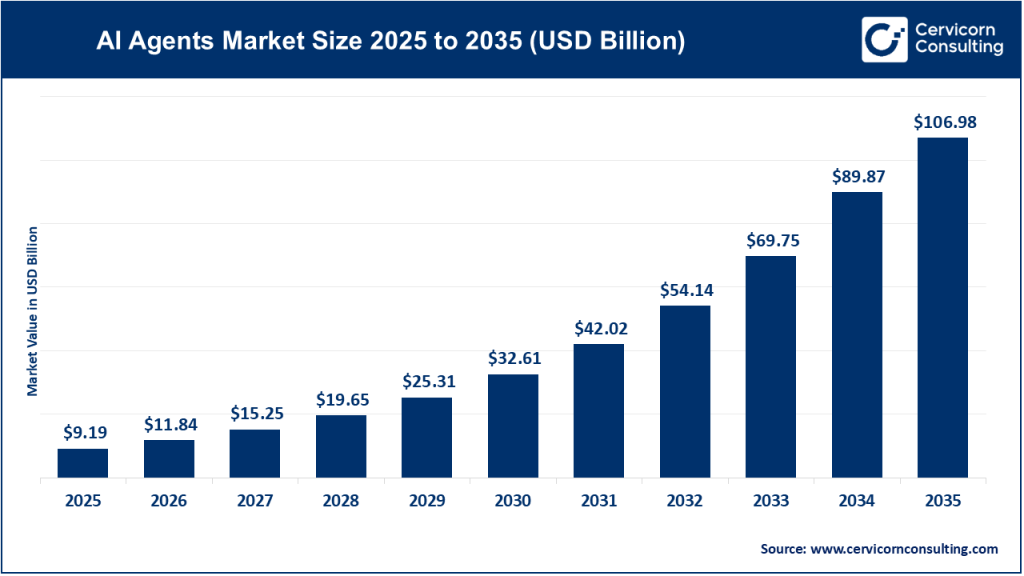
AI Agents Market Size
The global AI agents market size was valued at approximately USD 9.19 billion in 2025 and is projected to reach nearly USD 106.98 billion by 2035, growing at a CAGR of 27.82%.
AI Agents Market Growth Factors
The AI agents market is experiencing exceptional growth due to the rapid adoption of generative AI, large language models (LLMs), enterprise automation, cloud computing, and intelligent decision-making systems. Organizations across healthcare, banking, retail, manufacturing, logistics, telecommunications, and government are increasingly deploying AI agents to automate repetitive tasks, improve customer engagement, optimize workflows, and reduce operational costs.
Growing investments in AI infrastructure, expanding use of multi-agent systems, increasing demand for personalized digital assistants, and advancements in natural language processing (NLP), machine learning, and autonomous reasoning are further accelerating market expansion. The emergence of AI copilots, autonomous customer service platforms, enterprise workflow automation, and agentic AI solutions is creating new opportunities for businesses worldwide. Additionally, supportive government AI initiatives, increasing digital transformation programs, and rising investments from major technology companies continue to strengthen the global AI agents market.
Get a Free Sample: https://www.cervicornconsulting.com/sample/2649
What is the AI Agents Market?
The AI agents market refers to the global ecosystem of software platforms, technologies, and intelligent systems capable of performing tasks autonomously with minimal human intervention. Unlike traditional automation software, AI agents can understand context, analyze information, make decisions, learn from interactions, and execute actions independently.
Modern AI agents combine several advanced technologies, including:
- Large Language Models (LLMs)
- Machine Learning
- Natural Language Processing (NLP)
- Reinforcement Learning
- Computer Vision
- Knowledge Graphs
- Autonomous Planning
- Enterprise Workflow Automation
AI agents are increasingly deployed as:
- Customer service agents
- Sales assistants
- HR assistants
- Coding assistants
- Financial advisors
- Healthcare assistants
- Supply chain coordinators
- Cybersecurity monitoring agents
- Enterprise productivity assistants
With enterprises rapidly embracing intelligent automation, AI agents are evolving from simple chatbots into sophisticated digital workers capable of handling complex business processes.
Why is the AI Agents Market Important?
The growing importance of AI agents lies in their ability to augment human productivity while reducing operational complexity. Businesses face increasing pressure to improve efficiency, lower costs, and deliver personalized customer experiences. AI agents help organizations achieve these goals by automating repetitive and knowledge-intensive tasks.
Key reasons why AI agents are becoming essential include:
Improved Productivity
AI agents can operate continuously without downtime, allowing businesses to automate routine administrative tasks while enabling employees to focus on strategic activities.
Enhanced Customer Experience
Modern AI agents provide instant responses, multilingual support, personalized recommendations, and 24/7 customer service, significantly improving customer satisfaction.
Cost Reduction
Organizations can reduce labor costs, minimize human errors, and improve operational efficiency through intelligent automation.
Faster Decision-Making
AI agents analyze large datasets in real time, enabling businesses to make informed decisions more quickly.
Enterprise Scalability
Companies can scale customer support, sales operations, and internal workflows without proportionally increasing workforce costs.
Leading Companies Driving the AI Agents Market
| Company | Specialization | Key Focus Areas | Notable Features | 2025 Revenue* | Estimated AI Agents Market Position | Global Presence |
|---|---|---|---|---|---|---|
| Google LLC | Generative AI, Cloud AI, Agentic AI | Gemini AI, Vertex AI, AI Workspace | Gemini-powered enterprise agents, multimodal AI, AI Overviews | Approximately US$400+ billion (Alphabet) | Leading innovator through Gemini ecosystem | North America, Europe, Asia-Pacific, Latin America, Middle East & Africa |
| IBM Corporation | Enterprise AI | Watsonx, AI governance, Hybrid Cloud | Enterprise AI agents, secure AI deployment | US$67.5 billion | Strong enterprise AI provider | More than 170 countries |
| Microsoft Corporation | Cloud AI | Microsoft Copilot, Azure AI, AI Studio | Enterprise copilots, productivity AI, autonomous workflows | US$281.7 billion | Global leader in enterprise AI platforms | More than 190 countries |
| Salesforce, Inc. | CRM AI | Agentforce, Einstein AI, Data Cloud | Autonomous CRM agents for sales, service, and marketing | US$37.9 billion (FY2025) | Pioneer in AI-powered CRM agents | More than 150 countries |
| SAP SE | Enterprise Software | Business AI, Joule AI, ERP automation | AI-powered enterprise workflow agents integrated into SAP ecosystem | €36.8 billion | Leading ERP-focused AI innovator | More than 180 countries |
Leading Trends Transforming the AI Agents Market
1. Rise of Autonomous AI Agents
The market is moving beyond chatbots toward autonomous AI agents capable of independently planning, reasoning, and completing complex workflows.
Examples include:
- Autonomous coding assistants
- AI research assistants
- Procurement agents
- Finance automation agents
These systems require significantly less human supervision than earlier AI solutions.
2. Multi-Agent Collaboration
Businesses are increasingly deploying multiple AI agents that collaborate to complete business processes.
For example:
- One agent gathers customer information.
- Another processes payments.
- Another schedules deliveries.
- Another provides customer updates.
This distributed intelligence greatly improves enterprise efficiency.
3. Integration with Enterprise Software
Enterprise software vendors are embedding AI agents directly into business applications.
Common integrations include:
- ERP
- CRM
- HR platforms
- Supply chain software
- Customer support systems
Employees can now complete business operations using conversational interfaces instead of navigating multiple software applications.
4. Industry-Specific AI Agents
Organizations increasingly demand specialized AI agents rather than generic conversational assistants.
Industry examples include:
Healthcare:
- Clinical documentation
- Patient scheduling
- Insurance verification
Banking:
- Fraud detection
- Loan processing
- Financial advisory
Retail:
- Personalized shopping
- Inventory optimization
- Demand forecasting
Manufacturing:
- Predictive maintenance
- Production scheduling
- Quality inspection
5. Responsible and Explainable AI
As AI agents make more business-critical decisions, organizations require transparency, explainability, and regulatory compliance.
This trend has accelerated investments in:
- AI governance
- Bias detection
- Ethical AI
- Security monitoring
- Model auditing
Impact of These Trends on the Market
These emerging trends are transforming enterprise software by making AI agents active participants in business operations rather than passive assistants.
The impact includes:
- Higher workforce productivity
- Faster digital transformation
- Reduced operational costs
- Improved customer satisfaction
- Better decision intelligence
- Increased enterprise competitiveness
- Greater return on AI investments
Organizations adopting AI agents early are expected to gain significant competitive advantages through faster innovation and improved operational agility.
Successful Examples of AI Agents Around the World
Microsoft Copilot
Microsoft Copilot integrates AI agents into Word, Excel, PowerPoint, Outlook, Teams, and Dynamics 365.
Businesses use Copilot to:
- Generate reports
- Summarize meetings
- Create presentations
- Analyze spreadsheets
- Draft emails
- Automate workflows
Millions of enterprise users have incorporated Copilot into daily productivity tasks.
Google Gemini
Google has embedded Gemini AI agents across:
- Workspace
- Cloud Platform
- Search
- Android
- Vertex AI
Gemini assists users with:
- Research
- Coding
- Document creation
- Data analysis
- Enterprise automation
Its multimodal capabilities enable understanding of text, images, code, audio, and video.
Salesforce Agentforce
Salesforce Agentforce enables organizations to deploy autonomous AI agents for:
- Customer service
- Sales support
- Marketing campaigns
- CRM automation
Businesses can automate customer interactions while maintaining personalized engagement.
IBM Watsonx
IBM’s Watsonx platform provides enterprise AI agents focused on:
- Banking
- Government
- Healthcare
- Manufacturing
Its emphasis on governance, security, and explainability makes it particularly suitable for highly regulated industries.
SAP Joule
SAP Joule serves as an intelligent enterprise assistant integrated into SAP applications.
Capabilities include:
- Business insights
- Workflow automation
- Procurement support
- HR assistance
- Finance management
- Supply chain optimization
Large enterprises use Joule to streamline ERP operations and improve employee productivity.
Global Regional Analysis
North America
North America remains the largest AI agents market due to its advanced digital infrastructure, strong cloud ecosystem, and concentration of leading AI companies.
Major growth drivers include:
- High enterprise AI adoption
- Significant venture capital funding
- Mature cloud computing infrastructure
- Strong R&D investments
- Rapid deployment of generative AI
Government Initiatives
Government support includes:
- National AI research investments
- AI risk management frameworks
- Responsible AI guidelines
- Public-private partnerships
- Funding for AI innovation and workforce development
These initiatives encourage innovation while promoting trustworthy AI deployment.
Europe
Europe is witnessing substantial growth driven by enterprise automation, Industry 4.0, and increasing demand for trustworthy AI.
Industries leading adoption include:
- Automotive
- Manufacturing
- Financial services
- Healthcare
- Public administration
Government Policies
European governments support AI development through:
- AI research funding
- Digital transformation programs
- Cross-border AI collaboration
- Ethical AI regulations
- Strong data privacy requirements
The region emphasizes human-centric AI and regulatory compliance, fostering responsible enterprise adoption.
Asia-Pacific
Asia-Pacific is projected to be the fastest-growing regional market.
Rapid digitalization, expanding cloud infrastructure, and government-backed AI programs are fueling adoption.
Countries including China, India, Japan, South Korea, Singapore, and Australia are investing heavily in AI ecosystems.
Government Initiatives
Regional governments support AI through:
- National AI missions
- Smart city projects
- AI startup funding
- Digital economy strategies
- AI education initiatives
- Semiconductor manufacturing investments
Large-scale AI adoption across manufacturing, retail, financial services, and healthcare continues to drive regional market expansion.
Latin America
Latin America is gradually embracing AI agents as organizations modernize customer engagement and business operations.
Growing adoption is observed across:
- Banking
- Retail
- Telecommunications
- Healthcare
- Government services
Government Support
Governments are encouraging AI through:
- Digital transformation policies
- Startup ecosystem development
- Innovation grants
- Cloud adoption initiatives
- AI workforce training
Although still emerging, increasing investments from multinational technology companies are accelerating AI deployment.
Middle East & Africa
The Middle East & Africa region is becoming an attractive AI investment destination due to ambitious digital transformation strategies and smart city initiatives.
Growing sectors include:
- Government
- Energy
- Financial services
- Healthcare
- Transportation
Government Initiatives
Several governments are implementing:
- National AI strategies
- Smart government programs
- Digital infrastructure investments
- AI innovation centers
- Public sector AI adoption
- International AI partnerships
Large investments in intelligent automation are positioning the region as an important future market for AI agents.
Future Outlook
The AI agents market is entering a transformative phase where intelligent software is evolving from task automation tools into autonomous digital colleagues capable of reasoning, planning, learning, and executing business operations. As organizations continue integrating generative AI, enterprise automation, cloud-native architectures, and industry-specific AI solutions, AI agents are expected to become an integral component of digital enterprises. Continued investments by leading technology companies, supportive government initiatives, and rising enterprise demand for productivity-enhancing solutions are expected to sustain strong market growth over the coming years.
To Get Detailed Overview, Contact Us: https://www.cervicornconsulting.com/contact-us
Read Report: Generative AI in Aerospace and Defense Market Revenue, Trends, and Strategic Insights by 2035