


Table of Contents
ToggleGenerative AI in Aerospace and Defense Market Size
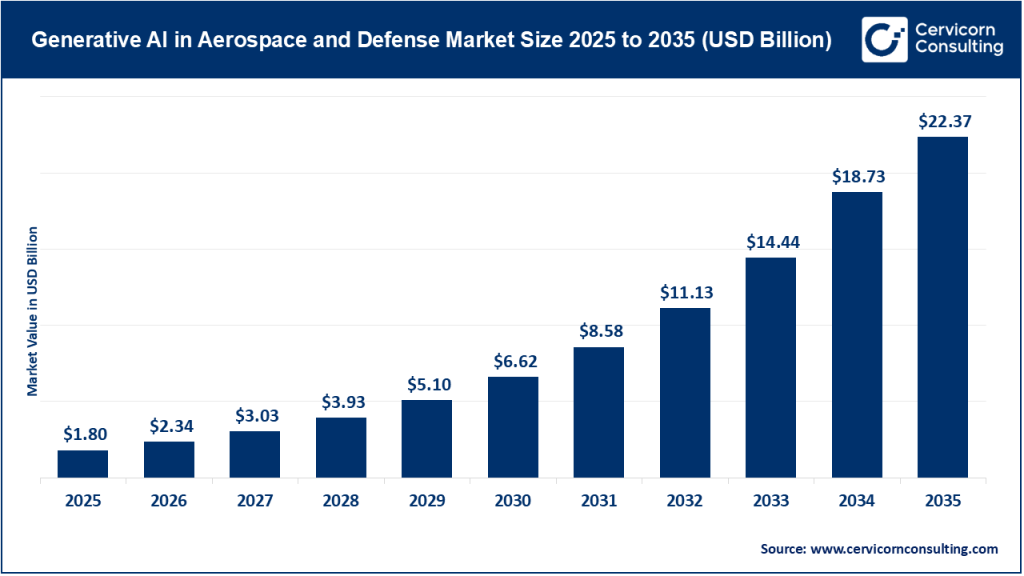
The global generative AI in aerospace and defense market size was valued at approximately USD 1.80 billion in 2025 and is projected to reach nearly USD 22.37 billion by 2035, growing at a CAGR of 28.66%.
What is the Generative AI in Aerospace and Defense Market?
The generative AI in aerospace and defense market encompasses software platforms, AI models, cloud infrastructures, machine learning systems, digital engineering tools, and services designed to generate new outputs for military, aerospace, and defense applications. Unlike traditional AI systems that focus primarily on data analysis and prediction, generative AI can create original content, including engineering designs, mission scenarios, maintenance procedures, intelligence reports, training simulations, and synthetic operational environments.
Applications span across multiple domains, including:
- Aircraft and spacecraft design optimization
- Autonomous defense systems
- Mission planning and simulation
- Cybersecurity threat detection
- Predictive maintenance
- Intelligence, surveillance, and reconnaissance (ISR)
- Digital twin development
- Synthetic training environments
- Defense logistics optimization
- Command and control systems
The integration of generative AI is enabling aerospace and defense organizations to modernize operations while addressing increasingly complex mission requirements.
Get a Free Sample: https://www.cervicornconsulting.com/sample/2639
Why is Generative AI Important in Aerospace and Defense?
Generative AI is becoming a strategic technology because it addresses some of the industry’s most pressing challenges.
Accelerated Design and Development
Aircraft, spacecraft, and defense systems require years of engineering and testing. Generative AI significantly reduces design cycles by automatically generating optimized configurations and engineering alternatives.
Enhanced Decision-Making
Military commanders and defense analysts can leverage AI-generated insights and simulations to evaluate multiple operational scenarios rapidly and improve mission outcomes.
Improved Cybersecurity
Generative AI helps identify vulnerabilities, simulate cyberattacks, and develop advanced threat detection mechanisms to protect critical defense infrastructure.
Cost Reduction
Automating complex engineering, maintenance, and planning processes reduces operational costs while improving productivity.
Advanced Training
Synthetic environments generated through AI provide realistic training experiences without requiring expensive physical exercises.
Intelligence Enhancement
Generative AI processes massive datasets from satellites, sensors, and intelligence networks to generate actionable intelligence reports in real time.
Generative AI in Aerospace and Defense Market Growth Factors
The growth of the generative AI in aerospace and defense market is being driven by rising defense modernization programs, increasing investments in AI-enabled military capabilities, growing adoption of autonomous systems, expansion of digital engineering initiatives, demand for predictive maintenance solutions, rapid advancements in large language models and machine learning technologies, increasing cybersecurity threats, growing use of digital twins across aerospace manufacturing, rising demand for mission-critical simulations, integration of AI into intelligence and surveillance operations, government support for defense AI innovation programs, expanding cloud computing infrastructure, growing need for faster decision-making during military operations, and increasing collaboration between defense contractors, technology firms, and government agencies to develop next-generation AI-powered defense ecosystems.
Major Companies Shaping the Generative AI in Aerospace and Defense Market
Company Analysis
| Company | Specialization | Key Focus Areas | Notable Features | 2025 Revenue* | Market Presence |
|---|---|---|---|---|---|
| Lockheed Martin Corporation | Defense Systems & Aerospace | AI-enabled mission systems, autonomous platforms | Advanced digital engineering initiatives | ~$72 Billion | North America, Europe, Asia-Pacific, Middle East |
| Northrop Grumman Corporation | Aerospace & Defense Technologies | Autonomous systems, ISR, AI integration | Strong defense AI investments | ~$42 Billion | Global |
| Raytheon Technologies Corporation (RTX) | Aerospace & Defense Solutions | AI-driven defense systems, cybersecurity | Integrated defense technologies | ~$82 Billion | Worldwide |
| BAE Systems plc | Defense, Security & Aerospace | AI-powered military systems | Advanced electronic warfare solutions | ~$32 Billion | Europe, North America, Asia-Pacific |
| General Dynamics Information Technology Inc. | Defense IT & Digital Solutions | AI, cloud computing, cybersecurity | Government-focused digital transformation | Part of General Dynamics revenue ~$50 Billion | Global Government Networks |
Lockheed Martin Corporation
Lockheed Martin is among the leading innovators integrating generative AI into defense operations. The company is investing heavily in AI-enabled mission planning, autonomous systems, predictive maintenance, and digital engineering platforms.
Key Contributions
- AI-assisted aircraft design
- Autonomous combat systems
- Digital twin technologies
- Mission simulation environments
- Advanced cybersecurity solutions
The company’s focus on integrating generative AI into next-generation defense programs positions it as a significant market leader.
Northrop Grumman Corporation
Northrop Grumman has expanded its AI initiatives across autonomous systems, ISR platforms, and advanced military analytics.
Strategic Focus Areas
- Autonomous aircraft development
- AI-powered command and control systems
- Intelligence analysis automation
- Mission planning optimization
- Space defense applications
Generative AI supports faster decision-making and operational efficiency across defense missions.
Raytheon Technologies Corporation (RTX)
RTX is actively integrating generative AI into defense electronics, cybersecurity frameworks, missile systems, and aerospace engineering.
Notable Capabilities
- AI-enhanced radar systems
- Predictive maintenance solutions
- Cyber threat simulation
- Defense logistics optimization
- Advanced sensor fusion
RTX’s broad technology portfolio enables large-scale deployment of AI technologies across defense programs.
BAE Systems plc
BAE Systems is deploying generative AI across military platforms, electronic warfare systems, and defense intelligence applications.
Core Strengths
- Electronic warfare
- AI-powered battlefield awareness
- Advanced military communications
- Autonomous mission support
- Synthetic training environments
The company continues to strengthen AI capabilities through strategic partnerships and research investments.
General Dynamics Information Technology Inc.
General Dynamics Information Technology (GDIT) focuses on integrating generative AI into government and defense digital transformation initiatives.
Primary Applications
- Secure AI deployment
- Cloud-based defense systems
- Cybersecurity operations
- Data analytics
- AI-assisted government services
GDIT plays a crucial role in enabling secure adoption of generative AI technologies within defense agencies.
Leading Trends in the Generative AI in Aerospace and Defense Market
Expansion of Digital Engineering
Digital engineering is becoming central to aerospace and defense development. Generative AI accelerates design processes by automatically creating optimized aircraft structures, propulsion systems, and mission architectures.
Impact
- Faster product development
- Reduced engineering costs
- Improved design efficiency
- Enhanced innovation capabilities
Growth of Autonomous Defense Systems
Autonomous drones, unmanned vehicles, and robotic systems increasingly rely on generative AI for mission planning and adaptive decision-making.
Impact
- Improved operational flexibility
- Reduced human risk exposure
- Enhanced battlefield intelligence
- Increased mission effectiveness
AI-Powered Predictive Maintenance
Maintenance remains a major cost factor in aerospace operations. Generative AI analyzes equipment performance and predicts failures before they occur.
Impact
- Reduced downtime
- Lower maintenance costs
- Increased fleet readiness
- Improved asset utilization
Synthetic Data Generation
Military organizations often face limited access to real-world operational data. Generative AI creates synthetic datasets for training machine learning models.
Impact
- Improved AI model accuracy
- Enhanced training efficiency
- Better cybersecurity preparedness
- Reduced data privacy concerns
Cybersecurity Transformation
Generative AI is increasingly used to simulate cyber threats and strengthen defense cyber resilience.
Impact
- Faster threat detection
- Improved incident response
- Enhanced infrastructure protection
- Advanced cyber warfare readiness
Digital Twin Adoption
Digital twins are virtual replicas of aircraft, satellites, and military systems.
Impact
- Real-time performance monitoring
- Reduced testing costs
- Faster design validation
- Improved mission planning
Successful Examples of Generative AI in Aerospace and Defense Around the World
United States Defense AI Initiatives
The United States Department of Defense has launched multiple AI programs supporting autonomous systems, intelligence analysis, logistics optimization, and battlefield decision-making.
Outcomes
- Faster intelligence processing
- Improved mission planning
- Enhanced operational readiness
- Greater strategic awareness
AI-Based Aircraft Design Programs
Several aerospace manufacturers use generative design algorithms to develop lighter and more fuel-efficient aircraft components.
Results
- Reduced material consumption
- Improved fuel efficiency
- Faster development cycles
- Enhanced structural performance
Autonomous Drone Operations
Military organizations across North America, Europe, and Asia-Pacific increasingly utilize AI-enabled drone fleets capable of adapting to dynamic battlefield environments.
Benefits
- Real-time threat response
- Reduced operational risks
- Improved surveillance capabilities
- Enhanced mission effectiveness
Space Defense Applications
Space agencies and defense organizations leverage generative AI for satellite operations, mission planning, and orbital threat assessment.
Benefits
- Improved satellite management
- Enhanced space situational awareness
- Better mission success rates
- Reduced operational costs
AI-Driven Cyber Defense Centers
Several countries have established AI-powered cybersecurity centers capable of identifying and responding to threats in real time.
Advantages
- Enhanced cyber resilience
- Faster threat mitigation
- Improved infrastructure security
- Reduced vulnerability exposure
Global Regional Analysis
North America
North America remains the dominant market for generative AI in aerospace and defense due to substantial defense budgets, strong technological capabilities, and early AI adoption.
Market Drivers
- Large defense modernization programs
- Significant AI investments
- Advanced aerospace sector
- Strong defense contractor ecosystem
Government Initiatives and Policies
The United States government has implemented numerous AI strategies supporting military modernization.
Key initiatives include:
- Department of Defense AI adoption programs
- Joint Artificial Intelligence Center (JAIC) initiatives
- Responsible AI implementation frameworks
- AI-enabled defense procurement policies
- National AI research funding programs
Canada is also investing in defense AI innovation, cybersecurity, and aerospace digitalization initiatives.
Europe
Europe is rapidly expanding AI adoption across defense and aerospace sectors.
Major Growth Drivers
- Rising geopolitical security concerns
- Defense modernization efforts
- Growth in autonomous systems
- Increased AI research funding
Government Initiatives and Policies
European governments are promoting AI innovation through:
- European Union AI strategies
- Defense innovation funds
- Military AI ethics frameworks
- Cross-border defense collaboration programs
- Digital sovereignty initiatives
Countries including the United Kingdom, France, Germany, and Italy are increasing investments in AI-powered defense capabilities.
Asia-Pacific
Asia-Pacific represents the fastest-growing regional market.
Key Growth Factors
- Rising defense expenditures
- Expansion of indigenous aerospace industries
- Increasing geopolitical tensions
- Strong government technology investments
Government Initiatives and Policies
Regional governments are implementing:
- National AI development strategies
- Defense technology modernization programs
- Aerospace innovation initiatives
- Smart military transformation projects
- AI-focused research funding mechanisms
Countries such as China, India, Japan, South Korea, and Australia are aggressively pursuing AI-enabled defense technologies.
Middle East and Africa
The Middle East is increasingly investing in advanced defense technologies to strengthen national security capabilities.
Market Drivers
- Defense diversification initiatives
- Smart military programs
- Rising cybersecurity investments
- Expansion of aerospace industries
Government Initiatives and Policies
Governments are supporting AI adoption through:
- National AI strategies
- Defense innovation hubs
- Military digital transformation programs
- Smart city and security initiatives
The United Arab Emirates and Saudi Arabia are emerging as major regional AI innovation centers.
Latin America
Latin America is gradually adopting generative AI technologies across defense and aerospace applications.
Growth Drivers
- Border security requirements
- Cybersecurity modernization
- Military digital transformation
- Increased defense technology partnerships
Government Initiatives and Policies
Regional governments are introducing:
- Digital defense strategies
- AI research programs
- Cybersecurity modernization initiatives
- Defense innovation partnerships
Brazil remains the largest aerospace and defense market in the region and is leading AI adoption efforts.
Emerging Opportunities in the Generative AI in Aerospace and Defense Market
Several opportunities are expected to shape future market expansion:
AI-Powered Battlefield Management
Advanced generative AI systems will provide real-time operational recommendations and scenario simulations.
Human-Machine Teaming
Collaboration between military personnel and AI systems will improve mission effectiveness and decision-making.
Next-Generation Aerospace Manufacturing
Generative AI will continue transforming aircraft and spacecraft design through automated engineering innovation.
Space Security Applications
Growing concerns regarding space defense will drive demand for AI-powered satellite management and threat assessment systems.
Secure Defense Cloud Platforms
Cloud-enabled AI ecosystems will become critical for supporting scalable military operations and secure data management.
Future Outlook
The generative AI in aerospace and defense market is positioned for substantial growth as governments, military organizations, and aerospace manufacturers increasingly prioritize intelligent technologies. Continuous advancements in machine learning, large language models, autonomous systems, digital twins, and cybersecurity solutions are expected to accelerate adoption worldwide. With rising defense modernization initiatives, expanding AI research investments, and growing demand for operational efficiency, generative AI is set to become a foundational technology across the global aerospace and defense ecosystem.
To Get Detailed Overview, Contact Us: https://www.cervicornconsulting.com/contact-us
Read Report: Industry 4.0 in Aerospace and Defense Market Revenue, Trends, and Strategic Insights by 2035