


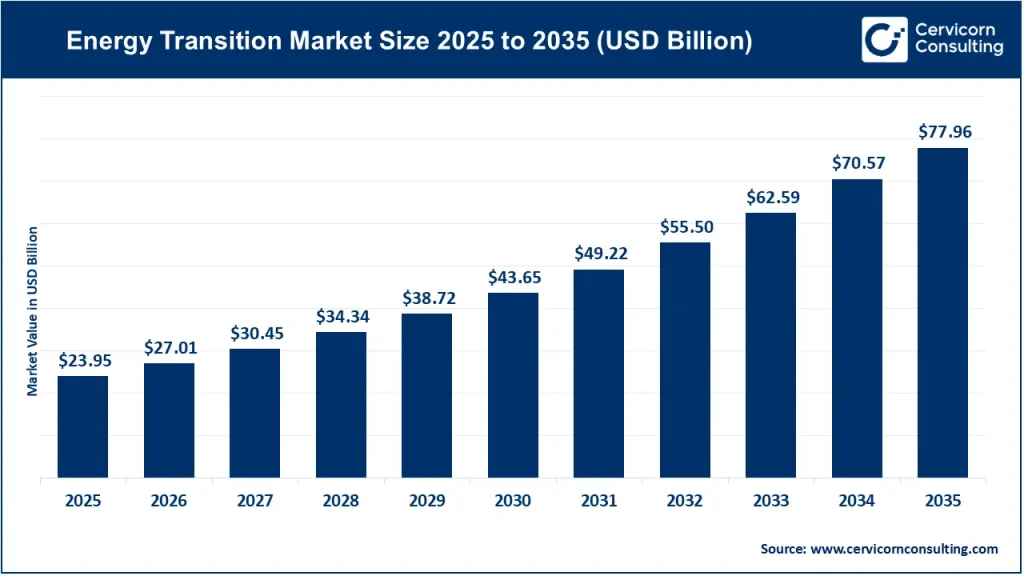
Energy Transition Market Size
The global energy transition market size was valued at approximately USD 23.95 billion in 2025 and is projected to reach about USD 77.96 billion by 2035, expanding at a 12.53% CAGR from 2026 to 2035.
Energy Transition Market Growth Factors
The energy transition market is being driven by a combination of climate targets, falling renewable-energy costs, electrification of transportation and industry, rising electricity demand, grid modernization, energy-security concerns, technological advances, corporate decarbonization commitments, and government incentives. Renewable power additions, battery storage, electric vehicles, green hydrogen, carbon-management technologies, smart grids, distributed energy resources, and energy-efficiency solutions are expanding the addressable market.
At the same time, electricity demand is increasing because of data centers, artificial intelligence, industrial reshoring, heat pumps, electric mobility, and broader electrification. The World Economic Forum reported that global energy demand increased 2.2% in 2024, while clean-energy investment exceeded USD 2 trillion, demonstrating the scale of capital moving into the transition even as energy-related emissions remained high.
Energy security is another major driver, encouraging countries to reduce dependence on imported fossil fuels by developing domestic renewable generation, storage, transmission networks, nuclear power, and alternative fuels. Utilities are consequently moving beyond traditional electricity generation and distribution toward integrated portfolios combining renewable generation, storage, digital grid technologies, demand response, electric-vehicle infrastructure, and flexible generation.
Get a Free Sample: https://www.cervicornconsulting.com/sample/2755
What Is the Energy Transition Market?
The energy transition market encompasses technologies, infrastructure, services, and investments that support the shift from carbon-intensive energy systems toward lower-carbon and increasingly clean energy systems.
It includes renewable energy technologies such as:
- Solar power
- Wind power
- Hydropower
- Geothermal energy
- Biomass and bioenergy
It also covers:
- Battery energy storage
- Smart grids and grid modernization
- Electric vehicles and charging infrastructure
- Energy efficiency
- Green hydrogen and low-carbon fuels
- Carbon capture and storage
- Electrification of buildings and industrial processes
- Distributed energy resources
- Digital energy-management systems
- Nuclear and other low-carbon power technologies
The market is therefore broader than the renewable-energy industry alone. It represents the transformation of the entire energy value chain, from electricity generation and transmission to transportation, buildings, industry, and energy consumption.
Why Is the Energy Transition Market Important?
Energy transition has become strategically important because energy systems influence economic competitiveness, national security, environmental sustainability, and industrial development.
Decarbonization
Reducing dependence on coal, oil, and natural gas is essential for lowering greenhouse-gas emissions. Renewable power, electrification, energy efficiency, storage, hydrogen, and carbon-management technologies are increasingly being deployed to reduce emissions across the energy system.
Energy Security
The transition can reduce exposure to volatile international fuel prices and geopolitical disruptions. Domestic solar, wind, hydropower, nuclear generation, storage, and interconnected electricity networks can improve energy resilience.
Rising Electricity Demand
Electrification is increasing electricity demand across transportation, buildings, manufacturing, and digital infrastructure. AI data centers are becoming a particularly important source of incremental electricity demand. This creates opportunities for utilities, renewable developers, grid operators, storage providers, and energy-technology companies.
Industrial Opportunity
Energy transition is creating new industries around batteries, solar modules, wind turbines, power electronics, electric vehicles, hydrogen, grid equipment, and energy software. Countries are increasingly viewing clean-energy manufacturing as an industrial-policy opportunity rather than solely an environmental objective.
Infrastructure Modernization
Large-scale renewable deployment requires stronger transmission and distribution networks, advanced grid management, storage, flexible generation, and digital monitoring. Consequently, grid infrastructure has become one of the most important investment areas within the energy transition ecosystem.
Leading Companies in the Energy Transition Market
The following companies are major U.S. electric and energy utilities with significant roles in grid modernization, clean-energy deployment, electrification, generation transformation, and infrastructure investment.
| Company | Specialization | Key Focus Areas | Notable Features | 2025 Revenue | Market Share* | Global Presence |
|---|---|---|---|---|---|---|
| Exelon Corporation | Regulated electricity and gas utilities | Grid modernization, electrification, resilience, clean energy | One of the largest U.S. regulated utility groups; operates through multiple utilities | USD 24.26B | Not separately disclosed | Primarily U.S. |
| Duke Energy Corporation | Electric and natural gas utilities | Renewable generation, grid investment, nuclear, storage, electrification | Large regulated utility footprint and major long-term capital program | USD 32.24B | Not separately disclosed | Primarily U.S. |
| Pacific Gas and Electric Company / PG&E Corporation | Electricity and natural gas utility | Grid resilience, wildfire mitigation, clean energy, electrification | Major California utility undergoing large-scale grid modernization | USD 24.94B | Not separately disclosed | U.S., primarily California |
| Southern Company | Electric and natural gas utilities | Nuclear, renewables, grid modernization, storage, reliability | Major Southeast U.S. utility group with significant nuclear and infrastructure investment | USD 29.55B | Not separately disclosed | Primarily U.S. |
| American Electric Power (AEP) | Electric generation, transmission and distribution | Transmission, renewables, grid expansion, electrification | Operates one of the largest electric transmission systems in the U.S. | USD 21.9B | Not separately disclosed | Primarily U.S. |
Exelon Corporation
Exelon is one of the largest U.S. regulated utilities, with operations focused on electricity and natural-gas distribution. Its 2025 total operating revenues reached USD 24.26 billion, including USD 22.66 billion from electric operating revenues and USD 2.35 billion from natural gas.
The company’s role in the energy transition is closely connected to distribution-grid modernization, system reliability, electrification, energy efficiency, and enabling customers to adopt cleaner technologies.
Exelon’s large regulated utility footprint gives it an important position in connecting renewable generation, electric vehicles, distributed energy resources, and changing customer demand to the electricity network.
Duke Energy Corporation
Duke Energy is one of the largest U.S. electric and natural gas utilities. The company reported USD 32.237 billion in total operating revenues in 2025, compared with USD 30.357 billion in 2024.
Duke’s energy-transition activities include renewable energy, grid modernization, nuclear generation, energy storage, electric-vehicle infrastructure, and system resilience. Its 2025 results were accompanied by a USD 103 billion five-year capital plan, illustrating the enormous infrastructure investment required to accommodate rising electricity demand and modernize the energy system.
Duke’s strategy demonstrates how traditional utilities are increasingly becoming infrastructure platforms for the electrification economy.
Pacific Gas and Electric Company
Pacific Gas and Electric Company, operated under PG&E Corporation, is one of the largest electric and natural gas utilities in California. Its 2025 operating revenues totaled USD 24.935 billion, consisting of USD 18.318 billion in electricity revenue and USD 6.617 billion in natural gas revenue.
PG&E’s transition priorities include grid resilience, wildfire mitigation, electrification, renewable-energy integration, distributed energy resources, and modernization of California’s electricity infrastructure.
California’s aggressive climate and clean-energy policies make PG&E particularly important to the development of advanced grid infrastructure and electrification technologies.
Southern Company
Southern Company operates major electric and natural gas businesses across the southeastern United States. The company reported USD 29.553 billion in 2025 operating revenues, up from USD 26.724 billion in 2024.
Southern Company’s energy-transition strategy includes nuclear power, renewable energy, battery storage, grid modernization, advanced technologies, and resilience. The company has also highlighted plans to invest more than USD 80 billion over five years to strengthen its grid and deploy advanced technologies.
Its approach illustrates the increasingly important role of nuclear generation and grid investment alongside renewable-energy development.
American Electric Power
American Electric Power is a major U.S. electric utility with one of the country’s largest transmission systems. AEP operates across multiple states, serves approximately 5.6 million U.S. customers, has approximately 40,000 miles of transmission lines, around 252,000 miles of distribution lines, and approximately 33 GW of generating capacity. Its 2025 revenue was USD 21.9 billion.
AEP’s energy-transition role is strongly linked to transmission expansion, renewable integration, grid modernization, and the infrastructure required to connect new generation and large electricity loads.
Leading Energy Transition Trends and Their Impact
1. Rapid Electrification
Transportation, buildings, industrial processes, and heating systems are increasingly being electrified.
The growth of electric vehicles, heat pumps, electric industrial equipment, and data centers is increasing electricity demand. This benefits utilities and grid-equipment suppliers while creating a requirement for substantial generation and transmission investment.
2. Renewable Energy Expansion
Solar and wind remain central to global energy-transition strategies because of their scalability and increasingly competitive economics.
Renewable investment reached approximately USD 690 billion globally in 2025, according to BloombergNEF.
The impact extends beyond generation. Greater renewable penetration increases demand for batteries, transmission, flexible generation, forecasting systems, and advanced grid controls.
3. Battery Energy Storage
Battery storage is becoming an essential component of modern electricity systems because solar and wind output varies according to weather conditions.
Storage enables electricity to be shifted from periods of high renewable generation to periods of high demand. It can also provide frequency regulation, backup power, and grid-balancing services.
4. Grid Modernization
The energy transition cannot scale without modern electricity networks.
Transmission and distribution systems must accommodate two-way power flows, distributed generation, electric vehicles, batteries, smart meters, and rapidly changing demand patterns.
Global grid investment reached approximately USD 483 billion in 2025, according to BloombergNEF.
5. AI and Data Center Power Demand
AI is emerging as an unexpected accelerator of the energy transition.
Large data centers require significant quantities of reliable electricity, encouraging utilities to invest in generation, transmission, storage, and advanced energy-management systems.
This is creating a new balance between decarbonization and energy abundance: countries increasingly need clean energy while simultaneously expanding overall electricity supply.
6. Green Hydrogen and Low-Carbon Fuels
Hydrogen is gaining attention in sectors that are difficult to electrify directly, including heavy industry, chemicals, shipping, and potentially aviation.
Although investment remains smaller than in renewable energy and transportation, hydrogen could become strategically important for industrial decarbonization.
7. Distributed Energy Resources
Rooftop solar, home batteries, smart thermostats, electric vehicles, and virtual power plants are turning consumers into active participants in electricity markets.
Distributed systems can reduce pressure on centralized infrastructure and provide flexibility during periods of peak demand. Residential battery attachment to new U.S. solar installations reached 37% in 2025, highlighting the growing relationship between solar generation and storage.
Successful Examples of Energy Transition Around the World
Denmark: Wind-Powered Energy Transition
Denmark is one of the world’s best-known energy-transition examples. Wind generated approximately 54% of Denmark’s electricity, while wind, bioenergy, and solar together represented 81% of the country’s power mix according to the IEA’s Denmark assessment.
Denmark has combined wind development with district heating, energy efficiency, electricity interconnections, and emerging Power-to-X technologies.
The country demonstrates that high renewable penetration can be supported by grid interconnection, flexible energy systems, and coordinated national policy.
Germany: Energiewende
Germany’s Energiewende represents one of the world’s most ambitious long-term energy-transition programs. The country has expanded wind and solar generation while pursuing reductions in fossil-fuel dependence.
The German experience demonstrates the importance of long-term policy frameworks, renewable incentives, grid investment, and industrial participation.
China: Large-Scale Renewable Deployment
China has emerged as a global leader in renewable-energy deployment and clean-energy manufacturing.
Its scale in solar, wind, batteries, electric vehicles, and associated supply chains has significantly influenced global technology costs and deployment rates.
China’s clean-energy investment reached an estimated USD 627 billion in 2025, according to the World Economic Forum’s 2026 Energy Transition Index analysis.
India: Solar and Diversified Clean Energy
India is rapidly expanding renewable-energy capacity while continuing to meet substantial growth in electricity demand.
The country reached 100 GW of installed solar capacity in February 2025 and has a target of 500 GW of non-fossil energy capacity by 2030. India has also committed to achieving net-zero emissions by 2070.
India’s transition is particularly significant because it combines rapid economic development with increasing renewable deployment, electrification, energy efficiency, and domestic clean-energy manufacturing.
Australia: Renewable Energy and Battery Storage
Australia has demonstrated the potential of combining renewable generation with large-scale battery storage. The Hornsdale Power Reserve in South Australia is frequently cited as an example of how battery storage can support grid stability and renewable integration.
Global Regional Analysis
North America
North America remains one of the most important energy-transition markets because of its enormous electricity infrastructure, industrial base, capital availability, and growing electricity demand.
The United States is experiencing strong investment in renewable generation, batteries, transmission, nuclear power, carbon-management technologies, electric vehicles, and grid modernization.
Federal and state-level policies have historically supported clean-energy investment through tax incentives, grants, loans, emissions regulations, renewable-energy standards, and infrastructure programs. At the same time, the rapid growth of AI data centers and manufacturing is increasing the need for reliable generation and transmission.
Utilities including Exelon, Duke Energy, PG&E, Southern Company, and AEP are therefore positioned at the intersection of energy transition and rapidly growing electricity demand.
Canada is also advancing clean electricity through renewable generation, hydroelectricity, nuclear power, transmission development, carbon pricing, and clean-energy investment programs.
Europe
Europe remains a policy-driven center of energy transition.
The European Union’s climate and energy framework emphasizes renewable energy, energy efficiency, emissions reduction, electrification, clean hydrogen, grid development, and energy security.
The region’s energy transition accelerated following the energy-security challenges created by Russia’s invasion of Ukraine, strengthening the economic case for domestic renewable energy and diversification.
Cross-border infrastructure is becoming increasingly important. In 2026, Denmark and Germany agreed to cooperate on the Bornholm Energy Island, including 3 GW of offshore wind capacity connected to both countries. The project has received €645 million in EU support through the Connecting Europe Facility.
The North Sea is also emerging as a major offshore-wind and cross-border electricity hub, with European governments targeting substantial interconnected offshore capacity.
Asia Pacific
Asia Pacific represented approximately 44.6% of the global energy transition market in 2025, making it the largest regional market.
China is the dominant force in large-scale renewable manufacturing and deployment, while India is rapidly expanding solar, wind, storage, transmission, and electrification.
Japan and South Korea are emphasizing hydrogen, batteries, offshore wind, nuclear power, energy efficiency, and advanced energy technologies.
The region’s enormous population, manufacturing base, industrial demand, and expanding electricity consumption make Asia Pacific central to the global transition.
Latin America
Latin America benefits from substantial renewable-energy resources, particularly hydropower, solar, wind, and bioenergy.
Brazil is a leading regional market because of its relatively clean electricity mix and established biofuels sector. The country is also expanding transmission infrastructure and renewable-energy auctions to attract private investment.
Other markets, including Chile, Mexico, Colombia, and Argentina, are developing solar, wind, green hydrogen, storage, and transmission opportunities.
Brazil’s experience demonstrates the value of competitive auctions, long-term contracts, and transmission investment for attracting private capital.
Middle East and Africa
The Middle East is increasingly diversifying from oil and gas toward solar power, hydrogen, carbon management, and low-carbon industrial development.
Countries such as the United Arab Emirates and Saudi Arabia are investing heavily in utility-scale solar and emerging hydrogen value chains.
Africa presents both a major challenge and an enormous opportunity. Many countries have low levels of electricity access but substantial solar, wind, hydro, and geothermal resources.
The energy transition in Africa therefore differs from mature markets: it is not only about replacing fossil fuels but also about expanding electricity access, improving energy affordability, developing decentralized energy systems, and creating local clean-energy industries.
Government Initiatives and Policies Shaping the Energy Transition Market
Government policy remains one of the strongest determinants of energy-transition investment.
United States
U.S. policy has supported clean-energy investment through tax incentives, infrastructure funding, renewable-energy programs, grid investments, energy-efficiency measures, and incentives for domestic manufacturing.
At the state level, renewable portfolio standards, clean-energy standards, utility integrated-resource planning, electric-vehicle policies, and building-efficiency requirements continue to shape investment.
European Union
The European Union is pursuing policies focused on renewable energy, emissions reduction, energy efficiency, electrification, clean hydrogen, carbon reduction, and energy security.
EU energy cooperation increasingly emphasizes both domestic transition and partnerships with major markets such as China and India.
China
China has combined national energy targets, renewable deployment programs, industrial policy, infrastructure investment, manufacturing support, and research and development to create one of the world’s largest clean-energy ecosystems.
This integrated approach has helped China build substantial positions across solar, wind, batteries, electric vehicles, and associated supply chains.
India
India’s policy framework includes a target of 500 GW of non-fossil electricity capacity by 2030, a net-zero target for 2070, expansion of solar and wind, domestic clean-energy manufacturing, energy-efficiency programs, and green-hydrogen development.
India is also increasing its wind-energy manufacturing and deployment capacity. By 2026, the country had a substantial project pipeline and was targeting continued expansion toward 2030 and beyond.
Japan and South Korea
Japan and South Korea are emphasizing energy efficiency, renewable power, nuclear energy, hydrogen, ammonia, batteries, and advanced energy technologies.
Their strategies reflect the constraints of energy-import-dependent economies and place strong emphasis on energy security and technological leadership.
Emerging Markets
Emerging markets increasingly require international climate finance, development-bank participation, private investment, blended finance, and technology transfer.
Indonesia’s Just Energy Transition Partnership illustrates both the potential and difficulty of financing coal-to-clean-energy transitions in emerging economies.
Future Market Outlook
The energy transition market is moving from a policy-led growth phase toward a broader infrastructure and economic transformation.
The next stage will increasingly be shaped by electricity demand growth, grid constraints, energy storage, AI-driven power consumption, industrial electrification, renewable generation, nuclear power, and energy security.
The scale of capital required remains substantial. The World Economic Forum estimates that clean-energy investment exceeded USD 2 trillion in 2024 but remained significantly below the approximately USD 5.6 trillion required annually through 2030 to achieve global transition objectives.
This gap creates significant opportunities for utilities, renewable developers, grid-equipment manufacturers, battery companies, energy-management software providers, engineering firms, investors, and infrastructure developers.
The market is also becoming increasingly interconnected. Solar and wind require transmission; transmission requires digital controls; renewable generation requires storage; electrification increases electricity demand; and rising electricity demand requires new generation and stronger grids.
As a result, the energy transition is no longer limited to replacing fossil fuels with renewables. It is evolving into a comprehensive transformation of how electricity is generated, transmitted, stored, managed, transported, and consumed.
To Get Detailed Overview, Contact Us: https://www.cervicornconsulting.com/contact-us
Read Report: Biohydrogen Market Revenue, Trends, and Strategic Insights by 2035