


Table of Contents
ToggleWater 4.0 Market Size
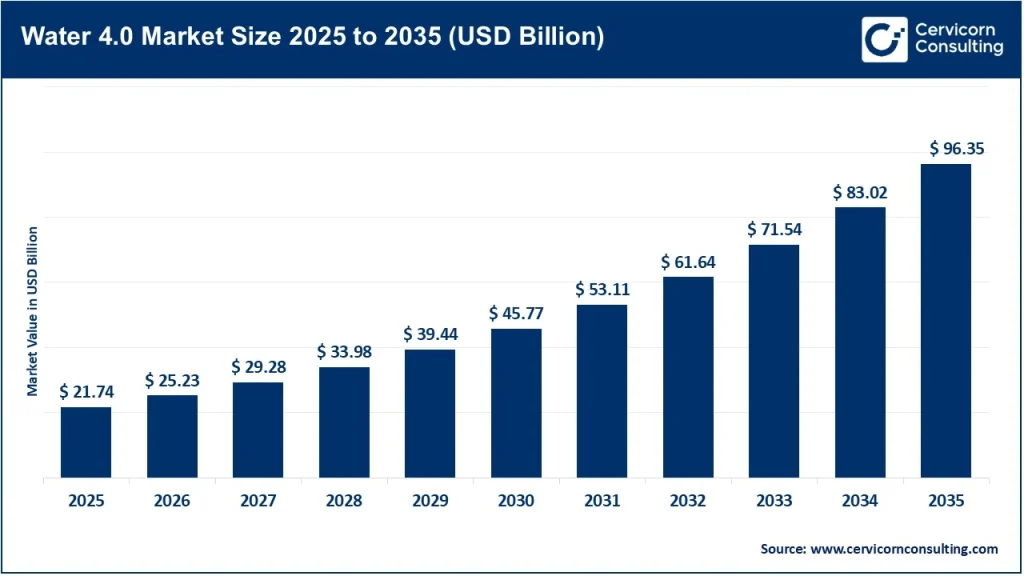
The global water 4.0 market was valued at approximately USD 21.74 billion in 2025 and is projected to reach nearly USD 96.35 billion by 2035, expanding at a compound annual growth rate (CAGR) of about 16.1% between 2026 and 2035.
What is the Water 4.0 Market?
The Water 4.0 market refers to the adoption of Industry 4.0 technologies in water and wastewater management systems. It encompasses smart sensors, digital twins, AI-driven analytics, predictive maintenance, smart metering, automated treatment systems, and real-time monitoring platforms that improve water efficiency and operational performance.
Water 4.0 combines traditional water infrastructure with digital intelligence, enabling utilities, municipalities, and industrial users to monitor, manage, and optimize water resources throughout the entire water lifecycle—from sourcing and treatment to distribution, consumption, and reuse.
The market includes solutions for:
- Smart water networks
- Advanced water treatment systems
- Digital monitoring platforms
- Smart metering infrastructure
- Leak detection technologies
- Predictive asset management
- Wastewater management automation
- Cloud-based water analytics
Why is Water 4.0 Important?
Water 4.0 is becoming increasingly important because global water demand is expected to rise significantly due to population growth, urbanization, industrialization, and climate change. Traditional water management systems often suffer from inefficiencies such as water loss, delayed maintenance, and limited visibility into network performance.
The adoption of Water 4.0 technologies helps organizations:
- Reduce non-revenue water losses
- Improve water quality monitoring
- Enhance operational efficiency
- Optimize energy consumption
- Extend infrastructure lifespan
- Enable predictive maintenance
- Support sustainability goals
- Improve regulatory compliance
- Strengthen drought resilience
- Facilitate water reuse and recycling
As water security becomes a global priority, digital transformation is increasingly viewed as a necessity rather than an option.
Get a Free Sample: https://www.cervicornconsulting.com/sample/2960
Water 4.0 Market Growth Factors
The Water 4.0 market is experiencing substantial growth due to rising concerns about water scarcity, increasing investments in smart city projects, growing adoption of IoT-enabled water monitoring systems, rapid urbanization, aging water infrastructure, stricter environmental regulations, increasing industrial demand for water optimization, advancements in artificial intelligence and machine learning technologies, expansion of cloud-based water management platforms, rising government investments in wastewater treatment facilities, growing emphasis on sustainability and carbon reduction targets, increasing deployment of smart meters, and the need for real-time monitoring and predictive maintenance solutions across municipal and industrial water networks.
Leading Companies in the Water 4.0 Market
The competitive landscape is dominated by technology providers, water treatment specialists, automation companies, and digital infrastructure providers.
| Company | Specialization | Key Focus Areas | Notable Features | 2025 Revenue* | Estimated Market Share | Global Presence |
|---|---|---|---|---|---|---|
| Xylem | Smart water infrastructure and analytics | Smart metering, water treatment, network intelligence | AI-driven water management, digital twins, leak detection | Approximately $9.0 Billion | 8–10% | 150+ countries |
| Veolia Water Technologies | Water and wastewater treatment | Industrial water solutions, recycling, desalination | Advanced treatment technologies and sustainability solutions | Water Technologies revenue approximately €4.95 Billion | 7–9% | 50+ countries |
| SUEZ Water Technologies & Solutions | Water treatment and resource recovery | Smart treatment plants, digital water services | Industrial and municipal water optimization | Estimated multi-billion-dollar business segment | 5–7% | Global operations |
| ABB | Industrial automation and digitalization | Smart pumps, SCADA systems, analytics | AI-enabled process optimization | ABB Group revenue exceeds $30 Billion annually | 4–6% | 100+ countries |
| Schneider Electric | Water automation and energy management | Smart water networks, control systems | EcoStruxure digital water platform | Revenue exceeds €38 Billion annually | 4–6% | 100+ countries |
Leading Trends Shaping the Water 4.0 Market
1. Artificial Intelligence and Predictive Analytics
AI-powered systems are enabling utilities to forecast equipment failures, optimize treatment processes, and reduce operational costs. Predictive analytics helps identify potential pipeline failures before they occur, minimizing disruptions and maintenance expenses.
Impact:
- Reduced downtime
- Lower maintenance costs
- Improved water quality
- Better resource allocation
2. Smart Water Metering
The deployment of Advanced Metering Infrastructure (AMI) is transforming water consumption monitoring. Smart meters provide real-time consumption data and improve billing accuracy.
Impact:
- Reduced water wastage
- Improved customer engagement
- Enhanced revenue collection
- Better demand forecasting
3. Digital Twins
Digital twins create virtual replicas of water systems, allowing operators to simulate scenarios and optimize performance.
Impact:
- Enhanced planning capabilities
- Faster decision-making
- Reduced operational risks
- Improved infrastructure resilience
4. Internet of Things (IoT) Integration
IoT sensors are increasingly being installed throughout water networks to monitor pressure, flow, quality, and infrastructure health.
Impact:
- Real-time monitoring
- Early leak detection
- Improved operational visibility
- Better regulatory compliance
5. Cloud-Based Water Management
Cloud platforms enable centralized monitoring of distributed water assets and facilitate data-driven decision-making.
Impact:
- Scalability
- Improved collaboration
- Reduced IT costs
- Enhanced data accessibility
6. Water Reuse and Circular Water Systems
Growing water scarcity is encouraging industries and municipalities to adopt water recycling and reuse technologies.
Impact:
- Reduced freshwater consumption
- Sustainability improvements
- Lower operating costs
- Enhanced water security
Successful Examples of Water 4.0 Around the World
Singapore’s Smart Water Management Program
Singapore has become a global benchmark for Water 4.0 adoption. The country’s national water agency utilizes advanced sensors, predictive analytics, and digital monitoring systems to optimize water distribution and treatment operations.
Key achievements include:
- Real-time network monitoring
- Smart water quality management
- Reduced water losses
- Enhanced drought resilience
Thames Water Digital Transformation – United Kingdom
Thames Water has invested heavily in smart sensors and digital monitoring technologies to identify leaks and improve operational efficiency.
Benefits achieved:
- Faster leak detection
- Reduced non-revenue water
- Improved customer service
- Enhanced network reliability
Smart Water Grid in South Korea
South Korea has implemented smart water grid initiatives that integrate IoT devices and AI-powered analytics across municipal water networks.
Results include:
- Improved water conservation
- Better infrastructure management
- Reduced operational costs
- Enhanced sustainability
Digital Water Utility Programs in Australia
Australia has adopted advanced digital water management systems to address recurring drought conditions and improve water resource planning.
Outcomes include:
- Improved drought preparedness
- Enhanced water allocation
- Better infrastructure utilization
- Increased efficiency
Smart Water Cities in the Netherlands
Netherlands is utilizing AI-driven water management platforms and digital twins to strengthen urban water resilience.
Benefits include:
- Flood risk reduction
- Improved urban planning
- Better asset management
- Increased operational efficiency
Global Regional Analysis
North America
North America remains one of the most advanced markets for Water 4.0 technologies due to aging infrastructure, strong utility investments, and favorable government funding programs.
Key Drivers
- Aging water pipelines
- Smart city initiatives
- Water conservation programs
- Advanced digital infrastructure
Government Initiatives
The United States government continues to support water infrastructure modernization through federal funding initiatives and infrastructure investment programs focused on resilience, cybersecurity, and digital transformation.
Market Outlook
The region is expected to maintain strong growth due to continued investments in smart utilities and wastewater treatment modernization.
Europe
Europe is a leading adopter of sustainable water technologies, driven by strict environmental regulations and ambitious climate goals.
Key Drivers
- Circular economy initiatives
- Water reuse programs
- Carbon neutrality targets
- Digital utility transformation
Government Policies
The European Commission promotes smart water management through water framework directives, sustainability regulations, and funding programs that encourage digitalization and resource efficiency.
Market Outlook
Increasing emphasis on sustainability and climate adaptation will continue driving Water 4.0 adoption across the region.
Asia-Pacific
Asia-Pacific represents the fastest-growing Water 4.0 market due to rapid urbanization, industrialization, and increasing water stress.
Key Drivers
- Population growth
- Urban infrastructure development
- Industrial expansion
- Smart city investments
Government Initiatives
China
China is investing heavily in smart city infrastructure and digital water monitoring systems under its urban modernization strategies.
India
India supports water digitization through programs such as:
- Jal Jeevan Mission
- Smart Cities Mission
- AMRUT (Atal Mission for Rejuvenation and Urban Transformation)
- National Water Mission
These initiatives encourage smart metering, water conservation, and infrastructure modernization.
Japan
Japan continues investing in advanced water treatment technologies and automation systems to address aging infrastructure and population challenges.
Market Outlook
Asia-Pacific is expected to record the highest growth rate due to extensive investments in digital infrastructure and water security.
Latin America
Water scarcity and infrastructure modernization needs are creating opportunities for Water 4.0 deployment throughout Latin America.
Key Drivers
- Urbanization
- Water loss reduction programs
- Utility modernization
- Climate resilience initiatives
Government Policies
Countries such as Brazil, Chile, and Mexico are promoting water infrastructure investments and public-private partnerships to improve water management efficiency.
Market Outlook
Digital water technologies are expected to gain momentum as governments focus on reducing non-revenue water losses.
Middle East & Africa
The region is emerging as a significant market for Water 4.0 technologies due to extreme water scarcity and growing desalination investments.
Key Drivers
- Water scarcity
- Desalination expansion
- Population growth
- Industrial development
Government Initiatives
Saudi Arabia
Saudi Arabia is investing in smart water infrastructure under Vision 2030, including digital water networks and advanced desalination projects.
United Arab Emirates
United Arab Emirates is deploying AI-based water management systems to improve efficiency and support sustainability goals.
Market Outlook
Growing investments in desalination and smart utility infrastructure are expected to accelerate Water 4.0 adoption throughout the region.
Future Outlook
The Water 4.0 market is positioned for substantial expansion as governments, municipalities, and industries prioritize digital transformation, sustainability, and water security. The integration of AI, IoT, cloud computing, and predictive analytics into water management systems will continue to reshape the industry, creating smarter, more resilient, and more sustainable water ecosystems worldwide. Rising investments in smart cities, climate adaptation strategies, wastewater reuse, and intelligent infrastructure will further strengthen the market’s long-term growth trajectory.
To Get Detailed Overview, Contact Us: https://www.cervicornconsulting.com/contact-us
Read Report: Pharma 5.0 Market Revenue, Trends, and Strategic Insights by 2035