


Table of Contents
ToggleU.S. Long Term Care Market Size
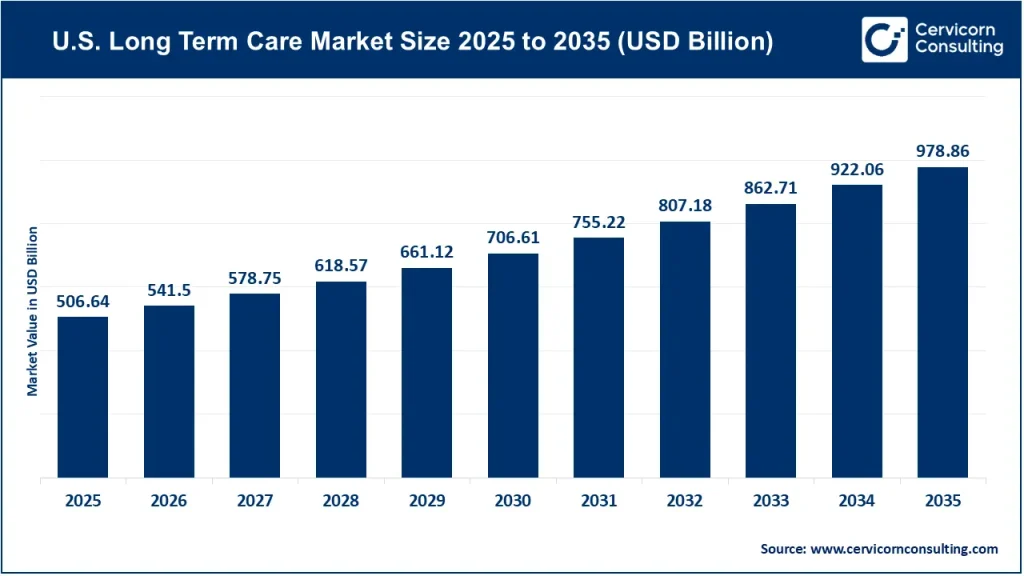
The U.S. long term care market was valued at approximately USD 506.64 billion in 2025 and is projected to reach USD 978.86 billion by 2035, expanding at a CAGR of 6.81% during the forecast period.
U.S. Long Term Care Market Growth Factors
The U.S. long term care market is experiencing significant growth due to the rapidly aging population, increasing life expectancy, rising prevalence of chronic diseases such as Alzheimer’s disease, dementia, diabetes, cardiovascular disorders, and mobility impairments, growing demand for home healthcare services, technological advancements in remote patient monitoring and digital health, expansion of Medicare Advantage and Medicaid-funded long-term services, increasing preference for aging in place, workforce investments in skilled nursing and rehabilitation services, greater adoption of value-based care models, rising healthcare expenditures, expanding hospice and palliative care services, and continuous investments by public and private organizations in senior care infrastructure.
Additionally, the growing integration of artificial intelligence, telehealth, predictive analytics, wearable health devices, and electronic health records is improving care coordination, reducing hospital readmissions, and enhancing patient outcomes, making long-term care one of the fastest-evolving healthcare segments in the United States.
Get a Free Sample: https://www.cervicornconsulting.com/sample/2709
What is the U.S. Long Term Care Market?
The U.S. long term care (LTC) market encompasses a broad range of healthcare, medical, personal, and social support services designed for individuals who require assistance with daily living activities over an extended period. These services are primarily utilized by elderly adults, individuals with disabilities, patients recovering from severe illnesses, and people living with chronic conditions.
Long-term care extends beyond traditional hospital treatment. It includes continuous assistance with activities such as bathing, dressing, eating, medication management, rehabilitation, mobility support, memory care, skilled nursing, hospice care, and home healthcare.
The market consists of several care settings, including:
- Nursing homes
- Skilled nursing facilities
- Assisted living communities
- Home healthcare agencies
- Hospice providers
- Adult day care centers
- Rehabilitation facilities
- Memory care communities
- Continuing Care Retirement Communities (CCRCs)
As healthcare shifts toward patient-centered care, home-based long-term care has become one of the fastest-growing segments due to improved affordability, convenience, and patient satisfaction.
Why is the U.S. Long Term Care Market Important?
Long-term care has become a cornerstone of the U.S. healthcare system because millions of Americans require ongoing medical and non-medical support throughout their lives.
Several factors underline its importance.
Growing Elderly Population
The United States is witnessing one of the largest demographic shifts in history. Baby Boomers are entering retirement age, substantially increasing demand for assisted living, skilled nursing, rehabilitation, and home healthcare services.
Rising Burden of Chronic Diseases
Conditions such as Alzheimer’s disease, Parkinson’s disease, diabetes, arthritis, stroke, and heart disease require continuous monitoring and long-term management.
Reduced Hospital Readmissions
Long-term care providers improve recovery while lowering unnecessary hospital admissions, reducing healthcare costs across the system.
Improved Quality of Life
Modern long-term care focuses on personalized treatment plans, rehabilitation, emotional wellbeing, nutrition, and independent living rather than solely treating illnesses.
Economic Contribution
The market supports millions of healthcare workers, including:
- Registered nurses
- Licensed practical nurses
- Physical therapists
- Occupational therapists
- Speech therapists
- Home health aides
- Care coordinators
- Social workers
The sector also drives investments in healthcare infrastructure, medical technology, and senior housing.
Major Segments of the U.S. Long Term Care Market
The market includes multiple service categories.
Home Healthcare
Provides nursing, therapy, rehabilitation, and personal care directly in patients’ homes.
Skilled Nursing Facilities
Offer 24-hour medical supervision, rehabilitation, and specialized nursing services.
Assisted Living
Provides housing combined with assistance for daily activities while maintaining resident independence.
Hospice Care
Focuses on comfort care and quality of life for patients with terminal illnesses.
Memory Care
Specialized facilities designed for Alzheimer’s and dementia patients.
Rehabilitation Centers
Provide post-surgical recovery, orthopedic rehabilitation, stroke rehabilitation, and physical therapy.
Major Companies Operating in the U.S. Long Term Care Market
| Company | Specialization | Key Focus Areas | Notable Features | 2025 Revenue (Approx.) | Estimated Market Share |
|---|---|---|---|---|---|
| Brookdale Senior Living Inc. | Senior living communities, assisted living, memory care | Independent living, assisted living, dementia care | One of the largest senior living operators in the U.S. with nationwide facilities | Approximately USD 3.2 Billion | 5–7% |
| Genesis HealthCare | Skilled nursing, rehabilitation, post-acute care | Skilled nursing facilities, rehabilitation therapy, transitional care | Extensive network of skilled nursing and rehabilitation centers | Approximately USD 2.3 Billion | 3–5% |
| LHC Group, Inc. | Home healthcare and hospice | Home nursing, hospice, home therapy | Strong partnerships with hospital systems and community-based care | Approximately USD 2.6 Billion* | 4–6% |
| Amedisys Inc. | Home health, hospice, personal care | Skilled home healthcare, palliative care, telehealth | Leading provider of home-based healthcare with advanced care coordination | Approximately USD 2.4 Billion* | 4–5% |
| Enhabit Inc. (formerly part of Encompass Health) | Home health and hospice | Rehabilitation, home nursing, hospice | Focuses on integrated home-based care with broad geographic coverage | Approximately USD 1.1 Billion | 2–3% |
Leading Trends Transforming the U.S. Long Term Care Market
1. Rapid Growth of Home-Based Healthcare
Patients increasingly prefer receiving medical services at home instead of institutional settings.
Impact:
- Lower healthcare costs
- Better patient satisfaction
- Reduced infection risks
- Faster recovery
2. Artificial Intelligence in Patient Monitoring
AI is helping providers predict health deterioration before emergencies occur.
Applications include:
- Fall detection
- Medication adherence
- Risk prediction
- Clinical decision support
Impact:
- Reduced hospital readmissions
- Improved patient safety
- Higher operational efficiency
3. Telehealth Integration
Virtual consultations have become standard in long-term care.
Benefits include:
- Remote physician access
- Mental health support
- Medication management
- Chronic disease monitoring
Impact:
Improves healthcare accessibility for rural and mobility-limited patients.
4. Expansion of Memory Care Services
Growing Alzheimer’s and dementia cases have increased investments in specialized facilities.
Providers are introducing:
- Cognitive therapy
- Personalized care plans
- Secure environments
- Behavioral support programs
Impact:
Improves quality of life while supporting caregivers.
5. Smart Healthcare Technologies
Digital transformation is reshaping long-term care facilities.
Examples include:
- Smart beds
- Wearable sensors
- Electronic health records
- Remote monitoring systems
- Automated medication dispensing
Impact:
Enhances care quality while reducing operational costs.
6. Workforce Development Programs
Healthcare providers continue investing in:
- Nurse training
- Retention initiatives
- Career advancement
- Workforce automation
Impact:
Addresses staffing shortages while improving patient outcomes.
7. Value-Based Care Models
Instead of rewarding service volume, providers are increasingly compensated based on patient outcomes.
Impact:
- Better clinical performance
- Lower healthcare expenditures
- Increased accountability
Technology Revolutionizing Long-Term Care
Technology has become central to improving care delivery.
Major innovations include:
Artificial Intelligence
- Clinical decision support
- Predictive analytics
- Personalized treatment planning
Internet of Things (IoT)
Connected devices monitor:
- Heart rate
- Blood pressure
- Oxygen levels
- Sleep quality
- Physical activity
Robotics
Robotic assistants help with:
- Mobility support
- Medication reminders
- Patient engagement
- Rehabilitation
Cloud-Based Health Records
Cloud platforms enable seamless information sharing among hospitals, physicians, specialists, therapists, and caregivers.
Successful Examples of the U.S. Long Term Care Market Around the World
Although the U.S. market is unique, several international models demonstrate successful long-term care approaches that influence global best practices.
Japan’s Long-Term Care Insurance (LTCI) System
Japan introduced a nationwide Long-Term Care Insurance system to support its aging population. The program emphasizes community-based services, home care, preventive care, and rehabilitation while reducing the burden on families. Its structured funding model and focus on aging in place have inspired policymakers and healthcare providers worldwide.
Impact
- Expanded access to long-term care services.
- Encouraged preventive and home-based care.
- Reduced reliance on acute hospital care.
- Improved quality of life for older adults.
The Netherlands’ Community-Based Elder Care
The Netherlands has developed an integrated care model that combines home healthcare, nursing services, social support, and rehabilitation. Multidisciplinary teams coordinate care, allowing many older adults to remain in their homes for longer periods.
Impact
- High patient satisfaction.
- Strong coordination between healthcare providers.
- Reduced institutionalization.
- Better chronic disease management.
Germany’s Long-Term Care Insurance Model
Germany’s mandatory long-term care insurance provides financial support for institutional and home-based care. Individuals can choose between cash benefits for family caregiving or professional care services, offering flexibility and encouraging personalized care.
Impact
- Broader financial protection for families.
- Increased availability of home care services.
- Balanced public and private care delivery.
Scandinavian Digital Elder Care Programs
Countries such as Sweden and Denmark have integrated digital technologies into elder care through remote monitoring, electronic health records, and telehealth services. Municipal healthcare systems collaborate with technology providers to deliver continuous care while promoting independence among seniors.
Impact
- Improved monitoring of chronic conditions.
- Greater efficiency in care coordination.
- Enhanced patient safety through digital tools.
- Support for aging in place.
Australia’s Consumer-Directed Home Care
Australia’s consumer-directed home care approach gives older adults greater control over the services they receive. Funding is allocated based on assessed needs, allowing individuals to tailor care plans to their preferences and maintain independence.
Impact
- Increased patient choice and satisfaction.
- Flexible service delivery.
- Strong emphasis on home-based care and quality standards.
Government Initiatives and Policies Shaping the U.S. Long Term Care Market
Government support plays a crucial role in expanding access, improving quality, and ensuring affordability of long-term care services across the United States.
Medicare and Medicaid Long-Term Care Support
Medicaid remains the largest public payer for long-term services and supports, covering nursing facility care and many home- and community-based services for eligible individuals. Medicare complements this by covering limited skilled nursing and home health services following qualifying hospital stays.
Market Impact
- Increased accessibility for low-income populations.
- Growth of home- and community-based care.
- Financial stability for long-term care providers.
Home and Community-Based Services (HCBS) Expansion
Federal and state initiatives continue to expand HCBS programs, enabling more individuals to receive care in their homes rather than institutional settings. Waiver programs and state innovations have broadened eligibility and service options.
Market Impact
- Rising demand for home healthcare agencies.
- Greater patient independence.
- Lower institutional care costs.
Value-Based Care and Quality Reporting Programs
The Centers for Medicare & Medicaid Services (CMS) has implemented quality reporting, star ratings, and value-based purchasing initiatives for nursing homes, home health agencies, and skilled nursing facilities. These programs tie reimbursement to care quality and patient outcomes.
Market Impact
- Improved accountability and transparency.
- Better patient outcomes.
- Incentives for quality improvement.
Workforce Development and Training Initiatives
Federal and state governments have introduced grants, loan repayment programs, and workforce development initiatives to address shortages of nurses, therapists, and direct care workers. These efforts support recruitment, retention, and ongoing professional education.
Market Impact
- Enhanced staffing capacity.
- Improved quality of care.
- Greater resilience of the long-term care workforce.
Digital Health and Telehealth Policies
Policies supporting reimbursement for telehealth services and investment in health information technology have accelerated digital transformation in long-term care. Remote patient monitoring and virtual consultations are increasingly integrated into care delivery.
Market Impact
- Expanded access to specialist care.
- Better chronic disease management.
- Improved care coordination across providers.
Infection Prevention and Emergency Preparedness Standards
Following recent public health emergencies, regulators have strengthened infection control requirements, emergency preparedness protocols, and reporting standards for long-term care facilities. Providers are investing in staff training, infrastructure, and surveillance systems to meet these expectations.
Market Impact
- Higher patient safety standards.
- Increased operational resilience.
- Greater public confidence in long-term care services.
To Get Detailed Overview, Contact Us: https://www.cervicornconsulting.com/contact-us
Read Report: Clinical Decision Support Systems (CDSS) Market Revenue, Trends, and Strategic Insights by 2035