


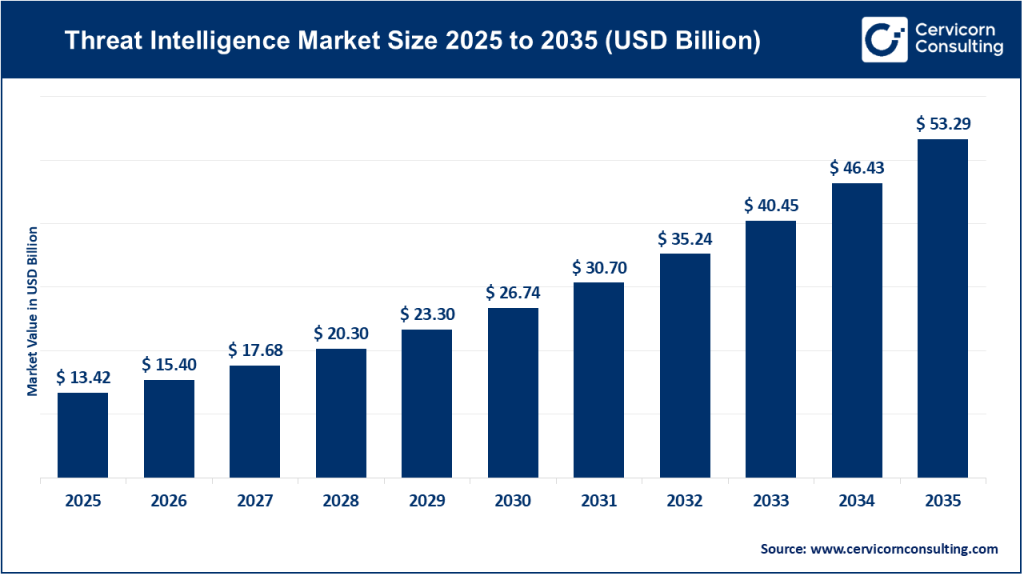
Threat Intelligence Market Size
The global threat intelligence market is experiencing rapid expansion. It was valued at approximately USD 13.42 billion in 2025 and is projected to grow significantly, reaching up to USD 53.29 billion by 2035 with a CAGR of 14.8%, driven by increasing cyber threats and digital transformation initiatives.
What is the Threat Intelligence Market?
The threat intelligence market refers to the global ecosystem of technologies, platforms, services, and solutions designed to collect, analyze, and interpret data related to cybersecurity threats. These solutions provide actionable insights that help organizations detect, prevent, and respond to cyberattacks proactively rather than reactively.
Threat intelligence integrates data from multiple sources such as network logs, dark web monitoring, malware analysis, and user behavior analytics. It enables security teams to understand attacker tactics, techniques, and procedures (TTPs), allowing organizations to anticipate and mitigate risks before they escalate into serious incidents.
The market encompasses various offerings including:
- Strategic threat intelligence (high-level risk insights)
- Tactical intelligence (attack patterns and indicators)
- Operational intelligence (real-time threat monitoring)
- Technical intelligence (IP addresses, malware signatures, etc.)
Why is the Threat Intelligence Market Important?
The importance of threat intelligence has grown dramatically as cyberattacks become more frequent, sophisticated, and financially damaging.
1. Proactive Cybersecurity
Traditional security systems are reactive—they respond after an attack occurs. Threat intelligence shifts the approach to proactive defense, identifying threats before they impact systems.
2. Protection Against Advanced Threats
Modern cyber threats such as ransomware-as-a-service, phishing campaigns, and advanced persistent threats (APTs) require intelligent detection mechanisms. Threat intelligence helps identify patterns and predict attacker behavior.
3. Enhanced Incident Response
Threat intelligence improves Security Operations Center (SOC) efficiency by enabling faster detection and response, reducing dwell time and minimizing damage.
4. Risk Management and Compliance
Organizations must comply with regulations like GDPR, HIPAA, and other frameworks. Threat intelligence helps assess risks and ensures compliance with cybersecurity standards.
5. Business Continuity
Cyberattacks can disrupt operations and cause financial losses. Threat intelligence helps organizations maintain uptime and continuity by preventing breaches.
Get a Free Sample: https://www.cervicornconsulting.com/sample/2915
Threat Intelligence Market Growth Factors
The growth of the threat intelligence market is driven by the rapid rise in cyberattacks, increasing adoption of cloud computing and digital transformation, expansion of remote and hybrid work environments, growing regulatory compliance requirements, and advancements in artificial intelligence and machine learning technologies that enhance predictive threat detection capabilities; additionally, the proliferation of ransomware-as-a-service, geopolitical tensions fueling cyber warfare, increased investment in cybersecurity infrastructure, and the need for real-time threat monitoring and faster incident response are significantly accelerating market expansion across industries worldwide.
Key Companies in the Threat Intelligence Market
Below is a detailed overview of major companies shaping the global threat intelligence landscape:
| Company | Specialization | Key Focus Areas | Notable Features | 2024 Revenue | Market Share | Global Presence |
|---|---|---|---|---|---|---|
| Palo Alto Networks, Inc. | Cybersecurity platforms & AI-driven threat intelligence | Network security, cloud security, SOC automation | Cortex XDR, AI-powered analytics, integrated platform | ~$9.2 billion (FY2025) | Leading player | Strong presence across North America, Europe, Asia-Pacific |
| FireEye, Inc. (Trellix) | Threat intelligence & incident response | Advanced threat detection, malware analysis | Mandiant intelligence, real-time threat insights | ~$1B+ (estimated) | Significant | Global operations across enterprise and government sectors |
| IBM Corporation | Enterprise cybersecurity & AI | Security analytics, threat intelligence platforms | IBM QRadar, Watson AI integration | ~$60B+ (total revenue) | Major enterprise share | Global footprint across 170+ countries |
| Cisco Systems, Inc. | Network security & intelligence | Threat detection, network protection | Cisco Talos Intelligence Group | ~$57B+ (total revenue) | Strong | Worldwide presence in telecom and enterprise sectors |
| CrowdStrike Holdings, Inc. | Cloud-native endpoint security | Threat intelligence, endpoint protection | Falcon platform, AI-based detection | ~$3B+ | Rapidly growing | Strong presence in US, Europe, APAC |
Insights:
- Companies like Palo Alto Networks, IBM, and Cisco dominate due to integrated platforms and global intelligence networks.
- CrowdStrike is gaining traction with cloud-native and AI-driven solutions.
- FireEye (Trellix) remains a leader in incident response and threat intelligence services.
Leading Trends and Their Impact
1. AI and Machine Learning Integration
Artificial intelligence is transforming threat intelligence by enabling predictive threat detection, automated response mechanisms, and behavioral analytics.
Impact: Faster detection, reduced false positives, and improved efficiency.
2. Rise of Cloud-Based Threat Intelligence
Cloud deployment is becoming dominant due to scalability and flexibility.
Impact: Organizations can deploy intelligence systems quickly and manage distributed infrastructures effectively.
3. Real-Time Threat Intelligence
Organizations now demand real-time data to respond instantly to threats.
Impact: Reduced response time and minimized breach impact.
4. Threat Intelligence Sharing Platforms
Collaboration between governments and enterprises is increasing.
Impact: Improved global cybersecurity posture through shared insights.
5. Integration with Security Operations (SOC)
Threat intelligence is being embedded into SIEM and SOAR systems.
Impact: Streamlined workflows and automated incident response.
6. Focus on Dark Web Monitoring
Organizations are increasingly monitoring dark web activities.
Impact: Early detection of stolen data and planned cyberattacks.
Successful Examples of Threat Intelligence Market Around the World
United States – Financial Sector Protection
Major banks use threat intelligence platforms to monitor fraud patterns and cyber threats in real time. AI integration helps detect anomalies and prevent financial crimes.
United Kingdom – National Cybersecurity Collaboration
Government-led threat intelligence sharing initiatives help organizations defend against nation-state attacks and coordinated cyber threats.
India – National Cybersecurity Framework
India’s CERT-In provides threat intelligence alerts and advisories to organizations, strengthening cybersecurity resilience across sectors.
Israel – Cybersecurity Innovation Ecosystem
Israel integrates threat intelligence into national defense and private-sector systems, making it one of the most advanced cybersecurity ecosystems globally.
Global Enterprises – Cloud-Based Intelligence Platforms
Modern platforms provide scalable, real-time protection across endpoints, enabling organizations to manage threats efficiently across geographies.
Global Regional Analysis
North America
North America dominates the threat intelligence market, accounting for over 35% of the global share.
Key Drivers:
- High adoption of advanced cybersecurity solutions
- Presence of major market players
- Strong regulatory frameworks
Government Initiatives:
- Cybersecurity Information Sharing Act (CISA)
- Increased federal cybersecurity funding
Europe
Europe represents a significant market driven by strict data protection regulations.
Key Drivers:
- GDPR compliance requirements
- Rising cyber threats across industries
Government Policies:
- General Data Protection Regulation (GDPR)
- European Union Cybersecurity Strategy
Asia-Pacific
Asia-Pacific is the fastest-growing region in the threat intelligence market.
Key Drivers:
- Rapid digital transformation
- Increasing cyberattacks in emerging economies
- Growth in fintech and e-commerce sectors
Government Initiatives:
- India: CERT-In cybersecurity framework
- China: National cybersecurity laws
- Japan: National cybersecurity strategies
Latin America
The region is witnessing steady growth due to increasing cyber threats and digital adoption.
Key Drivers:
- Growth in digital banking
- Rising awareness of cybersecurity risks
Government Efforts:
- National cybersecurity strategies in Brazil and Mexico
Middle East & Africa
This region is emerging as a key market due to investments in digital infrastructure.
Key Drivers:
- Smart city initiatives
- Growth in oil & gas sector digitalization
Government Policies:
- UAE National Cybersecurity Strategy
- Saudi Vision 2030 cybersecurity initiatives
Market Dynamics and Future Outlook
The threat intelligence market is evolving rapidly with the convergence of artificial intelligence, big data, and cloud computing. Organizations are shifting from isolated security tools to integrated cybersecurity ecosystems.
Key future developments include:
- AI-driven autonomous security systems
- Increased adoption among small and medium enterprises
- Expansion of managed threat intelligence services
- Greater collaboration between public and private sectors
The increasing complexity of cyber threats and the expansion of digital infrastructures will continue to fuel demand for threat intelligence solutions globally.
To Get Detailed Overview, Contact Us: https://www.cervicornconsulting.com/contact-us
Read Report: Multimodal Transport Market Revenue, Trends, and Strategic Insights by 2035