


Table of Contents
ToggleStroke Diagnostic and Therapeutic Market Size
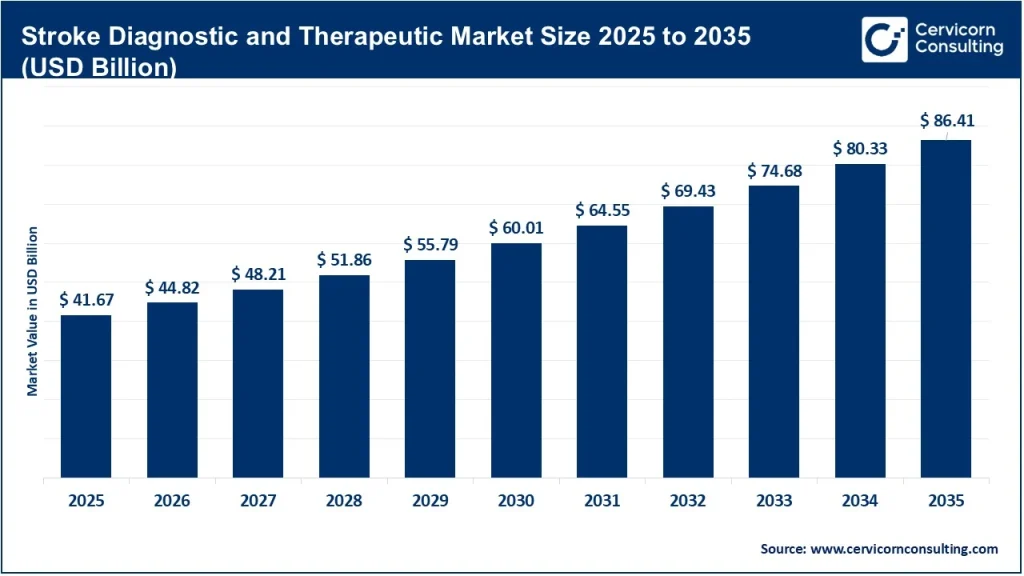
The global stroke diagnostic and therapeutic market was valued at approximately USD 41.67 billion in 2025 and is projected to reach nearly USD 86.41 billion by 2035, growing at a CAGR of 7.6%.
What is the Stroke Diagnostic and Therapeutic Market?
The stroke diagnostic and therapeutic market encompasses the technologies, medical devices, pharmaceuticals, imaging systems, monitoring tools, and treatment solutions used for the diagnosis, management, and treatment of stroke. Stroke is one of the leading causes of death and long-term disability globally, occurring when blood flow to the brain is interrupted due to a blockage (ischemic stroke) or bleeding (hemorrhagic stroke). The market includes advanced imaging modalities such as computed tomography (CT), magnetic resonance imaging (MRI), angiography systems, ultrasound devices, thrombolytic drugs, mechanical thrombectomy devices, neurovascular interventions, rehabilitation technologies, and AI-powered diagnostic platforms. Healthcare providers rely on these solutions to identify stroke types quickly, assess brain damage, guide treatment decisions, and improve patient outcomes.
The growing burden of stroke cases, coupled with increasing awareness about early diagnosis and timely intervention, has significantly accelerated investments in stroke diagnostics and therapeutics worldwide. Innovations in artificial intelligence, telemedicine, robotics, and minimally invasive neurovascular procedures continue to reshape the market landscape.
Stroke Diagnostic and Therapeutic Market Growth Factors
The stroke diagnostic and therapeutic market is witnessing substantial growth due to the increasing prevalence of stroke among aging populations, rising incidence of lifestyle-related diseases such as hypertension, diabetes, obesity, and cardiovascular disorders, growing healthcare expenditures, expanding access to advanced neuroimaging technologies, and increasing awareness regarding the importance of rapid stroke intervention. The adoption of artificial intelligence-enabled diagnostic platforms, development of next-generation thrombectomy devices, expansion of stroke care centers, favorable reimbursement policies in developed countries, government initiatives supporting neurological healthcare, advancements in tele-stroke networks, and growing investments in research and development by leading medical technology companies are further accelerating market growth.
Additionally, increasing demand for minimally invasive procedures, improved emergency medical services, and the integration of digital health solutions are creating significant opportunities for market expansion across both developed and emerging economies.
Get a Free Sample: https://www.cervicornconsulting.com/sample/2983
Why is the Stroke Diagnostic and Therapeutic Market Important?
Reducing Mortality Rates
Stroke remains one of the most significant causes of mortality globally. Early diagnosis and effective treatment can dramatically reduce death rates. Modern imaging technologies help clinicians identify stroke type within minutes, enabling faster treatment decisions.
Preventing Long-Term Disability
Millions of stroke survivors experience long-term neurological impairment. Advanced therapeutic interventions such as mechanical thrombectomy and targeted thrombolysis significantly improve recovery outcomes when administered promptly.
Supporting Aging Populations
As global populations age, stroke incidence is expected to rise considerably. Diagnostic and therapeutic solutions help healthcare systems manage increasing patient volumes while improving quality of care.
Driving Healthcare Innovation
The market serves as a catalyst for innovation in artificial intelligence, medical imaging, robotics, neurovascular interventions, and digital health technologies.
Enhancing Healthcare Efficiency
Rapid diagnosis and treatment reduce hospitalization duration, rehabilitation costs, and long-term healthcare expenditures, benefiting both patients and healthcare providers.
Major Companies in the Stroke Diagnostic and Therapeutic Market
| Company | Specialization | Key Focus Areas | Notable Features | 2025 Revenue* | Market Share* | Global Presence |
|---|---|---|---|---|---|---|
| F. Hoffmann-La Roche Ltd | Diagnostics and Pharmaceuticals | Stroke biomarkers, laboratory diagnostics, molecular testing | Strong diagnostics portfolio and global healthcare reach | Approximately USD 73 Billion | Significant player in diagnostics | Presence in over 100 countries |
| Siemens Healthineers AG | Medical Imaging and Diagnostics | MRI, CT, angiography, AI-assisted stroke detection | Advanced neuroimaging and digital health integration | Approximately USD 25 Billion | Major imaging market participant | Operations in more than 180 countries |
| GE HealthCare Technologies Inc. | Diagnostic Imaging and Monitoring | CT scanners, MRI systems, AI-powered stroke workflows | Rapid imaging and workflow optimization solutions | Approximately USD 20 Billion | Strong global imaging market share | Presence across North America, Europe, Asia-Pacific, and Middle East |
| Canon Medical Systems Corporation | Diagnostic Imaging Systems | Advanced CT, MRI, angiography, neurological imaging | High-resolution imaging for stroke diagnosis | Estimated USD 5 Billion | Established imaging provider | Extensive operations worldwide |
| Koninklijke Philips N.V. | Image-Guided Therapy and Patient Monitoring | Neurovascular interventions, image-guided treatment, monitoring systems | Integrated stroke care ecosystem | Approximately USD 19 Billion | Leading healthcare technology provider | Presence in over 100 countries |
Leading Trends Shaping the Stroke Diagnostic and Therapeutic Market
Artificial Intelligence in Stroke Diagnosis
Artificial intelligence is revolutionizing stroke care by enabling rapid interpretation of brain scans. AI algorithms can detect large vessel occlusions, intracranial hemorrhages, and ischemic stroke indicators within seconds.
Impact on the Market
- Faster diagnosis and treatment initiation
- Improved diagnostic accuracy
- Reduced burden on radiologists
- Enhanced patient outcomes
- Increased adoption of automated imaging platforms
Growth of Mechanical Thrombectomy
Mechanical thrombectomy has emerged as one of the most effective treatments for acute ischemic stroke caused by large vessel occlusions.
Impact on the Market
- Increased demand for neurovascular devices
- Expansion of specialized stroke centers
- Higher treatment success rates
- Growth in minimally invasive interventions
Expansion of Tele-Stroke Networks
Telemedicine solutions are enabling stroke specialists to remotely assess patients in underserved regions.
Impact on the Market
- Improved rural healthcare access
- Faster treatment decisions
- Reduced healthcare disparities
- Greater adoption of digital health infrastructure
Advanced Neuroimaging Technologies
Modern CT and MRI systems provide enhanced visualization of brain tissue and vascular structures.
Impact on the Market
- Better treatment planning
- Increased diagnostic confidence
- Early identification of high-risk patients
- Expansion of imaging equipment installations
Personalized Stroke Treatment
Healthcare providers increasingly utilize patient-specific diagnostic data to optimize treatment strategies.
Impact on the Market
- Improved clinical outcomes
- Better risk stratification
- Growth in precision medicine applications
- Increased use of biomarker testing
Robotic-Assisted Neurovascular Procedures
Robotics is beginning to transform complex neurovascular interventions.
Impact on the Market
- Improved procedural precision
- Reduced physician fatigue
- Enhanced treatment consistency
- Future expansion of remote interventions
Successful Examples of Stroke Diagnostic and Therapeutic Solutions Around the World
United States: Comprehensive Stroke Center Network
The United States has developed one of the world’s most advanced stroke care ecosystems through comprehensive stroke centers equipped with cutting-edge imaging technologies, thrombectomy capabilities, and tele-stroke services.
Key Achievements
- Reduced treatment times
- Increased thrombectomy adoption
- Improved survival rates
- Enhanced emergency response coordination
Germany: AI-Driven Stroke Imaging Programs
German hospitals have integrated artificial intelligence into radiology workflows to accelerate stroke diagnosis.
Key Achievements
- Faster image interpretation
- Improved clinical decision-making
- Reduced diagnostic delays
- Better patient outcomes
United Kingdom: National Stroke Strategy
The UK’s coordinated stroke care framework emphasizes rapid diagnosis, standardized treatment protocols, and rehabilitation services.
Key Achievements
- Streamlined patient pathways
- Improved acute stroke management
- Better rehabilitation outcomes
- Reduced mortality rates
Japan: Advanced Neurovascular Intervention Programs
Japan is a global leader in neurovascular technologies and minimally invasive stroke treatment.
Key Achievements
- High adoption of thrombectomy procedures
- Strong innovation in neurovascular devices
- Advanced imaging integration
- Enhanced stroke survival rates
Australia: Tele-Stroke Expansion
Australia has leveraged telemedicine to improve stroke care access across remote regions.
Key Achievements
- Expanded specialist coverage
- Faster treatment decisions
- Reduced geographic barriers
- Improved healthcare equity
Global Regional Analysis of the Stroke Diagnostic and Therapeutic Market
North America
North America represents the largest market for stroke diagnostics and therapeutics due to advanced healthcare infrastructure, high healthcare spending, strong reimbursement systems, and widespread adoption of innovative technologies.
Market Drivers
- High prevalence of stroke and cardiovascular diseases
- Extensive network of stroke centers
- Significant R&D investments
- Rapid adoption of AI-based diagnostics
Government Initiatives and Policies
United States
- National programs promoting stroke awareness and prevention
- Investments in neurological research through federal agencies
- Expansion of telehealth regulations
- Support for advanced stroke treatment reimbursement
Canada
- National stroke prevention programs
- Increased funding for neurological care
- Expansion of digital health initiatives
- Support for rural stroke management services
Regional Outlook
North America will continue to lead the market due to ongoing technological innovation and strong healthcare infrastructure.
Europe
Europe holds a significant share of the global market, supported by universal healthcare systems, strong research capabilities, and increasing adoption of advanced neuroimaging technologies.
Market Drivers
- Aging population
- Rising stroke incidence
- Strong healthcare funding
- Growing use of AI-powered diagnostics
Government Initiatives and Policies
European Union
- Support for digital health transformation
- Funding for neurological disease research
- Cross-border healthcare collaborations
- Medical device innovation programs
Germany
- Investments in hospital modernization
- Adoption of AI in diagnostic imaging
- Expansion of stroke treatment centers
United Kingdom
- National stroke improvement strategies
- Public awareness campaigns
- Investments in telemedicine infrastructure
Regional Outlook
Europe is expected to maintain strong growth through continued healthcare innovation and supportive regulatory frameworks.
Asia-Pacific
Asia-Pacific is projected to experience the fastest growth in the stroke diagnostic and therapeutic market due to rising healthcare investments, expanding aging populations, and increasing disease burden.
Market Drivers
- Large patient population
- Growing healthcare infrastructure
- Increasing medical technology adoption
- Rising government healthcare expenditure
Government Initiatives and Policies
China
- Healthcare modernization initiatives
- Expansion of hospital infrastructure
- Investments in AI-powered healthcare
- Support for domestic medical technology development
Japan
- Advanced neurological healthcare programs
- Aging population healthcare initiatives
- Strong support for medical innovation
India
- Expansion of tertiary healthcare facilities
- Increasing focus on non-communicable diseases
- Government health insurance programs
- Investments in digital healthcare systems
Regional Outlook
Asia-Pacific is expected to emerge as the most attractive growth market owing to rapid healthcare development and increasing awareness of stroke management.
Latin America
Latin America is witnessing gradual growth driven by healthcare modernization efforts and increasing awareness regarding stroke diagnosis and treatment.
Market Drivers
- Growing healthcare investments
- Increasing burden of chronic diseases
- Rising access to diagnostic imaging
Government Initiatives and Policies
Brazil
- Public healthcare expansion
- Investments in specialized treatment centers
- Stroke prevention programs
Mexico
- Improved healthcare accessibility
- Digital health adoption initiatives
- Expansion of emergency care services
Regional Outlook
The region offers significant long-term growth opportunities as healthcare infrastructure continues to improve.
Middle East and Africa
The Middle East and Africa region is experiencing increasing demand for advanced stroke care solutions due to healthcare investments and growing awareness.
Market Drivers
- Rising prevalence of lifestyle diseases
- Expansion of healthcare facilities
- Adoption of advanced diagnostic equipment
Government Initiatives and Policies
Saudi Arabia
- Healthcare transformation programs
- Investments in smart hospitals
- Digital health expansion initiatives
United Arab Emirates
- Advanced healthcare infrastructure development
- AI-driven healthcare adoption
- Expansion of specialized neurological centers
South Africa
- Improved access to stroke treatment services
- Healthcare modernization projects
- Public health awareness campaigns
Regional Outlook
The region is expected to experience steady growth as governments prioritize healthcare infrastructure development and neurological disease management.
Emerging Opportunities in the Stroke Diagnostic and Therapeutic Market
The market continues to evolve with growing opportunities in AI-assisted diagnostics, portable imaging technologies, wearable monitoring devices, next-generation thrombectomy systems, cloud-based stroke management platforms, digital therapeutics, robotic neurovascular interventions, and biomarker-based diagnostic testing. The integration of artificial intelligence with advanced imaging systems is expected to significantly reduce diagnosis time while improving treatment precision. Furthermore, expanding tele-stroke networks across emerging economies, increasing investments in precision medicine, and growing adoption of minimally invasive stroke therapies are likely to create substantial growth opportunities for healthcare providers, medical device manufacturers, pharmaceutical companies, and digital health innovators throughout the coming decade.
To Get Detailed Overview, Contact Us: https://www.cervicornconsulting.com/contact-us
Read Report: Medical Affairs Outsourcing Market Revenue, Trends, and Strategic Insights by 2035