


Table of Contents
ToggleSpecialty Gas Market Size
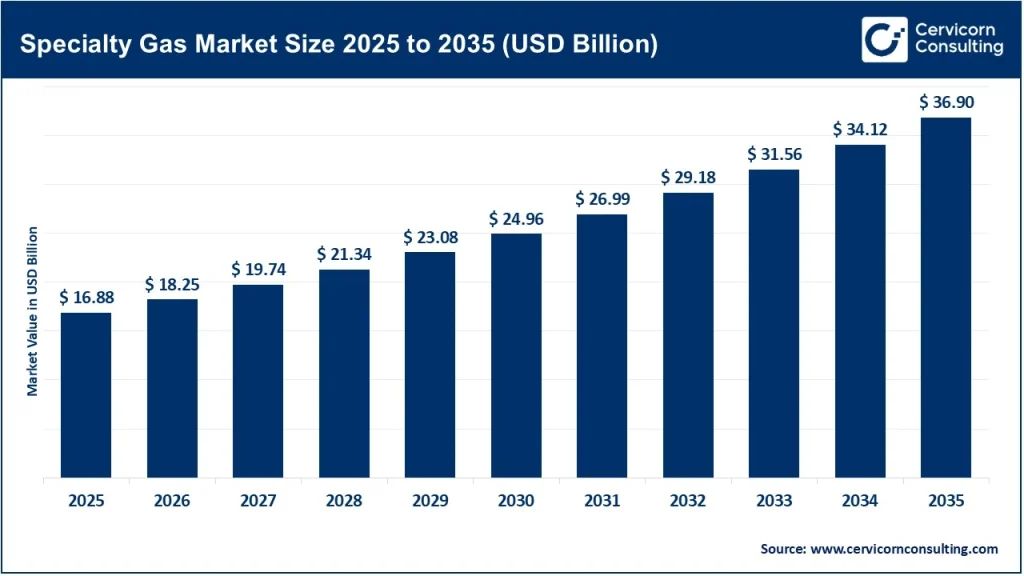
The global specialty gas market was estimated at about USD 16.88 billion in 2025 and is projected to reach nearly USD 36.90 billion by 2035, expanding at a CAGR of 8.2%, driven by the rising need across industries for high-purity gases in advanced and performance-critical applications.
What is the Specialty Gas Market?
The specialty gas market refers to the global industry involved in the production, purification, packaging, and distribution of ultra-high-purity gases and precisely calibrated gas mixtures used in advanced industrial, scientific, medical, and technological applications. Specialty gases typically possess purity levels exceeding 99.995%, making them essential for processes where even trace contamination can significantly affect results. These gases include noble gases, carbon gases, halogen gases, and ultra-high-purity electronic gases used in semiconductor manufacturing, calibration gases for analytical instruments, and medical gases for diagnostics and therapy.
The specialty gas market plays a critical role in enabling innovations across industries such as electronics fabrication, pharmaceuticals, aerospace manufacturing, environmental monitoring, and advanced research laboratories.
Why the Specialty Gas Market is Important?
The specialty gas market is strategically important because it supports modern high-technology manufacturing ecosystems and ensures quality control across scientific and industrial workflows. Semiconductor fabrication relies heavily on ultra-pure gases for wafer etching and deposition processes, while healthcare institutions depend on specialty calibration gases to maintain diagnostic accuracy in imaging and respiratory monitoring equipment.
Environmental monitoring agencies utilize specialty gases to calibrate sensors that track air pollutants and greenhouse gases, enabling regulatory compliance and sustainability initiatives worldwide. Additionally, specialty gases support advanced research laboratories working in nanotechnology, biotechnology, and materials science. As industries transition toward digitalization, clean energy solutions, and precision manufacturing, specialty gases act as enabling materials that ensure process reliability, safety, and reproducibility across complex workflows.
Get a Free Sample: https://www.cervicornconsulting.com/sample/2927
Specialty Gas Market Growth Factors
The specialty gas market is experiencing strong expansion due to increasing demand from semiconductor fabrication facilities requiring ultra-high-purity gases for wafer processing and thin-film deposition; rapid growth in the healthcare sector supporting diagnostic imaging, respiratory therapy, and laboratory calibration applications; rising adoption of specialty gases in environmental monitoring for air-quality compliance and emissions control; expansion of advanced manufacturing sectors such as aerospace and automotive electronics; increasing investments in renewable energy technologies and hydrogen infrastructure; growing government spending on healthcare modernization and research laboratories; rising demand for flat-panel displays and microelectronics devices; and the widespread use of specialty gases in chemical vapor deposition cleaning processes, all of which collectively strengthen market adoption across industrial ecosystems worldwide.
Competitive Landscape: Major Specialty Gas Companies
Below is a structured comparison of leading specialty gas companies operating globally:
| Company | Specialization | Key Focus Areas | Notable Features | 2024 Revenue | Market Share | Global Presence |
|---|---|---|---|---|---|---|
| Air Liquide | Industrial & specialty gases, healthcare gases | Electronics gases, hydrogen energy, medical gases | Strong innovation pipeline and sustainability investments | €27.06 billion | ~18–20% (industrial gases segment est.) | 70+ countries |
| Linde plc | Industrial gases and engineering solutions | Semiconductor gases, hydrogen infrastructure | Largest industrial gases supplier globally | ~$33+ billion (est.) | ~25% global industrial gases leadership | 100+ countries |
| Air Products and Chemicals, Inc. | Industrial gases and clean hydrogen | LNG processing gases, electronics gases | Leader in hydrogen megaproject investments | ~$12+ billion (est.) | ~10–12% | 50+ countries |
| Messer Group GmbH | Industrial & specialty gases | Metal processing gases, pharmaceuticals | Strong European and Asian footprint | ~$4+ billion (est.) | ~4–6% | 30+ countries |
| Taiyo Nippon Sanso Corporation | Specialty electronic gases | Semiconductor gases, specialty materials | Strong Asia semiconductor ecosystem presence | ~$7+ billion (est.) | ~6–8% | 30+ countries |
Leading Trends and Their Impact on the Specialty Gas Market
1. Semiconductor Industry Expansion
The rapid expansion of semiconductor fabrication plants globally is increasing the demand for electronic specialty gases such as silane, nitrogen trifluoride, and helium mixtures. As countries invest heavily in chip manufacturing capacity, specialty gas suppliers are strengthening regional production infrastructure to meet localized demand.
Impact: Drives capacity expansion and long-term supply contracts between gas suppliers and semiconductor manufacturers.
2. Growth of Hydrogen Economy
Hydrogen is emerging as a clean energy carrier supporting decarbonization strategies worldwide. Specialty gas companies are investing in hydrogen purification, storage, and distribution technologies.
Impact: Creates new revenue streams and strengthens partnerships with energy infrastructure providers.
3. Rising Demand for Medical and Healthcare Gases
Healthcare applications remain one of the fastest-growing segments due to increased diagnostic testing, respiratory therapy adoption, and hospital infrastructure expansion.
Impact: Encourages development of medical-grade gas packaging and delivery systems.
4. Environmental Monitoring and Sustainability Compliance
Governments worldwide are implementing stricter emissions monitoring regulations, requiring accurate calibration gases.
Impact: Expands specialty gas demand in regulatory compliance and environmental testing laboratories.
5. Miniaturization of Electronics
As electronic devices become smaller and more complex, ultra-high-purity gases become essential for precision manufacturing.
Impact: Strengthens long-term demand from microelectronics industries.
Successful Examples of Specialty Gas Market Applications Around the World
United States: Semiconductor Manufacturing Ecosystem
The United States hosts several advanced semiconductor fabrication facilities requiring continuous supply of ultra-pure gases for wafer manufacturing and lithography processes. Specialty gas suppliers maintain onsite production plants to support uninterrupted chip fabrication.
Result: Strengthened domestic electronics manufacturing capacity.
Japan: Electronics-Grade Gas Leadership
Japan remains a global leader in high-purity specialty gases used in semiconductor and display manufacturing. Companies such as Taiyo Nippon Sanso play a major role in supplying gases to chip fabrication clusters.
Result: Strong integration with advanced electronics supply chains.
Germany: Industrial Manufacturing Excellence
Germany’s automotive and precision engineering sectors utilize specialty gases in welding automation, metal treatment, and emissions monitoring calibration.
Result: Improved manufacturing quality and sustainability compliance.
South Korea: Display Panel Manufacturing
South Korea’s display manufacturing ecosystem relies heavily on specialty gases for OLED and LCD fabrication processes.
Result: Supports leadership in display technologies globally.
India: Expanding Healthcare Gas Infrastructure
India’s healthcare modernization initiatives are increasing demand for specialty calibration gases in diagnostic laboratories and hospitals.
Result: Growth opportunities for domestic and international specialty gas suppliers.
Global Regional Analysis Including Government Initiatives and Policies Shaping the Market
North America
North America remains one of the most technologically advanced specialty gas markets due to strong semiconductor manufacturing capacity, research infrastructure, and environmental monitoring programs. Government initiatives such as semiconductor manufacturing incentives and hydrogen energy funding programs are strengthening domestic production ecosystems. Regulatory agencies enforce strict emissions monitoring requirements, increasing demand for calibration gases across industries.
Policy Influence: Clean energy funding and semiconductor incentives drive specialty gas consumption growth.
Europe
Europe’s specialty gas market benefits from strong industrial automation capabilities and sustainability regulations promoting emissions monitoring technologies. Hydrogen strategy programs across Germany, France, and the Netherlands are accelerating investments in clean fuel infrastructure. Additionally, strict environmental compliance frameworks encourage adoption of specialty calibration gases.
Policy Influence: European Green Deal initiatives promote hydrogen-based energy adoption.
Asia-Pacific
Asia-Pacific dominates the global specialty gas market due to rapid industrialization and semiconductor manufacturing expansion across China, Japan, South Korea, and India. The region accounts for the largest revenue share globally, supported by strong electronics production ecosystems and healthcare infrastructure investments.
Governments across the region are supporting domestic semiconductor manufacturing capabilities through subsidies and infrastructure development programs.
Policy Influence: Semiconductor manufacturing incentives significantly boost specialty gas demand.
Latin America
Latin America’s specialty gas market is gradually expanding due to growth in oil refining, mining, and healthcare infrastructure. Governments are investing in environmental monitoring capabilities and industrial modernization programs.
Policy Influence: Environmental compliance regulations support calibration gas adoption.
Middle East & Africa
The Middle East and Africa region is witnessing increasing specialty gas adoption due to refinery modernization projects, petrochemical expansions, and healthcare infrastructure investments. Hydrogen energy initiatives in Gulf countries are also supporting specialty gas supply chain development.
Policy Influence: Industrial diversification strategies drive specialty gas demand.
To Get Detailed Overview, Contact Us: https://www.cervicornconsulting.com/contact-us
Read Report: Aluminium Foil Market Revenue, Trends, and Strategic Insights by 2035