


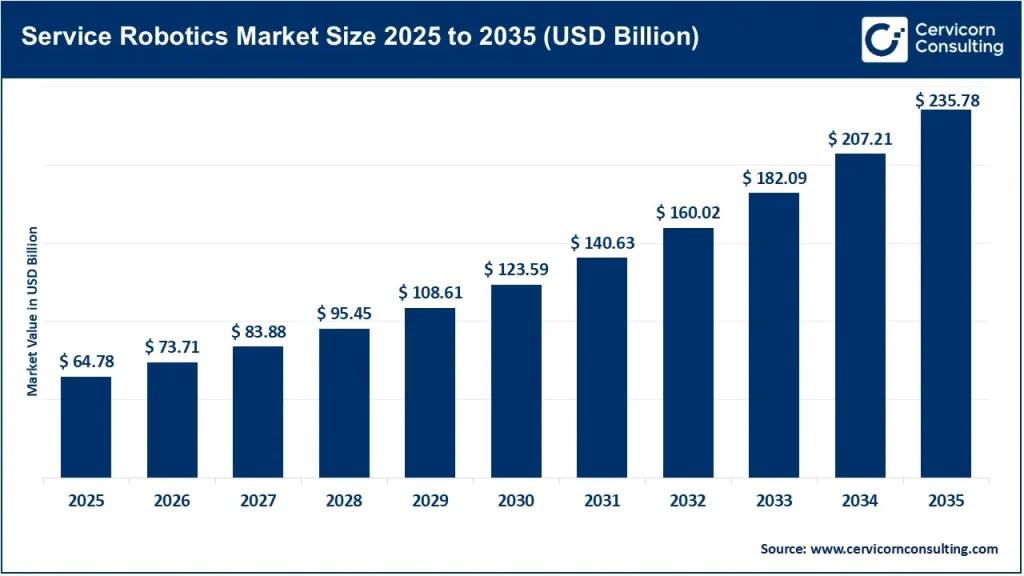
Service Robotics Market Size
The global service robotics market was valued at USD 64.78 billion in 2025 and is projected to reach approximately USD 235.78 billion by 2035, expanding at a CAGR of 13.8% during the forecast period. Market growth is driven by increasing adoption of artificial intelligence (AI), autonomous navigation technologies, labor shortages across industries, rising healthcare automation, expanding warehouse logistics, and growing demand for domestic assistance robots. Service robots are becoming an integral part of healthcare, hospitality, agriculture, retail, defense, logistics, and household applications as organizations seek greater efficiency, safety, and cost optimization.
What is the Service Robotics Market?
The service robotics market consists of robots designed to assist humans by performing useful tasks outside traditional industrial manufacturing environments. Unlike industrial robots that operate primarily on factory assembly lines, service robots interact directly with people or operate in dynamic environments.
These robots combine artificial intelligence, machine vision, advanced sensors, machine learning, cloud computing, autonomous navigation, and robotics software to perform complex operations with minimal human intervention.
The market is broadly divided into:
- Professional Service Robots
- Surgical robots
- Warehouse robots
- Delivery robots
- Agricultural robots
- Inspection robots
- Cleaning robots
- Security robots
- Personal Service Robots
- Robot vacuum cleaners
- Lawn mowing robots
- Educational robots
- Personal assistant robots
- Companion robots
- Elderly care robots
Growing digital transformation across industries continues to accelerate demand for intelligent robotic systems capable of operating safely alongside humans.
Get a Free Sample: https://www.cervicornconsulting.com/sample/2992
Service Robotics Market Growth Factors
The service robotics market is witnessing rapid expansion due to the convergence of artificial intelligence, machine learning, computer vision, cloud robotics, autonomous mobility, and advanced sensor technologies. Rising labor shortages across logistics, healthcare, agriculture, hospitality, and retail sectors are encouraging organizations to automate repetitive and labor-intensive tasks. The increasing aging population worldwide is driving demand for healthcare robots, rehabilitation systems, and elderly assistance solutions. Rapid expansion of e-commerce has accelerated warehouse automation through autonomous mobile robots (AMRs) and robotic fulfillment systems. Governments are actively investing in robotics research, Industry 4.0 initiatives, smart manufacturing, defense modernization, and healthcare digitization, further supporting market growth. Falling hardware costs, improvements in battery technology, widespread 5G connectivity, edge AI computing, and greater public acceptance of autonomous technologies are also creating favorable conditions for sustained adoption across developed and emerging economies.
Why is the Service Robotics Market Important?
Service robotics is transforming nearly every major industry by enabling intelligent automation while improving productivity, operational efficiency, safety, and service quality.
Major benefits include:
- Addresses global labor shortages
- Reduces operating costs
- Improves workplace safety
- Enhances healthcare outcomes
- Enables 24/7 operations
- Increases warehouse productivity
- Supports precision agriculture
- Improves customer experience
- Enables contactless delivery
- Enhances disaster response capabilities
Service robots also reduce human exposure to hazardous environments including infectious disease zones, chemical facilities, mining operations, offshore energy sites, and disaster recovery areas.
Major Applications of Service Robotics
Healthcare
- Robotic surgery
- Patient rehabilitation
- Hospital logistics
- Pharmacy automation
- Elderly care
- Telepresence robots
Logistics
- Warehouse automation
- Inventory management
- Autonomous delivery
- Order fulfillment
- Parcel sorting
Hospitality
- Hotel concierge robots
- Restaurant serving robots
- Cleaning robots
- Room delivery robots
Agriculture
- Autonomous harvesting
- Crop monitoring
- Precision spraying
- Livestock management
Retail
- Shelf monitoring
- Inventory robots
- Customer assistance
- Automated checkout support
Defense & Public Safety
- Bomb disposal
- Surveillance
- Search and rescue
- Border monitoring
Domestic Applications
- Vacuum cleaning
- Lawn mowing
- Pool cleaning
- Companion robots
- Home security
Competitive Landscape
The service robotics industry is highly competitive, with global technology companies continuously investing in AI, machine vision, collaborative robotics, cloud robotics, and autonomous navigation.
| Company | Specialization | Key Focus Areas | Notable Features | 2025 Revenue* | Estimated Market Position | Global Presence |
|---|---|---|---|---|---|---|
| ABB Ltd. | Robotics & automation | Mobile robotics, logistics, healthcare | AI-enabled industrial and service robots | ~$34 billion | Strong automation leader | 100+ countries |
| Amazon Robotics | Warehouse robotics | Fulfillment automation, autonomous logistics | Large-scale warehouse robot deployment | Included within Amazon revenue | Dominant in e-commerce robotics | Global |
| Boston Dynamics | Mobile robotics | Inspection, logistics, industrial mobility | Spot and Stretch robots | Private company | Innovation leader | North America, Europe, Asia |
| Intuitive Surgical Inc. | Medical robotics | Robotic-assisted surgery | da Vinci Surgical System | ~$9 billion | Global leader in surgical robotics | 70+ countries |
| KUKA AG | Industrial & service robotics | Healthcare, logistics, smart factories | Autonomous mobile robots | ~$4.5 billion | Major robotics supplier | Global |
Company Profiles
ABB Ltd.
ABB has become one of the world’s largest robotics and automation companies. The company integrates AI, machine learning, digital twins, collaborative robots, and autonomous mobile robots to improve warehouse automation, healthcare logistics, and industrial services.
Key strengths include:
- Collaborative robots
- AI-enabled automation
- Logistics robotics
- Digital factory solutions
- Autonomous navigation
Amazon Robotics
Amazon Robotics has revolutionized warehouse automation through autonomous robots that move inventory throughout fulfillment centers.
Major innovations include:
- Autonomous Mobile Robots (AMRs)
- AI-driven inventory optimization
- Robotic picking
- Warehouse orchestration
- Automated package movement
Amazon continues expanding robotic fulfillment capabilities globally to improve delivery speed and operational efficiency.
Boston Dynamics
Boston Dynamics is renowned for advanced mobile robots capable of operating in complex real-world environments.
Flagship robots include:
- Spot inspection robot
- Stretch warehouse robot
- Atlas humanoid platform
Its robots are increasingly deployed for industrial inspections, hazardous environments, warehouse automation, and research.
Intuitive Surgical Inc.
Intuitive Surgical dominates robotic-assisted surgery through the globally recognized da Vinci Surgical System.
Key advantages include:
- High surgical precision
- Minimally invasive procedures
- Reduced patient recovery time
- Advanced visualization
- Surgeon ergonomics
Thousands of hospitals worldwide utilize robotic-assisted surgical systems across multiple specialties.
KUKA AG
KUKA develops intelligent robotic solutions for logistics, healthcare, manufacturing, and smart warehouses.
Its portfolio includes:
- Autonomous mobile robots
- Collaborative robots
- Smart logistics
- Digital manufacturing
- AI-powered robotics
KUKA continues expanding robotics software and connected automation capabilities.
Leading Trends Shaping the Service Robotics Market
Artificial Intelligence Integration
AI enables robots to recognize objects, understand environments, make decisions, and continuously improve performance through learning algorithms.
Impact
- Higher autonomy
- Better navigation
- Predictive maintenance
- Improved decision-making
Autonomous Mobile Robots (AMRs)
AMRs are replacing traditional guided vehicles in warehouses, hospitals, airports, and manufacturing facilities.
Impact
- Reduced transportation costs
- Improved warehouse efficiency
- Flexible deployment
- Faster fulfillment
Healthcare Robotics Expansion
Healthcare remains one of the fastest-growing segments.
Growth areas include:
- Surgical robotics
- Hospital delivery robots
- Rehabilitation systems
- Patient monitoring
- Elderly assistance
Impact
- Improved patient care
- Reduced medical errors
- Greater hospital efficiency
Human-Robot Collaboration
Collaborative robots (cobots) safely work alongside human employees.
Benefits include:
- Improved productivity
- Reduced injuries
- Flexible manufacturing
- Enhanced workplace safety
Cloud Robotics
Cloud computing allows robots to share knowledge, access real-time analytics, and receive software updates remotely.
Impact includes:
- Faster deployment
- Lower maintenance costs
- Continuous learning
- Fleet management
Robotics-as-a-Service (RaaS)
Instead of purchasing robots outright, businesses increasingly subscribe to robotics services.
Advantages include:
- Lower upfront investment
- Easy scalability
- Reduced maintenance burden
- Faster adoption
AI Vision Systems
Computer vision significantly improves robotic perception.
Applications include:
- Quality inspection
- Medical imaging
- Autonomous navigation
- Retail shelf monitoring
Successful Examples of Service Robotics Around the World
Amazon Fulfillment Centers (United States)
Amazon operates one of the world’s largest warehouse robotics ecosystems.
Benefits include:
- Faster order processing
- Reduced walking distances
- Higher warehouse efficiency
- Improved inventory accuracy
da Vinci Surgical Robots (Global)
Intuitive Surgical’s da Vinci systems have enabled millions of minimally invasive procedures across specialties such as urology, gynecology, cardiothoracic, and general surgery, improving precision and patient recovery.
Boston Dynamics Spot (United States, Europe, Asia)
Spot robots are deployed for:
- Construction inspection
- Mining
- Oil & gas facilities
- Utility inspections
- Disaster response
Hotel Service Robots (Japan)
Japanese hotels use robots for:
- Guest reception
- Luggage transportation
- Room delivery
- Cleaning
This improves operational efficiency while addressing labor shortages.
Agricultural Robots (Netherlands)
Dutch farms deploy autonomous robots for:
- Greenhouse monitoring
- Crop harvesting
- Precision spraying
- Yield optimization
These technologies support sustainable, high-productivity agriculture.
Hospital Logistics Robots (South Korea)
Hospitals increasingly deploy autonomous robots for:
- Medicine delivery
- Sample transportation
- Sterilization
- Medical supply logistics
This reduces staff workload while improving operational efficiency.
Global Regional Analysis
North America
North America remains the largest service robotics market due to:
- Strong AI ecosystem
- Advanced healthcare infrastructure
- Warehouse automation
- High labor costs
- Technology investments
Government Initiatives
- National AI research programs
- Defense robotics funding
- Smart manufacturing support
- Healthcare innovation grants
- Public-private robotics partnerships
The United States leads in medical robotics, warehouse automation, and autonomous delivery technologies.
Europe
Europe represents a mature robotics market supported by strong industrial automation and digital transformation strategies.
Growth sectors include:
- Healthcare robotics
- Agricultural robotics
- Collaborative robots
- Smart logistics
- Inspection robots
Government Policies
- Industry 4.0 initiatives
- Horizon Europe research funding
- AI regulatory frameworks
- Digital Europe Programme
- Sustainability-focused automation policies
Germany, France, Italy, and the Nordic countries are major contributors to robotics innovation.
Asia-Pacific
Asia-Pacific is projected to witness the fastest growth during the forecast period due to rapid industrialization, urbanization, aging populations, expanding healthcare infrastructure, and aggressive investments in AI and robotics. Governments are actively supporting robotics through long-term industrial modernization strategies, research funding, and smart manufacturing programs. China continues to scale automation under advanced manufacturing initiatives, Japan promotes robotics for elderly care and productivity enhancement, South Korea invests heavily in intelligent robots through national innovation programs, and Singapore encourages service robot adoption in healthcare, hospitality, and logistics. These policies, combined with strong electronics manufacturing ecosystems and rising private-sector investments, are accelerating regional market expansion.
Latin America
Latin America is gradually expanding service robotics adoption across healthcare, agriculture, mining, and logistics.
Key growth drivers include:
- Warehouse modernization
- Agricultural automation
- Mining robotics
- Healthcare investments
Government Support
- Digital transformation programs
- Smart agriculture initiatives
- Innovation funding
- Industry modernization strategies
Brazil and Mexico remain the leading regional markets.
Middle East & Africa
The Middle East & Africa region is experiencing increasing adoption of service robotics across healthcare, hospitality, airports, oil & gas, and public services.
Major applications include:
- Hotel service robots
- Airport automation
- Healthcare delivery robots
- Security robots
- Inspection robots
Government Initiatives
Governments across the Gulf region are investing in AI, robotics, and smart city development through national innovation strategies. These initiatives promote automation in public services, healthcare, transportation, and infrastructure while encouraging research partnerships and technology adoption. In Africa, digital transformation agendas and innovation hubs are gradually supporting robotics use in agriculture, healthcare, and education, creating new opportunities for long-term market growth.
To Get Detailed Overview, Contact Us: https://www.cervicornconsulting.com/contact-us
Read Report: Polyvinyl Chloride (PVC) Market Revenue, Trends, and Strategic Insights by 2035