


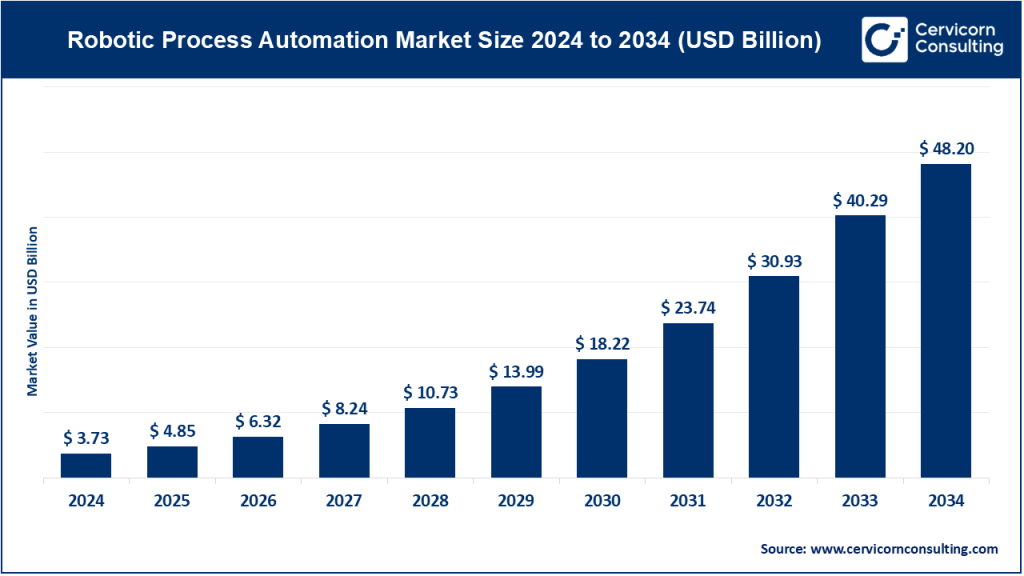
Robotic Process Automation Market Size
The global robotic process automation market size was worth USD 3.73 billion in 2024 and is anticipated to expand to around USD 48.20 billion by 2034, registering a compound annual growth rate (CAGR) of 30.28% from 2025 to 2034.
What Is the Robotic Process Automation Market?
Robotic Process Automation (RPA) refers to the use of software robots or “bots” to automate rule-based, repetitive, high-volume business processes across a variety of enterprise domains. These bots mimic human actions by interacting with digital systems, applications, and user interfaces to execute structured tasks such as data entry, invoice processing, transaction reconciliation, report generation, and more. The RPA market comprises software platforms, services (consulting, deployment, maintenance), and deployment models (cloud, on-premises) that support RPA development and operation. Organizations—spanning BFSI, healthcare, manufacturing, telecom, and other sectors—leverage RPA to drive digital transformation, enhance efficiency, reduce costs, increase accuracy, and free human workers for more value‑added work.
Growth Factors Driving the RPA Market
The RPA market is being propelled by a confluence of factors: enterprises’ strong demand for operational efficiency and cost reduction, increasing pressure to eliminate human error in repetitive tasks, widespread digital transformation initiatives, and the drive to scale automation strategically; moreover, the ongoing integration of RPA with artificial intelligence (AI), machine learning (ML), and generative models is enabling “intelligent automation” that can tackle semi-structured and unstructured data, which broadens the applicability of RPA. Cloud-native, low-code and no-code RPA platforms further democratize access, allowing non-technical business users to build bots, while subscription (SaaS) models reduce upfront cost and complexity.
Simultaneously, macro-level trends such as labor shortages, the need for regulatory compliance (especially in sectors like BFSI and healthcare), and the growing adoption of hybrid work models all encourage companies to automate routine workflows. These dynamics, combined with supportive government digitalization programs and increasing vendor innovation, are fueling rapid adoption and expansion of the RPA market.
Why Is the RPA Market Important?
RPA holds strategic importance for businesses and governments alike because it enables a cost-effective way to modernize legacy systems without requiring wholesale reengineering. By automating high-volume repetitive tasks, RPA helps reduce human errors, accelerate process execution, and achieve substantial cost savings — often with measurable return on investment (ROI) in under 12 months. For enterprises, this means freeing up human capital to focus on higher-value, creative or analytical tasks. In regulated industries such as financial services, RPA ensures compliance by enforcing consistent process execution.
In the public sector, RPA can free bureaucratic capacity, reduce administrative burden, and improve service delivery. Indeed, governments are increasingly leveraging RPA as part of their digital transformation strategies to improve transparency, speed, and citizen satisfaction. On a broader scale, RPA democratizes automation; as platforms become more accessible (cloud, low-code), even SMEs can benefit, thus driving productivity across the economy.
Top Companies in the RPA Market: Profiles & Key Focus
UiPath
- Specialization & Key Focus Areas: UiPath is widely regarded as a leader in enterprise automation. It emphasizes end-to-end business automation, combining RPA with AI-powered capabilities (e.g., document understanding, agentic automation). They focus on cloud-native deployments, low-code studios, and governance/orchestration of automation at scale.
- Notable Features: UiPath offers features like unattended bots, attended bots, AI integration, agent-based orchestration, and a marketplace for reusable automation components. Its platform supports both developers and business users via no-code or low-code interfaces.
- 2024 Revenue: In fiscal year 2024, UiPath reported total revenue of US$ 1.308 billion, with 31% year-over-year growth in its Q4 (US$ 405 million) and an annual recurring revenue (ARR) of US$ 1.464 billion.
- Market Share & Global Presence: UiPath is among the top-tier RPA vendors globally and operates in North America, Europe, Asia-Pacific, and other regions.
- Additional Notes: The company is moving toward agentic automation, focusing on intelligent, adaptive bots.
Automation Anywhere
- Specialization & Key Focus Areas: Automation Anywhere is known for scalable RPA with strong focus on distributed bot deployment, cognitive automation, document automation, analytics, and cloud offerings.
- Notable Features: Their platform includes bots for task automation, document understanding, OCR, and analytics dashboards.
- Global Presence: The company serves clients worldwide, with Centers of Excellence in multiple regions to support large-scale automation programs.
Blue Prism
- Specialization & Key Focus Areas: Blue Prism emphasizes enterprise-grade, rule-based automation. Its strengths include unattended bots, security, governance, and integration with legacy systems.
- Notable Features: The platform supports scalability, process orchestration, and governance, making it ideal for highly regulated industries.
- Global Presence: Strong presence in Europe, North America, and other mature markets, with long-standing adoption by large enterprises.
Pegasystems
- Specialization & Key Focus Areas: Pegasystems blends RPA with business process management (BPM), case management, and CRM. They focus on automating complex, decision-based workflows and integrating automation with customer engagement.
- Notable Features: Pega offers low-code development, decision AI, case management, process orchestration, and real-time analytics.
- Global Presence: Pega serves financial services, insurance, telecom, healthcare, and government clients worldwide.
NICE Systems
- Specialization & Key Focus Areas: NICE focuses on contact center automation, back-office automation, and compliance. Its platform integrates RPA with AI-driven analytics and workforce optimization.
- Notable Features: NICE supports attended automation, real-time process optimization, voice and desktop automation, and process analytics.
- Global Presence: NICE has a broad customer base across North America, Europe, and Asia, especially in customer service automation.
Leading Trends in the RPA Market & Their Impact
- AI / ML Integration / Cognitive Automation: Modern RPA is incorporating AI and machine learning, allowing bots to process unstructured data, make decisions, and learn from experience.
- Agentic Automation & Generative AI: Bots are evolving into autonomous agents capable of orchestrating workflows and adapting to dynamic business environments.
- Cloud-First & SaaS Deployment: Cloud-based RPA offers scalability, flexibility, lower costs, and faster deployment, enabling global access.
- Low-Code / No-Code Automation: These platforms empower business users to build bots without programming expertise, accelerating adoption.
- Process Mining and Analytics: Integrated process mining tools help organizations discover inefficiencies before automation and monitor bot performance post-deployment.
- Hyperautomation & Automation Orchestration: Combining RPA with AI, analytics, and process mining enables enterprise-wide automation strategies.
- Governance, Security & Compliance: As adoption grows, enterprises emphasize governance frameworks, security, auditability, and regulatory compliance.
- Sustainability & Efficiency: Automation reduces waste, optimizes resources, and improves operational efficiency.
Successful Examples of RPA Deployments Around the World
- Financial Services / Banking: Banks and insurance firms automate KYC, AML, account opening, claims processing, and reporting, improving speed and accuracy.
- Government / Public Sector: Agencies in North America and Europe use RPA to streamline administrative processes and improve service delivery.
- Healthcare: Hospitals and payers automate claims processing, patient registration, scheduling, billing, and data entry.
- Telecommunications & Manufacturing: RPA is used for billing, order processing, customer support, supply chain, invoice reconciliation, and inventory management.
- Global Corporations: Enterprises worldwide are establishing automation Centers of Excellence to standardize bot development, governance, and monitoring.
Global / Regional Analysis: Government Initiatives and Policies
- North America: Largest RPA market, with federal agencies deploying bots to reduce administrative burden. Regulatory compliance drives enterprise adoption.
- Europe: Significant market share with strong digital transformation initiatives. GDPR and other regulations make secure, auditable RPA solutions attractive.
- Asia-Pacific: Fastest-growing market due to digitalization, Industry 4.0 investments, and a strong IT services sector. Government programs in smart cities and e-governance support RPA adoption.
- Middle East & Africa: Emerging market where governments are deploying RPA to improve administrative efficiency and citizen services.
- India: Growing adoption driven by IT services, cost-conscious enterprises, and government digital initiatives.
- Regulatory / Policy Considerations: Data privacy, security, and national AI strategies are shaping RPA adoption. Upskilling programs help public-sector employees design, govern, and maintain bots.
Challenges and Considerations
- Skill shortage: There is a lack of professionals skilled in RPA design, governance, and scaling.
- Change management: Employee resistance and fear of job displacement can hinder adoption.
- Scalability: Large-scale deployments require strong orchestration and governance.
- Security & compliance risks: Automating sensitive processes introduces risk; access controls and audit trails are crucial.
- ROI and business case: Poorly planned implementations can underdeliver despite automation potential.
Summary
- RPA automates repetitive, rule-based tasks, enhancing efficiency, accuracy, and cost-effectiveness.
- Market growth is driven by digital transformation, AI integration, labor optimization, and enterprise demand.
- Leading vendors include UiPath, Automation Anywhere, Blue Prism, Pegasystems, and NICE Systems, each offering specialized capabilities and global reach.
- Market trends include AI-driven automation, agentic bots, cloud-first strategies, low-code development, and orchestration.
- Successful applications span banking, healthcare, government, telecom, and manufacturing.
- Regional adoption is shaped by government initiatives, regulatory frameworks, and digital transformation priorities.
- Challenges include skill gaps, governance, security, change management, and scalability.
To Get Detailed Overview, Contact Us: https://www.cervicornconsulting.com/contact-us
Read Report: Electric Vehicle (EV) Charging Station Market Revenue, Global Presence, and Strategic Insights by 2035