


Robotaxi Market Size
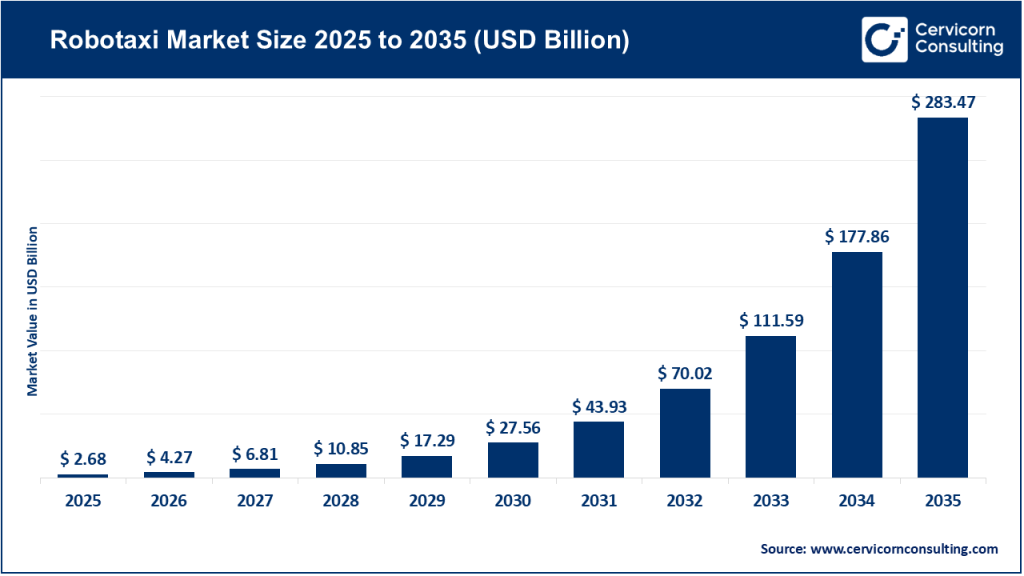
The global robotaxi market size was worth USD 2.68 billion in 2025 and is anticipated to expand to around USD 283.47 billion by 2035, registering a compound annual growth rate (CAGR) of 59.4% from 2026 to 2035.
Robotaxi Market Growth Factors
The robotaxi market is expanding at an extraordinary pace, driven by a convergence of technological breakthroughs, economic incentives, urbanization trends, and regulatory evolution. Advances in artificial intelligence, machine learning, sensor fusion, and high-precision mapping have dramatically enhanced the reliability and safety of autonomous vehicles. Modern perception systems combining cameras, radar, LiDAR, and neural networks enable vehicles to interpret complex traffic environments with increasing accuracy. As autonomy technologies mature, operational risks decline, making commercial deployment more viable.
Simultaneously, rising urban congestion and increasing transportation demand are pushing cities to seek scalable, efficient alternatives to privately owned vehicles. Robotaxis offer the potential to reduce traffic density by enabling shared mobility at scale. Because autonomous fleets can operate continuously without driver fatigue, they can significantly improve asset utilization while lowering cost-per-mile.
Electrification also plays a pivotal role. Many robotaxi platforms are built on electric vehicle architectures, aligning with global sustainability targets. Electric autonomous fleets reduce emissions, lower fuel costs, and simplify maintenance compared to internal combustion vehicles. Governments worldwide are supporting this transition through incentives, infrastructure investments, and policy frameworks encouraging both electrification and automation.
Furthermore, strong capital investment from technology firms, automakers, and venture capital has accelerated research, development, and commercialization efforts. Strategic collaborations between automotive manufacturers, AI developers, and mobility service providers have reduced barriers to entry and improved ecosystem efficiency. Together, these factors are propelling robotaxis from experimental prototypes toward large-scale commercial reality.
Get a Free Sample: https://www.cervicornconsulting.com/sample/2903
Why the Robotaxi Market is Important
The robotaxi market represents one of the most transformative shifts in the history of transportation. Its importance lies in its potential to fundamentally improve safety, efficiency, accessibility, and sustainability.
From a safety perspective, autonomous vehicles aim to drastically reduce accidents caused by human error — historically responsible for the majority of road incidents. AI-driven systems do not suffer from distraction, fatigue, or impaired judgment. Over time, widespread adoption could lead to significant reductions in traffic fatalities and injuries.
Economically, robotaxis promise a redefinition of mobility costs. Removing the driver component can lower operating expenses, potentially making transportation more affordable for consumers while enabling new business models. Fleet operators benefit from higher utilization rates, optimized routing, and predictive maintenance systems.
Socially, robotaxis expand mobility access. Elderly individuals, disabled passengers, and those without driving licenses gain new independence. In urban centers, autonomous ride services could reduce the need for private vehicle ownership, reshaping city infrastructure and freeing valuable space currently dedicated to parking.
Environmentally, robotaxi fleets — particularly electric ones — align with climate goals by lowering emissions, improving traffic flow, and encouraging shared mobility. In combination, these benefits position robotaxis not simply as a technological novelty, but as a structural pillar of future transportation systems.
Key Companies Shaping the Robotaxi Market
Tesla, Inc.
Specialization: Electric vehicles, autonomous driving systems
Key Focus Areas: Full Self-Driving (FSD) technology, AI-based autonomy, fleet deployment
Notable Features:
Tesla approaches robotaxis through its vision-centric autonomy strategy. Instead of relying heavily on LiDAR, Tesla emphasizes camera-based perception combined with neural network processing. The company’s Full Self-Driving platform continuously evolves through large-scale real-world data collection from millions of vehicles.
Tesla’s long-term strategy includes a purpose-built autonomous vehicle designed specifically for ride-hailing. The company envisions a scalable robotaxi network capable of integrating both company-owned fleets and privately owned Tesla vehicles.
2024 Revenue: Tesla’s revenue is reported across broader automotive and energy segments, with robotaxi operations still emerging.
Market Share: Developing position; high potential due to vertical integration and AI capabilities
Global Presence: Extensive global EV footprint supporting future autonomous scaling
Didi Chuxing Technology Co
Specialization: Ride-hailing and mobility platforms
Key Focus Areas: Autonomous driving integration, AI research, fleet operations
Notable Features:
Didi’s strength lies in its vast ride-hailing ecosystem. With deep operational knowledge of urban mobility patterns, the company is uniquely positioned to integrate autonomous vehicles into an already mature demand network. Didi’s investments in autonomous research aim to convert traditional ride demand into driverless services as regulatory environments permit.
2024 Revenue: Embedded within broader mobility services
Market Share: Strong in China’s mobility sector
Global Presence: Significant presence in Asia and international markets
Uber Technologies Inc.
Specialization: Mobility aggregation and platform services
Key Focus Areas: Autonomous partnerships, fleet integration, infrastructure support
Notable Features:
Uber plays a platform-centric role in the robotaxi market. Rather than developing full autonomy stacks independently, Uber increasingly collaborates with autonomous vehicle developers. This strategy enables rapid integration of robotaxi services into its global network.
Uber’s investments in fleet management tools, AI training ecosystems, and charging infrastructure position it as a critical intermediary between technology providers and consumers.
2024 Revenue: Primarily driven by ride-hailing and delivery segments
Market Share: Indirect but influential through partnerships
Global Presence: Extensive multi-continent operations
AutoX, Inc.
Specialization: Autonomous driving software and robotaxi fleets
Key Focus Areas: Level 4 autonomy, urban navigation systems
Notable Features:
AutoX focuses on fully driverless technology stacks capable of operating in dense urban environments. The company emphasizes AI-driven perception systems, autonomous decision-making algorithms, and scalable fleet deployment strategies.
2024 Revenue: Not publicly disclosed (private company)
Market Share: Emerging autonomous technology player
Global Presence: Active primarily in China with expansion ambitions
Aptiv
Specialization: Automotive technology and autonomy systems
Key Focus Areas: Sensors, computing platforms, vehicle intelligence
Notable Features:
Aptiv operates as an enabling technology provider rather than a direct robotaxi operator. Its expertise in advanced driver assistance systems (ADAS), perception hardware, and vehicle computing platforms makes it a foundational supplier within the autonomous ecosystem.
2024 Revenue: Reported across automotive technology segments
Market Share: Strong supplier influence
Global Presence: Broad international automotive partnerships
Leading Trends and Their Impact
AI-Driven Autonomy Improvements
Artificial intelligence remains the backbone of robotaxi systems. Continuous learning algorithms refine vehicle perception, enhance predictive modeling, and improve navigation reliability.
Impact: Higher safety margins, smoother passenger experiences, accelerated adoption
Fleet Electrification
Electric vehicle architectures dominate robotaxi designs due to lower operating costs and sustainability alignment.
Impact: Reduced emissions, lower maintenance expenses, regulatory support advantages
Mobility Platform Integration
Partnerships between autonomous developers and ride-hailing platforms enable rapid commercialization.
Impact: Faster scaling, improved customer access, ecosystem consolidation
Operational Domain Expansion
Robotaxis are expanding beyond central urban cores into suburban regions, airports, and controlled environments.
Impact: Increased revenue streams, improved utilization rates, wider consumer exposure
Successful Robotaxi Deployments Around the World
Several regions have demonstrated meaningful progress in robotaxi operations:
United States: Commercial driverless services operating in select cities with growing ride volumes
China: Large-scale pilot programs supported by structured regulatory frameworks
Europe: Carefully regulated trials emphasizing safety validation
Middle East: Proactive smart city initiatives integrating autonomous mobility
These deployments validate both technological feasibility and consumer acceptance under real-world conditions.
Global Regional Analysis
North America
North America leads technological innovation and commercialization. Regulatory flexibility in certain states has enabled real-world deployment, testing, and scaling.
Government Influence: Pilot approvals, autonomous testing frameworks, EV incentives
Market Characteristics: Early adoption, strong investment ecosystem
Asia-Pacific
Asia-Pacific represents the fastest-growing robotaxi market. Dense urban populations, supportive industrial policy, and infrastructure investments accelerate deployment.
Government Influence: Autonomous testing zones, AI development support
Market Characteristics: Rapid scaling potential, large demand base
Europe
Europe prioritizes safety, standardization, and regulatory precision. Adoption is measured but stable.
Government Influence: Safety-first regulatory structures
Market Characteristics: Gradual expansion, high compliance requirements
Middle East & Emerging Regions
Forward-looking smart city strategies position select Middle Eastern markets as early adopters.
Government Influence: Infrastructure modernization, technology partnerships
Market Characteristics: High readiness, controlled deployment environments
Government Initiatives and Policies Shaping the Market
Governments play a decisive role in robotaxi expansion:
• Regulatory sandboxes enabling controlled testing
• Safety and liability frameworks building public trust
• Infrastructure funding supporting EV and autonomy integration
• Smart city collaborations optimizing urban mobility systems
Policy alignment between innovation and safety remains critical for sustainable market growth.
To Get Detailed Overview, Contact Us: https://www.cervicornconsulting.com/contact-us
Read Report: Temperature-Controlled Packaging Solutions Market Growth Drivers, Trends, Key Players and Regional Insights by 2035