


Reverse Osmosis (RO) Membrane Market Size
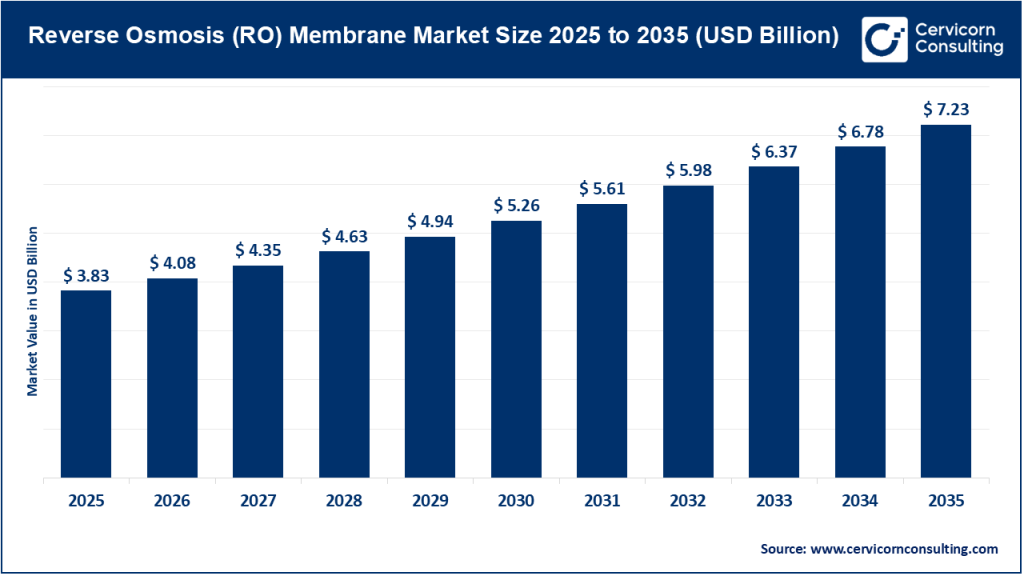
The global reverse osmosis (RO) membrane market was estimated at about USD 3.83 billion in 2025 and is projected to reach nearly USD 7.23 billion by 2035, expanding at a CAGR of 6.6%.
What is the Reverse Osmosis (RO) Membrane Market?
The Reverse Osmosis (RO) membrane market refers to the global industry centered on the production, development, and commercialization of semi-permeable membranes used in reverse osmosis systems. These membranes are engineered to remove dissolved salts, contaminants, bacteria, and impurities from water by applying pressure to force water molecules through a selective barrier. Widely used in desalination, wastewater treatment, and industrial purification processes, RO membranes are a cornerstone technology in modern water management systems.
The market has witnessed significant expansion due to rising demand for potable water and increasing industrial water reuse requirements. According to industry insights, the global RO membrane market is projected to grow steadily, driven by advancements in thin-film composite (TFC) membranes and increasing investments in desalination infrastructure.
Why is the Reverse Osmosis (RO) Membrane Market Important?
The importance of the RO membrane market lies in its direct role in addressing one of the most pressing global challenges: water scarcity. With growing population, urbanization, and industrialization, freshwater resources are under immense pressure.
RO membranes enable:
- Desalination of seawater, making it suitable for drinking and agriculture
- Recycling of wastewater, reducing dependency on freshwater sources
- Industrial water purification, ensuring high-quality process water
- Public health protection, by removing harmful contaminants
Countries facing severe droughts and water shortages are increasingly relying on RO-based desalination plants to secure water supply. For instance, large-scale desalination projects are helping nations diversify water sources and improve resilience against climate change.
Get a Free Sample: https://www.cervicornconsulting.com/sample/2942
Reverse Osmosis (RO) Membrane Market Growth Factors
The growth of the reverse osmosis membrane market is primarily driven by increasing global water scarcity, rapid industrialization, and stringent environmental regulations governing wastewater discharge; rising demand for clean and potable water across residential, municipal, and industrial sectors; expansion of seawater desalination capacity in water-stressed regions; technological advancements such as low-pressure and fouling-resistant membranes improving efficiency and reducing operational costs; growing adoption of water reuse and recycling systems; and increased investments by governments and private entities in water infrastructure projects worldwide, all of which collectively accelerate market expansion.
Key Companies in the Reverse Osmosis (RO) Membrane Market
Below is a structured comparison of leading players:
| Company | Specialization | Key Focus Areas | Notable Features | 2024 Revenue* | Market Share | Global Presence |
|---|---|---|---|---|---|---|
| DuPont Water Solutions | Advanced membrane materials & water technologies | Industrial water treatment, desalination | Chlorine-resistant membranes, high durability | ~$20B (DuPont total) | Significant | North America, Europe, Asia |
| Toray Industries, Inc. | Polymer chemistry & membrane technologies | Desalination, municipal water treatment | Hydrophilic nanolayer technology, high efficiency | ~$18B | Leading | Global (strong in Asia & Middle East) |
| Hydranautics (Nitto Group) | RO & NF membrane solutions | Industrial and municipal water systems | Energy-efficient membranes, high rejection rates | Nitto ~$7B | Strong niche player | Global |
| LG Chem | Chemical and advanced materials | Energy-efficient RO membranes, desalination | Ultralow-pressure membranes, reduced energy use | ~$30B | Growing | Asia, Middle East, Americas |
| SUEZ Water Technologies & Solutions | Integrated water solutions | Industrial water reuse, desalination, utilities | End-to-end water treatment systems | ~$20B (Veolia/SUEZ combined segments) | Strong | Europe, Americas, Middle East |
*Note: Revenue figures represent overall company revenues (approximate) as segment-specific data may vary.
These companies dominate through innovation, global supply chains, and continuous R&D investments.
Leading Trends and Their Impact
1. Development of Ultra-Low Pressure Membranes
Manufacturers are increasingly focusing on membranes that operate at lower pressures, reducing energy consumption significantly. This is crucial because energy costs are a major component of desalination operations. New products launched by companies such as LG Chem highlight this shift toward efficiency.
Impact:
- Reduced operational costs
- Increased adoption in developing regions
- Improved sustainability
2. Fouling-Resistant and Durable Membranes
Membrane fouling (clogging due to contaminants) is a key operational challenge. Companies are developing anti-fouling coatings and surface modifications to extend membrane life.
Impact:
- Lower maintenance costs
- Increased lifespan of systems
- Improved reliability in industrial applications
3. Integration with Smart Technologies
RO systems are increasingly integrated with IoT-based monitoring tools to track performance, detect faults, and optimize usage.
Impact:
- Real-time monitoring
- Predictive maintenance
- Enhanced operational efficiency
4. Expansion of Desalination Projects
Large-scale desalination plants are expanding globally, especially in water-scarce regions like the Middle East and North Africa.
Impact:
- High demand for RO membranes
- Increased investments in infrastructure
- Growth of public-private partnerships
5. Sustainability and Circular Water Economy
Governments and industries are emphasizing water reuse and recycling.
Impact:
- Increased adoption of RO in wastewater treatment
- Reduced environmental footprint
- Regulatory compliance
Successful Examples of Reverse Osmosis (RO) Membrane Applications
1. Orange County Groundwater Replenishment System (USA)
One of the world’s most advanced water recycling facilities uses RO membranes to convert wastewater into potable water. It supplies a significant portion of the region’s water demand and demonstrates the viability of water reuse at scale.
2. Shuaibah Desalination Plant (Saudi Arabia)
A major desalination facility using advanced RO membranes supplied by leading manufacturers, producing large volumes of freshwater daily.
3. Morocco’s Desalination Expansion
Morocco is rapidly expanding its desalination capacity to address prolonged drought conditions, aiming to supply a majority of its population with desalinated water.
4. Singapore NEWater Program
Singapore uses RO membranes in its advanced water recycling program, producing high-quality reclaimed water for industrial and potable use.
5. Israel’s Desalination Plants
Israel is a global leader in desalination, relying heavily on RO technology to meet most of its freshwater needs.
Global Regional Analysis Including Government Initiatives and Policies
Asia-Pacific (Largest Market)
Asia-Pacific dominates the RO membrane market due to rapid industrialization, population growth, and water scarcity challenges. Countries like China and India are heavily investing in wastewater treatment and desalination projects.
Government Initiatives:
- India’s Jal Jeevan Mission (rural water supply)
- China’s water pollution control policies
- Investments in smart water infrastructure
Impact:
- Strong demand for RO membranes
- Expansion of municipal water treatment plants
Middle East & Africa (Fastest Growing Region)
This region is heavily dependent on desalination due to limited freshwater resources.
Government Initiatives:
- Saudi Arabia’s Vision 2030 water strategy
- UAE desalination expansion programs
- Morocco’s renewable-powered desalination projects
Impact:
- Massive deployment of RO membranes
- Growth of large-scale desalination plants
North America
North America is a mature but stable market, driven by water reuse and regulatory compliance.
Government Policies:
- EPA regulations on wastewater discharge
- Support for water recycling initiatives
- Investments in sustainable infrastructure
Impact:
- Replacement demand for membranes
- Growth in industrial applications
Europe
Europe emphasizes sustainability, water reuse, and strict environmental regulations.
Key Policies:
- EU Water Framework Directive
- Industrial Emissions Directive
These policies mandate advanced water treatment systems, boosting demand for RO membranes.
Latin America
Emerging market with increasing adoption of RO technology in mining and municipal sectors.
Government Initiatives:
- Water infrastructure investments
- Public-private partnerships
Impact:
- Gradual market expansion
- Increased industrial usage
Market Dynamics and Competitive Landscape
The RO membrane market is moderately fragmented, with major players competing through innovation, product differentiation, and strategic partnerships. Companies are focusing on:
- Expanding manufacturing capacities
- Enhancing membrane efficiency
- Reducing operational costs
- Strengthening global distribution networks
Technological advancements such as solvent-free membrane production and nanotechnology-based membranes are shaping the future of the industry.
Future Outlook
The reverse osmosis membrane market is expected to witness sustained growth over the next decade due to:
- Increasing global water demand
- Climate change impacts on water availability
- Rising adoption of desalination and water reuse
- Continuous technological advancements
With governments prioritizing water security and sustainability, RO membranes will remain a critical component of global water infrastructure.
To Get Detailed Overview, Contact Us: https://www.cervicornconsulting.com/contact-us
Read Report: Steel Decarbonization Market Revenue, Trends, and Strategic Insights by 2035