


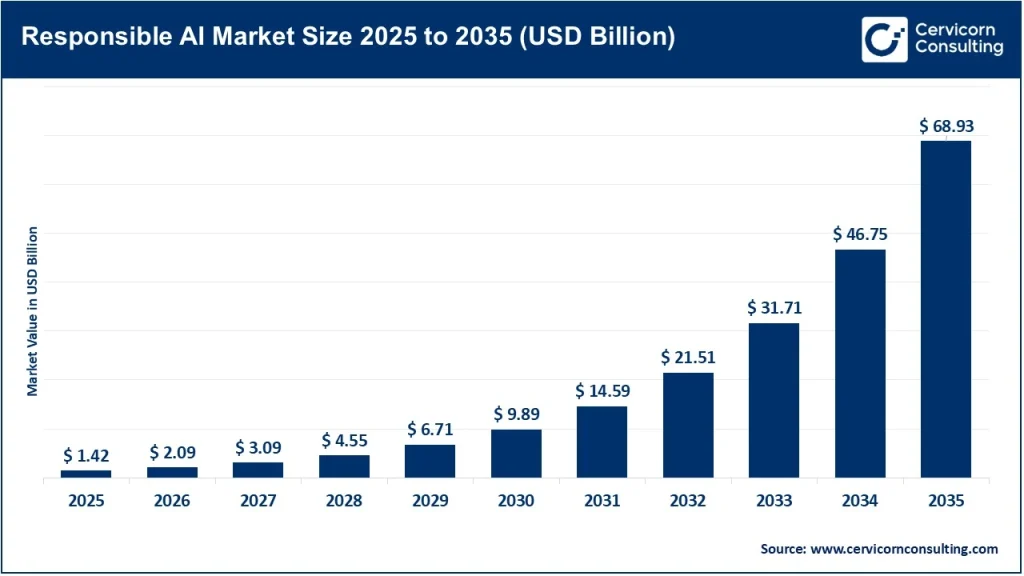
Responsible AI Market Size
The global responsible AI market was valued at approximately USD 1.42 billion in 2025 and is projected to reach nearly USD 68.93 billion by 2035, expanding at a compound annual growth rate (CAGR) of about 47.6% between 2026 and 2035.
Responsible AI Market Growth Factors
The responsible AI market is growing rapidly due to the increasing adoption of artificial intelligence across industries, rising government regulations regarding AI governance, growing awareness about ethical AI practices, and increasing concerns related to bias, transparency, privacy, and cybersecurity. Enterprises are investing heavily in explainable AI technologies and governance frameworks to ensure fair and accountable decision-making systems. The rising implementation of generative AI applications in healthcare, finance, retail, manufacturing, and public services is further driving the need for responsible AI solutions that can manage risks and ensure regulatory compliance.
Additionally, organizations are emphasizing data protection, model monitoring, fairness testing, and AI auditing tools to strengthen customer trust and minimize reputational risks. The expansion of cloud-based AI services, advancements in machine learning operations (MLOps), and increasing partnerships between governments, academic institutions, and technology providers are also accelerating market growth. Furthermore, increasing investments in AI ethics research, workforce training programs, and sustainable AI initiatives are expected to create substantial growth opportunities for responsible AI vendors worldwide.
What is Responsible AI Market?
The responsible AI market encompasses technologies, platforms, services, frameworks, and governance solutions designed to ensure that artificial intelligence systems operate ethically, transparently, securely, and in compliance with legal and social standards. It includes AI fairness assessment tools, explainable AI platforms, AI governance software, bias detection systems, risk management solutions, data privacy technologies, and compliance monitoring services.
Responsible AI solutions help organizations build trustworthy AI models by ensuring fairness in automated decision-making, protecting sensitive data, reducing harmful bias, and improving accountability throughout the AI lifecycle. These solutions are widely used in sectors such as healthcare, banking, insurance, retail, government, transportation, telecommunications, and manufacturing.
The market also includes consulting and implementation services that help organizations develop AI ethics strategies, governance policies, and compliance programs. As artificial intelligence becomes deeply integrated into critical business operations, responsible AI is becoming an essential component of enterprise risk management and digital transformation strategies.
Get a Free Sample: https://www.cervicornconsulting.com/sample/2956
Why Responsible AI is Important?
Responsible AI is important because artificial intelligence systems increasingly influence decisions related to healthcare diagnoses, financial approvals, recruitment processes, law enforcement, customer service, and public administration. If AI systems are not properly designed and monitored, they can produce biased, inaccurate, or discriminatory outcomes that negatively impact individuals and society.
Responsible AI practices help organizations ensure fairness, accountability, and transparency in AI-driven decision-making. They reduce the risks of unethical data usage, privacy violations, and algorithmic discrimination. By implementing explainable AI models and governance mechanisms, businesses can improve stakeholder confidence and strengthen regulatory compliance.
The importance of responsible AI has increased significantly with the rise of generative AI technologies and autonomous systems. Governments and regulatory authorities worldwide are introducing policies and standards that require companies to demonstrate transparency, risk management, and human oversight in AI operations.
Responsible AI also supports long-term innovation and sustainable growth by promoting trust between businesses, consumers, and regulators. Companies that adopt responsible AI frameworks are better positioned to protect their brand reputation, reduce operational risks, and create socially beneficial AI applications.
Major Companies in the Responsible AI Market
| Company | Specialization | Key Focus Areas | Notable Features | 2025 Revenue | Market Share | Global Presence |
|---|---|---|---|---|---|---|
| Microsoft | AI platforms, cloud computing, enterprise AI governance | Responsible AI governance, AI transparency, fairness tools, cybersecurity | Azure AI Responsible AI Dashboard, Copilot governance tools, AI ethics framework | Approx. USD 280+ billion | Strong leadership in enterprise AI governance | North America, Europe, Asia-Pacific, Middle East, Latin America |
| IBM | AI governance software and enterprise AI solutions | Explainable AI, bias mitigation, AI lifecycle governance | IBM Watsonx Governance platform, AI risk management tools | Approx. USD 65+ billion | Major enterprise AI governance provider | Global operations across more than 170 countries |
| Google (DeepMind) | Advanced AI research and machine learning | AI safety, AI alignment, explainability, ethical generative AI | DeepMind safety research, Gemini AI governance capabilities | Approx. USD 350+ billion (Alphabet) | Significant influence in AI research and cloud AI services | Strong presence across global digital markets |
| Amazon Web Services (AWS) | Cloud AI infrastructure and AI services | Responsible generative AI, AI model transparency, cloud security | AWS AI Service Cards, Bedrock guardrails, compliance frameworks | Approx. USD 110+ billion | Leading cloud-based AI services provider | Extensive global cloud infrastructure |
| Salesforce | CRM-based AI and enterprise automation | Trusted AI for customer engagement, secure generative AI | Einstein Trust Layer, ethical customer data management | Approx. USD 40+ billion | Strong presence in enterprise customer AI solutions | North America, Europe, Asia-Pacific |
Leading Trends in the Responsible AI Market and Their Impact
1. Expansion of Generative AI Governance
The rapid adoption of generative AI technologies is one of the most influential trends shaping the responsible AI market. Organizations are increasingly deploying large language models, AI copilots, and generative automation tools across customer service, marketing, software development, and healthcare operations.
However, generative AI systems introduce significant risks related to hallucinations, misinformation, intellectual property infringement, and data privacy concerns. As a result, enterprises are investing in AI governance platforms that provide model monitoring, content filtering, explainability, and compliance auditing capabilities.
This trend is accelerating demand for responsible AI software and consulting services while encouraging vendors to develop more transparent and controllable AI systems.
2. Rising Regulatory Compliance Requirements
Governments and regulatory agencies worldwide are introducing AI regulations to ensure ethical deployment and accountability. Organizations are increasingly adopting responsible AI frameworks to comply with evolving regulations such as the European Union AI Act and AI governance standards introduced in North America and Asia-Pacific.
Compliance-focused responsible AI solutions are helping companies assess risks, maintain documentation, and monitor AI behavior throughout deployment cycles. This trend is expected to create long-term growth opportunities for governance software providers and AI auditing firms.
3. Increasing Demand for Explainable AI
Businesses and consumers are demanding greater transparency regarding how AI systems make decisions. Explainable AI solutions enable organizations to understand, interpret, and justify algorithmic outcomes.
Industries such as healthcare, banking, insurance, and government are prioritizing explainability because AI-driven decisions in these sectors directly impact human lives and financial outcomes. The increasing demand for explainable AI is encouraging innovation in model interpretability, visualization tools, and algorithmic accountability platforms.
4. Integration of AI Ethics into Enterprise Strategy
Responsible AI is no longer treated solely as a compliance requirement. Enterprises are integrating AI ethics into broader corporate governance and sustainability strategies.
Companies are establishing AI ethics committees, implementing internal AI policies, and conducting regular bias assessments to strengthen trust and improve operational accountability. This trend is transforming responsible AI from a niche governance function into a core component of digital transformation initiatives.
5. Growth of AI Risk Management Platforms
Organizations are increasingly adopting AI risk management platforms that monitor model performance, bias, cybersecurity vulnerabilities, and regulatory compliance.
These platforms help enterprises identify potential risks before they affect customers or business operations. The increasing complexity of AI systems is driving demand for continuous monitoring and automated governance tools.
Successful Examples of Responsible AI Around the World
Microsoft Responsible AI Framework
Microsoft has emerged as a leading example of responsible AI implementation through its comprehensive Responsible AI Standard and governance framework. The company has developed fairness assessment tools, transparency guidelines, and AI governance practices integrated across Azure AI services.
Microsoft’s Responsible AI Dashboard helps developers identify bias, evaluate model performance, and improve transparency throughout the AI lifecycle. The company also established an internal Office of Responsible AI to oversee governance and policy implementation.
IBM Watsonx Governance
IBM has been a pioneer in explainable and trustworthy AI solutions. The company introduced IBM Watsonx Governance to help enterprises manage AI risks, ensure regulatory compliance, and monitor AI model performance.
IBM’s AI governance platform provides automated documentation, bias detection, explainability tools, and lifecycle management capabilities that support responsible AI adoption in highly regulated industries.
Google DeepMind AI Safety Research
Google DeepMind has invested heavily in AI safety and alignment research to ensure that advanced AI systems operate in accordance with human values and ethical principles.
The organization focuses on reinforcement learning safety, interpretability research, and risk mitigation strategies for generative AI systems. DeepMind’s research has influenced industry-wide discussions on AI alignment and responsible deployment practices.
Salesforce Einstein Trust Layer
Salesforce introduced the Einstein Trust Layer to ensure secure and ethical generative AI deployment in customer relationship management systems. The platform provides data masking, zero data retention policies, audit trails, and compliance monitoring.
This initiative demonstrates how responsible AI can be integrated into enterprise productivity and customer engagement platforms without compromising data security or customer trust.
Singapore’s National AI Governance Framework
Singapore has established one of the world’s most advanced national AI governance frameworks. The government developed practical guidelines that help organizations implement transparent and accountable AI systems.
The country actively collaborates with businesses, universities, and international organizations to promote ethical AI innovation while supporting economic growth and digital transformation.
Global Regional Analysis of the Responsible AI Market
North America
North America dominates the global responsible AI market due to strong technological infrastructure, high AI adoption rates, and significant investments in AI governance and cybersecurity. The United States and Canada are major contributors to regional market growth.
Large technology companies headquartered in the region are investing heavily in AI ethics frameworks, explainability tools, and governance platforms. Financial institutions, healthcare providers, and government agencies are increasingly implementing responsible AI solutions to comply with regulations and reduce operational risks.
Government Initiatives and Policies
The United States government has introduced multiple initiatives focused on trustworthy AI development, including the AI Bill of Rights framework and AI risk management guidelines developed by the National Institute of Standards and Technology (NIST). Federal agencies are encouraging transparent and accountable AI deployment across public and private sectors.
Canada has also established AI governance programs emphasizing ethical AI innovation, privacy protection, and human rights considerations.
Europe
Europe represents one of the most regulated and policy-driven responsible AI markets globally. The region is focused on establishing ethical standards, consumer protection measures, and transparency requirements for AI deployment.
European organizations are rapidly adopting AI governance solutions to comply with evolving regulatory frameworks. Industries such as banking, healthcare, manufacturing, and public administration are investing in responsible AI technologies to meet strict compliance requirements.
Government Initiatives and Policies
The European Union AI Act is one of the most comprehensive AI regulatory frameworks globally. The legislation classifies AI systems based on risk levels and imposes obligations related to transparency, safety, human oversight, and accountability.
The General Data Protection Regulation (GDPR) also plays a major role in shaping responsible AI adoption by emphasizing data privacy and individual rights. European governments continue investing in ethical AI research and digital innovation programs.
Asia-Pacific
Asia-Pacific is expected to witness the fastest growth in the responsible AI market due to increasing AI adoption, expanding digital economies, and rising government investments in AI governance frameworks.
Countries such as China, Japan, South Korea, Singapore, and India are actively promoting AI innovation while introducing policies to ensure ethical and secure AI deployment.
The rapid expansion of cloud computing, smart manufacturing, fintech, and e-commerce industries is driving demand for AI governance and compliance solutions across the region.
Government Initiatives and Policies
China has introduced AI governance guidelines focused on algorithmic transparency, cybersecurity, and social stability. The country is implementing stricter regulations for generative AI services and recommendation algorithms.
Japan is promoting human-centric AI development through collaborative public-private initiatives. Singapore continues to lead regional AI governance efforts through its Model AI Governance Framework.
India is increasingly emphasizing ethical AI adoption through digital governance programs and responsible AI policy discussions aimed at balancing innovation with public accountability.
Latin America
Latin America is gradually emerging as a promising responsible AI market due to increasing digital transformation initiatives and growing awareness regarding data privacy and AI ethics.
Financial services, telecommunications, and retail sectors are adopting AI governance tools to improve transparency and customer trust. Cloud-based AI solutions are gaining traction as organizations modernize business operations.
Government Initiatives and Policies
Several Latin American countries are developing national AI strategies focused on ethical AI adoption, digital inclusion, and data protection. Brazil and Mexico are among the leading regional markets implementing AI governance discussions and regulatory frameworks.
Middle East and Africa
The Middle East and Africa region is experiencing growing interest in responsible AI due to increasing smart city initiatives, government digital transformation programs, and investments in AI-powered public services.
Countries in the Gulf region are actively adopting AI technologies across healthcare, energy, transportation, and financial services sectors.
Government Initiatives and Policies
The United Arab Emirates and Saudi Arabia have launched national AI strategies emphasizing ethical AI innovation, economic diversification, and responsible technology deployment.
Governments in the region are partnering with global technology providers to develop AI governance standards and strengthen cybersecurity capabilities.
Future Outlook of the Responsible AI Market
The future of the responsible AI market appears highly promising as organizations increasingly recognize the importance of trustworthy and ethical AI systems. Rising investments in generative AI governance, explainable AI, privacy-enhancing technologies, and AI risk management platforms are expected to drive long-term market growth.
Technology companies are likely to continue expanding responsible AI capabilities through advanced governance tools, automated compliance monitoring, and AI auditing solutions. Governments worldwide are expected to introduce more comprehensive AI regulations that emphasize transparency, accountability, and human oversight.
As artificial intelligence becomes more deeply integrated into business operations and public services, responsible AI will become a strategic necessity rather than an optional governance measure. Enterprises that prioritize ethical AI development and transparent governance practices will be better positioned to build consumer trust, achieve regulatory compliance, and maintain sustainable competitive advantages in the evolving digital economy.
To Get Detailed Overview, Contact Us: https://www.cervicornconsulting.com/contact-us
Read Report: Hydrogen Bikes Market Revenue, Trends, and Strategic Insights by 2035