


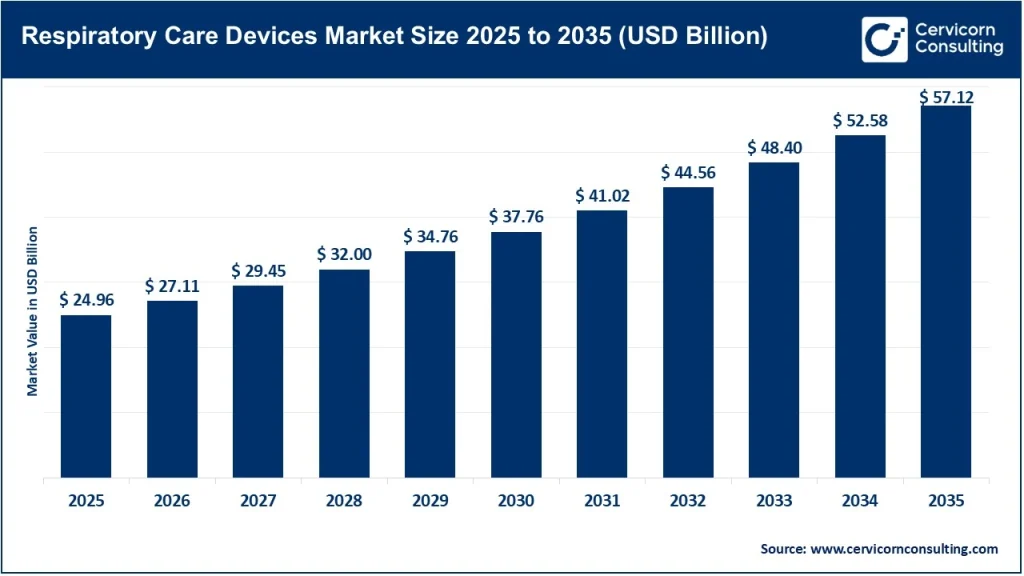
Respiratory Care Devices Market Size
The global respiratory care devices market reached an estimated valuation of USD 24.96 billion in 2025 and is projected to grow substantially, attaining approximately USD 57.12 billion by 2035. This growth reflects a strong compound annual growth rate (CAGR) of around 8.6% throughout the forecast period.
What is the Respiratory Care Devices Market?
The respiratory care devices market refers to the global industry involved in the manufacturing, development, distribution, and commercialization of medical devices used for respiratory monitoring, diagnosis, therapy, and patient support. These devices assist healthcare professionals and patients in managing respiratory illnesses effectively across hospitals, clinics, ambulatory care centers, and home healthcare settings.
Respiratory care devices play a critical role in improving lung function, enhancing oxygen delivery, monitoring breathing patterns, and supporting critically ill patients with breathing assistance. The market is divided into several product categories including therapeutic devices, diagnostic devices, monitoring equipment, and consumables. Therapeutic respiratory devices such as ventilators and oxygen concentrators account for a significant share of the market due to their widespread use in critical care and chronic disease management.
The increasing burden of respiratory diseases worldwide has accelerated the adoption of respiratory care technologies. According to global healthcare organizations, millions of people suffer from chronic respiratory conditions annually, leading to rising hospitalization rates and healthcare costs. As healthcare systems continue focusing on preventive care and remote patient monitoring, the respiratory care devices market is expected to witness robust growth over the coming years.
Get a Free Sample: https://www.cervicornconsulting.com/sample/2955
Why is the Respiratory Care Devices Market Important?
The respiratory care devices market is important because respiratory illnesses remain among the leading causes of mortality and morbidity globally. Air pollution, smoking habits, occupational hazards, lifestyle changes, and viral outbreaks have increased the incidence of respiratory disorders across both developed and developing nations.
Respiratory care devices improve patient outcomes by enabling early diagnosis, effective treatment, and continuous monitoring of respiratory conditions. Devices such as ventilators and oxygen concentrators became particularly essential during global healthcare emergencies, highlighting the critical importance of respiratory support infrastructure.
The market also supports the transition toward home healthcare and telemedicine. Portable oxygen therapy systems, wearable respiratory monitoring devices, and connected CPAP systems allow patients to manage chronic diseases conveniently at home, reducing hospital admissions and lowering healthcare expenses.
In addition, respiratory care devices contribute to enhanced quality of life for elderly populations and patients with chronic illnesses. The growing preference for minimally invasive treatment solutions and digital healthcare ecosystems further strengthens the importance of this market.
Respiratory Care Devices Market Growth Factors
The respiratory care devices market is experiencing strong expansion due to several interconnected growth factors including the increasing prevalence of chronic respiratory diseases such as asthma, COPD, and sleep apnea; rapid growth in the geriatric population susceptible to respiratory complications; rising levels of air pollution and smoking-related illnesses; growing awareness regarding early respiratory disease diagnosis and treatment; increasing healthcare expenditure across emerging economies.
Rising adoption of home healthcare and remote patient monitoring solutions; advancements in portable ventilators, oxygen concentrators, and smart respiratory monitoring technologies; expansion of telehealth infrastructure; favorable reimbursement policies in developed countries; and increasing investments in healthcare infrastructure following global public health emergencies. Furthermore, the integration of artificial intelligence, cloud-based respiratory monitoring systems, and connected healthcare platforms is improving patient management and clinical efficiency, thereby accelerating demand for advanced respiratory care devices worldwide.
Key Segments within the Respiratory Care Devices Market
Therapeutic Devices
Therapeutic respiratory devices dominate the respiratory care devices market due to their extensive use in hospitals and home healthcare settings. These devices include ventilators, nebulizers, humidifiers, oxygen concentrators, and CPAP systems.
Monitoring Devices
Monitoring devices such as pulse oximeters and capnography systems are increasingly adopted for continuous patient monitoring. The demand for wearable respiratory monitoring systems is also rising due to the expansion of remote healthcare services.
Diagnostic Devices
Diagnostic respiratory devices include spirometers, polysomnography systems, and peak flow meters. These devices assist healthcare professionals in identifying respiratory conditions at an early stage.
Home Healthcare Applications
Home healthcare applications represent one of the fastest-growing segments within the respiratory care devices market. Patients increasingly prefer portable respiratory devices that provide convenience, mobility, and cost-effective treatment.
Leading Trends and Their Impact on the Respiratory Care Devices Market
Rise of Home-Based Respiratory Care
The increasing demand for home healthcare solutions has transformed the respiratory care devices market significantly. Patients with chronic respiratory conditions are adopting portable oxygen concentrators, CPAP devices, and remote respiratory monitoring systems to receive treatment from home.
This trend reduces hospitalization costs, improves patient comfort, and enables healthcare providers to monitor patients remotely. Companies are developing compact, lightweight, and battery-operated respiratory devices to meet growing demand.
Integration of Artificial Intelligence and IoT
Artificial intelligence and Internet of Things (IoT) technologies are reshaping respiratory care. Smart respiratory devices can track patient data in real time, detect abnormalities, and send alerts to healthcare professionals.
Connected respiratory devices improve treatment compliance, support predictive analytics, and enable personalized patient care. AI-driven algorithms are also helping clinicians optimize ventilator settings and respiratory therapy management.
Growing Adoption of Telemedicine
Telemedicine has become an essential component of respiratory healthcare management. Digital platforms integrated with respiratory monitoring devices enable virtual consultations, remote diagnosis, and continuous patient engagement.
This trend is particularly beneficial for rural and underserved populations where access to specialized respiratory care may be limited.
Demand for Portable and Wearable Devices
Portable and wearable respiratory devices are gaining popularity due to their convenience and mobility. Compact oxygen concentrators and wearable respiratory sensors support active lifestyles while enabling continuous monitoring.
The increasing preference for non-invasive respiratory therapies is also contributing to innovation in lightweight and user-friendly respiratory equipment.
Technological Innovations in Ventilation Systems
Manufacturers are focusing on advanced ventilation systems with improved safety, automation, and precision. Modern ventilators include touchscreen interfaces, cloud connectivity, and adaptive ventilation technologies that enhance clinical outcomes.
Expansion of Pediatric Respiratory Care Solutions
The increasing prevalence of pediatric respiratory conditions is encouraging the development of child-friendly respiratory devices. Manufacturers are introducing specialized nebulizers, masks, and ventilators designed specifically for infants and children.
Competitive Landscape of the Respiratory Care Devices Market
The respiratory care devices market is highly competitive with major multinational corporations investing heavily in research and development, product innovation, mergers and acquisitions, and global expansion strategies. Companies are focusing on advanced digital respiratory solutions, AI integration, and home healthcare technologies to strengthen their market positions.
| Company | Specialization | Key Focus Areas | Notable Features | 2025 Revenue | Market Share | Global Presence |
|---|---|---|---|---|---|---|
| Koninklijke Philips N.V. | Respiratory therapy and connected healthcare solutions | Sleep apnea devices, ventilators, oxygen therapy, patient monitoring | Strong digital health ecosystem, connected care platforms, advanced respiratory monitoring systems | Approx. USD 20+ billion | Significant global share in respiratory and sleep therapy devices | North America, Europe, Asia-Pacific, Latin America, Middle East & Africa |
| ResMed Inc. | Sleep apnea and respiratory care technologies | CPAP devices, cloud-based respiratory monitoring, home healthcare | Industry-leading sleep apnea technologies, AI-enabled patient management systems | Approx. USD 4+ billion | Major share in sleep apnea and CPAP market | Operations in more than 140 countries |
| Medtronic plc | Medical technology and respiratory intervention systems | Ventilators, airway management, respiratory monitoring | Broad hospital network, advanced critical care respiratory systems | Approx. USD 32+ billion | Strong presence in critical care respiratory solutions | Global operations across developed and emerging economies |
| Fisher & Paykel Healthcare Corporation Limited | Humidification and respiratory support systems | Neonatal respiratory care, humidifiers, respiratory consumables | Expertise in humidification technologies and neonatal care | Approx. USD 1.8+ billion | Strong niche presence in humidification devices | Asia-Pacific, North America, Europe, Middle East |
| GE HealthCare | Diagnostic imaging and respiratory monitoring | Respiratory monitoring systems, ICU technologies, patient diagnostics | Integration of imaging and monitoring technologies | Approx. USD 20+ billion | Strong hospital equipment market presence | Extensive global healthcare distribution network |
What are Some Successful Examples of Respiratory Care Devices Market Around the World?
United States: Advanced Home Respiratory Care Ecosystem
The United States represents one of the most advanced respiratory care markets globally. Widespread adoption of CPAP devices for sleep apnea management and increasing demand for portable oxygen concentrators have created a mature home healthcare ecosystem.
Healthcare providers in the U.S. utilize connected respiratory devices integrated with telemedicine platforms, allowing physicians to monitor patient compliance and treatment effectiveness remotely.
Germany: Technological Innovation in Respiratory Monitoring
Germany has become a major center for respiratory medical technology innovation. The country emphasizes advanced ICU respiratory systems, precision monitoring devices, and digital healthcare integration.
German hospitals have adopted AI-enabled ventilators and respiratory monitoring solutions that improve patient safety and treatment outcomes.
Japan: Elderly Care and Portable Oxygen Therapy
Japan’s aging population has accelerated demand for portable respiratory devices and home oxygen therapy systems. The country has successfully integrated compact respiratory technologies into elderly care services.
Japanese manufacturers are known for producing lightweight, energy-efficient respiratory devices tailored to long-term home use.
China: Rapid Expansion of Respiratory Healthcare Infrastructure
China has experienced rapid growth in respiratory healthcare infrastructure due to increasing respiratory disease prevalence and government healthcare investments.
Domestic and international companies are expanding manufacturing capabilities and introducing cost-effective respiratory care devices to meet growing demand.
India: Affordable Respiratory Care Solutions
India has emerged as a significant market for affordable respiratory care technologies. Increasing awareness regarding respiratory disorders, expansion of healthcare infrastructure, and government support for domestic medical device manufacturing are driving market growth.
Several Indian hospitals and startups are developing low-cost ventilators and oxygen delivery systems to improve healthcare accessibility.
Global Regional Analysis of the Respiratory Care Devices Market
North America
North America dominates the respiratory care devices market due to advanced healthcare infrastructure, high healthcare spending, and widespread adoption of technologically advanced medical devices.
The United States accounts for a significant portion of regional revenue because of rising cases of COPD, asthma, and sleep apnea. The region also benefits from favorable reimbursement policies and strong investment in healthcare innovation.
Government Initiatives and Policies in North America
Government agencies and healthcare organizations in North America have introduced policies to improve respiratory disease management and emergency preparedness. Public healthcare programs support reimbursement for respiratory therapies and home oxygen equipment.
The region has also invested heavily in strengthening critical care infrastructure and emergency ventilator availability following global health crises.
Europe
Europe represents a substantial share of the respiratory care devices market due to increasing respiratory disease prevalence, growing elderly populations, and strong healthcare systems.
Countries such as Germany, France, and the United Kingdom are leading adopters of advanced respiratory monitoring and ventilation technologies. The region also benefits from high awareness regarding respiratory disease prevention and treatment.
Government Initiatives and Policies in Europe
European governments actively support healthcare modernization and digital health integration. Policies promoting home healthcare services and chronic disease management are encouraging the adoption of connected respiratory devices.
The European Union has also established regulatory frameworks focused on medical device safety, quality standards, and patient protection.
Asia-Pacific
Asia-Pacific is projected to experience the fastest growth in the respiratory care devices market due to increasing healthcare investments, expanding urban populations, rising pollution levels, and improving healthcare access.
Countries including China, India, Japan, and South Korea are investing heavily in respiratory healthcare infrastructure and domestic medical device manufacturing.
The growing middle-class population and rising awareness regarding respiratory diseases are also supporting market expansion.
Government Initiatives and Policies in Asia-Pacific
Governments across Asia-Pacific are implementing healthcare reforms aimed at improving respiratory disease diagnosis and treatment. Several countries are promoting local medical device production through incentives and funding programs.
Public awareness campaigns related to smoking cessation, air pollution control, and respiratory disease prevention are also positively influencing market growth.
Latin America
Latin America is witnessing gradual growth in the respiratory care devices market due to improving healthcare infrastructure and increasing awareness regarding chronic respiratory diseases.
Brazil and Mexico are among the major contributors to regional market growth. Rising healthcare investments and expansion of private healthcare services are increasing demand for respiratory care technologies.
Government Initiatives and Policies in Latin America
Governments in Latin America are investing in healthcare modernization and expanding access to respiratory treatment services. Public health campaigns targeting respiratory illnesses and smoking-related diseases are contributing to increased device adoption.
Middle East and Africa
The Middle East and Africa region is experiencing growing demand for respiratory care devices due to increasing respiratory disease cases, rising healthcare investments, and expansion of critical care facilities.
Countries in the Gulf region are investing heavily in advanced healthcare technologies and hospital infrastructure. Increasing prevalence of smoking-related respiratory disorders and environmental pollution is also driving demand.
Government Initiatives and Policies in the Middle East and Africa
Governments across the Middle East are implementing healthcare transformation programs focused on digital healthcare and advanced medical technologies. Investments in ICU capacity, respiratory care training, and emergency preparedness are supporting market development.
In Africa, international healthcare partnerships and public health initiatives are improving access to respiratory care solutions in underserved communities.
Emerging Opportunities in the Respiratory Care Devices Market
The respiratory care devices market presents numerous opportunities for manufacturers, healthcare providers, and investors. Increasing demand for remote patient monitoring, AI-powered respiratory analytics, and personalized respiratory therapy solutions is creating significant innovation potential.
Emerging markets are expected to play a major role in future industry expansion due to improving healthcare infrastructure and rising medical device adoption. Companies focusing on affordable, portable, and digitally connected respiratory devices are likely to gain competitive advantages.
The integration of cloud computing, wearable technologies, and predictive healthcare analytics is expected to transform respiratory disease management in the coming years. In addition, increasing investments in sustainable healthcare technologies and energy-efficient respiratory devices are opening new growth avenues for the global respiratory care devices market.
Future Outlook of the Respiratory Care Devices Market
The future of the respiratory care devices market appears highly promising due to continuous technological advancements, increasing prevalence of respiratory disorders, and growing demand for patient-centric healthcare solutions.
Healthcare providers are expected to adopt more connected respiratory devices capable of delivering real-time patient insights and predictive diagnostics. The transition toward home healthcare and value-based care models will further strengthen demand for portable respiratory devices.
Artificial intelligence, digital therapeutics, and cloud-based respiratory management platforms are expected to redefine respiratory care delivery across hospitals and home settings. As governments and healthcare organizations continue prioritizing respiratory disease management, the respiratory care devices market is likely to witness sustained long-term growth worldwide.
To Get Detailed Overview, Contact Us: https://www.cervicornconsulting.com/contact-us
Read Report: High Performance Computing Market Revenue, Trends, and Strategic Insights by 2035