


Table of Contents
TogglePublic Safety and Security Market Size
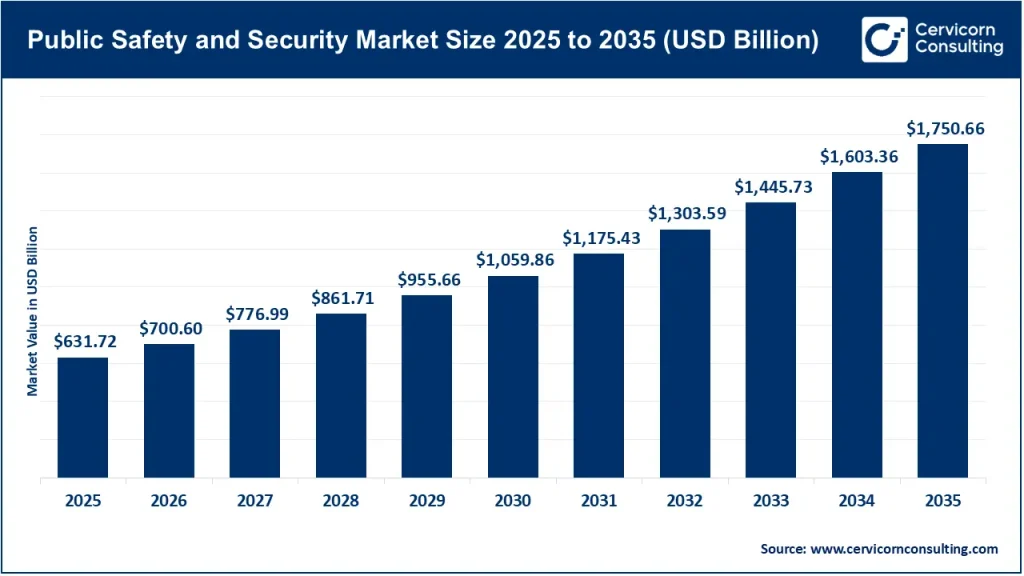
The global public safety and security market was valued at approximately USD 631.72 billion in 2025 and is projected to reach nearly USD 1,750.66 billion by 2035, growing at a CAGR of 10.73%.
Public Safety and Security Market Growth Factors
The public safety and security market is experiencing robust growth due to the increasing frequency of cyberattacks, terrorist threats, natural disasters, urbanization, and the growing need for resilient critical infrastructure protection. Governments worldwide are investing heavily in smart city initiatives, AI-powered surveillance systems, emergency communication networks, intelligent transportation systems, and next-generation command-and-control centers to enhance public safety. The rapid adoption of cloud computing, Internet of Things (IoT), big data analytics, facial recognition, drones, and predictive policing technologies is transforming security operations by enabling faster response times and real-time situational awareness. Rising defense budgets, modernization of law enforcement agencies, stricter homeland security regulations, and increasing public-private partnerships are further accelerating market expansion.
Additionally, the expansion of digital infrastructure has heightened concerns around cybersecurity, driving investments in integrated physical and cyber security solutions that protect governments, businesses, and citizens alike.
What is the Public Safety and Security Market?
The public safety and security market encompasses technologies, software platforms, communication systems, surveillance equipment, cybersecurity solutions, emergency response infrastructure, and integrated services designed to protect citizens, critical infrastructure, public institutions, and businesses from physical and digital threats.
The market includes solutions such as:
- Video surveillance systems
- Emergency communication networks
- Computer-aided dispatch (CAD)
- Records management systems
- Cybersecurity platforms
- Border security technologies
- Disaster management systems
- Biometric identification
- AI-enabled monitoring
- Smart city security infrastructure
- Public warning systems
- Incident management software
Public safety organizations—including police departments, fire services, emergency medical services (EMS), transportation authorities, military agencies, disaster management organizations, and homeland security departments—rely on these technologies to improve operational efficiency and emergency preparedness.
Get a Free Sample: https://www.cervicornconsulting.com/sample/2664
Why is the Public Safety and Security Market Important?
Public safety has become one of the highest priorities for governments worldwide. Modern societies depend heavily on secure transportation, reliable communication networks, energy systems, healthcare facilities, financial institutions, and digital infrastructure.
The importance of the market includes:
Protection Against Evolving Threats
Threats are no longer limited to traditional crime. Governments must address:
- Cybercrime
- Terrorism
- Critical infrastructure attacks
- Border infiltration
- Natural disasters
- Industrial accidents
- Public health emergencies
Advanced security technologies help identify risks before they escalate.
Faster Emergency Response
Modern emergency response systems use:
- AI
- GPS tracking
- Cloud dispatch
- Real-time analytics
- Integrated communication
These technologies significantly reduce emergency response times.
Smart City Development
As cities become increasingly connected, public safety systems are being integrated with:
- Traffic management
- Public transportation
- Environmental monitoring
- Utility networks
This creates safer and more efficient urban environments.
Cybersecurity Protection
Government agencies increasingly rely on digital infrastructure, making cybersecurity an essential component of public safety strategies.
Economic Stability
Secure environments encourage:
- Investment
- Tourism
- Business expansion
- Infrastructure development
A safe society contributes directly to economic growth.
Leading Companies in the Public Safety and Security Market
| Company | Specialization | Key Focus Areas | Notable Features | 2025 Revenue* | Estimated Market Share | Global Presence |
|---|---|---|---|---|---|---|
| Motorola Solutions, Inc. | Mission-critical communications | Land mobile radio (LMR), command centers, video security, emergency response | Strong public safety ecosystem through software, services, and communications | US$11.7 billion | ~8–10% | North America, Europe, Asia-Pacific, Middle East, Latin America |
| Cisco Systems, Inc. | Networking and cybersecurity | Secure networking, cloud security, AI-enabled infrastructure | Integrated networking, Zero Trust security, Splunk-powered analytics | US$56.7 billion | ~7–9% | More than 100 countries |
| Honeywell International Inc. | Industrial automation and building security | Smart buildings, industrial cybersecurity, surveillance, emergency systems | AI-enabled building management and critical infrastructure protection | US$37.4 billion | ~5–7% | Over 70 countries |
| NEC Corporation | Biometrics and digital government | Facial recognition, border control, public safety platforms | Industry-leading biometric identification technologies | FY2025 consolidated revenue: JPY 3.58 trillion | ~4–6% | Asia-Pacific, Europe, North America, Middle East |
| Thales | Defense, aerospace, and digital identity | Critical infrastructure, cybersecurity, border management, secure communications | Advanced encryption, secure digital identity, transportation security | Multi-billion-euro global defense and digital security business | ~4–6% | More than 60 countries |
Leading Trends Transforming the Public Safety and Security Market
1. Artificial Intelligence-Powered Surveillance
AI is revolutionizing surveillance by enabling systems to:
- Detect suspicious behavior
- Identify abandoned objects
- Recognize faces
- Analyze crowd movements
- Predict incidents
AI significantly reduces manual monitoring while improving detection accuracy.
Market Impact
Governments are investing in intelligent video analytics to improve public safety without proportionally increasing workforce requirements.
2. Smart Cities Driving Security Investments
Smart cities require integrated security infrastructure capable of monitoring transportation systems, utilities, public spaces, and emergency services from centralized command centers.
Impact
Cities are deploying:
- Smart cameras
- Connected sensors
- Traffic monitoring
- Emergency alert systems
- Environmental sensors
These technologies improve operational efficiency and urban resilience.
3. Cloud-Based Public Safety Platforms
Traditional on-premise systems are being replaced by cloud-based platforms offering:
- Faster deployment
- Lower maintenance costs
- Real-time collaboration
- Secure data sharing
- Improved scalability
Cloud technologies enable agencies to coordinate more effectively during emergencies.
4. Cybersecurity Integration
Public safety agencies increasingly rely on connected devices and digital infrastructure, making cybersecurity an essential component of modern security strategies.
Key investments include:
- Zero Trust architectures
- Endpoint protection
- Identity management
- Security operations centers (SOCs)
- Threat intelligence platforms
5. Internet of Things (IoT) Expansion
IoT devices now support:
- Smart traffic systems
- Environmental monitoring
- Fire detection
- Connected emergency vehicles
- Infrastructure monitoring
Real-time data enhances situational awareness and enables proactive decision-making.
6. Drone Technology for Emergency Response
Drones assist law enforcement and emergency responders by providing:
- Disaster assessment
- Search and rescue
- Border surveillance
- Fire monitoring
- Traffic analysis
Drone deployment reduces response time while improving responder safety.
7. Predictive Analytics
Public safety organizations increasingly use predictive analytics to forecast:
- Crime hotspots
- Traffic congestion
- Weather-related emergencies
- Resource requirements
These insights support better planning and resource allocation.
Successful Examples of Public Safety and Security Around the World
Singapore Smart Nation Initiative
Singapore has developed one of the world’s most advanced smart city ecosystems.
Key technologies include:
- AI surveillance
- Smart traffic management
- National sensor networks
- Digital identity systems
- Integrated emergency response
The initiative enables authorities to monitor urban infrastructure in real time while improving emergency coordination.
Safe City Projects in Dubai
Dubai has invested extensively in:
- AI-powered cameras
- Intelligent policing
- Smart traffic monitoring
- Predictive crime analysis
The city integrates security technologies with smart city infrastructure to improve public safety and operational efficiency.
London’s Extensive CCTV Network
London operates one of the world’s largest public surveillance networks.
The system supports:
- Crime prevention
- Transportation security
- Event monitoring
- Counterterrorism operations
Integration with AI analytics continues to enhance operational effectiveness.
Japan’s Disaster Management System
Japan combines:
- Earthquake early warning
- Tsunami monitoring
- Public alert systems
- Smart evacuation technologies
The country’s advanced disaster preparedness framework has become a global benchmark for emergency management.
United States FirstNet
The nationwide broadband network provides first responders with dedicated communication infrastructure during emergencies.
Benefits include:
- Reliable communications
- High-speed data
- Video transmission
- Priority network access
- Nationwide interoperability
The platform has improved coordination among emergency services.
Global Regional Analysis
North America
North America remains the largest public safety and security market due to substantial investments in homeland security, emergency communications, cybersecurity, and smart infrastructure.
Key Growth Drivers
- Homeland security modernization
- AI adoption
- Smart city deployment
- Critical infrastructure protection
- Cybersecurity spending
Government Initiatives
The United States continues to invest through agencies such as the Department of Homeland Security (DHS), the Cybersecurity and Infrastructure Security Agency (CISA), and nationwide emergency communications programs. Canada is also strengthening cybersecurity frameworks and emergency preparedness through federal and provincial initiatives focused on critical infrastructure resilience.
Europe
Europe emphasizes data protection, border security, transportation safety, and cybersecurity.
Countries including Germany, France, the United Kingdom, and the Netherlands are investing heavily in intelligent surveillance and secure digital identity systems.
Government Policies
Major initiatives include:
- Smart border management
- Critical infrastructure resilience
- Cross-border security cooperation
- Digital identity modernization
- AI governance frameworks
The European Union also supports cybersecurity collaboration and resilience through region-wide policies and funding programs.
Asia-Pacific
Asia-Pacific is expected to witness the fastest growth due to rapid urbanization, smart city investments, infrastructure expansion, and digital transformation.
Major contributors include:
- China
- India
- Japan
- South Korea
- Singapore
- Australia
Government Initiatives
China
The government continues expanding smart city infrastructure, AI-enabled surveillance, transportation security, and emergency management capabilities.
India
Programs such as the Safe City Mission, Digital India, emergency response modernization, and investments in integrated command-and-control centers are accelerating deployment of advanced public safety technologies.
Japan
National investments focus on disaster resilience, cybersecurity, critical infrastructure protection, and advanced public warning systems.
Singapore
The Smart Nation initiative integrates digital government services, IoT, AI, and cybersecurity to enhance public safety and urban management.
Latin America
Latin American countries are modernizing public safety infrastructure to address rising crime rates and improve emergency response capabilities.
Key investment areas include:
- Video surveillance
- Intelligent policing
- Border security
- Emergency communication systems
Government Policies
Governments across Brazil, Mexico, Chile, and Colombia are expanding digital policing, smart city projects, and national cybersecurity strategies to strengthen public safety and critical infrastructure protection.
Middle East & Africa
The Middle East is becoming an important market owing to large-scale smart city developments and national security modernization programs.
Countries including:
- United Arab Emirates
- Saudi Arabia
- Qatar
are investing significantly in AI-driven surveillance, border management, transportation security, and critical infrastructure protection.
Government Initiatives
Saudi Arabia
Vision 2030 supports digital transformation, smart city development, AI adoption, and modernization of public security infrastructure.
United Arab Emirates
Government investments focus on smart policing, intelligent transportation systems, cybersecurity, and integrated emergency response as part of broader digital government initiatives.
Africa
Several countries are improving border management, emergency communications, and disaster preparedness with support from regional and international development programs, though adoption levels vary across the continent.
Government Initiatives and Policies Shaping the Market
Governments worldwide are driving the evolution of the public safety and security market through policy reforms, funding programs, and technology adoption strategies. Key initiatives include:
- National cybersecurity strategies that strengthen defenses against cyber threats targeting public services and critical infrastructure.
- Smart city programs that integrate surveillance, IoT sensors, intelligent traffic management, and emergency response systems into urban planning.
- Critical infrastructure protection regulations covering energy, transportation, healthcare, telecommunications, and water systems.
- Border modernization projects incorporating biometrics, AI-enabled screening, digital identity verification, and automated passenger processing.
- Emergency communications upgrades, including interoperable broadband networks, next-generation 911 systems, and unified command-and-control platforms.
- AI governance and data privacy regulations designed to encourage responsible deployment of facial recognition, predictive analytics, and automated decision-making while protecting civil liberties.
- Public-private partnerships (PPPs) that accelerate innovation by combining government investment with expertise from technology providers in cloud computing, cybersecurity, communications, and intelligent surveillance.
Collectively, these initiatives are accelerating the adoption of integrated public safety ecosystems that combine physical security, digital security, real-time analytics, and resilient communications to improve preparedness, response, and long-term community resilience.
To Get Detailed Overview, Contact Us: https://www.cervicornconsulting.com/contact-us
Read Report: Electric Trucks Market Revenue, Trends, and Strategic Insights by 2035