


Table of Contents
ToggleProsthetics and Orthotics Market Size
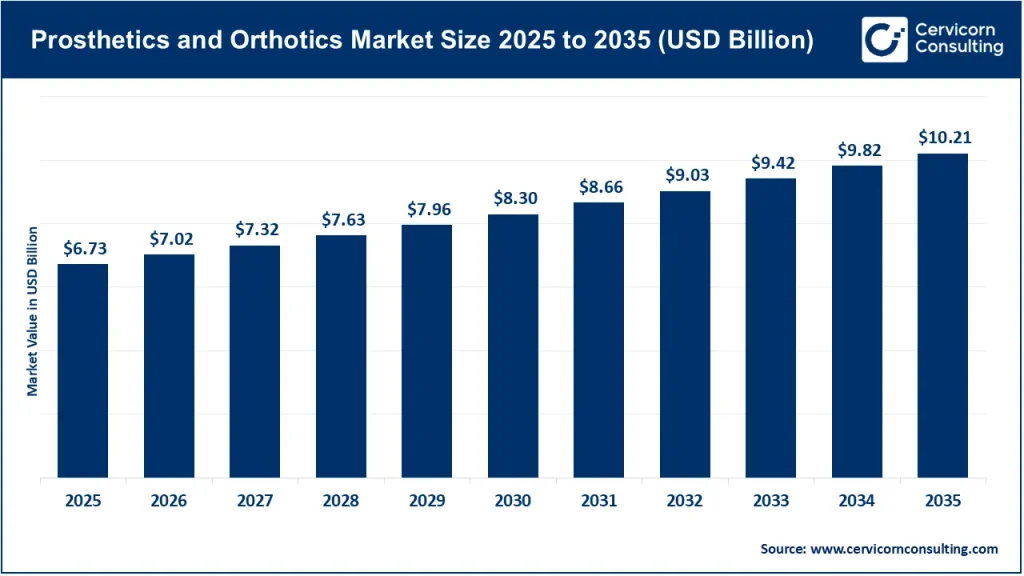
The global prosthetics and orthotics market was valued at approximately USD 6.73 billion in 2025 and is projected to reach nearly USD 10.21 billion by 2035, growing at a CAGR of 4.26%.
What is the Prosthetics and Orthotics Market?
The prosthetics and orthotics market encompasses the design, manufacturing, distribution, and servicing of artificial limbs (prosthetics) and supportive devices (orthotics) intended to replace or enhance the function of missing or weakened body parts.
Prosthetics are artificial devices that replace missing limbs or body parts resulting from congenital conditions, trauma, diabetes-related amputations, cancer, military injuries, or accidents. These include lower-limb prostheses, upper-limb prostheses, myoelectric prosthetic hands, and advanced robotic limbs.
Orthotics refer to externally applied devices such as braces, splints, insoles, spinal supports, and orthopedic supports that help correct musculoskeletal deformities, improve mobility, reduce pain, and provide structural support.
The market includes:
- Upper-extremity prosthetics
- Lower-extremity prosthetics
- Myoelectric prosthetic devices
- Sports prosthetics
- Cranial orthoses
- Spinal orthoses
- Knee braces
- Foot orthotics
- Ankle-foot orthoses (AFOs)
- Robotic rehabilitation devices
- Digital scanning and customization solutions
The integration of artificial intelligence (AI), robotics, sensors, additive manufacturing, and biomechanics is transforming the sector into one of the most innovative areas within modern healthcare.
Get a Free Sample: https://www.cervicornconsulting.com/sample/2677
Prosthetics and Orthotics Market Growth Factors
The prosthetics and orthotics market is experiencing strong growth due to the increasing prevalence of diabetes and vascular diseases leading to amputations, rising numbers of road accidents and traumatic injuries, growing aging populations susceptible to musculoskeletal disorders, expanding demand for rehabilitation services, technological advancements in bionic limbs and microprocessor-controlled prostheses, wider adoption of 3D printing for customized devices, increasing healthcare expenditures, favorable reimbursement frameworks in developed economies, rising awareness about mobility restoration solutions, growing participation of military veterans in advanced rehabilitation programs, expansion of sports medicine applications, and continuous investments in research and development focused on lightweight materials, AI-enabled prosthetic systems, and smart orthotic technologies.
Why the Prosthetics and Orthotics Market is Important
Restoring Independence
Prosthetic and orthotic devices allow patients to regain mobility, independence, and confidence after limb loss or physical impairment.
Reducing Healthcare Burden
These devices help prevent complications associated with immobility, reducing long-term healthcare costs and hospital admissions.
Supporting Aging Populations
As populations age globally, orthopedic disorders, arthritis, and mobility limitations are becoming more prevalent, increasing demand for orthotic solutions.
Improving Workforce Participation
Individuals using advanced prosthetic devices can return to employment, education, and daily activities, contributing to economic productivity.
Enhancing Sports and Rehabilitation
Athletes and physically active individuals increasingly use specialized prosthetics and orthotics to improve performance and recover from injuries.
Advancing Healthcare Innovation
The sector serves as a major platform for innovations in robotics, AI, biomechanics, and personalized healthcare technologies.
Major Companies in the Prosthetics and Orthotics Market
Company Profiles
| Company | Specialization | Key Focus Areas | Notable Features | Estimated 2025 Revenue | Market Share | Global Presence |
|---|---|---|---|---|---|---|
| Ossur | Prosthetics, orthotics, bracing solutions | Bionic prosthetics, injury prevention, rehabilitation | Advanced microprocessor knees, smart bracing technologies | Approx. USD 900+ Million | Significant global share | North America, Europe, Asia-Pacific, Latin America |
| Blatchford Limited | Prosthetic limbs and mobility technologies | Lower-limb prosthetics, rehabilitation | Intelligent prosthetic ankles and knees | Approx. USD 250+ Million | Strong European presence | Europe, Americas, Asia-Pacific, Middle East |
| Fillauer LLC | Prosthetic and orthotic components | Mobility systems, pediatric solutions | Diverse component portfolio and customization capabilities | Approx. USD 200+ Million | Notable specialist share | North America, Europe, Asia-Pacific |
| Bauerfeind | Orthopedic supports and compression therapy | Orthoses, braces, rehabilitation products | Premium orthopedic support systems | Approx. USD 900+ Million | Major orthotics market participant | More than 20 countries globally |
| Aether Biomedical | Bionic upper-limb prosthetics | AI-powered prosthetic hands | Zeus bionic hand technology | Emerging high-growth participant | Growing share in advanced prosthetics | Europe, North America, Asia-Pacific |
Leading Trends Shaping the Prosthetics and Orthotics Market
1. Rise of Bionic Prosthetics
Modern bionic limbs incorporate sensors, microprocessors, and machine learning algorithms that enable natural movement and improved user control.
Impact:
- Enhanced mobility
- Improved patient satisfaction
- Reduced energy expenditure during movement
- Greater adoption among younger users
2. Artificial Intelligence Integration
AI is revolutionizing prosthetic functionality through adaptive learning and predictive movement analysis.
Impact:
- Personalized user experiences
- Better gait adaptation
- Improved movement precision
- Faster rehabilitation outcomes
3. Expansion of 3D Printing Technologies
3D printing is enabling affordable and highly customized prosthetic and orthotic devices.
Impact:
- Lower manufacturing costs
- Faster production cycles
- Better anatomical fit
- Increased accessibility in developing regions
4. Smart Orthotics Development
Orthotic devices increasingly feature embedded sensors that monitor pressure distribution, posture, and movement.
Impact:
- Real-time health monitoring
- Better treatment outcomes
- Reduced injury risks
- Improved patient compliance
5. Lightweight Material Innovations
Manufacturers are increasingly utilizing advanced carbon fiber composites, titanium alloys, and high-performance polymers.
Impact:
- Greater comfort
- Improved durability
- Enhanced mobility
- Reduced device weight
6. Digital Scanning and CAD-Based Customization
Digital design technologies are replacing traditional casting methods.
Impact:
- Higher precision fittings
- Reduced clinical appointment times
- Improved manufacturing efficiency
- Enhanced patient experience
7. Growth of Pediatric Prosthetics
Demand for specialized prosthetic devices for children continues to increase.
Impact:
- Improved developmental outcomes
- Greater customization needs
- Expansion of pediatric rehabilitation services
8. Sports-Specific Prosthetic Solutions
Athletes increasingly seek prosthetics optimized for running, cycling, and competitive sports.
Impact:
- Increased participation in sports
- Enhanced performance outcomes
- Growth in premium prosthetic segments
9. Tele-Rehabilitation Services
Remote monitoring and virtual consultations are becoming common within prosthetic and orthotic care.
Impact:
- Improved patient access
- Reduced travel requirements
- Better long-term follow-up care
10. Human-Machine Interface Advancements
Researchers continue developing advanced neural interfaces that connect prosthetic devices directly with the nervous system.
Impact:
- Improved control accuracy
- Greater sensory feedback
- More natural movement patterns
Successful Examples of Prosthetics and Orthotics Around the World
Ossur’s Rheo Knee System
The Rheo Knee utilizes artificial intelligence and sensor technology to continuously adapt to user movement patterns.
Achievements:
- Widely adopted globally
- Enhanced walking stability
- Improved mobility on varied terrain
Blatchford’s Linx System
The Linx system integrates microprocessor-controlled knees and ankles that communicate in real time.
Achievements:
- Improved gait synchronization
- Reduced falls
- Enhanced confidence among users
Aether Biomedical’s Zeus Hand
The Zeus Hand represents one of the most advanced multi-grip bionic prosthetic hands available.
Achievements:
- AI-powered movement control
- Lightweight design
- Improved dexterity for daily tasks
Bauerfeind Orthopedic Support Systems
Bauerfeind’s orthotic solutions are widely used by athletes and rehabilitation centers.
Achievements:
- Injury prevention
- Improved recovery outcomes
- Strong presence in sports medicine
Jaipur Foot Program – India
One of the most recognized humanitarian prosthetic initiatives globally.
Achievements:
- Affordable prosthetic solutions
- Millions of beneficiaries
- Expanded mobility access in low-income populations
Ottobock C-Leg Technology
Although not included among the featured companies, Ottobock’s C-Leg remains a landmark example of prosthetic innovation.
Achievements:
- Microprocessor-controlled knee movement
- Significant reduction in falls
- Global clinical adoption
e-NABLE Global Community
A volunteer-driven initiative using 3D printing to provide prosthetic hands.
Achievements:
- Low-cost prosthetics
- Global accessibility
- Rapid customization
Global Regional Analysis of the Prosthetics and Orthotics Market
North America
North America remains the largest and most technologically advanced prosthetics and orthotics market.
Market Drivers
- High healthcare expenditure
- Strong reimbursement systems
- Advanced rehabilitation infrastructure
- Large diabetic population
- Rapid adoption of AI-powered prosthetics
Government Initiatives and Policies
United States
The U.S. government supports prosthetic innovation through:
- Department of Veterans Affairs rehabilitation programs
- Defense Advanced Research Projects Agency (DARPA) research initiatives
- Medicare and Medicaid reimbursement support
- National Institute of Biomedical Imaging and Bioengineering funding
Veteran-focused rehabilitation programs have accelerated adoption of advanced prosthetic technologies.
Canada
Government-supported healthcare programs and disability assistance schemes contribute to broader accessibility for prosthetic and orthotic devices.
Regional Outlook
North America is expected to maintain leadership due to continuous innovation and strong healthcare infrastructure.
Europe
Europe represents a mature market characterized by strong healthcare systems and technological leadership.
Market Drivers
- Aging population
- Rising orthopedic disorders
- Strong reimbursement policies
- High awareness levels
Government Initiatives and Policies
Germany
Germany supports prosthetic and orthotic adoption through statutory health insurance coverage and rehabilitation programs.
United Kingdom
The National Health Service (NHS) provides prosthetic rehabilitation services and supports patient access to mobility devices.
France
Government healthcare programs reimburse numerous orthotic and prosthetic treatments.
Regional Outlook
Europe continues to be a hub for prosthetic research, biomechanical innovation, and orthopedic product development.
Asia-Pacific
Asia-Pacific is projected to witness the fastest growth in the global prosthetics and orthotics market.
Market Drivers
- Large patient population
- Increasing diabetes prevalence
- Growing healthcare investments
- Expanding rehabilitation infrastructure
- Rising awareness regarding mobility solutions
Government Initiatives and Policies
China
The Chinese government promotes rehabilitation services through healthcare modernization programs and disability support initiatives.
Japan
Japan actively invests in robotic rehabilitation and assistive technologies due to its rapidly aging population.
India
Government programs such as:
- Assistance to Disabled Persons (ADIP) Scheme
- Artificial Limbs Manufacturing Corporation of India (ALIMCO)
- Accessible India Campaign
support wider access to prosthetic and orthotic devices.
Regional Outlook
Asia-Pacific is becoming a major manufacturing, innovation, and demand center for prosthetics and orthotics.
Latin America
The region is gradually expanding its prosthetics and orthotics capabilities.
Market Drivers
- Rising disability awareness
- Expanding healthcare access
- Increasing government healthcare spending
Government Initiatives and Policies
Brazil
Brazil supports rehabilitation services through public healthcare programs and disability assistance initiatives.
Mexico
Government-supported rehabilitation centers are improving access to prosthetic technologies.
Regional Outlook
Increasing healthcare modernization efforts are expected to drive future growth.
Middle East and Africa
The region is witnessing increasing demand due to healthcare expansion and rising investments in rehabilitation services.
Market Drivers
- Growing incidence of diabetes-related amputations
- Expanding healthcare infrastructure
- Rising rehabilitation awareness
Government Initiatives and Policies
Saudi Arabia
Vision 2030 initiatives support healthcare modernization and rehabilitation technology adoption.
United Arab Emirates
Government investments in smart healthcare and rehabilitation facilities are boosting demand.
South Africa
Public-private partnerships are improving prosthetic accessibility for underserved populations.
Regional Outlook
The Middle East and Africa are expected to experience steady growth as healthcare access and rehabilitation services continue to expand.
Emerging Opportunities in the Prosthetics and Orthotics Market
Personalized Prosthetics
Customization through AI, digital scanning, and additive manufacturing will continue creating growth opportunities.
Neural-Controlled Prosthetics
Brain-computer interfaces represent one of the most transformative opportunities in the industry.
Rehabilitation Robotics
Integration between robotic rehabilitation systems and prosthetic devices is expected to enhance recovery outcomes.
Low-Cost Solutions for Emerging Markets
Affordable prosthetic technologies can significantly improve accessibility in developing economies.
Smart Connected Devices
Internet of Things (IoT)-enabled prosthetics and orthotics will facilitate remote monitoring, predictive maintenance, and personalized care.
Military and Veteran Rehabilitation Programs
Growing investments in veteran healthcare and advanced rehabilitation technologies will continue driving demand for high-performance prosthetic solutions worldwide.
To Get Detailed Overview, Contact Us: https://www.cervicornconsulting.com/contact-us
Read Report: South Korea Humanoid Robot Market Revenue, Trends, and Strategic Insights by 2035