


Table of Contents
TogglePredictive AI Market Size
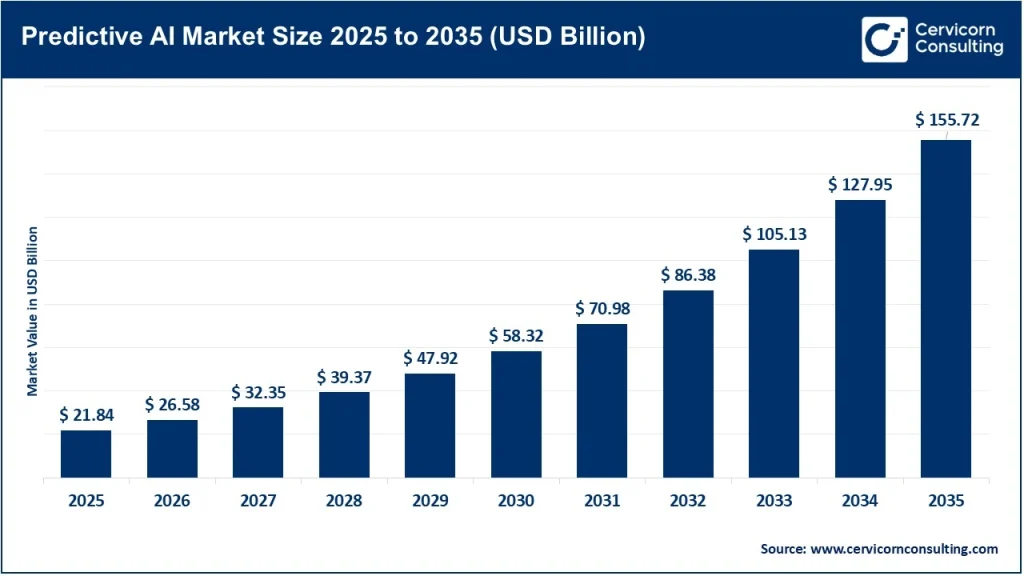
The global predictive AI market was valued at approximately USD 21.84 billion in 2025 and is projected to reach nearly USD 155.72 billion by 2035, expanding at a compound annual growth rate (CAGR) of about 21.7% between 2026 and 2035.
What Is the Predictive AI Market?
The Predictive AI market refers to the ecosystem of technologies, software platforms, services, and solutions that use artificial intelligence (AI), machine learning (ML), statistical modeling, and advanced analytics to predict future events, behaviors, trends, and outcomes. Predictive AI systems analyze historical and real-time data to identify patterns, generate forecasts, assess risks, and recommend actions.
These solutions are widely used across industries including healthcare, banking, manufacturing, retail, telecommunications, logistics, government, and energy. Organizations leverage Predictive AI to improve decision-making, optimize operations, enhance customer experiences, detect fraud, forecast demand, and reduce business risks. As enterprises increasingly adopt data-driven strategies, Predictive AI has emerged as one of the most valuable segments within the broader AI and analytics industry.
According to industry estimates, the global predictive analytics and predictive AI ecosystem is experiencing rapid growth, with market valuations expected to increase significantly over the next decade as cloud computing, big data, and AI technologies become more deeply integrated into business operations.
Predictive AI Market Growth Factors
The Predictive AI market is expanding rapidly due to the exponential growth of enterprise data, increasing adoption of cloud computing, advancements in machine learning algorithms, rising demand for real-time business intelligence, growing investments in digital transformation initiatives, widespread implementation of Industry 4.0 technologies, increasing need for fraud detection and risk management solutions, growing use of AI-powered customer analytics, expansion of IoT-connected devices generating massive datasets, and the emergence of automated decision-making systems across industries.
Organizations are increasingly recognizing the value of predictive insights for improving operational efficiency, reducing costs, forecasting demand, optimizing supply chains, enhancing customer retention, and supporting strategic planning. Furthermore, the integration of generative AI with predictive analytics platforms, increased availability of scalable cloud infrastructure, and supportive government AI initiatives worldwide are accelerating market adoption across both developed and emerging economies.
Get a Free Sample: https://www.cervicornconsulting.com/sample/2974
Why Is Predictive AI Important?
1. Enables Proactive Decision-Making
Traditional analytics explains what happened in the past, while Predictive AI helps organizations understand what is likely to happen next. This proactive capability allows businesses to take preventive measures before problems occur.
2. Improves Operational Efficiency
Predictive models help organizations optimize resource allocation, inventory management, workforce planning, and production schedules, leading to significant cost savings.
3. Enhances Customer Experience
Businesses use Predictive AI to anticipate customer preferences, personalize recommendations, and improve customer engagement through targeted marketing campaigns.
4. Strengthens Risk Management
Financial institutions, insurers, and government agencies leverage Predictive AI to identify risks, detect fraud, assess creditworthiness, and enhance cybersecurity defenses.
5. Accelerates Innovation
Predictive AI supports research and development efforts by forecasting trends, identifying opportunities, and helping organizations adapt quickly to changing market conditions.
Major Companies Driving the Predictive AI Market
The Predictive AI market is highly competitive, with several technology leaders investing heavily in AI, machine learning, cloud analytics, and enterprise intelligence solutions.
| Company | Specialization | Key Focus Areas | Notable Features | 2025 Revenue* | Estimated Market Position | Global Presence |
|---|---|---|---|---|---|---|
| IBM Corporation | Enterprise AI & Analytics | Predictive analytics, AI governance, hybrid cloud | Watsonx, AI automation, industry-specific solutions | Approx. USD 66 billion | Leading global player | 175+ countries |
| SAS Institute Inc. | Advanced Analytics & Data Science | Statistical modeling, predictive analytics, forecasting | SAS Viya platform, AutoML, risk analytics | Privately held, estimated multi-billion-dollar revenue | Strong leadership in analytics | 140+ countries |
| Microsoft Corporation | Cloud AI & Predictive Intelligence | AI platforms, cloud analytics, predictive modeling | Azure AI, Microsoft Fabric, Copilot integration | USD 281.7 billion | Major market leader | 190+ countries |
| SAP SE | Enterprise Business Analytics | ERP intelligence, predictive business analytics | SAP Analytics Cloud, Joule AI | EUR 21.6–21.9 billion cloud revenue guidance | Strong enterprise presence | 180+ countries |
| Oracle Corporation | Cloud Data Analytics & AI | Predictive business intelligence, AI-driven databases | Oracle Analytics Cloud, Autonomous Database | Approx. USD 57 billion | Significant market participant | 175+ countries |
*Revenues represent overall company revenues or publicly reported business revenues rather than Predictive AI-specific revenue.
IBM Corporation
IBM remains a major force in predictive AI through its Watsonx ecosystem and enterprise-grade analytics solutions. The company focuses on regulated industries such as banking, healthcare, insurance, and government, where explainable AI and governance are essential.
SAS Institute Inc.
SAS is widely recognized as one of the pioneers of predictive analytics. Its solutions are heavily used in financial services, healthcare, telecommunications, and manufacturing for forecasting, fraud detection, and risk management.
Microsoft Corporation
Microsoft’s Azure AI ecosystem has become one of the fastest-growing platforms for predictive analytics. Integration of AI capabilities across Azure, Dynamics 365, and Microsoft Fabric enables enterprises to scale predictive intelligence across operations.
SAP SE
SAP leverages predictive AI within enterprise resource planning (ERP), supply chain management, and business intelligence applications. The company is integrating AI-powered forecasting capabilities across its cloud ecosystem.
Oracle Corporation
Oracle’s AI-powered analytics platforms help enterprises automate forecasting, planning, customer insights, and operational intelligence. The company’s cloud-first strategy is driving broader adoption of predictive AI capabilities.
Leading Trends in the Predictive AI Market and Their Impact
Rise of Generative AI-Powered Predictive Systems
Organizations are increasingly combining generative AI with predictive analytics to generate deeper insights, automated reports, and intelligent recommendations. This trend improves accessibility and reduces the need for specialized data science expertise.
Impact:
- Faster decision-making
- Increased automation
- Improved business intelligence
Expansion of Cloud-Based Predictive Analytics
Cloud deployment models now account for the majority of predictive analytics implementations due to scalability, flexibility, and lower infrastructure costs.
Impact:
- Reduced deployment costs
- Faster implementation
- Enhanced global accessibility
Growth of Industry-Specific AI Solutions
Vendors are developing predictive AI solutions tailored for healthcare, manufacturing, banking, retail, logistics, and energy sectors.
Impact:
- Higher prediction accuracy
- Faster adoption
- Greater return on investment
Real-Time Predictive Intelligence
Organizations increasingly require instant insights generated from streaming data collected through IoT devices, sensors, mobile applications, and connected systems.
Impact:
- Improved operational responsiveness
- Better risk management
- Enhanced customer experiences
Explainable AI and Responsible AI Adoption
Governments and enterprises are emphasizing transparency and accountability in AI-driven decision-making.
Impact:
- Increased trust in AI systems
- Improved regulatory compliance
- Greater enterprise adoption
Predictive Maintenance Applications
Manufacturing and industrial organizations increasingly use AI models to predict equipment failures before they occur.
Impact:
- Reduced downtime
- Lower maintenance costs
- Improved productivity
Successful Examples of Predictive AI Around the World
Healthcare: Early Disease Detection
Hospitals in North America and Europe use predictive AI systems to identify patients at risk of chronic diseases, hospital readmissions, and treatment complications.
Results:
- Improved patient outcomes
- Reduced healthcare costs
- Faster diagnosis
Banking and Financial Services
Financial institutions use predictive AI for credit scoring, fraud detection, anti-money laundering compliance, and customer behavior analysis.
Results:
- Reduced fraud losses
- Better risk assessment
- Enhanced customer targeting
Retail and E-Commerce
Global retailers leverage predictive AI to forecast demand, optimize inventory levels, and personalize customer recommendations.
Results:
- Increased sales
- Improved inventory management
- Higher customer satisfaction
Manufacturing and Industry 4.0
Industrial companies deploy predictive maintenance systems powered by AI to monitor equipment health and forecast failures.
Results:
- Lower operational costs
- Increased asset utilization
- Reduced production disruptions
Logistics and Transportation
Transportation companies use predictive AI for route optimization, fuel efficiency improvements, and demand forecasting.
Results:
- Reduced transportation costs
- Improved delivery performance
- Enhanced sustainability
Global Regional Analysis of the Predictive AI Market
North America
North America remains the largest market for predictive AI, driven by strong technology infrastructure, advanced cloud adoption, substantial AI investments, and the presence of leading technology companies. The region accounted for approximately one-third of the global predictive analytics market in recent years.
Government Initiatives and Policies
- U.S. National AI Initiative supporting AI research and commercialization.
- Federal investments in AI infrastructure and semiconductor manufacturing.
- Increased focus on AI governance and responsible AI deployment.
- Public-private partnerships accelerating AI innovation.
Market Outlook
Healthcare, BFSI, defense, retail, and manufacturing sectors continue to drive substantial adoption across the United States and Canada.
Europe
Europe is witnessing strong growth due to digital transformation efforts, industrial automation, and increasing adoption of AI-driven business intelligence solutions.
Government Initiatives and Policies
- European Union AI Act promoting responsible AI deployment.
- Digital Europe Programme supporting AI innovation.
- National AI strategies implemented across Germany, France, Spain, Italy, and the United Kingdom.
- Investments in AI research centers and supercomputing infrastructure.
Market Outlook
Demand is growing across manufacturing, automotive, healthcare, and financial services sectors.
Asia-Pacific
Asia-Pacific is expected to be the fastest-growing regional market due to rapid digitalization, expanding cloud infrastructure, increasing AI investments, and strong government support.
Government Initiatives and Policies
China
- New Generation Artificial Intelligence Development Plan.
- Major investments in AI innovation and smart city projects.
India
- IndiaAI Mission supporting AI ecosystem development.
- Digital India initiatives promoting data-driven innovation.
Japan
- Society 5.0 strategy integrating AI into economic development.
- Investments in smart manufacturing and robotics.
South Korea
- National AI Strategy supporting industrial AI deployment.
- AI semiconductor and cloud infrastructure investments.
Market Outlook
Rapid growth is expected in banking, healthcare, manufacturing, telecommunications, and e-commerce applications.
Latin America
Latin America is gradually adopting predictive AI technologies as organizations modernize digital infrastructure and embrace cloud-based analytics.
Government Initiatives and Policies
- National AI strategies in Brazil, Chile, and Colombia.
- Public investments in digital transformation programs.
- Increasing collaboration with global technology providers.
Market Outlook
Financial services, agriculture, retail, and logistics sectors represent key growth opportunities.
Middle East & Africa
The Middle East and Africa region is emerging as an important market for predictive AI due to smart city projects, digital transformation initiatives, and economic diversification programs.
Government Initiatives and Policies
United Arab Emirates
- National Artificial Intelligence Strategy 2031.
- AI adoption across government services and smart city initiatives.
Saudi Arabia
- Vision 2030 emphasizing digital transformation and AI innovation.
- Investments in data centers and AI infrastructure.
South Africa
- Growing AI innovation ecosystem supported by public and private sector investments.
Market Outlook
Government modernization programs, energy sector optimization, healthcare digitization, and smart infrastructure projects are expected to accelerate predictive AI adoption across the region.
Competitive Landscape
The predictive AI market remains moderately concentrated, with major vendors such as IBM, SAS, Microsoft, SAP, and Oracle maintaining strong market positions through cloud platforms, advanced analytics capabilities, AI integration, and global partner ecosystems. Competitive differentiation increasingly depends on industry-specific solutions, explainable AI capabilities, scalability, and seamless integration with enterprise systems. As organizations continue prioritizing data-driven decision-making, competition among technology providers is expected to intensify further.
To Get Detailed Overview, Contact Us: https://www.cervicornconsulting.com/contact-us
Read Report: AI Agents in Healthcare Market Revenue, Trends, and Strategic Insights by 2035