


Predictive AI Market: Strategic Business Decisions Shaping the Next Phase of Enterprise Intelligence
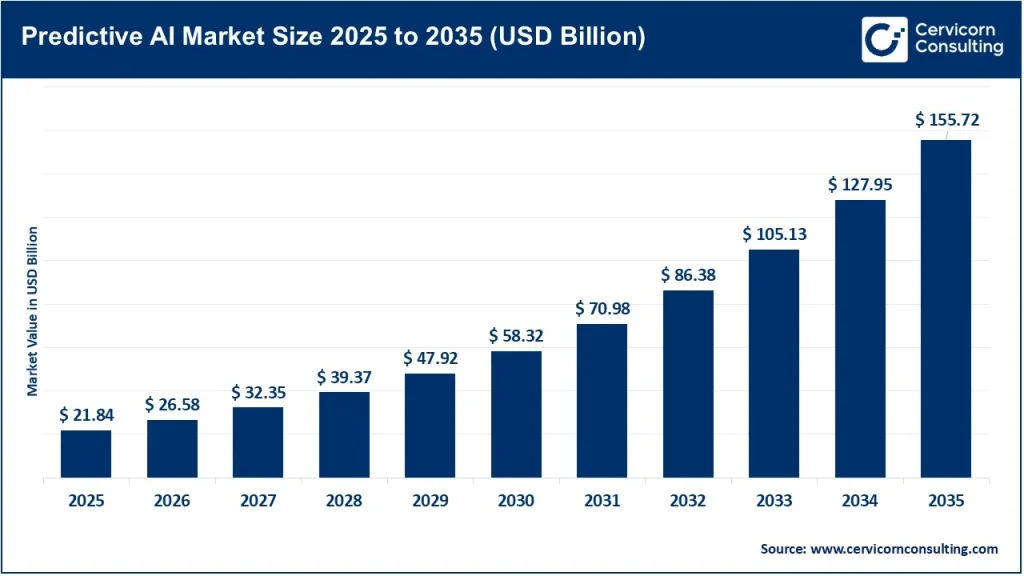
The global predictive AI market was valued at USD 21.84 billion in 2025 and is projected to reach approximately USD 155.72 billion by 2035, expanding at a CAGR of 21.7% from 2026 to 2035. This growth reflects a broader shift in enterprise AI adoption, where companies are moving beyond analyzing historical performance toward predicting future business outcomes and making proactive decisions.
Predictive AI is increasingly being integrated into demand forecasting, fraud detection, predictive maintenance, customer analytics, supply chain optimization, and revenue planning. However, as adoption expands, the competitive landscape is shifting from developing accurate prediction models to delivering measurable business outcomes through enterprise integration, data quality, governance, and decision automation.
For technology providers and enterprise buyers, the next phase of market development raises several important questions: Which applications offer the strongest commercial opportunities? Should companies prioritize cloud or hybrid deployment? Where should vendors focus their product development? And how can organizations convert predictive capabilities into measurable operational and financial improvements?
1. Should Companies Prioritize Demand Forecasting or Higher-Value Predictive Applications?
Demand forecasting accounted for 19.7% of the predictive AI market in 2025, making it the leading application segment. Its widespread adoption reflects the importance of inventory planning, production scheduling, procurement optimization, and demand visibility across retail, manufacturing, logistics, and consumer goods industries.
However, market leadership does not necessarily indicate the highest future growth potential.
Predictive maintenance is emerging as an important growth application as industrial companies increasingly connect machinery, production equipment, and operational systems to real-time data platforms. Predicting equipment failures before they occur can reduce unplanned downtime, extend asset life, and improve maintenance scheduling.
Fraud detection and risk analytics also represent significant opportunities, particularly in banking, insurance, and digital financial services. Organizations are increasingly using predictive models to identify suspicious transactions, assess credit risk, detect anomalies, and improve underwriting decisions.
Companies developing predictive AI solutions should evaluate applications based on three commercial factors:
-
Revenue potential: Demand forecasting and customer analytics offer broad applicability across industries.
-
Operational value: Predictive maintenance and supply chain optimization can generate measurable cost savings.
-
Critical business impact: Fraud detection, cybersecurity threat prediction, and financial risk analytics address high-priority enterprise requirements.
The strategic opportunity is to move beyond generic predictive analytics platforms and develop application-specific solutions that address measurable business problems.
Get a Free Sample: https://www.cervicornconsulting.com/sample/2974
2. Cloud or Hybrid Deployment: Which Architecture Should Enterprise Buyers Choose?
Cloud-based deployment accounted for 49.8% of the predictive AI market in 2025, supported by scalability, flexible computing resources, centralized data management, and lower upfront infrastructure requirements.
Cloud deployment is particularly attractive to organizations that need to process large datasets, deploy predictive models across multiple locations, and integrate AI capabilities into existing enterprise applications.
However, hybrid deployment is gaining importance as businesses balance computing flexibility with data security, regulatory compliance, and infrastructure control.
This distinction is especially relevant for BFSI, healthcare, government, and other sectors handling sensitive business and customer information.
Enterprise buyers should evaluate deployment architecture based on:
-
Data sensitivity: Determine whether customer, financial, or operational information can be processed in public cloud environments.
-
Integration requirements: Assess compatibility with existing ERP, CRM, data warehouses, and legacy infrastructure.
-
Total cost of ownership: Compare cloud subscription expenses with infrastructure investments and ongoing maintenance costs.
-
Scalability: Evaluate whether the architecture can support increasing data volumes and model complexity.
-
Regulatory requirements: Consider data residency, access controls, auditability, and industry-specific compliance obligations.
For predictive AI vendors, hybrid deployment capabilities can become an important competitive differentiator, particularly when targeting large enterprises with complex IT environments.
3. Should Predictive AI Vendors Invest More in Machine Learning or Deep Learning?
Machine learning represented 34.6% of the predictive AI technology segment in 2025, reflecting its established role in enterprise forecasting, fraud detection, customer churn prediction, credit scoring, and predictive maintenance.
Its adoption is supported by mature algorithms, established enterprise applications, and compatibility with existing analytics infrastructure.
Nevertheless, increasingly complex prediction requirements are creating opportunities for deep learning and neural network technologies.
Deep learning is particularly relevant when organizations need to analyze large datasets, identify complex patterns, and process unstructured information. Applications include healthcare prediction, industrial monitoring, financial risk modeling, and advanced customer behavior analysis.
The investment decision should depend on the complexity of the problem rather than the perceived sophistication of the technology.
-
Machine learning: Suitable for structured datasets, conventional forecasting, classification, risk scoring, and many enterprise prediction tasks.
-
Deep learning: More relevant for complex relationships, large-scale datasets, image-based prediction, and sophisticated pattern recognition.
-
Natural language processing: Supports predictive insights from text-based customer interactions, documents, and communications.
-
Computer vision: Creates opportunities for visual inspection, industrial quality prediction, and equipment monitoring.
For technology providers, the competitive advantage will increasingly come from offering flexible model architectures that allow enterprises to select appropriate prediction techniques without introducing unnecessary computing costs or operational complexity.
4. How Can Companies Convert Predictive AI Pilots into Enterprise-Wide Deployments?
Enterprise AI adoption is expanding, but organizations continue to face difficulties translating experimentation into production-scale business impact.
A predictive model may demonstrate strong accuracy during testing but deliver limited commercial value when it is not connected to actual business workflows.
For example, a demand forecasting model may predict inventory requirements accurately, but its value remains restricted if procurement teams cannot use those predictions to adjust purchasing schedules automatically.
Similarly, predictive maintenance software may identify potential equipment failures, but operational benefits depend on whether maintenance teams receive timely alerts and can act on them.
Companies should prioritize the following implementation areas:
Enterprise system integration: Predictive AI should connect with ERP, CRM, supply chain management, manufacturing execution, and other operational platforms.
Model monitoring: Prediction accuracy must be evaluated continuously as customer behavior, market conditions, and operating environments change.
Workflow redesign: Organizations should establish processes through which predictive insights influence procurement, production, pricing, maintenance, and customer management decisions.
Internal capabilities: Data engineering, machine learning operations, and business analytics teams must work together to support deployment and ongoing optimization.
Performance measurement: Companies should assess implementations using business outcomes such as reduced downtime, improved forecast accuracy, lower fraud losses, and increased customer retention.
For predictive AI vendors, enterprise integration and implementation support can be as commercially important as the underlying prediction technology.
5. Which Industries Offer the Strongest Opportunities for Predictive AI Expansion?
BFSI accounted for 22.8% of the predictive AI market in 2025, making it the leading end-use industry. Financial institutions have established demand for predictive models across fraud detection, credit scoring, underwriting, default prediction, and customer analytics.
However, opportunities are expanding across other industries as organizations generate larger volumes of operational and customer data.
Healthcare and life sciences: Predictive AI can support clinical outcome prediction, patient risk identification, resource planning, and healthcare operations. Vendors must account for data privacy, model validation, and regulatory requirements.
Manufacturing: Predictive maintenance, production forecasting, quality control, and energy optimization are creating opportunities for AI solutions integrated with industrial IoT infrastructure.
Retail and e-commerce: Customer churn prediction, personalized recommendations, demand forecasting, inventory optimization, and pricing analytics are becoming important applications.
IT and telecommunications: Predictive AI can support network failure prediction, cybersecurity risk identification, customer churn management, and infrastructure capacity planning.
Automotive and transportation: Fleet maintenance, vehicle performance monitoring, logistics forecasting, and traffic prediction are potential areas of adoption.
For vendors evaluating market entry, industry selection should consider data availability, purchasing capacity, implementation complexity, regulatory barriers, and the financial impact of prediction accuracy.
A specialized solution addressing a clearly defined industry problem may offer stronger differentiation than a general-purpose platform competing across multiple sectors.
6. How Should Companies Position Their Products Against Established Predictive AI Providers?
The predictive AI market includes established technology companies, analytics specialists, enterprise software providers, and emerging AI solution developers.
Major participants include:
-
IBM Corporation: Enterprise AI, machine learning, predictive analytics, and governed AI capabilities.
-
SAS Institute Inc.: Advanced analytics, statistical modeling, forecasting, and risk management solutions.
-
Microsoft Corporation: Cloud-based AI, enterprise analytics, and integration with business applications.
-
SAP SE: Predictive capabilities integrated with enterprise resource planning and business data environments.
-
Oracle Corporation: Enterprise data management, cloud infrastructure, and predictive analytics.
-
Salesforce, Inc.: Customer analytics, sales forecasting, and AI-enabled CRM applications.
-
Alteryx, Inc.: Analytics automation, data preparation, and predictive modeling.
-
RapidMiner, Inc.: Data science and machine learning capabilities for enterprise applications.
-
Dell Technologies: Infrastructure and computing solutions supporting enterprise AI workloads.
-
TIBCO Software Inc.: Data integration, analytics, and enterprise decision-support capabilities.
-
MathWorks, Inc.: Mathematical computing, statistical modeling, and predictive algorithm development.
-
KNIME AG: Data analytics, workflow automation, and machine learning solutions.
For smaller technology providers, competing directly with established platforms on infrastructure scale or product breadth may be difficult.
Instead, differentiation can come from specialized industry applications, faster implementation, integration with legacy systems, explainable prediction models, flexible pricing, and domain-specific expertise.
Enterprise buyers should compare providers based on model performance, deployment flexibility, interoperability, governance capabilities, scalability, and long-term support rather than relying exclusively on product demonstrations.
7. Can Data Governance and Model Explainability Become Competitive Differentiators?
Data quality and governance remain important barriers to predictive AI adoption.
Predictive models depend on reliable historical and real-time information. Fragmented databases, inconsistent data definitions, missing information, and weak data ownership can reduce prediction accuracy and undermine enterprise confidence.
The issue becomes more significant when predictive AI influences decisions involving credit approvals, insurance underwriting, healthcare outcomes, pricing, and cybersecurity.
Companies should evaluate governance capabilities across several areas:
-
Data quality: Establish processes to identify missing, inconsistent, outdated, and inaccurate information.
-
Model explainability: Enable business teams to understand the factors influencing important predictions.
-
Bias monitoring: Evaluate whether models generate systematically unfair or unreliable outcomes.
-
Data security: Establish appropriate access controls, encryption, and data protection procedures.
-
Model lifecycle management: Monitor performance, validate predictions, and retrain models when necessary.
-
Regulatory compliance: Align AI deployment with applicable privacy, security, and industry regulations.
For vendors, explainability and governance should not be treated as optional features. They can influence enterprise purchasing decisions, particularly in regulated industries where accountability and auditability are essential.
Regional Opportunities: Where Should Predictive AI Companies Expand?
Regional market development will influence investment priorities, product localization, partnerships, and customer acquisition strategies.
The 2025 regional market distribution highlights different levels of adoption and expansion potential.
-
North America: Accounted for 40.2% of the global market in 2025. Its established cloud ecosystem, enterprise software infrastructure, and strong adoption of advanced analytics make it an important market for enterprise AI providers.
-
Europe: Represented 25.8% of the market. Industrial digitalization, manufacturing analytics, financial services, and demand for trustworthy AI solutions support regional opportunities.
-
Asia-Pacific: Held 24.1% of the market and is positioned as an important growth region. Expanding digital infrastructure, manufacturing automation, financial technology, and enterprise AI investments are supporting adoption.
-
LAMEA: Accounted for 9.9% of the market, with opportunities emerging across banking, telecommunications, government services, energy, and industrial applications.
For companies evaluating geographic expansion, Asia-Pacific deserves particular attention because of its growing enterprise technology ecosystem and increasing demand for predictive capabilities across multiple industries.
India is also an important market to monitor, supported by expanding digital infrastructure, enterprise transformation, and growing AI readiness across healthcare, financial services, and industrial sectors.
However, market entry strategies should account for differences in enterprise spending, local data regulations, cloud infrastructure maturity, and availability of skilled AI professionals.
What the Market Outlook Means for Technology Providers and Enterprise Buyers
The expansion of predictive AI is creating opportunities across software development, enterprise analytics, cloud infrastructure, data management, and industry-specific AI applications.
However, market growth alone does not guarantee commercial success. The competitive environment will increasingly reward companies that can connect prediction capabilities with measurable improvements in business performance.
For technology providers, the priorities include developing specialized applications, strengthening enterprise integrations, improving model explainability, and offering flexible deployment architectures.
For enterprise buyers, the focus should be on identifying high-value use cases, evaluating data readiness, measuring implementation costs, and establishing clear performance benchmarks before scaling deployments.
The most important competitive shift is likely to be from selling predictive capabilities to delivering decisions that improve revenue, reduce operational risk, and strengthen business efficiency.
Frequently Asked Questions
1. What is the predictive AI market size in 2025 and 2035?
The global predictive AI market was valued at USD 21.84 billion in 2025 and is projected to reach approximately USD 155.72 billion by 2035.
2. What is the expected CAGR of the predictive AI market?
The market is projected to grow at a CAGR of 21.7% between 2026 and 2035.
3. Which segment dominates the predictive AI market?
Software dominated the component segment with a 68.4% share in 2025. Among applications, demand forecasting led with a 19.7% share.
4. Which region dominates the predictive AI market?
North America dominated the global market with a 40.2% share in 2025, supported by enterprise AI adoption, cloud infrastructure, and advanced analytics deployment.
5. Which industries are major adopters of predictive AI?
BFSI, healthcare and life sciences, retail and e-commerce, manufacturing, IT and telecommunications, and automotive and transportation are important end-use industries.
6. What are the major challenges facing predictive AI adoption?
Poor data quality, fragmented enterprise infrastructure, governance requirements, model explainability, talent shortages, and difficulties scaling pilot projects into production environments are among the major challenges.
To Get Detailed Overview, Contact Us: https://www.cervicornconsulting.com/contact-us