


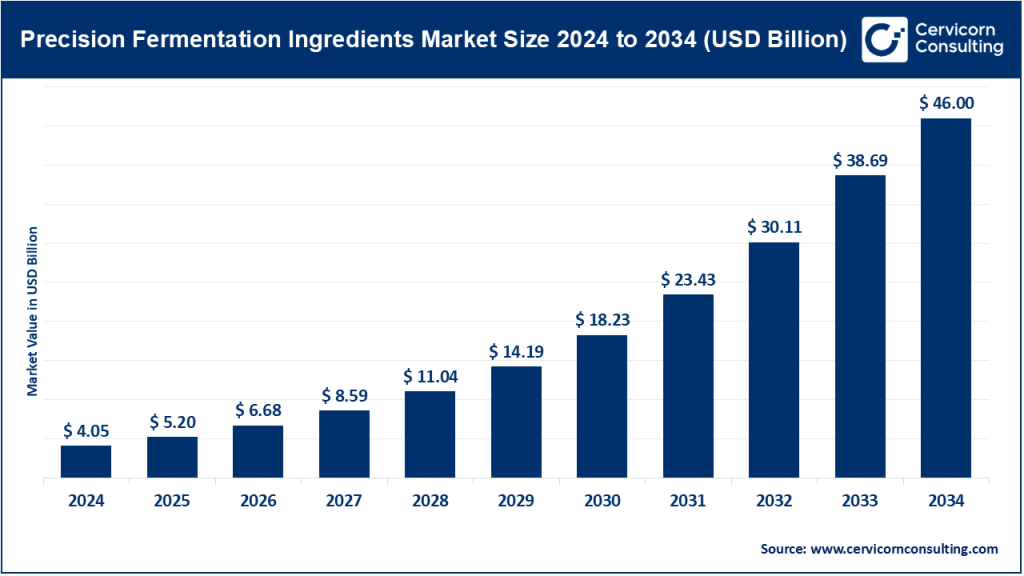
Precision Fermentation Ingredients Market Size
The global precision fermentation ingredients market size was worth USD 4.05 billion in 2024 and is anticipated to expand to around USD 46 billion by 2034, registering a compound annual growth rate (CAGR) of 28.50% from 2025 to 2034.
Growth Factors
The precision fermentation ingredients market is being propelled by an interplay of sustainability concerns, technological innovation, and changing consumer preferences. Rising demand for animal-free, eco-friendly food solutions is pushing food and ingredient companies to adopt bio-based processes; simultaneous advances in synthetic biology, strain engineering, and bioprocess scaling are making precision fermentation more cost-effective and commercially viable. Increased investment from venture capital and strategic partnerships with established food producers accelerate innovation and commercialization. Moreover, growing regulatory support for alternative proteins and green manufacturing, alongside growing health consciousness and demand for functional ingredients (like enzymes, proteins, vitamins, and bioactives), amplify adoption. Finally, the expansion of precision fermentation into non-food sectors — such as pharmaceuticals, cosmetics, and materials — further broadens its market reach.
What Is the Precision Fermentation Ingredients Market?
The precision fermentation ingredients market refers to the global sector devoted to producing high-value, functional compounds (proteins, peptides, enzymes, vitamins, heme proteins, and more) by using engineered microbial hosts (yeast, bacteria, fungi, algae) in carefully controlled fermentation processes. Unlike conventional fermentation (e.g., beer or yogurt), precision fermentation leverages synthetic biology and strain engineering to instruct microbes to produce specific target molecules with high purity and yield. These ingredients are then sold to food, beverage, nutraceutical, pharmaceutical, and other industries, where they act as sustainable, cost-efficient alternatives to animal-derived or chemically synthesized components.
Get a Free Sample: https://www.cervicornconsulting.com/sample/2380
Why Is It Important?
Precision fermentation ingredients are important for multiple reasons:
- Sustainability: Traditional animal agriculture has a heavy environmental footprint (land, water, greenhouse gases). Precision fermentation can bypass many of these by producing ingredients without animals, thereby contributing to lower emissions and resource use.
- Scalability and Consistency: Engineered microbes can be grown at industrial scale in fermentation tanks, providing consistent quality and supply, unlike agricultural-based sources which depend on seasonality, climate, and geographical constraints.
- Novel Functionalities: Precision fermentation enables the creation of ingredients that are difficult or impossible to extract from natural sources in a sustainable way — for example, specific enzymes, rare peptides, or novel proteins with tailored functionalities.
- Health and Ethics: For consumers concerned about animal welfare, lactose intolerance, allergens, or zoonotic disease risks, precision‑fermented ingredients (such as animal-free dairy proteins or egg proteins) provide a compelling alternative.
- Industrial and Economic Advantage: As biotech infrastructure matures, precision fermentation offers companies a pathway to innovate rapidly, reduce dependency on volatile commodity markets, and design differentiated ingredients.
Top Companies in the Precision Fermentation Ingredients Market
Here we profile some leading companies and what sets them apart.
Ginkgo Bioworks, Inc.
- Specialization: Ginkgo builds engineered cell lines (microbes) and offers platform services for cell programming, including design, automation, and strain optimization.
- Key Focus Areas: Cell engineering, automation, biosecurity, large-scale foundries, partnerships for biomanufacturing.
- Notable Features: High-throughput design-build-test-learn cycles, extensive automation infrastructure, strong platform capabilities, and capacity to serve both research and commercial partners.
- 2024 Revenue: USD 227 million.
- Market Share & Presence: Headquartered in Boston, U.S., and operates globally.
Eden Brew
- Specialization: Animal-free dairy proteins, particularly whey and casein, produced via engineered yeast or other microbes.
- Key Focus Areas: Alternative dairy proteins, scalable fermentation processes, partnerships with food manufacturers.
- Notable Features: Replicating functional and nutritional properties of dairy proteins while eliminating the need for cows.
- 2024 Revenue & Market Share: Detailed financials not publicly disclosed.
- Global Presence: Based in Australia, with international distribution networks.
Perfect Day, Inc.
- Specialization: Animal-free dairy proteins, especially whey and casein, via precision fermentation.
- Key Focus Areas: Scaling up fermentation production, reducing cost, targeting food & beverage manufacturers, regulatory approvals, and sustainability.
- Notable Features: Proteins are bio-identical to cow-derived dairy but produced without animals, with significantly reduced environmental footprint.
- 2024 Funding/Financials: Raised over $800 million since inception; operating revenue not publicly broken out.
- Market Share & Presence: Strong U.S. base; ingredients used globally by food manufacturers.
Modern Meadow, Inc.
- Specialization: Bio-fabricated materials (e.g., leather) and biomaterials via precision fermentation.
- Key Focus Areas: Biofabrication, biomaterials, collagen, functional proteins.
- Notable Features: Combines tissue engineering and precision fermentation to create biomaterials with tailored properties.
- 2024 Revenue & Presence: Detailed revenue not publicly disclosed; headquartered in the U.S.
MycoTechnology, Inc.
- Specialization: Fungal fermentation (mycelium) to produce functional food ingredients.
- Key Focus Areas: Myco-derived flavor modifiers, food applications, fungi-based peptide or protein ingredients.
- Notable Features: Mycelium improves taste, texture, and bioactive content of ingredients.
- 2024 Revenue & Market Share: Specific revenue not publicly disclosed.
- Global Presence: Based in the U.S.; ingredients used internationally.
Leading Trends & Their Impact on the Market
- Scaling and Commercialization of Alternative Proteins
Production of animal-free dairy, egg proteins, collagen, and heme at industrial scale reduces cost and enables mainstream adoption. - Regulatory & Safety Approvals
GRAS and Novel Food approvals accelerate commercialization while ensuring consumer safety. - Platform Partnerships & Co‑Development
Collaboration with food brands validates technology and expands market reach. - Advances in Bioprocess Engineering
Improved strain optimization, fermentation, and downstream processing enhance yields and reduce costs. - Investor Momentum & Funding
Venture capital and strategic partnerships fuel R&D, scale-up, and commercialization. - Expansion into Non-Food Applications
Cosmetics, pharmaceuticals, and materials benefit from precision fermentation. - Sustainability & ESG Focus
Companies meet environmental and social goals by adopting low-carbon, traceable ingredient production.
Successful Global Examples
- Perfect Day (U.S.): Dairy proteins used in ice cream, cheese, and yogurt.
- The Protein Brewery (Singapore): Mycelium-derived protein approved by regulatory authorities.
- iFAB (Illinois, U.S.): Biomanufacturing hub using precision fermentation for plant-based ingredients.
- Imagindairy (Israel): Produces non-GMO whey and casein proteins at industrial scale.
- European Alt-Protein Research Consortium (EU): Invested €290 million in precision fermentation and alternative protein research.
Global & Regional Analysis: Government Initiatives & Policies Shaping the Market
North America
- Strong investment in synthetic biology and precision fermentation.
- Public grants for biomanufacturing hubs and R&D.
- Regulatory support via GRAS approvals for commercialization.
Europe
- EU invests heavily in alternative protein research.
- Novel Foods regulation governs market entry, ensuring safety and trust.
Asia-Pacific
- Singapore and other countries are biotech hubs with regulatory approvals for innovative ingredients.
- India and China promote sustainable food technologies via incentives and research funding.
- Universities and research institutes develop cost-effective microbial strains.
Regulatory & Policy Challenges
- Varying frameworks can delay commercialization.
- Certification (GRAS or Novel Food) unlocks global export potential.
- Labeling standards influence consumer perception of bioengineered or animal-free ingredients.
Putting It All Together: Why This Market Is Poised for a Transformation
By combining sustainability imperatives, rapid biotechnological advances, strong regulatory tailwinds, and increasing consumer demand for ethical and functional ingredients, the precision fermentation ingredients market is set for a major disruption. Key companies — such as Ginkgo Bioworks, Perfect Day, Eden Brew, Modern Meadow, and MycoTechnology — each play different but complementary roles: platform providers, ingredient producers, and application innovators. Their collective impact is enabling a shift away from resource-intensive, animal-based production toward a bio-based, scalable, and ethical model.
With government support through grants, incentives, and clear regulatory pathways, markets in North America, Europe, and Asia are accelerating the adoption of these novel ingredients. Meanwhile, trends in co-development with food brands, investor funding, and cross-sector applications (pharma, cosmetics, materials) are creating a robust pipeline for growth.
As processes mature and economies of scale improve, cost-competitiveness will increase, making precision‑fermented ingredients mainstream. This market is reshaping how we think about food, nutrition, and sustainability at a foundational level.
To Get Detailed Overview, Contact Us: https://www.cervicornconsulting.com/contact-us
Read Report: Seeds Market Revenue, Global Presence, and Strategic Insights by 2035