


Table of Contents
TogglePower Management IC Market Size
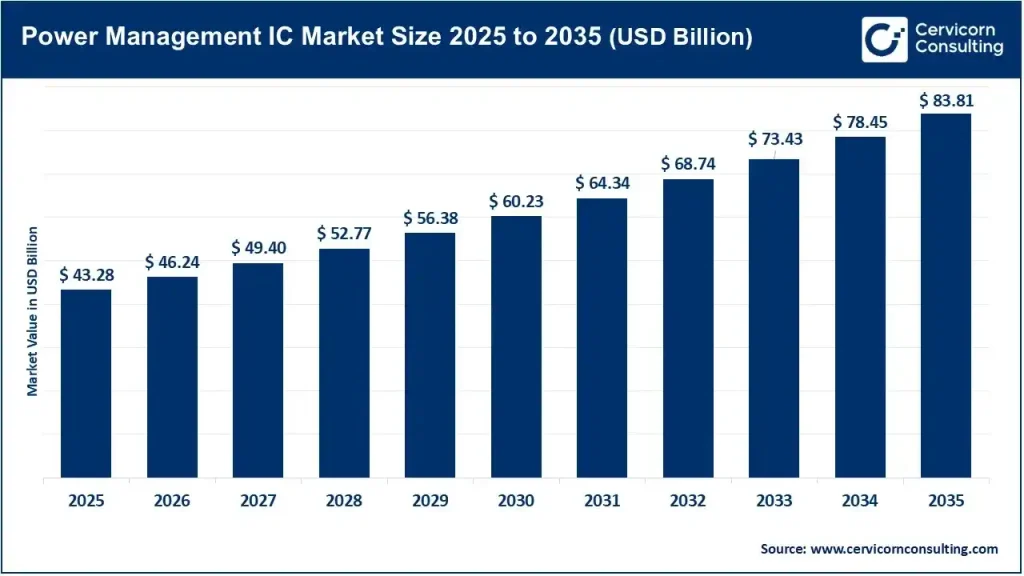
The global power management IC market was valued at approximately USD 43.28 billion in 2025 and is projected to reach USD 83.81 billion by 2035, representing a 6.8% CAGR from 2026 to 2035.
Power Management IC Market Growth Factors
The growth of the Power Management IC market is being driven by the rapid expansion of electric vehicles, AI data centers, smartphones, IoT devices, industrial automation, renewable-energy infrastructure, consumer electronics, and connected systems, all of which require increasingly sophisticated power-control architectures. The rising semiconductor content of vehicles is particularly important because EVs, hybrid vehicles, ADAS platforms, infotainment systems, battery-management systems, and automotive networking require multiple power-conversion and monitoring functions.
At the same time, AI computing is increasing the power density of servers and accelerating demand for highly efficient power delivery, voltage regulation, and thermal-management solutions. IoT and wearable devices are creating additional demand for ultra-low-power PMICs that can extend battery life, while industrial automation and robotics require reliable power architectures capable of supporting sensors, processors, communications, and motor-control systems. Growing renewable-energy deployment is also creating opportunities for PMICs used in energy storage, solar power conversion, charging infrastructure, and power-management systems.
Furthermore, semiconductor manufacturers are investing in advanced packaging, wide-bandgap technologies, higher integration, and intelligent power-management solutions to improve energy efficiency and reduce system size.
Get a Free Sample: https://www.cervicornconsulting.com/sample/3022
What Is the Power Management IC Market?
A Power Management Integrated Circuit (PMIC) is a semiconductor device designed to manage the electrical power requirements of an electronic system. Rather than relying on multiple discrete power-management components, a PMIC can integrate several functions into a compact chip.
Typical PMIC functions include:
- Voltage regulation
- DC-DC conversion
- AC-DC power control
- Battery charging
- Battery monitoring
- Power sequencing
- Voltage monitoring
- Load switching
- Power distribution
- Protection against overvoltage and overcurrent
- Thermal monitoring
- Energy optimization
PMICs are available in different architectures and are designed for applications ranging from low-power wearable electronics to high-power automotive, industrial, and computing systems.
Common PMIC categories include battery-management ICs, voltage regulators, switching regulators, power-management controllers, LED drivers, motor-control ICs, power-factor-correction ICs, and specialized power-control devices.
The market spans a broad ecosystem of semiconductor suppliers, including integrated device manufacturers, analog semiconductor specialists, automotive semiconductor companies, and fabless chip designers.
Why Is the PMIC Market Important?
PMICs are critical because modern electronic systems cannot operate efficiently without precise power management. Processors, sensors, memory, communications modules, displays, motors, and other components often operate at different voltage levels. PMICs ensure that each subsystem receives appropriate and stable power.
Their importance is particularly evident in battery-powered electronics. Efficient power conversion can reduce energy losses and extend operating time. In smartphones and wearables, this directly affects battery life and device size. In EVs, power-management technologies influence charging, battery utilization, thermal performance, and overall vehicle efficiency.
PMICs are also becoming strategically important in AI and data-center infrastructure. AI processors consume significant amounts of electricity, creating demand for sophisticated power-delivery networks capable of handling higher currents and rapidly changing workloads. Infineon, for example, has identified AI power as a major growth opportunity and has highlighted emerging 800-VDC architectures for AI data centers.
Leading Companies in the Power Management IC Market
The competitive environment is relatively concentrated. Mordor Intelligence estimates that Texas Instruments, Analog Devices, Infineon Technologies, NXP Semiconductors, and STMicroelectronics collectively controlled approximately 55% of 2025 PMIC revenue.
| Company | Specialization | Key Focus Areas | Notable Features | 2025 Revenue* | PMIC Market Share** | Global Presence |
|---|---|---|---|---|---|---|
| Texas Instruments | Analog and power-management semiconductors | Industrial, automotive, data centers, consumer electronics | Very broad PMIC portfolio, internal manufacturing, 300mm wafer capacity | $17.68B | ~12.5% | North America, Europe, Asia, global sales |
| Analog Devices | High-performance analog and mixed-signal ICs | Industrial, automotive, communications, healthcare | High-precision power and signal-management technologies | $11.0B | ~10–11%* | North America, Europe, Asia-Pacific, global |
| Infineon Technologies | Power semiconductors and automotive electronics | EVs, renewable energy, industrial, AI/data centers | Strong power portfolio, SiC/GaN capabilities, automotive expertise | €14.66B | ~10–11%* | Europe, Asia-Pacific, Americas |
| NXP Semiconductors | Automotive and embedded semiconductors | Automotive, IoT, industrial, communications | Automotive power management, safety and connectivity integration | $12.27B | ~9–10%* | Americas, Europe, Asia-Pacific |
| STMicroelectronics | Analog, power and embedded semiconductors | Automotive, industrial, energy, IoT | SiC technology, integrated manufacturing, automotive solutions | $11.80B | ~9–10%* | Europe, Americas, Asia-Pacific |
Texas Instruments
Texas Instruments is one of the most important suppliers of analog and power-management semiconductors. Its PMIC portfolio covers voltage regulators, battery-management solutions, power converters, monitoring devices, power switches, gate drivers, and related components.
TI’s major opportunity areas include industrial equipment, automotive electronics, data centers, personal electronics, and communications. In 2025, industrial and automotive each represented approximately 33% of TI revenue, while data centers represented 9%.
A particularly important development is TI’s planned more than $60 billion investment in seven U.S. semiconductor fabs, supporting foundational semiconductor production across Texas and Utah.
Analog Devices
Analog Devices specializes in high-performance analog and mixed-signal technologies. Its power-management capabilities complement its extensive sensing, signal-processing, and data-conversion portfolio.
ADI’s PMIC opportunities are concentrated in industrial automation, automotive systems, communications infrastructure, healthcare equipment, instrumentation, and energy systems. The company reported $11.0 billion in fiscal 2025 revenue, up 17% year over year.
The company’s acquisition of Maxim Integrated also strengthened its position across power-management and analog semiconductor technologies.
Infineon Technologies
Infineon Technologies has a particularly strong position in automotive and power electronics. Its portfolio covers power-management ICs, microcontrollers, power semiconductors, sensors, SiC, GaN, and automotive semiconductor solutions.
Infineon generated €14.662 billion in fiscal 2025 revenue. The company is also investing heavily in power infrastructure for EVs, renewable energy, industrial systems, and AI data centers.
Its Dresden Smart Power Fab has received support under the European Chips Act, with total funding for the Dresden site of around €1 billion.
NXP Semiconductors
NXP Semiconductors has a strong focus on automotive and embedded applications. Its power-management technologies are integrated into automotive systems, industrial and IoT products, mobile applications, and communication infrastructure.
NXP generated $12.269 billion in 2025 revenue. Its portfolio combines power management with embedded processing, connectivity, security, RF, and mixed-signal technologies.
This integration is particularly valuable in vehicles, where multiple semiconductor functions must operate together under demanding reliability and safety requirements.
STMicroelectronics
STMicroelectronics is another major PMIC and power semiconductor supplier, with strong positions in automotive, industrial automation, energy, IoT, and consumer electronics.
ST generated $11.80 billion in 2025 revenue. Its strategy increasingly emphasizes power efficiency, automotive electrification, SiC technologies, and integrated semiconductor manufacturing.
ST’s Catania SiC manufacturing project in Italy is supported by a €2 billion direct grant under European state-aid arrangements supporting a planned €5 billion investment.
Leading Trends and Their Impact
1. Electrification and EV Adoption
Electric vehicles require significantly more sophisticated power-management architectures than conventional vehicles. PMICs support battery-management systems, charging, power conversion, infotainment, ADAS, lighting, connectivity, and vehicle control.
The expansion of 48-V mild-hybrid systems and high-voltage EV architectures is creating demand for higher-efficiency power-management solutions. Automotive and e-mobility is among the fastest-growing PMIC application areas.
2. AI Data Centers
AI computing is transforming the power-management landscape. GPUs and AI accelerators require enormous amounts of electricity, making power conversion efficiency a critical infrastructure issue.
This is creating demand for high-current voltage regulators, multiphase power-management solutions, power stages, advanced controllers, and high-voltage distribution architectures.
The emergence of 800-VDC data-center architectures could further expand opportunities for power semiconductor and PMIC suppliers.
3. Energy Efficiency
Energy efficiency is becoming a primary design requirement across electronics. PMIC manufacturers are therefore developing solutions with lower standby losses, improved switching efficiency, adaptive power modes, and better thermal performance.
Research indicates that low-power PMICs represented nearly 49.94% of 2025 market revenue, while high-power PMICs are expected to expand at a strong pace as electrification and computing workloads increase.
4. SiC and GaN Integration
Silicon carbide and gallium nitride are enabling higher switching frequencies, higher efficiency, and smaller power systems. Although SiC and GaN are not themselves PMICs, their growing use is influencing the development of associated controllers, gate drivers, protection ICs, and power-management architectures.
This trend is especially significant for EV charging, renewable energy, industrial power supplies, and data centers.
5. Increasing Integration
Manufacturers are integrating more functions into individual PMICs. Instead of using numerous discrete components, designers can use integrated solutions that combine regulation, monitoring, sequencing, protection, and communication.
This can reduce PCB area, component count, system complexity, and power losses.
Successful Examples of PMIC Market Development Around the World
United States: Data Centers and Advanced Manufacturing
The United States provides one of the strongest examples of PMIC demand being linked to AI infrastructure and semiconductor manufacturing. Hyperscale data centers and AI computing facilities are increasing the need for high-efficiency power delivery.
At the manufacturing level, TI’s planned investment of more than $60 billion across seven U.S. fabs demonstrates how foundational analog and power semiconductors are being treated as strategically important technologies.
The U.S. CHIPS and Science Act is also supporting domestic semiconductor manufacturing. TI was awarded up to $1.61 billion in direct CHIPS Act funding for projects in Texas and Utah.
Europe: EVs, Industrial Power and SiC
Europe is developing PMIC demand through vehicle electrification, renewable energy, industrial automation, and semiconductor sovereignty initiatives.
The European Chips Act supports semiconductor investments across the region, including Infineon’s Dresden Smart Power Fab and STMicroelectronics’ projects in Italy and France.
ST’s Catania SiC project demonstrates how government support, semiconductor manufacturing, and electrification are converging.
Asia-Pacific: Consumer Electronics and Automotive
Asia-Pacific is the largest regional PMIC market, accounting for approximately 44.23% of 2025 revenue according to Mordor Intelligence.
The region benefits from enormous electronics manufacturing ecosystems in China, Taiwan, South Korea, Japan, and Southeast Asia. Smartphone production, displays, computing equipment, EV manufacturing, battery production, and industrial electronics all contribute to PMIC demand.
South Korea is also an important market. Its PMIC market generated approximately $1.83 billion in 2025, with projected growth to about $3.52 billion by 2033.
India: Semiconductor Manufacturing and Electronics Localization
India is increasingly positioning itself as a semiconductor design and manufacturing hub. The India Semiconductor Mission aims to build a semiconductor and display ecosystem and establish India as a global hub for electronics manufacturing and design.
The country’s expanding electronics manufacturing, smartphones, automotive electronics, EVs, renewable energy, telecom equipment, and data-center industries provide multiple avenues for PMIC demand.
Recent policy developments have also expanded India’s semiconductor support ecosystem, with the country’s semiconductor program moving toward a broader value-chain approach covering manufacturing, packaging, design, materials, equipment, R&D, and talent.
Global Regional Analysis and Government Initiatives
North America
North America remains one of the most influential PMIC markets because of its strong semiconductor design ecosystem, data-center investments, automotive technology, aerospace and defense industries, and industrial automation capabilities.
Grand View Research estimated North America’s share at 44.3% of global PMIC revenue in 2025 under its market definition.
Government policy is reinforcing the region’s position. The U.S. CHIPS and Science Act is encouraging domestic semiconductor production, while companies such as TI and ADI are expanding U.S. manufacturing capabilities.
For PMIC manufacturers, this translates into greater emphasis on domestic supply-chain resilience and long-term wafer capacity.
Europe
Europe is particularly strong in automotive electronics, industrial automation, renewable energy, and power semiconductor technologies.
The European Chips Act is designed to strengthen Europe’s semiconductor ecosystem and reduce strategic supply-chain vulnerabilities. Projects involving STMicroelectronics, Infineon, and other semiconductor manufacturers are supporting local capacity.
Government support for SiC and smart-power manufacturing is particularly relevant because EV adoption and renewable-energy deployment require increasingly efficient power-conversion technologies.
Asia-Pacific
Asia-Pacific represents the largest regional PMIC market in several industry estimates.
China’s huge electronics manufacturing ecosystem makes it a critical PMIC consumption center, while Japan contributes through automotive, industrial, robotics, and electronics technologies. South Korea is particularly important for smartphones, memory, displays, batteries, automotive electronics, and advanced semiconductor manufacturing.
Taiwan’s semiconductor ecosystem also supports PMIC demand through advanced electronics manufacturing and foundry activity.
The region’s growth is increasingly shifting from consumer electronics toward EVs, energy storage, AI computing, industrial automation, and high-performance computing.
Latin America
Latin America represents a smaller PMIC market but has opportunities in automotive manufacturing, consumer appliances, telecommunications, industrial electronics, renewable energy, and localized manufacturing.
Brazil and Mexico are particularly important because of their automotive and electronics manufacturing ecosystems. Growth in EV adoption, industrial automation, and renewable energy can increase demand for power-management components.
Middle East and Africa
The Middle East and Africa are emerging opportunities for PMIC suppliers through renewable energy, telecommunications, data centers, electric mobility, and distributed power systems.
Solar power and off-grid electricity applications are particularly relevant because these systems require efficient power conversion, battery management, charging, and energy-storage control.
Mordor Intelligence identifies the Middle East as one of the fastest-growing regional PMIC markets, with applications increasingly linked to energy infrastructure and emerging digital systems.
Government Policies Shaping the PMIC Market
Government policy is becoming an increasingly important component of PMIC market development. Semiconductor supply-chain disruptions during recent years have encouraged countries to establish domestic manufacturing capabilities and reduce dependence on geographically concentrated production.
The U.S. CHIPS and Science Act supports domestic semiconductor manufacturing through grants, incentives, and investments in research and development. TI’s CHIPS funding and major domestic fab expansion illustrate the direct impact of these policies on analog and power semiconductor capacity.
The European Chips Act is similarly encouraging investment in European semiconductor production, including smart-power, automotive, SiC, and advanced semiconductor facilities.
In India, the India Semiconductor Mission is building an ecosystem spanning semiconductor manufacturing, design, packaging, and related infrastructure.
Meanwhile, automotive electrification policies worldwide are indirectly supporting PMIC demand by accelerating EV production, charging infrastructure, battery manufacturing, and vehicle-electronics content.
The result is a market increasingly shaped not only by consumer electronics demand but also by energy security, semiconductor sovereignty, AI infrastructure, EV adoption, renewable energy, and industrial digitalization. As power consumption rises across virtually every major technology category, PMICs are evolving from relatively invisible supporting components into strategic technologies that determine system efficiency, reliability, thermal performance, battery life, and overall operating cost.
To Get Detailed Overview, Contact Us: https://www.cervicornconsulting.com/contact-us
Read Report: Solid-State Transformer Market Revenue, Trends, and Strategic Insights by 2035