


Table of Contents
TogglePolypropylene Market Size
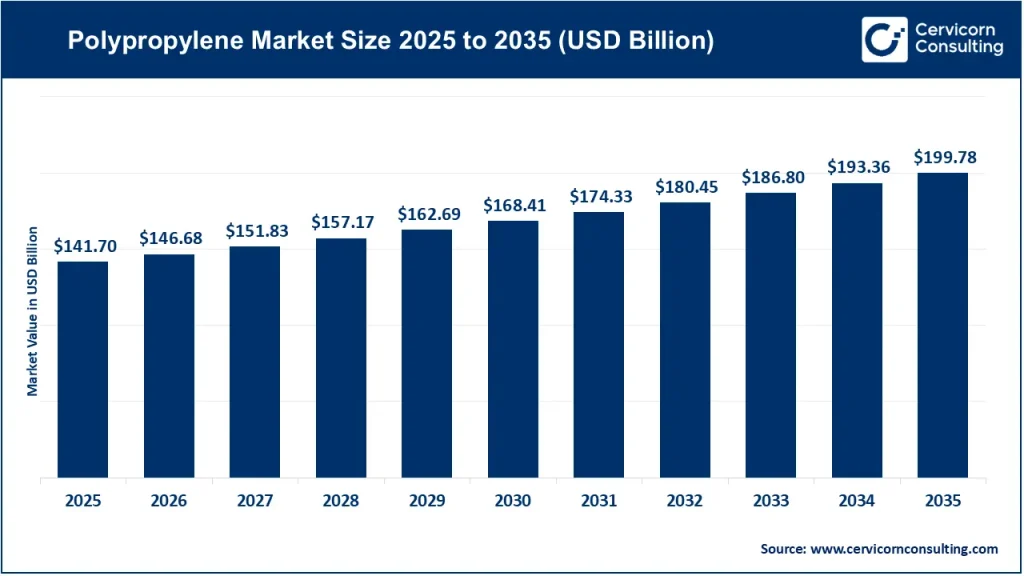
The global polypropylene market was valued at approximately USD 141.70 billion in 2025 and is projected to reach nearly USD 199.78 billion by 2035, growing at a CAGR of 3.49%.
Polypropylene Market Growth Factors
The polypropylene market is witnessing consistent growth due to increasing demand from the packaging, automotive, construction, healthcare, electrical and electronics, and consumer goods industries. Rising urbanization, expanding manufacturing activities, growing adoption of lightweight materials in automobiles for fuel efficiency, increasing use of recyclable plastics, rapid development of flexible packaging, technological innovations in polymer processing, and expanding investments in petrochemical infrastructure are major factors supporting market expansion. Additionally, government initiatives promoting industrial development, improvements in recycling technologies, increasing demand for medical-grade polypropylene, and the growing popularity of sustainable packaging continue to create new growth opportunities across developed and emerging economies.
What is the Polypropylene Market?
The polypropylene market comprises the global production, distribution, and consumption of polypropylene (PP), a thermoplastic polymer manufactured primarily from propylene monomers. Polypropylene is among the world’s most widely used plastics because of its excellent balance of strength, flexibility, chemical resistance, lightweight nature, durability, and affordability.
Polypropylene is available in various forms including:
- Homopolymer polypropylene
- Random copolymer polypropylene
- Impact copolymer polypropylene
These grades are utilized across numerous industries including:
- Packaging
- Automotive
- Medical devices
- Consumer products
- Textiles
- Electrical components
- Construction
- Agriculture
The material can be processed through injection molding, extrusion, blow molding, thermoforming, fiber spinning, and film production, making it one of the most versatile engineering plastics available today.
Get a Free Sample: https://www.cervicornconsulting.com/sample/2665
Why is the Polypropylene Market Important?
Polypropylene has become an essential material for modern industrial manufacturing because it combines performance, affordability, and versatility.
Its importance includes:
Cost-Effective Manufacturing
Compared to engineering plastics, polypropylene offers lower production costs while maintaining excellent mechanical properties.
Lightweight Automotive Components
Vehicle manufacturers increasingly replace metal components with polypropylene to improve fuel efficiency and reduce emissions.
Packaging Innovation
Food packaging, pharmaceutical packaging, flexible films, and rigid containers depend heavily on polypropylene because of its excellent moisture resistance and food safety characteristics.
Medical Applications
Polypropylene is widely used in:
- Syringes
- Laboratory equipment
- Medical containers
- Surgical instruments
- Nonwoven medical fabrics
because it withstands sterilization and possesses high chemical resistance.
Circular Economy
Advancements in mechanical and chemical recycling have positioned polypropylene as one of the major polymers supporting global sustainability goals.
Major Companies Operating in the Polypropylene Market
| Company | Specialization | Key Focus Areas | Notable Features | 2025 Revenue* | Estimated Market Share | Global Presence |
|---|---|---|---|---|---|---|
| SABIC | Petrochemicals and polymers | High-performance polypropylene, circular polymers | Strong sustainability initiatives and global production network | Approximately SAR 116.5 Billion (company revenue) | ~6–8% | Middle East, Europe, Asia-Pacific, Americas |
| Exxon Mobil Corporation | Integrated energy and chemicals | Advanced polypropylene resins, automotive polymers | Large-scale petrochemical integration | Approximately USD 332.2 Billion (company revenue) | ~5–7% | More than 60 countries |
| Borealis AG | Polyolefins | Automotive compounds, circular polypropylene | Borstar® technology and recycling leadership | Private company (revenue not publicly reported for 2025) | ~4–6% | Europe, Asia, Middle East, Americas |
| BASF SE | Specialty chemicals | Engineering plastics and advanced polymer solutions | Innovation-driven material science portfolio | Approximately €65–68 Billion (company-wide, 2025 estimate) | ~3–5% | More than 90 countries |
| INEOS Group | Petrochemicals | Commodity and specialty polypropylene | Extensive global manufacturing assets | Approximately €60–65 Billion (company-wide estimate) | ~7–9% | Europe, North America, Asia-Pacific |
Key Applications Driving Market Demand
Packaging Industry
Packaging remains the largest consumer of polypropylene globally.
Applications include:
- Food containers
- Beverage caps
- Flexible films
- Pouches
- Microwave-safe packaging
- Industrial packaging
The continued expansion of e-commerce and food delivery services has significantly increased demand for durable and lightweight polypropylene packaging solutions.
Automotive Industry
Modern vehicles increasingly rely on polypropylene for reducing vehicle weight.
Applications include:
- Interior trims
- Instrument panels
- Battery housings
- Bumpers
- Door panels
- Air ducts
Electric vehicle manufacturers also utilize polypropylene for lightweight battery components and thermal management systems.
Healthcare Sector
Medical-grade polypropylene has become indispensable due to its sterilization capability and chemical stability.
Applications include:
- Syringes
- Diagnostic equipment
- Laboratory consumables
- Medical packaging
- Personal protective equipment
Consumer Goods
Polypropylene is extensively used in manufacturing:
- Furniture
- Storage containers
- Household appliances
- Toys
- Kitchenware
- Luggage
Its durability and affordability make it a preferred choice for consumer product manufacturers.
Textile Industry
Polypropylene fibers are used in:
- Carpets
- Geotextiles
- Hygiene products
- Industrial fabrics
- Sportswear
The lightweight nature and moisture resistance of polypropylene fibers support growing textile demand.
Leading Trends Transforming the Polypropylene Market
1. Circular Polypropylene
Manufacturers are investing heavily in recycled and bio-based polypropylene.
Market Impact
- Lower carbon footprint
- Improved sustainability
- Growing regulatory compliance
- Increased investment in recycling infrastructure
2. Lightweight Automotive Materials
Automotive OEMs increasingly replace traditional materials with polypropylene composites.
Market Impact
- Lower vehicle emissions
- Improved fuel economy
- Enhanced electric vehicle range
- Reduced manufacturing costs
3. High-Performance Polymer Grades
Advanced polypropylene grades offer:
- Better heat resistance
- Improved impact strength
- Enhanced chemical resistance
- Superior durability
Market Impact
Expansion into aerospace, electronics, and advanced industrial applications.
4. Smart Packaging Solutions
Polypropylene packaging now integrates:
- QR codes
- RFID tags
- Tamper-evident technologies
- Improved barrier properties
Market Impact
Better supply chain visibility and enhanced consumer engagement.
5. Chemical Recycling Technologies
Chemical recycling is emerging as a transformative solution for difficult-to-recycle polypropylene waste.
Market Impact
- Improved recycled resin quality
- Greater circularity
- Reduced landfill waste
- Higher recycled content in consumer products
6. Medical Polymer Innovation
Healthcare demand continues to encourage development of ultra-pure polypropylene grades.
Market Impact
- Better patient safety
- Increased demand for disposable medical products
- Expansion of pharmaceutical packaging
Successful Examples of the Polypropylene Market Around the World
SABIC’s Certified Circular Polypropylene
SABIC has developed certified circular polypropylene produced using advanced recycling technologies. These materials are increasingly adopted by packaging manufacturers seeking to reduce virgin plastic usage while maintaining product quality.
Borealis Bornewables Portfolio
Borealis has introduced renewable polypropylene products manufactured using renewable feedstocks.
These products support:
- Sustainable packaging
- Automotive applications
- Consumer goods manufacturing
ExxonMobil Performance Polypropylene
ExxonMobil continues expanding high-performance polypropylene solutions for automotive manufacturers requiring lightweight, durable components that improve fuel economy and electric vehicle efficiency.
INEOS Advanced Polyolefins
INEOS produces specialty polypropylene grades used in food packaging, medical devices, industrial components, and consumer products while investing in recycling partnerships to improve circular material use.
BASF Sustainable Polymer Solutions
BASF collaborates with manufacturers to develop polypropylene compounds featuring improved durability, lower environmental impact, and compatibility with recycling systems.
Global Regional Analysis
North America
North America represents one of the largest polypropylene markets due to mature manufacturing industries and advanced petrochemical infrastructure.
Key Growth Drivers
- Strong packaging demand
- Automotive manufacturing
- Medical device production
- Advanced recycling technologies
Government Initiatives
Governments support:
- Plastic recycling investments
- Advanced manufacturing
- Circular economy initiatives
- Sustainable packaging development
The U.S. also benefits from abundant shale gas feedstocks that support competitive polypropylene production.
Europe
Europe continues leading sustainable polymer innovation.
Key Growth Drivers
- Circular economy regulations
- Automotive lightweight materials
- Green packaging initiatives
- Advanced polymer research
Government Policies
European regulations encourage:
- Higher recycled plastic content
- Extended Producer Responsibility (EPR)
- Plastic waste reduction
- Eco-design standards
These policies are accelerating investments in recyclable and bio-based polypropylene.
Asia-Pacific
Asia-Pacific dominates global polypropylene production and consumption.
Major markets include:
- China
- India
- Japan
- South Korea
- Southeast Asia
Growth Drivers
- Rapid industrialization
- Expanding middle-class population
- Consumer goods manufacturing
- Construction activities
- Automotive production
Government Initiatives
China promotes domestic petrochemical capacity expansion and advanced manufacturing through industrial development strategies. India supports petrochemical investments, infrastructure expansion, and manufacturing growth under initiatives such as “Make in India,” while Japan and South Korea continue funding advanced materials research and recycling technologies.
Latin America
The region is witnessing increasing polypropylene demand from:
- Food packaging
- Agriculture
- Consumer products
- Construction
Government Support
Several countries are encouraging:
- Industrial diversification
- Plastic recycling
- Manufacturing modernization
- Infrastructure development
Brazil remains the largest regional consumer.
Middle East & Africa
The Middle East has become one of the world’s largest polypropylene production hubs due to abundant feedstock availability.
Key Growth Drivers
- Large petrochemical complexes
- Export-oriented manufacturing
- Competitive production costs
Government Policies
Saudi Arabia, the UAE, and other Gulf countries continue investing in downstream petrochemical industries as part of broader economic diversification programs, supporting high-value polymer manufacturing and exports.
Africa is gradually increasing polypropylene consumption through infrastructure projects, packaging demand, and urbanization.
Emerging Opportunities in the Polypropylene Market
Several opportunities are expected to shape future market expansion:
- Growth of electric vehicle manufacturing
- Rising demand for recyclable packaging
- Expansion of healthcare infrastructure
- Increasing food safety regulations
- Development of bio-based polypropylene
- Smart manufacturing technologies
- AI-driven polymer design
- Advanced catalyst technologies
- Growth in reusable consumer products
- Expansion of chemical recycling capacity
Future Outlook
The polypropylene market is expected to maintain strong long-term growth as industries prioritize lightweight, durable, and recyclable materials. Advances in polymer chemistry, circular economy initiatives, and high-performance material development will continue to broaden polypropylene’s application scope across packaging, automotive, healthcare, electronics, construction, and consumer goods. Investments in sustainable production methods, recycling technologies, and innovative product grades are likely to strengthen the market’s resilience while supporting global environmental objectives.
To Get Detailed Overview, Contact Us: https://www.cervicornconsulting.com/contact-us
Read Report: 3D Printing in Healthcare Market Revenue, Trends, and Strategic Insights by 2035