


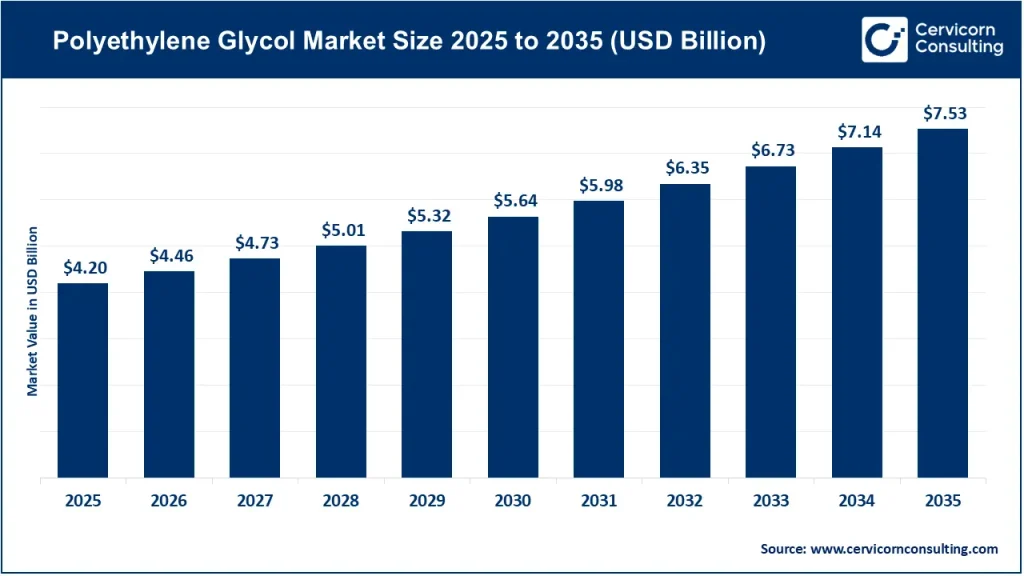
Polyethylene Glycol (PEG) Market Size
The global polyethylene glycol market was valued at approximately USD 5.9 billion in 2025 and is projected to reach USD 9.3 billion by 2033, expanding at a 6.0% CAGR from 2026 to 2033. Asia Pacific accounted for more than 48% of global revenue in 2025, while medical applications represented more than 40% of market revenue, highlighting the growing importance of healthcare and pharmaceutical demand.
Polyethylene Glycol (PEG) Market Growth Factors
The polyethylene glycol (PEG) market is expanding due to rising pharmaceutical and biotechnology production, growing demand for drug-delivery technologies, increasing use of PEG as a pharmaceutical excipient, expanding personal-care and cosmetics industries, and wider adoption of PEG-based materials in industrial applications. PEG’s water solubility, low volatility, chemical stability, lubricity, and compatibility with numerous active pharmaceutical ingredients make it useful in tablets, ointments, liquid formulations, ophthalmic preparations, suppositories, and other dosage forms. The increasing development of biologics and advanced therapeutics is another major growth factor because PEG can be chemically attached to biological molecules through PEGylation to improve properties such as circulation time and pharmacokinetic performance. PEG-containing lipid nanoparticles have also become strategically important for nucleic-acid delivery, including mRNA-based vaccines and RNA therapeutics.
At the same time, pharmaceutical manufacturing expansion in China, India, the United States, and Europe is creating additional demand for high-purity pharmaceutical-grade PEG. Personal-care manufacturers use PEG and PEG derivatives as solvents, humectants, thickeners, softeners, and formulation aids, while industrial manufacturers use different molecular-weight grades in lubricants, coatings, adhesives, ceramics, detergents, and chemical processing. The growing emphasis on advanced drug delivery, biologics, injectable formulations, and specialty excipients is therefore shifting demand from conventional commodity PEG toward higher-value grades with tighter purity and performance specifications.
Get a Free Sample: https://www.cervicornconsulting.com/sample/2747
What Is the Polyethylene Glycol (PEG) Market?
Polyethylene glycol, commonly abbreviated as PEG, is a family of polymers produced through the polymerization of ethylene oxide. PEG is available in numerous molecular weights, and its physical characteristics change according to molecular size. Lower-molecular-weight PEGs can exist as liquids, while higher-molecular-weight grades can appear as waxy solids or powders.
The versatility of PEG is one of the main reasons it has developed into a commercially important chemical material. Its combination of water solubility, hydrophilicity, flexibility, chemical stability, and relatively low toxicity in approved applications makes it useful across multiple industries.
The market includes PEG products supplied in different molecular weights and purity grades for pharmaceutical, medical, personal-care, cosmetic, food, industrial, and specialty applications. Pharmaceutical-grade PEG is particularly important because manufacturers require consistent molecular weight distribution, purity, residual-impurity control, and compliance with applicable pharmacopeial and manufacturing standards.
According to Grand View Research, medical applications represented more than 40% of PEG market revenue in 2025, while Asia Pacific held more than 48% of the global market.
Why Is Polyethylene Glycol Important?
PEG is important because it performs several functions within a single material platform.
Pharmaceutical Excipient
PEG is widely used as an inactive ingredient in pharmaceutical formulations. The U.S. FDA maintains an Inactive Ingredient Database covering inactive ingredients in approved drug products, providing pharmaceutical developers with information useful during formulation development.
PEG can function as a solvent, plasticizer, binder, lubricant, carrier, or formulation aid depending on its molecular weight and application. PEG 3350, for example, is used in laxative formulations.
Drug Delivery and PEGylation
One of PEG’s most strategically important applications is PEGylation, where PEG chains are covalently attached to pharmaceutical or biological molecules. This approach can improve the pharmacological and pharmaceutical characteristics of proteins and other large molecules. A review of approved PEGylated drugs reported successful use of PEGylation across numerous approved therapeutics.
PEG has also been incorporated into lipid nanoparticles used for nucleic-acid delivery. Examples include the PEG-containing lipid nanoparticles used in the Pfizer-BioNTech Comirnaty and Moderna Spikevax COVID-19 mRNA vaccines.
Cosmetics and Personal Care
PEG and PEG derivatives are used in cosmetics as solvents, moisture carriers, softeners, thickeners, emulsifying agents, and formulation aids. This makes PEG valuable in creams, lotions, shampoos, cleansers, toothpaste, and other personal-care formulations.
Industrial Applications
Beyond healthcare, PEG is used in lubricants, coatings, adhesives, detergents, ceramics, chemical processing, and specialty formulations. This diversification reduces dependence on a single end-use industry and supports demand across the broader chemical sector.
Key Companies in the Polyethylene Glycol (PEG) Market
The companies below are significant global chemical producers with capabilities, feedstocks, chemical portfolios, or downstream businesses relevant to the broader PEG value chain. PEG-specific market shares and PEG-specific revenues are generally not publicly disclosed, so company-wide revenue is provided for context rather than as PEG revenue.
| Company | Specialization | Key Focus Areas | Notable Features | 2025 Revenue | PEG Market Share | Global Presence |
|---|---|---|---|---|---|---|
| SABIC | Petrochemicals, chemicals, glycols, polymers | Chemicals, advanced materials, sustainability, innovation | Large integrated chemical portfolio and global R&D network | USD 31.07B | Not publicly disclosed | 140+ countries served |
| Sinopec Group | Energy and petrochemicals | Refining, chemicals, polymers, advanced materials | One of China’s largest integrated energy and chemical groups | RMB 2.78T operating income | Not publicly disclosed | Extensive operations across China and international markets |
| Braskem | Petrochemicals and thermoplastic resins | PE, PP, basic chemicals, biopolymers | Largest thermoplastic-resin producer in the Americas | BRL 70.72B net revenue | Not publicly disclosed | 10 countries; customers in 70+ countries |
| Celanese Corporation | Specialty chemicals and engineered materials | Engineered materials, acetyl chain, specialty polymers | Global production and technology network | USD 9.5B net sales | Not publicly disclosed | North America, Europe, Asia and other global markets |
| China National Chemical Corporation (ChemChina) | Chemicals and specialty materials | Materials science, petrochemicals, industrial chemicals | Integrated into Sinochem Holdings following 2021 restructuring | Standalone 2025 revenue not separately reported | Not publicly disclosed | Global operations through Sinochem Holdings |
SABIC
SABIC is one of the world’s major diversified chemical companies, with operations spanning chemicals, polymers, and agri-nutrients. Its chemicals portfolio includes olefins, glycols, and oxygenates, making it relevant to the broader chemical ecosystem surrounding PEG production.
SABIC reported 2025 revenue of SAR 116.53 billion, equivalent to approximately USD 31.07 billion. The company served customers in more than 140 countries, employed more than 26,000 people, and reported 55.5 million metric tons of production in 2025.
Its key focus areas include portfolio optimization, specialty chemicals, innovation, advanced materials, operational efficiency, and sustainability. Although SABIC does not publicly disclose a standalone PEG market share, its integrated chemical infrastructure gives it strategic relevance to glycol and downstream chemical markets.
Sinopec Group
Sinopec Group is a major Chinese integrated energy and petrochemical company with extensive chemical manufacturing capabilities. Its activities span refining, petrochemicals, chemical products, polymers, and related materials.
Sinopec reported RMB 2.78 trillion in 2025 operating income, with attributable profit of RMB 32.476 billion. The company has been emphasizing innovation, low-carbon transformation, high-quality development, and chemical-sector competitiveness.
Sinopec’s scale and integration across the petrochemical value chain make it an important participant in markets involving ethylene derivatives and specialty chemical feedstocks. Its PEG-specific revenue and market share are not separately disclosed.
Braskem
Braskem is a major petrochemical company focused on thermoplastic resins, basic chemicals, and biopolymers. Its portfolio is particularly strong in polyethylene and polypropylene.
Braskem reported 2025 consolidated net revenue of BRL 70.717 billion, compared with BRL 77.411 billion in 2024.
The company operates across 10 countries with 40 industrial units and serves customers in more than 70 countries. Its international network includes Brazil, the United States, Mexico, Germany, the Netherlands, Singapore, Peru, Argentina, Chile, and Colombia.
Braskem’s relevance to the broader PEG ecosystem comes primarily from its petrochemical and chemical manufacturing capabilities rather than from a publicly reported PEG-specific business.
Celanese Corporation
Celanese Corporation is a global chemical and specialty-materials company operating across engineered materials and the acetyl chain. The company serves automotive, medical, construction, electronics, industrial, consumer, and other end-use markets.
Celanese reported 2025 net sales of USD 9.5 billion, down 7% from the previous year.
Its global footprint includes North America, Europe, Asia, and other regions, with production and technology operations across countries including the United States, China, Germany, India, Japan, Singapore, South Korea, Brazil, Canada, Mexico, and the United Kingdom.
Its focus on specialty materials and high-value chemical applications positions the company within the broader specialty-chemical landscape, although it does not report a standalone PEG market share.
China National Chemical Corporation
China National Chemical Corporation, or ChemChina, is an important name in China’s chemical-industry history. However, it should not be treated as a standalone current corporate entity for 2025 financial analysis.
In 2021, Sinochem Group and ChemChina underwent a joint restructuring, creating Sinochem Holdings Corporation Ltd. as the holding entity.
Sinochem Holdings now operates across areas including life sciences, materials science, petrochemicals, environmental science, and rubber and tires, with approximately 210,000 employees.
Consequently, current PEG-related competitive analysis should consider the relevant businesses under Sinochem Holdings rather than assign a current standalone PEG market share to ChemChina.
Leading Trends and Their Impact on the PEG Market
1. Growth of Biopharmaceuticals
The expansion of biologics is one of the most important long-term trends for PEG. Proteins, peptides, nucleic acids, and other complex therapeutics require sophisticated delivery and stabilization technologies.
PEGylation has already been used in multiple approved drugs, demonstrating the commercial value of PEG-based modification technologies.
Impact: Demand is shifting toward high-purity PEG reagents, controlled molecular-weight grades, and specialty PEG derivatives.
2. Expansion of Advanced Drug Delivery
PEG is increasingly associated with nanomedicine and targeted drug-delivery systems. PEG-containing lipid nanoparticles have been used in mRNA vaccines and other nucleic-acid delivery technologies.
Impact: Pharmaceutical-grade PEG manufacturers can capture higher-value opportunities beyond conventional excipient applications.
3. Rising Demand for Pharmaceutical Excipients
As pharmaceutical manufacturing expands globally, demand for excipients is increasing alongside finished drug production. PEG’s flexibility allows it to support different formulation requirements.
Impact: Manufacturers are placing greater emphasis on quality consistency, pharmacopeial compliance, traceability, and impurity control.
4. Increasing Personal-Care Consumption
Growing consumer spending on skincare, haircare, cosmetics, and specialty personal-care products supports demand for PEG-based formulation ingredients.
Impact: Cosmetic manufacturers are seeking consistent grades and improved formulation performance while also paying greater attention to ingredient safety and impurity management.
5. Shift Toward Specialty Grades
Commodity PEG remains important, but pharmaceutical and advanced-material applications require more specialized grades.
Impact: Producers that can offer pharmaceutical-grade, high-purity, narrow-distribution, or application-specific PEG products may achieve stronger margins than suppliers focused exclusively on commodity grades.
6. Sustainability and Environmental Scrutiny
The chemical industry is under increasing pressure to reduce emissions, improve process efficiency, reduce waste, and develop more sustainable feedstocks.
PEG manufacturing and downstream applications are therefore increasingly influenced by sustainability requirements, manufacturing efficiency, and impurity management.
Impact: Producers are likely to invest in cleaner production technologies, energy efficiency, process optimization, and more sustainable chemical feedstocks.
Successful Examples of the Polyethylene Glycol Market Around the World
PEGylated Medicines in North America and Europe
The pharmaceutical industry provides some of the strongest examples of PEG commercialization. PEGylation has been used to modify therapeutic proteins, peptides, aptamers, and other biological molecules to improve pharmacological characteristics. Research has documented numerous approved PEGylated drugs, demonstrating the technology’s transition from laboratory research to commercial pharmaceutical products.
mRNA Vaccines
One of the most visible examples of PEG-related technology is the use of PEG-containing lipids in lipid nanoparticles used for mRNA vaccines.
Both Comirnaty and Spikevax use PEG-containing lipid nanoparticles to help deliver mRNA. PEG on the nanoparticle surface can reduce protein adsorption and phagocytic clearance, supporting the delivery system’s function.
This application demonstrated how PEG chemistry can move from a specialized pharmaceutical technology into a mass-scale global healthcare platform.
PEG 3350 in Gastrointestinal Treatments
PEG 3350 is another commercially established application. PEG-based formulations are used as osmotic laxatives and in bowel preparation products. This represents a large and mature pharmaceutical application where PEG functions directly as an active formulation component rather than simply as a processing aid.
Asia Pacific Pharmaceutical Manufacturing
Asia Pacific is the largest regional PEG market, accounting for more than 48% of global revenue in 2025. Growth is supported by pharmaceutical, healthcare, industrial, construction, automotive, and personal-care manufacturing in major economies such as China and India.
This regional concentration is creating opportunities for local production, pharmaceutical-grade excipient manufacturing, contract manufacturing, and supply-chain localization.
Global Regional Analysis
North America
North America remains an important market because of its advanced pharmaceutical industry, biotechnology ecosystem, specialty chemical manufacturing base, and sophisticated healthcare infrastructure.
The United States has particular strategic importance for pharmaceutical-grade PEG because of the country’s large biologics and drug-development sectors. Demand is also supported by PEG’s use in drug delivery, injectable formulations, diagnostics, personal care, and industrial products.
Government policy is increasingly focused on strengthening domestic pharmaceutical manufacturing. In May 2025, the U.S. government issued Executive Order 14293, directing federal agencies to streamline regulation and support domestic production of critical medicines and pharmaceutical inputs.
The FDA subsequently announced the FDA PreCheck initiative to improve regulatory predictability and facilitate construction of domestic pharmaceutical manufacturing facilities.
Market impact: These policies could increase domestic demand for pharmaceutical ingredients and excipients, including high-quality PEG, while encouraging supply-chain diversification and regional production.
Europe
Europe represents a mature PEG market supported by pharmaceutical manufacturing, cosmetics, specialty chemicals, and advanced materials.
The region’s pharmaceutical sector places strong emphasis on product quality, environmental performance, manufacturing standards, and supply security. PEG and PEG derivatives used in cosmetics are subject to scrutiny concerning impurities and manufacturing quality. European technical assessments have noted that PEGs are generally regarded as safe under intended cosmetic-use conditions while emphasizing the importance of controlling impurities such as ethylene oxide and 1,4-dioxane.
European pharmaceutical policy is also shifting toward stronger supply-chain resilience. The European Union reached a political agreement in 2025 on reforms to pharmaceutical legislation intended to improve access to medicines, strengthen competitiveness, reduce regulatory burdens, and improve security of supply.
Market impact: European PEG producers and users are likely to prioritize pharmaceutical-grade quality, sustainable production, traceability, and reliable regional supply.
Asia Pacific
Asia Pacific is the largest regional market, accounting for more than 48% of global PEG revenue in 2025.
China and India are particularly important because of their pharmaceutical manufacturing capacity, expanding healthcare industries, growing cosmetics markets, and large industrial bases.
China’s pharmaceutical policy is increasingly focused on innovation, regulatory modernization, drug quality, and global competitiveness. China’s State Council has called for improvements in pharmaceutical regulation, faster review and approval of innovative products, stronger whole-life-cycle quality control, and greater alignment with international regulatory requirements.
China’s 2025 Pharmacopoeia came into force on October 1, 2025, establishing updated national technical standards applicable to drug development, manufacturing, distribution, and regulatory oversight.
China also introduced specific pharmaceutical-excipient GMP provisions in 2025, strengthening standardized production and supervision of pharmaceutical excipients and packaging materials.
India is another important growth market. The Indian government has been promoting pharmaceutical self-reliance through initiatives including the Production Linked Incentive scheme for critical key starting materials, drug intermediates, and APIs, with a total financial outlay of ₹6,940 crore. The government has also implemented the PRIP scheme, with a ₹5,000 crore financial outlay for pharmaceutical and medical-device research and innovation.
Market impact: Asia Pacific is likely to remain the primary growth engine for PEG because of expanding pharmaceutical production, rising healthcare expenditure, increasing cosmetics consumption, and growing domestic chemical manufacturing.
Latin America
Latin America offers opportunities in pharmaceuticals, personal care, food, industrial chemicals, and consumer products. Brazil is the region’s most important chemical manufacturing hub and has a significant domestic pharmaceutical and cosmetics industry.
Braskem’s presence across Brazil and other international markets gives the region an important integrated petrochemical base. Braskem operates industrial units across Brazil and has international operations in North America, Europe, and Asia.
Market impact: Demand is expected to increase as pharmaceutical and personal-care production expands, although currency fluctuations, import dependence, infrastructure constraints, and economic volatility can affect market development.
Middle East & Africa
The Middle East represents an emerging opportunity because of large-scale petrochemical infrastructure, access to hydrocarbon feedstocks, and increasing efforts to develop downstream chemical manufacturing.
Countries such as Saudi Arabia are investing in industrial diversification and advanced chemical manufacturing. Large chemical producers such as SABIC provide a substantial regional platform for chemicals, glycols, polymers, and specialty materials. SABIC’s 2025 report highlights its role in developing downstream industries and manufacturing capabilities in Saudi Arabia.
Africa’s PEG demand is comparatively smaller but is supported by pharmaceutical imports and local manufacturing, cosmetics, personal care, food processing, and industrial applications.
Market impact: The region offers long-term opportunities for localized chemical production, pharmaceutical manufacturing, distribution infrastructure, and specialty chemical investments.
Government Initiatives and Policies Shaping the Global PEG Market
Government policy is increasingly influencing PEG demand indirectly through pharmaceutical manufacturing, excipient standards, healthcare investment, and chemical-sector regulation.
United States: Domestic pharmaceutical manufacturing policies, including Executive Order 14293 and FDA PreCheck, are encouraging investment in U.S.-based pharmaceutical production and supply-chain resilience.
European Union: Pharmaceutical-sector reforms are focused on improving medicine availability, strengthening strategic autonomy, reducing shortages, and supporting innovation.
China: Pharmaceutical reforms are targeting innovation, whole-lifecycle quality management, faster regulatory review, international regulatory alignment, and stronger pharmaceutical manufacturing capabilities.
India: PLI programs for APIs and key starting materials, along with the PRIP initiative, are supporting domestic pharmaceutical manufacturing and R&D.
These policies matter to PEG because pharmaceutical manufacturing is one of its largest application areas. As governments encourage domestic production of medicines, biologics, APIs, and pharmaceutical inputs, demand for compliant, high-purity excipients and drug-delivery materials is likely to increase.
Outlook for PEG Market Participants
The competitive landscape is expected to evolve around pharmaceutical-grade quality, specialty PEG derivatives, advanced drug delivery, sustainable manufacturing, supply-chain security, and regional production.
Manufacturers serving commodity industrial applications will continue competing primarily on scale, feedstock access, cost efficiency, and supply reliability. Meanwhile, suppliers serving pharmaceutical and biotechnology customers can differentiate through tighter specifications, regulatory documentation, manufacturing consistency, technical support, and specialized molecular-weight grades.
For pharmaceutical companies, biotechnology developers, cosmetics manufacturers, chemical producers, and investors, the most attractive opportunities are increasingly found where PEG intersects with biologics, mRNA delivery, lipid nanoparticles, specialty formulations, advanced excipients, and high-purity pharmaceutical ingredients.
With the global market estimated at USD 5.9 billion in 2025 and projected to reach USD 9.3 billion by 2033, PEG is moving beyond its traditional role as a commodity chemical toward a more strategically important material supporting pharmaceutical innovation, advanced drug delivery, personal care, and specialty chemical applications.
To Get Detailed Overview, Contact Us: https://www.cervicornconsulting.com/contact-us
Read Report: Mosquito Drone Market Revenue, Trends, and Strategic Insights by 2035