


Table of Contents
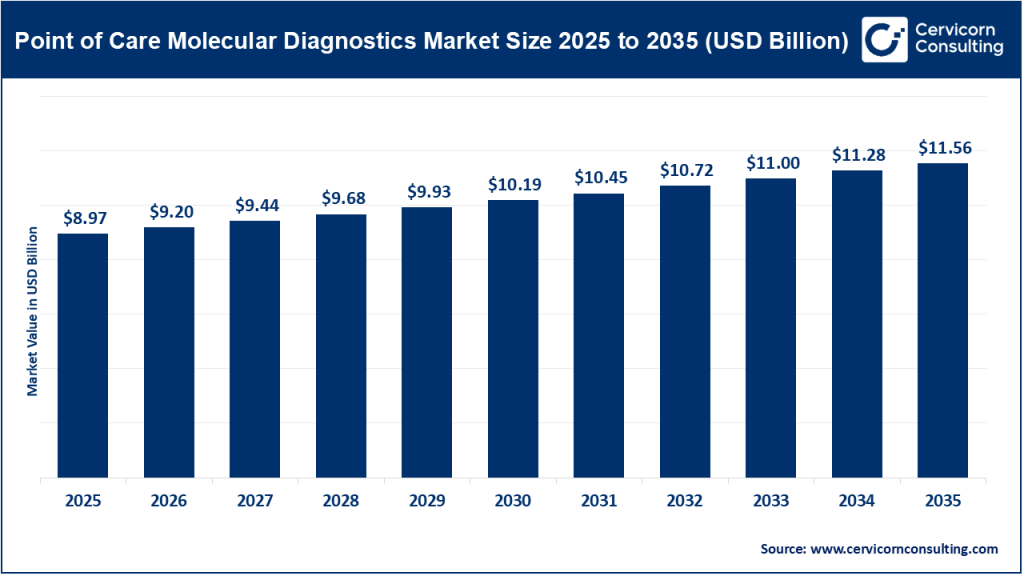
TogglePoint of Care Molecular Diagnostics Market Size
The global point of care molecular diagnostics market was valued at approximately USD 8.97 billion in 2025 and is projected to reach nearly USD 8.97 billion in 2025, expanding at a compound annual growth rate (CAGR) of about 2.57% between 2026 and 2035.
What is the Point of Care Molecular Diagnostics Market?
The point of care molecular diagnostics market refers to the industry focused on developing, manufacturing, and commercializing portable molecular diagnostic devices and assays that can perform genetic and molecular testing at or near the patient care site. These technologies utilize molecular biology techniques such as polymerase chain reaction (PCR), isothermal amplification, nucleic acid sequencing, and other advanced methods to identify pathogens, genetic markers, and disease-specific biomarkers.
Unlike traditional laboratory-based testing, point-of-care molecular diagnostics provides rapid results within minutes or hours, enabling healthcare professionals to make immediate treatment decisions. Applications span infectious disease detection, respiratory infections, sexually transmitted infections, oncology, genetic testing, and antimicrobial resistance monitoring.
The market encompasses diagnostic instruments, consumables, reagents, software solutions, and integrated testing platforms used in hospitals, clinics, emergency departments, pharmacies, ambulatory care centers, and home healthcare settings.
Get a Free Sample: https://www.cervicornconsulting.com/sample/2603
Point of Care Molecular Diagnostics Market Growth Factors
The growth of the point of care molecular diagnostics market is driven by the increasing prevalence of infectious diseases worldwide, rising demand for rapid and accurate diagnostic solutions, growing adoption of decentralized healthcare models, expanding applications of molecular testing beyond infectious disease diagnosis, technological advancements in miniaturized PCR and nucleic acid amplification systems, increasing investments in personalized medicine and precision healthcare, expanding healthcare infrastructure in emerging economies, growing awareness regarding early disease detection, rising need for antimicrobial stewardship programs, favorable reimbursement frameworks in developed markets, increasing demand for home-based diagnostic solutions, integration of artificial intelligence and digital health technologies, regulatory support for innovative diagnostic platforms, and continuous innovation by leading diagnostic companies aimed at enhancing test speed, sensitivity, portability, and affordability.
Why is the Point of Care Molecular Diagnostics Market Important?
Faster Clinical Decision-Making
One of the primary advantages of point-of-care molecular diagnostics is its ability to deliver rapid test results. Physicians can diagnose diseases and initiate treatment during the same patient visit, significantly improving clinical outcomes.
Enhanced Disease Surveillance
Rapid molecular testing plays a vital role in identifying infectious disease outbreaks and monitoring public health threats. Early detection enables timely intervention and containment strategies.
Improved Access to Healthcare
Point-of-care diagnostic devices allow testing in rural and underserved regions where access to centralized laboratories may be limited. This contributes to improved healthcare equity and accessibility.
Reduction in Healthcare Costs
Early diagnosis and timely treatment help reduce hospitalization rates, minimize unnecessary antibiotic use, and lower overall healthcare expenditures.
Support for Personalized Medicine
Molecular diagnostics enables targeted therapies by identifying genetic mutations and biomarkers, facilitating more effective and individualized treatment plans.
Pandemic Preparedness
The COVID-19 pandemic demonstrated the importance of rapid molecular testing in managing large-scale public health emergencies. Governments and healthcare organizations continue investing in point-of-care diagnostic infrastructure to improve preparedness for future outbreaks.
Major Companies in the Point of Care Molecular Diagnostics Market
Company Analysis
| Company | Specialization | Key Focus Areas | Notable Features | 2025 Revenue (Approx.) | Market Share (Approx.) | Global Presence |
|---|---|---|---|---|---|---|
| F. Hoffmann-La Roche AG | Molecular diagnostics, PCR systems, infectious disease testing | Molecular diagnostics, oncology, infectious diseases | Extensive PCR portfolio, integrated diagnostic ecosystems | USD 75+ Billion | 15-18% | Operations in over 100 countries |
| Abbott | Rapid diagnostics, molecular testing platforms | Infectious diseases, cardiovascular diagnostics, diabetes care | Portable molecular testing systems, strong POCT network | USD 42+ Billion | 12-15% | Presence in more than 160 countries |
| QIAGEN | Sample preparation and molecular testing technologies | Genomics, infectious diseases, companion diagnostics | Strong molecular assay development capabilities | USD 2.3+ Billion | 6-8% | Operations across 100+ countries |
| Bayer AG | Healthcare, life sciences, diagnostic collaborations | Precision medicine, healthcare innovation | Strong healthcare ecosystem and research capabilities | USD 54+ Billion | 3-5% | Global presence across Europe, Americas, Asia-Pacific |
| Nova Biomedical | Point-of-care analyzers and diagnostic instruments | Critical care diagnostics, hospital testing | Rapid testing systems with hospital integration | USD 400+ Million | 2-3% | Distribution network in more than 90 countries |
F. Hoffmann-La Roche AG
F. Hoffmann-La Roche AG is recognized as one of the most influential players in molecular diagnostics. The company’s molecular diagnostic portfolio includes PCR-based platforms used extensively for infectious disease detection, oncology diagnostics, and genetic testing.
Key Strengths
- Extensive molecular testing portfolio
- Strong investment in research and development
- Advanced automation capabilities
- Comprehensive infectious disease testing solutions
Roche’s integrated diagnostic ecosystem continues to support healthcare providers with rapid and highly accurate molecular testing technologies.
Abbott
Abbott has significantly expanded its molecular diagnostics capabilities through innovative point-of-care testing solutions. The company offers portable molecular diagnostic platforms designed to deliver laboratory-quality results within clinical settings.
Key Strengths
- User-friendly diagnostic platforms
- Broad infectious disease menu
- Strong global distribution network
- Rapid molecular testing capabilities
Abbott’s focus on decentralized healthcare has helped expand access to molecular diagnostics worldwide.
QIAGEN
QIAGEN specializes in molecular testing technologies, sample preparation systems, and genomic analysis solutions. The company plays a critical role in enabling accurate molecular diagnostics across various healthcare applications.
Key Strengths
- Advanced nucleic acid extraction technologies
- Strong genomic research expertise
- Companion diagnostic development
- Global molecular testing infrastructure
QIAGEN’s innovations continue to support both clinical diagnostics and research applications.
Bayer AG
Bayer AG contributes to the market through healthcare innovation, precision medicine initiatives, and strategic partnerships supporting molecular diagnostic advancements.
Key Strengths
- Significant healthcare R&D investments
- Precision medicine initiatives
- Strong pharmaceutical integration
- Global healthcare network
The company remains actively involved in advancing personalized healthcare solutions.
Nova Biomedical
Nova Biomedical specializes in point-of-care diagnostic analyzers used in hospitals and critical care environments.
Key Strengths
- Hospital-focused diagnostic solutions
- Rapid result generation
- Integrated healthcare workflows
- Strong critical care expertise
Nova Biomedical’s technologies contribute to faster patient management and clinical decision-making.
Leading Trends in the Point of Care Molecular Diagnostics Market and Their Impact
Miniaturization of Molecular Testing Devices
Diagnostic manufacturers are developing increasingly compact and portable molecular testing systems. Miniaturization enables deployment in remote healthcare facilities, emergency settings, and home healthcare environments.
Impact
- Greater accessibility
- Reduced infrastructure requirements
- Expansion of decentralized testing
Integration of Artificial Intelligence
Artificial intelligence is increasingly being incorporated into diagnostic platforms for result interpretation, workflow optimization, and predictive analytics.
Impact
- Improved diagnostic accuracy
- Faster clinical decision-making
- Enhanced disease surveillance
Multiplex Testing Capabilities
Modern molecular diagnostic systems can simultaneously detect multiple pathogens from a single sample.
Impact
- Reduced testing time
- Improved patient management
- Enhanced laboratory efficiency
Growth of Home-Based Diagnostics
Consumer demand for convenient healthcare solutions is encouraging the development of home-use molecular diagnostic devices.
Impact
- Increased patient engagement
- Reduced healthcare facility burden
- Expansion of telemedicine services
Connectivity and Digital Health Integration
Point-of-care diagnostic devices are increasingly connected to cloud platforms and electronic health records.
Impact
- Real-time data sharing
- Improved disease tracking
- Better healthcare coordination
Expansion Beyond Infectious Diseases
Molecular diagnostics is increasingly being applied to oncology, cardiovascular diseases, and genetic disorders.
Impact
- Broader market opportunities
- Growth in precision medicine
- Increased diagnostic value
Successful Examples of Point of Care Molecular Diagnostics Around the World
COVID-19 Rapid Molecular Testing Programs
Countries worldwide adopted rapid molecular diagnostic platforms during the COVID-19 pandemic to facilitate large-scale testing and disease surveillance.
Key Outcomes
- Faster diagnosis
- Reduced transmission
- Improved outbreak management
Tuberculosis Detection Programs in Africa
Several African nations implemented point-of-care molecular testing technologies to improve tuberculosis diagnosis in underserved regions.
Key Outcomes
- Earlier disease detection
- Reduced diagnostic delays
- Improved treatment initiation rates
Influenza Testing in North America
Hospitals and urgent care centers across North America utilize rapid molecular diagnostics to distinguish influenza infections from other respiratory illnesses.
Key Outcomes
- Appropriate antiviral treatment
- Reduced unnecessary antibiotic use
- Better patient outcomes
HIV Monitoring Programs
Point-of-care molecular diagnostics has improved HIV viral load testing in resource-limited settings.
Key Outcomes
- Enhanced treatment monitoring
- Increased patient retention
- Better disease management
Oncology Biomarker Testing in Europe
Healthcare providers increasingly use molecular diagnostic technologies to identify cancer-related biomarkers and guide targeted therapies.
Key Outcomes
- Personalized treatment plans
- Improved survival rates
- Enhanced healthcare efficiency
Global Regional Analysis of the Point of Care Molecular Diagnostics Market
North America
North America remains the largest regional market due to advanced healthcare infrastructure, strong reimbursement frameworks, and widespread adoption of innovative diagnostic technologies.
Market Drivers
- High healthcare expenditure
- Strong research ecosystem
- Rapid technology adoption
- Large infectious disease testing demand
Government Initiatives and Policies
Government agencies continue supporting diagnostic innovation through funding programs, emergency preparedness initiatives, and regulatory pathways that accelerate approval of advanced diagnostic technologies.
Public health agencies actively invest in disease surveillance infrastructure and decentralized testing capabilities.
Europe
Europe represents a mature market characterized by strong healthcare systems and extensive molecular diagnostic adoption.
Market Drivers
- Universal healthcare coverage
- Growing precision medicine initiatives
- Aging population
- Rising chronic disease burden
Government Initiatives and Policies
European governments support molecular diagnostics through national healthcare programs, cancer screening initiatives, infectious disease monitoring frameworks, and investments in personalized medicine research.
Regulatory harmonization efforts across the region facilitate market access for innovative diagnostic products.
Asia-Pacific
Asia-Pacific is expected to experience the fastest growth during the forecast period.
Market Drivers
- Expanding healthcare infrastructure
- Large patient population
- Increasing healthcare investments
- Rising awareness of early disease diagnosis
Government Initiatives and Policies
Countries such as China, India, Japan, and South Korea are increasing investments in diagnostic capabilities through healthcare modernization programs and public health initiatives.
Governments continue supporting local manufacturing, research collaborations, and deployment of diagnostic technologies in rural areas.
Latin America
The region is witnessing increasing adoption of point-of-care diagnostics driven by efforts to improve healthcare access.
Market Drivers
- Growing infectious disease burden
- Expanding healthcare infrastructure
- Increased healthcare spending
- Rising awareness of rapid diagnostics
Government Initiatives and Policies
National healthcare agencies are strengthening disease surveillance systems and expanding diagnostic testing capacity through public-private partnerships and healthcare modernization initiatives.
Middle East and Africa
The Middle East and Africa market is gradually expanding as governments focus on healthcare development and disease control programs.
Market Drivers
- Growing healthcare investments
- Rising prevalence of infectious diseases
- Increased healthcare accessibility
- International healthcare partnerships
Government Initiatives and Policies
Governments across the region are investing in laboratory modernization, infectious disease control programs, and healthcare infrastructure development. International organizations and public-private collaborations further support deployment of molecular diagnostic technologies in underserved communities.
Future Outlook of the Point of Care Molecular Diagnostics Market
The future of the point of care molecular diagnostics market appears highly promising as healthcare systems continue transitioning toward decentralized, patient-centered care models. Advancements in molecular biology, artificial intelligence, microfluidics, and digital health integration are expected to enhance the speed, affordability, and accessibility of molecular testing. Growing emphasis on infectious disease preparedness, precision medicine, and early disease detection will continue driving demand across developed and emerging economies. As governments, healthcare providers, and industry leaders invest in expanding diagnostic capabilities, point-of-care molecular diagnostics is expected to play an increasingly vital role in improving healthcare outcomes worldwide.
To Get Detailed Overview, Contact Us: https://www.cervicornconsulting.com/contact-us
Read Report: Remote Patient Monitoring Market Revenue, Trends, and Strategic Insights by 2035