


Table of Contents
TogglePhysical AI in Agriculture Market Size
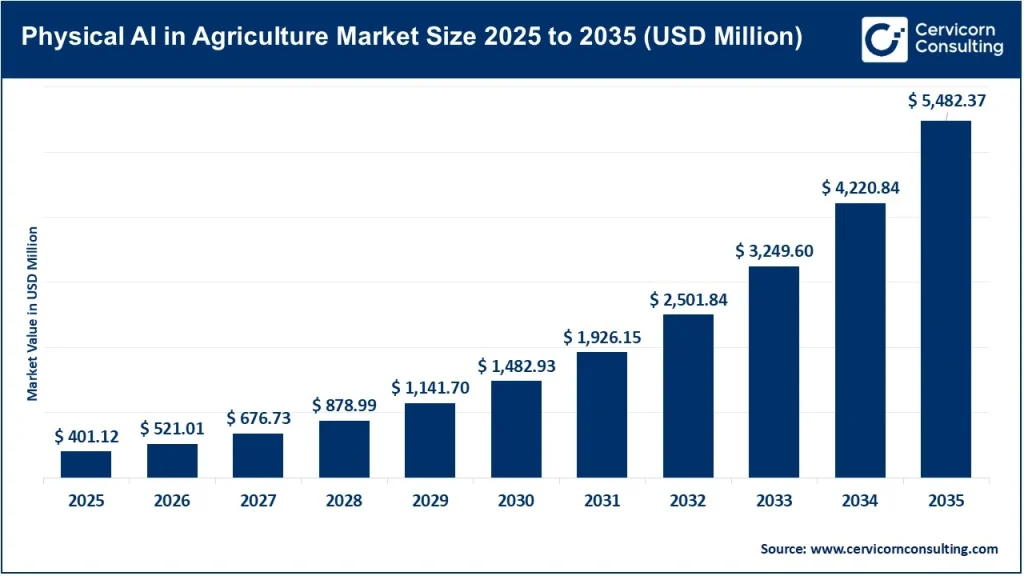
The global physical AI in agriculture market was valued at approximately USD 401.12 million in 2025 and is projected to reach nearly USD 5,482.37 million by 2035, growing at a CAGR of 29.9%.
Physical AI in Agriculture Market Growth Factors
The growth of the physical AI in agriculture market is primarily driven by increasing global food demand, rising labor shortages in agricultural sectors, growing adoption of precision farming technologies, expanding use of autonomous tractors and robotic harvesting systems, increasing investments in smart agriculture infrastructure, government support for digital farming initiatives, advancements in computer vision and machine learning algorithms, integration of IoT-enabled sensors across farms, demand for sustainable resource management, growing climate-related farming challenges, and the need to maximize productivity while minimizing operational costs and environmental impact.
What is the Physical AI in Agriculture Market?
Physical AI in agriculture refers to the deployment of artificial intelligence systems capable of interacting with the physical farming environment through autonomous machines, robots, drones, sensors, and intelligent equipment. Unlike traditional software-based AI that primarily performs data analysis, physical AI enables machines to perceive their surroundings, make decisions, and execute actions autonomously.
These systems combine several advanced technologies:
- Artificial Intelligence
- Machine Learning
- Robotics
- Computer Vision
- Edge Computing
- Autonomous Navigation
- Internet of Things (IoT)
- GPS and Geospatial Analytics
- Sensor Fusion
Physical AI applications in agriculture include:
- Autonomous tractors
- Robotic harvesters
- Precision spraying systems
- Smart irrigation systems
- Livestock monitoring robots
- Agricultural drones
- Weed detection and removal robots
- Autonomous planting equipment
- Yield prediction systems
By enabling machines to perform complex agricultural tasks with minimal human intervention, physical AI is revolutionizing modern farming practices.
Get a Free Sample: https://www.cervicornconsulting.com/sample/2988
Why is Physical AI Important in Agriculture?
Addressing Labor Shortages
Agricultural industries worldwide face a growing shortage of skilled labor. Physical AI helps bridge this gap by automating repetitive and labor-intensive farming operations such as planting, harvesting, spraying, and monitoring.
Improving Crop Productivity
AI-powered systems analyze field conditions in real time and optimize farming operations, leading to improved crop yields and reduced losses.
Enhancing Sustainability
Precision agriculture technologies powered by physical AI reduce excessive use of fertilizers, pesticides, and water, helping farmers achieve environmental sustainability goals.
Increasing Operational Efficiency
Autonomous machines can operate continuously with greater accuracy than conventional equipment, reducing operational costs and increasing productivity.
Supporting Climate Resilience
Physical AI systems help farmers respond to changing weather patterns, soil conditions, and pest outbreaks through predictive analytics and automated interventions.
Enabling Data-Driven Farming
Advanced sensors and AI algorithms provide farmers with actionable insights that improve decision-making across the agricultural value chain.
Major Technologies Driving Physical AI in Agriculture
Computer Vision
Computer vision systems identify crop health, detect weeds, monitor plant growth, and assess soil conditions using high-resolution imagery.
Agricultural Robotics
Robotic systems automate planting, harvesting, pruning, sorting, and packaging operations.
AI-Powered Drones
Drones equipped with AI algorithms collect field data, monitor crops, detect diseases, and support precision spraying.
Autonomous Vehicles
Self-driving tractors and agricultural machinery perform field operations with minimal human intervention.
Smart Sensors
IoT-enabled sensors continuously monitor:
- Soil moisture
- Nutrient levels
- Temperature
- Humidity
- Crop growth indicators
Edge AI
Edge computing enables real-time decision-making directly within agricultural equipment, reducing latency and improving operational efficiency.
Key Companies Operating in the Physical AI in Agriculture Market
Company Profile Comparison
| Company | Specialization | Key Focus Areas | Notable Features | 2025 Revenue* | Estimated Market Share* | Global Presence |
|---|---|---|---|---|---|---|
| John Deere | Smart Agricultural Equipment | Autonomous tractors, precision agriculture, AI-powered farming solutions | See & Spray technology, autonomous tractors, Operations Center platform | USD 55+ Billion | Leading global player | North America, Europe, Asia-Pacific, Latin America |
| CNH Industrial N.V. | Agricultural Machinery & Automation | Precision farming, autonomous equipment, digital agriculture | Raven precision agriculture platform, autonomous farming systems | USD 24+ Billion | Significant global share | More than 170 countries |
| AGCO Corporation | Precision Agriculture Solutions | Smart machinery, autonomous operations, farm data management | Fuse Smart Farming platform, AI-enabled machinery | USD 13+ Billion | Strong agricultural automation presence | Over 140 countries |
| Kubota Corporation | Intelligent Agricultural Machinery | Smart tractors, robotics, automation technologies | Compact autonomous tractors, precision farming systems | USD 22+ Billion | Strong Asia-Pacific presence | Asia, Europe, Americas |
| Trimble Inc. | Precision Agriculture Technology | GPS guidance, farm management, autonomous solutions | Advanced positioning systems, precision agriculture software | USD 4+ Billion | Leading precision technology provider | Global operations across 150+ countries |
John Deere
John Deere remains one of the most influential companies in physical AI-driven agriculture. The company has aggressively expanded its autonomous farming portfolio through AI-powered tractors, precision spraying systems, and advanced farm management platforms.
Key Strengths
- Autonomous tractor systems
- Computer vision-based crop monitoring
- AI-enabled precision spraying
- Cloud-connected farm operations
Competitive Advantage
John Deere’s “See & Spray” technology uses machine vision and AI algorithms to identify weeds and apply herbicides only where needed, significantly reducing chemical usage.
CNH Industrial N.V.
CNH Industrial is accelerating smart farming innovation through its New Holland and Case IH brands. The company integrates AI, robotics, telematics, and automation into next-generation agricultural equipment.
Key Strengths
- Autonomous field equipment
- Precision farming technologies
- Smart vehicle management
- Digital farm ecosystems
Competitive Advantage
Its acquisition of Raven Industries strengthened CNH’s precision agriculture capabilities and autonomous technology portfolio.
AGCO Corporation
AGCO focuses heavily on data-driven agriculture through its Fuse Smart Farming ecosystem.
Key Strengths
- Precision planting systems
- Autonomous machinery
- AI-powered analytics
- Smart farm connectivity
Competitive Advantage
The company enables seamless integration between machinery, data platforms, and farm management systems.
Kubota Corporation
Kubota has emerged as a leader in agricultural robotics, particularly across Asian markets.
Key Strengths
- Smart tractors
- Rice farming automation
- Agricultural robots
- Autonomous navigation systems
Competitive Advantage
Kubota’s solutions are designed specifically for small and medium-sized farms common across Asia-Pacific markets.
Trimble Inc.
Trimble is recognized globally for its precision agriculture technologies.
Key Strengths
- GPS guidance systems
- Farm management software
- Autonomous navigation
- Geospatial intelligence
Competitive Advantage
Trimble’s positioning and navigation technologies serve as foundational infrastructure for many autonomous farming applications.
Leading Trends Shaping the Physical AI in Agriculture Market
Rise of Autonomous Tractors
Self-driving tractors are becoming increasingly common across large-scale farming operations.
Impact
- Reduced labor dependency
- Improved field efficiency
- Enhanced operational accuracy
- Lower fuel consumption
AI-Powered Precision Spraying
Computer vision systems are enabling selective application of pesticides and herbicides.
Impact
- Reduced chemical costs
- Lower environmental impact
- Improved crop health
- Increased sustainability
Agricultural Robotics Expansion
Robotic harvesters and field robots are increasingly performing labor-intensive tasks.
Impact
- Higher productivity
- Consistent harvesting quality
- Reduced labor costs
- Increased operational scalability
Digital Twin Technology
Digital twins create virtual representations of farms and agricultural equipment.
Impact
- Predictive maintenance
- Scenario simulation
- Improved planning
- Reduced equipment downtime
AI-Driven Crop Monitoring
Advanced AI systems continuously monitor crop conditions through drones, satellites, and sensors.
Impact
- Early disease detection
- Yield optimization
- Resource conservation
- Better decision-making
Integration of Edge AI
Agricultural equipment increasingly performs AI processing directly on machines.
Impact
- Faster response times
- Real-time decision-making
- Reduced cloud dependency
- Improved field performance
Smart Irrigation Systems
AI-powered irrigation platforms optimize water use based on real-time environmental data.
Impact
- Water conservation
- Reduced costs
- Improved crop yields
- Climate resilience
Successful Examples of Physical AI in Agriculture Around the World
John Deere Autonomous Farming System – United States
John Deere has deployed autonomous tractors capable of navigating fields, planting crops, and performing tillage operations with minimal human intervention.
Results
- Improved operational efficiency
- Reduced labor requirements
- Increased field productivity
- Better resource utilization
Naïo Technologies Agricultural Robots – France
Naïo Technologies develops autonomous robots for weeding, crop maintenance, and vineyard operations.
Results
- Reduced herbicide usage
- Enhanced sustainability
- Lower labor dependency
- Increased precision farming adoption
Kubota Smart Agriculture Program – Japan
Kubota utilizes AI-powered autonomous tractors and rice farming equipment.
Results
- Increased productivity
- Addressed aging farmer population
- Improved precision operations
- Enhanced crop quality
Blue River Technology See & Spray – United States
Blue River Technology, acquired by John Deere, pioneered AI-based weed recognition systems.
Results
- Up to 90% reduction in herbicide usage in some applications
- Lower environmental footprint
- Improved crop management
- Enhanced profitability
DJI Agricultural Drones – China
DJI has become a major provider of agricultural drones used for spraying, monitoring, and crop assessment.
Results
- Rapid field coverage
- Lower operational costs
- Improved crop monitoring
- Increased precision agriculture adoption
Small Robot Company – United Kingdom
The company deploys autonomous robots for crop monitoring and precision farming operations.
Results
- Data-driven farming
- Reduced chemical inputs
- Improved soil health
- Enhanced sustainability
Global Regional Analysis
North America
North America currently leads the physical AI in agriculture market due to advanced agricultural infrastructure, widespread adoption of precision farming technologies, strong R&D investments, and the presence of major industry players.
Key Drivers
- Large-scale farming operations
- High technology adoption rates
- Labor shortages
- Strong government support
Government Initiatives
The United States Department of Agriculture (USDA) actively supports precision agriculture research, smart farming programs, and AI-enabled agricultural innovation through grants and technology adoption initiatives.
Market Outlook
The region is expected to remain a major innovation hub for autonomous farming technologies throughout the forecast period.
Europe
Europe represents a rapidly growing market driven by sustainability objectives and environmental regulations.
Key Drivers
- Green farming initiatives
- Carbon reduction targets
- Precision agriculture adoption
- Strong agricultural digitization programs
Government Policies
The European Union’s Common Agricultural Policy (CAP) encourages the adoption of digital farming technologies and sustainable agricultural practices.
Market Outlook
Countries such as Germany, France, the Netherlands, and the United Kingdom are investing heavily in agricultural robotics and AI-powered farming solutions.
Asia-Pacific
Asia-Pacific is projected to experience the fastest growth in the physical AI in agriculture market.
Key Drivers
- Rising food demand
- Agricultural modernization
- Growing mechanization
- Smart farming investments
Government Initiatives
China
China’s Digital Agriculture and Rural Development Plan promotes AI, robotics, drones, and smart farming technologies.
Japan
Japan supports agricultural automation through robotics and AI programs aimed at addressing workforce shortages.
India
The Indian government promotes digital agriculture through initiatives such as:
- Digital Agriculture Mission
- AgriStack
- Drone deployment programs
- Precision farming incentives
Market Outlook
China, Japan, India, South Korea, and Australia are expected to emerge as major growth centers for physical AI adoption.
Latin America
Latin America is becoming an attractive market due to its large agricultural sector and increasing adoption of precision farming technologies.
Key Drivers
- Expanding agribusiness sector
- Rising export-oriented farming
- Increasing mechanization
- Government modernization programs
Government Policies
Brazil and Argentina are supporting smart agriculture initiatives through agricultural innovation funds and digital transformation programs.
Market Outlook
Large commercial farms are increasingly deploying autonomous machinery and AI-based monitoring systems.
Middle East & Africa
The Middle East & Africa region is witnessing growing interest in AI-powered agriculture to address food security concerns and water scarcity challenges.
Key Drivers
- Water conservation needs
- Food security initiatives
- Smart irrigation adoption
- Controlled-environment agriculture
Government Initiatives
United Arab Emirates
The UAE National Food Security Strategy promotes AI-enabled agriculture and smart farming technologies.
Saudi Arabia
Saudi Vision 2030 includes investments in agricultural modernization, digital transformation, and AI-powered farming systems.
Market Outlook
Smart irrigation, autonomous greenhouse systems, and AI-powered crop monitoring are expected to drive future market growth across the region.
Government Initiatives and Policies Shaping the Physical AI in Agriculture Market
Governments worldwide recognize the strategic importance of AI-driven agriculture for food security, sustainability, and economic growth.
Major policy initiatives include:
United States
- USDA Precision Agriculture Programs
- AI Research Institutes
- Smart Farming Grants
European Union
- Common Agricultural Policy (CAP)
- Green Deal Initiatives
- Digital Europe Programme
China
- Smart Agriculture Development Strategy
- Rural Digitization Programs
- AI Innovation Funding
Japan
- Smart Agriculture Demonstration Projects
- Agricultural Robotics Incentives
- Farm Automation Programs
India
- Digital Agriculture Mission
- Drone Rules and Agriculture Drone Promotion
- AgriStack Digital Ecosystem
Australia
- National Agricultural Innovation Agenda
- Precision Farming Support Programs
- Smart Irrigation Initiatives
These policies are accelerating investment, innovation, and adoption of physical AI technologies, creating a favorable environment for long-term market expansion across the global agriculture sector.
To Get Detailed Overview, Contact Us: https://www.cervicornconsulting.com/contact-us
Read Report: Electronic Health Records Market Revenue, Trends, and Strategic Insights by 2035