


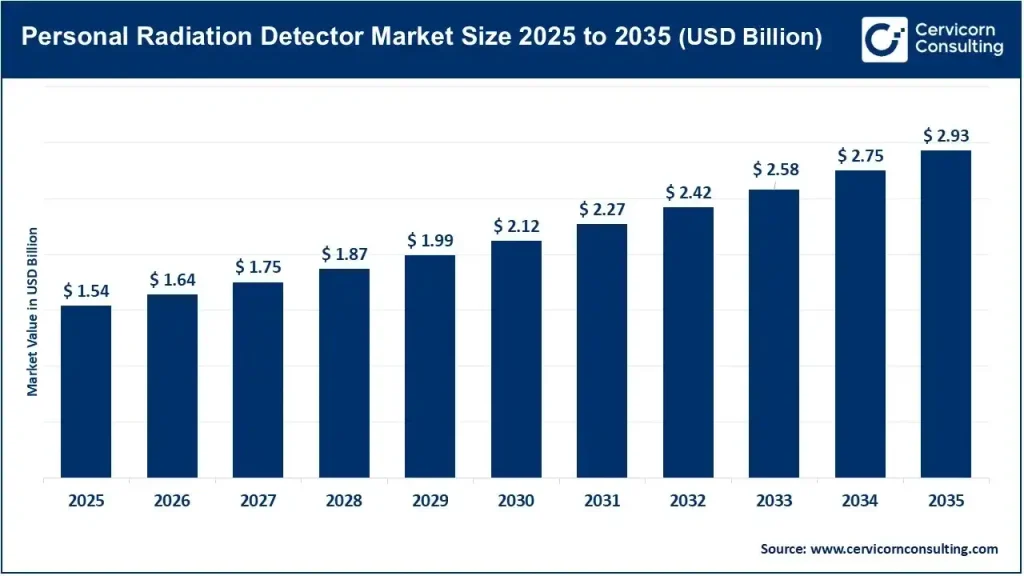
Personal Radiation Detector Market Size
The global personal radiation detector market reached USD 1.54 billion in 2025 and is projected to reach approximately USD 2.93 billion by 2035, expanding at a 6.6% CAGR from 2026 to 2035. North America represented about 38.2% of the market in 2025, supported by nuclear infrastructure, healthcare applications, defense spending, and stringent safety regulations.
Personal Radiation Detector Market Growth Factors
The personal radiation detector market is growing because of increasing nuclear security requirements, expansion of nuclear power generation, rising use of radiation-based medical diagnosis and treatment, stricter occupational safety regulations, greater preparedness for radiological emergencies, and the need for real-time monitoring among workers and first responders. Radiation cannot be detected through human senses, making specialized detection equipment essential for identifying potentially hazardous sources. The expansion of nuclear facilities and aging reactor infrastructure is also supporting demand for radiation monitoring and replacement equipment.
The IAEA reports that approximately 67% of global operational reactor capacity was more than 30 years old, creating continuing requirements for maintenance, modernization, safety monitoring, and radiation protection. Healthcare is another important demand generator because radiology, nuclear medicine, interventional procedures, and radiation oncology expose professionals to controlled sources of ionizing radiation.
In parallel, border security, homeland security, industrial radiography, nuclear-material transportation, scrap-metal inspection, environmental monitoring, and emergency response are increasing demand for compact detectors capable of identifying abnormal radiation quickly. Advances in scintillation detectors, semiconductor sensors, Geiger-Mueller technology, wireless connectivity, Bluetooth communication, improved battery life, ruggedized housings, intelligent alarm algorithms, and smartphone-based monitoring are further increasing the usefulness of PRDs. Regulatory requirements are particularly important because international and national frameworks increasingly emphasize individual monitoring, dose recording, worker training, and radiation-protection programs.
Get a Free Sample: https://www.cervicornconsulting.com/sample/3021
What Is the Personal Radiation Detector Market?
The personal radiation detector market covers the development, manufacturing, distribution, software integration, and servicing of devices designed to detect and monitor ionizing radiation around individual users. A personal radiation detector is generally a compact device that can detect gamma and/or neutron radiation and alert the wearer when potentially dangerous radiation is encountered. The U.S. Nuclear Regulatory Commission describes a PRD as a wearable gamma and/or neutron detector approximately the size of a pager.
The broader market includes electronic personal dosimeters, active dosimeters, radiation monitors, wearable radiation detectors, personal radiation alarms, and specialized first-responder detection equipment. Depending on the application, devices may measure accumulated dose, dose rate, identify radiation sources, store exposure histories, transmit information wirelessly, or provide audible, visual, and vibration alarms.
PRDs are used in nuclear power plants, hospitals, radiology departments, nuclear medicine facilities, research laboratories, industrial radiography, military operations, customs and border checkpoints, emergency services, HAZMAT teams, firefighting, scrap-metal processing, radioactive-material transportation, and environmental monitoring.
The market therefore sits at the intersection of radiation safety, healthcare, nuclear energy, homeland security, industrial safety, and emergency preparedness.
Why Is the Personal Radiation Detector Market Important?
Radiation exposure can create serious occupational and public-safety risks, while radiation itself cannot be detected through sight, smell, sound, taste, or touch. This makes instrumentation essential for recognizing radiation hazards.
PRDs provide three major benefits.
First, they enable immediate awareness. A worker can receive an audible, visual, or vibration alarm when a radiation threshold is reached rather than waiting for laboratory analysis.
Second, they support dose management. Electronic dosimeters can continuously track exposure and help radiation-safety officers determine whether working practices remain within regulatory limits.
Third, they improve emergency response. Firefighters, police officers, customs officials, HAZMAT teams, and nuclear-response personnel may encounter unknown radioactive sources. A portable detector allows them to recognize a radiological threat while maintaining distance and taking protective action.
In India, for example, the Atomic Energy Regulatory Board states that radiation workers should use appropriate personnel monitoring badges and that TLD badges are mandatory for occupational workers in radiation areas under the applicable regulatory framework. Employers are responsible for providing personnel monitoring services and maintaining dose records.
Personal Radiation Detector Market Competitive Landscape
The competitive environment includes diversified scientific-instrument companies as well as specialized radiation-monitoring manufacturers. The five companies below have strong positions in different parts of the market.
| Company | Specialization | Key Focus Areas | Notable Features | 2025 Revenue | Market Share* | Global Presence |
|---|---|---|---|---|---|---|
| Mirion Technologies | Radiation detection, dosimetry, nuclear safety | Nuclear power, healthcare, defense, laboratories | DMC 3000, connected dosimetry, telemetry, rugged detectors | USD 925.4M | ~12–16%** | North America, Europe, Asia-Pacific, global customer base |
| Thermo Fisher Scientific | Scientific instruments and radiation detection | Nuclear security, emergency response, laboratories, healthcare | RadEye PRD4, PRD-ER4, SPRD, NBR technology | USD 44.56B | ~10–14%** | Global |
| Fluke Corporation | Test and measurement; radiation safety | Healthcare, industrial safety, emergency response | Fluke 481 radiation detection meter | Not separately disclosed | ~5–8%** | Global distribution |
| Fuji Electric | Industrial, energy and radiation instrumentation | Nuclear facilities, industrial monitoring, healthcare | Radiation monitoring and dosimetry technologies | Company-wide FY2025 revenue disclosed in annual reporting | ~7–10%** | Japan, Asia-Pacific, Europe, North America and other markets |
| Polimaster | Portable radiation monitors and dosimeters | First responders, HAZMAT, defense, civil protection | PM1605BT, Bluetooth, IP68, long battery life | Private company; not publicly disclosed | ~4–6%** | Europe, Asia, Middle East and international markets |
Mirion reported USD 925.4 million in total 2025 revenue, including USD 614.6 million from Nuclear & Safety and USD 310.8 million from Medical. The company’s Nuclear & Safety portfolio includes personal radiation detection, dosimetry, nuclear monitoring, laboratory instrumentation, and defense-related detection equipment.
Thermo Fisher reported USD 44.56 billion in 2025 company-wide revenue, although revenue specifically attributable to RadEye personal radiation detectors is not separately reported.
Mirion Technologies
Mirion is one of the strongest specialists in radiation measurement and nuclear safety. Its portfolio spans dosimetry, radiation detection, nuclear instrumentation, medical radiation safety, and defense applications. The DMC 3000 personal electronic dosimeter provides audible, visual, and tactile alarms and supports X-ray and gamma detection, with optional beta, neutron, telemetry, and Bluetooth capabilities.
Its newer connected ecosystem illustrates an important direction for the market: transforming a standalone dosimeter into a networked safety device. The company’s Bluetooth module and MirionWatch can reinforce alarms through wrist-based vibration alerts.
Thermo Fisher Scientific
Thermo Fisher combines radiation detection with a massive global scientific-instrument and laboratory infrastructure. Its RadEye PRD4 and PRD-ER4 products target highly sensitive personal radiation detection, including gamma and neutron indication. The devices incorporate Natural Background Rejection technology to reduce nuisance alarms and can be configured for different operational requirements.
The RadEye portfolio is particularly relevant to customs, border security, first responders, emergency services, and organizations searching for orphan radioactive sources.
Fluke Corporation
Fluke participates in radiation safety primarily through portable measurement and radiation-safety instrumentation. Its Fluke 481 Radiation Detection Meter measures beta, gamma, and X-ray radiation and is designed for applications including contamination detection, hazardous-material assessment, radiation monitoring, and worker safety. Fluke states that the instrument has been used by government emergency-response professionals, HAZMAT teams, state inspectors, and nuclear-power workers.
Fluke Biomedical also provides radiation-safety and oncology quality-assurance solutions, giving the company exposure to the healthcare side of the radiation-monitoring ecosystem.
Fuji Electric
Fuji Electric has a broad industrial and energy technology portfolio that includes radiation monitoring capabilities. Its competitive advantage is its engineering base across energy, industrial systems, electronics, and instrumentation. The company reported its financial and segment performance through its 2025 annual reporting, with continued investment in new products and higher-value industrial technologies.
Fuji Electric is particularly relevant in Japan and Asia-Pacific, where nuclear facilities, industrial infrastructure, healthcare applications, and stringent safety practices create demand for radiation measurement technologies.
Polimaster
Polimaster specializes in portable radiation detection and dosimetry. Its PM1605BT Personal Radiation Monitor/Dosimeter uses a Geiger-Mueller counter and can detect and locate radioactive sources while providing audible, visual, and vibration alarms. Bluetooth and USB connectivity allow measurement histories to be transferred to computers or smartphones.
The PM1605BT is designed for harsh environments, with IP68 protection, operation from –30°C to 65°C, a battery life of up to nine months under specified conditions, and resistance to shock and falls. Its target users include firefighters, first responders, HAZMAT teams, police, paramedics, and civil-defense organizations.
Leading Trends and Their Impact on the Personal Radiation Detector Market
1. Connected and Wireless Dosimetry
Bluetooth, wireless communication, smartphone integration, and centralized exposure databases are changing PRDs from standalone instruments into connected safety platforms. Polimaster’s PM1605BT, for example, can communicate with smartphones through Bluetooth, while Mirion has developed Bluetooth connectivity for its DMC 3000 platform.
Impact: Connected systems improve real-time visibility, simplify recordkeeping, support centralized monitoring, and make it easier for radiation-safety officers to manage large workforces.
2. Artificial Intelligence and Intelligent Alarm Processing
A major challenge in radiation detection is distinguishing genuine threats from naturally occurring background radiation. Modern detectors increasingly use algorithms to reduce nuisance alarms and improve source identification.
Thermo Fisher’s RadEye PRD4 uses Natural Background Rejection technology to distinguish artificial radiation from naturally occurring fluctuations.
Impact: Better algorithms can improve detection speed, reduce unnecessary evacuations, and allow less-experienced users to operate sophisticated equipment.
3. Smaller and More Wearable Devices
Users increasingly expect radiation detectors to be lightweight, compact, rugged, and comfortable enough for full-shift use.
Impact: Miniaturization expands the addressable market among healthcare professionals, firefighters, industrial workers, security personnel, and emergency responders.
4. Multimodal Detection
Newer products increasingly combine gamma, X-ray, and neutron detection or provide optional modules for different radiation types. Mirion’s DMC 3000, for example, supports additional beta and neutron modules.
Impact: Multimodal systems reduce the need for multiple instruments and increase usefulness during complex emergency scenarios.
5. Ruggedization for Emergency Environments
First responders may operate in smoke, heat, water, protective clothing, or contaminated environments. Devices such as Polimaster’s PM1605BT are therefore being designed with high ingress protection, large buttons, vibration alerts, and impact resistance.
Impact: Rugged devices broaden PRD deployment beyond controlled nuclear and healthcare environments.
6. Growth of Nuclear Energy
The expansion and modernization of nuclear power infrastructure is an important long-term demand driver. The IAEA has highlighted both new nuclear construction and the aging global reactor fleet, with approximately 67% of operational capacity having been in service for more than three decades.
Impact: Reactor life extension, maintenance, decommissioning, new construction, and nuclear-fuel activities create sustained demand for personal monitoring and radiation safety.
Successful Examples of Personal Radiation Detector Market Applications Around the World
United States: Nuclear Security and Emergency Response
The United States has developed one of the world’s most mature radiation detection ecosystems. PRDs and related radiation instruments are used by nuclear facilities, emergency responders, law enforcement, border-security organizations, HAZMAT teams, hospitals, and industrial operators.
The NRC recognizes PRDs, handheld survey meters, radiation isotope identification devices, and radiation portal monitors as major categories of radiation-detection instruments.
The country’s regulatory framework also requires radiation workers who could receive significant occupational exposure to receive appropriate training and provides mechanisms for exposure monitoring and dose histories.
Europe: Individual Worker Monitoring
Europe provides an important example of regulation-driven adoption. Council Directive 2013/59/Euratom establishes basic safety standards for protection against ionizing radiation. It requires operational protection programs that can include worker classification, workplace monitoring, individual monitoring, education, training, and calibration of measuring instruments.
For Category A workers, systematic individual monitoring through a dosimetry service is required.
Market impact: Such regulatory structures encourage hospitals, nuclear operators, laboratories, industrial facilities, and contractors to maintain established personal monitoring programs.
India: Mandatory Personnel Monitoring in Radiation Work
India is another important example of regulation-led demand. AERB states that occupational radiation workers should use appropriate personnel monitoring devices and that TLD badges are mandatory for workers operating in radiation areas under its regulatory framework. Employers are responsible for providing personnel monitoring services and maintaining dose records.
This creates a strong foundation for continued adoption of personal dosimetry technologies across diagnostic radiology, nuclear medicine, radiation oncology, industrial applications, and research.
Nuclear and Emergency-Response Applications
Across countries, portable detectors are particularly valuable for emergency response. Thermo Fisher’s RadEye systems are designed for locating and identifying radiation sources, while Polimaster products target firefighters, HAZMAT teams, police, paramedics, and civil-defense personnel.
These applications demonstrate how PRDs can move beyond routine occupational monitoring into real-time threat detection and emergency decision-making.
Global Regional Analysis of the Personal Radiation Detector Market
North America
North America is the leading regional market, accounting for approximately 38.2% of global personal radiation detector market revenue in 2025, according to Cervicorn Consulting.
The region benefits from an extensive nuclear-energy infrastructure, advanced healthcare systems, defense spending, industrial radiography, research institutions, and mature radiation-safety regulations.
In the United States, occupationally exposed personnel include workers in nuclear fuel-cycle facilities, industrial radiography, radiology, nuclear medicine, radiation oncology, nuclear power plants, and government and university laboratories.
Government Initiatives and Policies
U.S. radiation protection is shaped by the NRC, EPA, Department of Energy, and other federal and state agencies. NRC requirements establish occupational exposure limits and worker-protection programs, while emergency-preparedness programs address radiological incidents.
The EPA also maintains public radiation-emergency preparedness guidance covering accidental and intentional radiological events.
Market impact: Strong regulation, emergency preparedness, nuclear-security programs, and healthcare radiation use create stable demand for PRDs and dosimetry services.
Europe
Europe represents another mature market because of strong regulatory harmonization under Euratom. Directive 2013/59/Euratom establishes a framework covering occupational, medical, public, and emergency exposure situations.
The directive requires systematic individual monitoring for Category A workers and allows individual monitoring requirements for Category B workers depending on risk.
European countries also operate nuclear power plants, medical radiation facilities, research laboratories, industrial radiography operations, and radioactive-material transport networks.
Market impact: Regulatory compliance supports demand for electronic dosimeters, passive badges, connected monitoring systems, calibration services, and radiation-management software.
Asia-Pacific
Asia-Pacific is one of the most attractive growth regions because of expanding healthcare infrastructure, industrialization, nuclear-energy development, and radiation-safety modernization.
China, Japan, South Korea, India, and other Asian economies maintain extensive medical and industrial radiation applications. The IAEA notes that more than 71% of the growth in nuclear generating capacity connected to the grid since 2021 occurred in Asia, particularly China.
Government Initiatives and Policies
India’s AERB framework requires personnel monitoring for radiation workers and emphasizes dose records and regulatory compliance.
Japan maintains stringent radiation-protection requirements influenced by its extensive nuclear and medical infrastructure and its experience with major nuclear incidents. China continues to expand nuclear power and related safety infrastructure, while other Asian countries are strengthening radiation monitoring as healthcare and industrial radiation applications grow.
Market impact: Nuclear expansion, new hospitals, modernization of diagnostic imaging, industrial inspection, and emergency-response capabilities should increase demand for compact and connected detectors.
Latin America
Latin America presents a developing opportunity for personal radiation detectors. Countries including Brazil, Argentina, and Mexico use radiation technologies in nuclear medicine, industrial inspection, research, agriculture, healthcare, and other specialized applications.
The region’s growth is closely connected to modernization of healthcare infrastructure, expansion of nuclear medicine, industrial radiography, and strengthening of radiation-protection practices.
Government Initiatives and Policies
National nuclear and radiation authorities generally align their radiation-protection practices with international standards and IAEA recommendations. The IAEA’s occupational radiation-protection framework calls for individual monitoring where appropriate, adequate, and feasible for workers in controlled areas.
Market impact: As regulatory systems become more sophisticated, demand is likely to shift from basic monitoring toward electronic, real-time, and digitally connected solutions.
Middle East & Africa
The Middle East & Africa represents an emerging market for PRDs, supported by nuclear-power development, healthcare investment, industrial inspection, oil and gas applications, defense, border security, and emergency preparedness.
The development of nuclear power projects in countries such as the United Arab Emirates, along with growing healthcare and industrial radiation applications, creates opportunities for radiation monitoring suppliers.
Government Initiatives and Policies
Countries developing nuclear facilities are typically required to establish radiation-protection programs, worker monitoring systems, emergency-response capabilities, and regulatory institutions. The IAEA provides international standards and appraisal mechanisms such as ORPAS, which assesses occupational radiation-protection programs against international safety standards.
Market impact: Nuclear infrastructure development can generate demand for personal dosimetry, portable detectors, area monitors, calibration services, training, and radiation-management software.
Future Direction of the Personal Radiation Detector Market
The next phase of the market is likely to be defined by connected, intelligent, rugged, and increasingly multifunctional radiation-monitoring devices. Traditional dosimeters that simply record cumulative exposure are increasingly being supplemented by instruments capable of measuring dose rate, identifying radiation types, transmitting information wirelessly, and generating immediate alarms.
The integration of Bluetooth, smartphone applications, cloud-connected databases, telemetry, and centralized worker-monitoring platforms will allow organizations to manage exposure data across large workforces. Mirion’s connected DMC 3000 ecosystem and Polimaster’s Bluetooth-enabled PM1605BT illustrate this transition.
At the same time, the continued expansion and modernization of nuclear power, growing medical use of ionizing radiation, stricter worker-protection requirements, and increasing attention to radiological emergency preparedness should keep personal radiation detection strategically important across healthcare, nuclear energy, defense, industrial safety, emergency response, and environmental monitoring.
To Get Detailed Overview, Contact Us: https://www.cervicornconsulting.com/contact-us
Read Report: x86 PC CPU Market Revenue, Trends, and Strategic Insights by 2035