


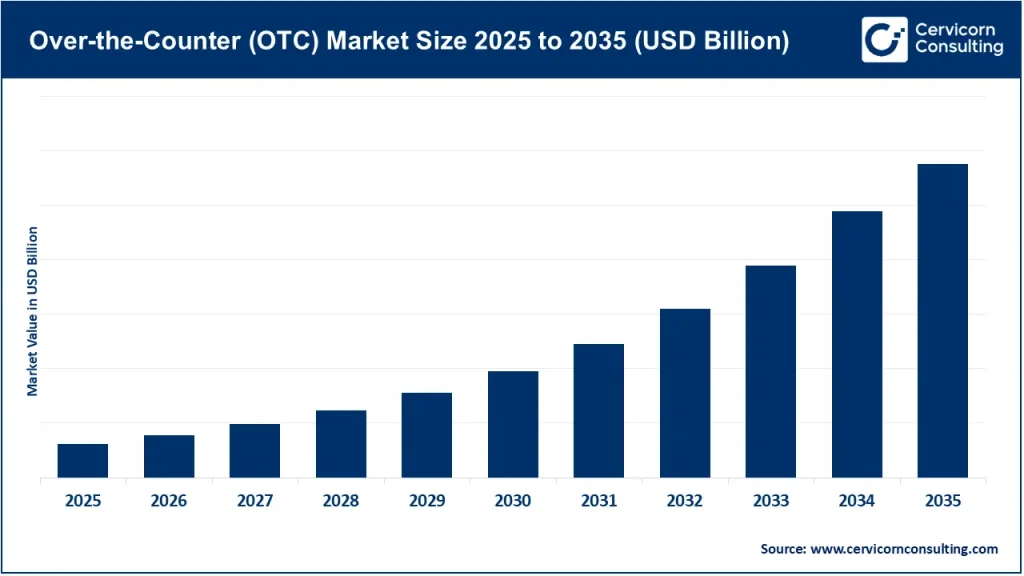
Over-the-Counter (OTC) Market Size
The global over-the-counter (OTC) market is projected to expand at a CAGR of 7.3% between 2026 and 2035.
Over-the-counter (OTC) market growth factors
The global over-the-counter (OTC) market is expanding as corporations, financial institutions, governments, institutional investors, and other market participants increasingly use customized financial instruments to manage interest-rate, foreign-exchange, credit, commodity, and equity risks. According to the Bank for International Settlements (BIS), the global notional value of outstanding OTC derivatives reached approximately USD 846 trillion in June 2025, representing a 16% increase from June 2024, while gross market value rose 29% to USD 21.8 trillion. Interest-rate derivatives remained the dominant category, accounting for approximately 79% of OTC derivatives notional outstanding, while foreign-exchange derivatives reached about USD 155 trillion.
Growth is being supported by volatile interest rates, currency movements, geopolitical uncertainty, changing monetary policies, cross-border trade, corporate treasury risk management, demand for customized hedging products, electronic trading, central clearing, improved reporting infrastructure, and the increasing use of technology in pricing and transaction processing. The growing participation of institutional investors and multinational corporations is also strengthening demand for OTC swaps, forwards, options, and structured products. In April 2025, OTC interest-rate derivatives turnover averaged approximately USD 7.9 trillion per day, 59% higher than in the 2022 BIS Triennial Survey, demonstrating the importance of OTC instruments in global risk management.
Get a Free Sample: https://www.cervicornconsulting.com/sample/2763
What is the over-the-counter (OTC) market?
The over-the-counter market refers to financial transactions conducted directly between counterparties rather than through a centralized exchange. OTC transactions can involve banks, corporations, investment funds, governments, institutional investors, asset managers, insurance companies, commodity companies, and other financial institutions.
OTC markets are particularly important for derivatives because counterparties can negotiate contract specifications according to their individual risk-management requirements. Common OTC instruments include interest-rate swaps, currency forwards and swaps, credit default swaps, commodity swaps and options, equity derivatives, structured products, and other customized contracts.
Unlike standardized exchange-traded derivatives, OTC contracts can be tailored in terms of maturity, notional amount, settlement terms, underlying asset, payment frequency, currency, and other contractual characteristics. This flexibility makes OTC markets particularly valuable for businesses with complex exposures.
The scale of the market is substantial. BIS data covering major reporting jurisdictions show that OTC derivatives include foreign-exchange, interest-rate, equity, commodity, and credit derivatives, with dealers reporting outstanding positions on a consolidated global basis.
Importantly, notional value should not be interpreted as the amount of money invested or the economic value at risk. It represents the reference amount used to calculate contractual payments. Gross market value is substantially smaller and provides a different measure of the value of outstanding contracts.
Why is the OTC market important?
1. Customized risk management
One of the biggest advantages of OTC markets is customization. A corporation with foreign-currency revenue can negotiate a currency forward matching the timing and amount of its expected cash flows. Similarly, a company with floating-rate debt can enter into an interest-rate swap to manage exposure to changing borrowing costs.
2. Foreign-exchange risk management
International businesses constantly face currency fluctuations. OTC FX forwards, swaps, and options allow importers, exporters, financial institutions, and multinational corporations to hedge currency exposure.
The scale of this activity is considerable. BIS reported that OTC FX derivatives outstanding increased by approximately 19% year over year to USD 155 trillion in June 2025.
3. Interest-rate risk management
Interest-rate derivatives are the largest component of the OTC derivatives market. Companies, banks, asset managers, and governments use swaps and related instruments to manage exposure to changing interest rates.
In April 2025, average daily OTC interest-rate derivatives turnover reached approximately USD 7.9 trillion. Overnight index swaps were the most actively traded instrument, with approximately USD 5.1 trillion in average daily turnover.
4. Supporting international trade and investment
OTC markets facilitate cross-border financing and investment by enabling market participants to manage currency, interest-rate, commodity, and credit risks. This is particularly important for multinational companies operating across multiple currencies and regulatory jurisdictions.
5. Price discovery and liquidity
Although OTC transactions are traditionally less centralized than exchange-traded transactions, dealer networks provide liquidity and facilitate transactions involving large or customized positions. Electronic trading platforms, transaction reporting, and data repositories are increasingly improving transparency.
6. Supporting financial stability
Regulated OTC markets can help institutions hedge exposures and transfer financial risks. Post-global-financial-crisis reforms have also strengthened reporting, clearing, margining, and risk-management requirements in major jurisdictions.
Leading companies in the over-the-counter (OTC) market
J.P. Morgan
Specialization: Global investment banking, fixed income, currencies and commodities, derivatives, financing, and corporate banking.
Key Focus Areas: J.P. Morgan maintains a major presence in OTC interest-rate, foreign-exchange, credit, commodity, and equity derivatives. Its broad corporate and institutional client network allows it to provide hedging, market-making, financing, and risk-management solutions.
Notable Features: The company combines investment banking, markets, payments, securities services, and commercial banking capabilities, enabling it to serve multinational corporations and institutional investors across multiple markets.
2025 Revenue: J.P. Morgan reported USD 78.5 billion in net revenue in 2025, up 12% year over year. Its Investment Banking revenue reached USD 10.2 billion, while Banking & Payments revenue was USD 37.1 billion.
Market Share: J.P. Morgan is widely regarded as one of the leading global dealer institutions in OTC derivatives. However, a single comparable percentage market share for the entire OTC market is not publicly disclosed because market shares vary significantly by asset class, currency, product, and geography.
Global Presence: The bank operates across major financial centers in North America, Europe, Asia-Pacific, Latin America, and other international markets.
Goldman Sachs
Specialization: Investment banking, global markets, fixed income, currencies and commodities, equities, derivatives, and institutional trading.
Key Focus Areas: Goldman Sachs focuses heavily on institutional market-making and risk-management services across rates, currencies, commodities, credit, and equities.
Notable Features: Its Global Banking & Markets franchise is particularly relevant to OTC markets because it combines market-making, financing, investment banking, and derivatives capabilities.
2025 Revenue: Goldman Sachs generated USD 58.28 billion in net revenues in 2025, an increase of 9% from 2024. Growth was supported by Global Banking & Markets, including stronger equities, investment banking, and Fixed Income, Currency and Commodities revenue.
Market Share: Goldman Sachs is a major global OTC derivatives dealer, particularly in institutional markets. Its precise share differs by product and cannot be represented accurately by one overall OTC percentage.
Global Presence: The firm has extensive operations throughout the Americas, Europe, Asia-Pacific, and other international financial centers.
Citigroup
Specialization: Foreign exchange, fixed income, derivatives, corporate banking, transaction services, securities services, and global markets.
Key Focus Areas: Citi has a strong emphasis on cross-border transactions, FX, fixed income, rates, commodities, and institutional markets.
Notable Features: Citi’s global network is particularly important for multinational corporations requiring currency and interest-rate risk management across jurisdictions. Its Markets business includes fixed income and equities, while its Services business supports global financial flows.
2025 Revenue: Citi reported USD 85.2 billion in 2025 revenue, its highest level in more than a decade. Its Markets revenue increased 11% during the year, while Services revenue grew 8%.
Market Share: Citi remains a major participant in global OTC markets, especially in foreign exchange and fixed-income-related activities. Its OTC market share varies according to product and region.
Global Presence: Citi has one of the industry’s broadest international networks, with significant operations across North America, Latin America, Europe, Asia-Pacific, and other global markets.
Bank of America
Specialization: Global markets, fixed income, currencies and commodities, equities, investment banking, corporate banking, and derivatives.
Key Focus Areas: Bank of America provides OTC solutions covering interest rates, currencies, credit, commodities, and equity-linked products.
Notable Features: Its Global Markets business combines sales, trading, financing, and risk-management services for corporations, institutional investors, governments, and other clients.
2025 Revenue: Bank of America generated USD 113.1 billion in revenue in 2025 and USD 30.5 billion in net income. Its 2025 sales and trading revenue was approximately USD 20.87 billion, including USD 12.27 billion from fixed income, currencies and commodities and USD 8.60 billion from equities.
Market Share: Bank of America is among the major global dealers participating in OTC derivatives. Its position is particularly significant in North American institutional markets and across FICC and equity products.
Global Presence: The company serves clients across the United States and international financial markets, with significant activities in Europe, Asia-Pacific, and other regions.
Morgan Stanley
Specialization: Institutional Securities, equities, fixed income, investment banking, derivatives, wealth management, and investment management.
Key Focus Areas: Morgan Stanley’s Institutional Securities business provides trading and market-making services across fixed income, currencies, commodities, equities, and derivatives.
Notable Features: The firm combines institutional trading capabilities with investment banking, wealth management, and investment management, giving it a broad client base.
2025 Revenue: Morgan Stanley reported USD 70.6 billion in net revenues in 2025, compared with USD 61.8 billion in 2024. Institutional Securities generated USD 33.1 billion in net revenues.
Market Share: Morgan Stanley is a leading institutional OTC market participant, with particularly strong positioning in equities and significant activity across rates, currencies, commodities, and credit.
Global Presence: The company maintains operations across North America, Europe, Asia-Pacific, and other major international financial centers.
Leading trends in the OTC market and their impact
1. Rising demand for interest-rate hedging
Interest-rate uncertainty remains one of the strongest drivers of OTC derivatives activity. Changes in monetary policy, inflation expectations, government borrowing, and economic growth influence corporate and institutional demand for interest-rate swaps and options.
BIS data show that interest-rate derivatives represented the overwhelming majority of OTC derivatives notional outstanding in 2025.
Impact: Banks and dealers are expanding pricing, risk-management, electronic execution, and clearing capabilities to support higher client activity.
2. Growth in FX derivatives
Globalization and changing trade relationships are increasing the need for currency risk management. Corporations operating international supply chains use forwards, swaps, and options to protect cash flows against currency fluctuations.
Impact: Demand is increasing for automated FX hedging, multi-currency liquidity management, and digital trading solutions.
3. Electronic OTC trading
OTC markets are becoming increasingly digital. Electronic platforms, automated pricing, algorithmic execution, APIs, and real-time analytics are reducing transaction friction.
Impact: Technology is improving speed and transparency while allowing dealers to manage larger transaction volumes more efficiently.
4. Central clearing
Post-financial-crisis reforms have encouraged greater use of central counterparties for standardized OTC derivatives. In the United States, the CFTC’s framework requires certain classes of interest-rate swaps and credit default swaps to be centrally cleared.
Impact: Clearing can reduce bilateral counterparty exposure but increases the importance of collateral, margin, liquidity, and clearing infrastructure.
5. Greater regulatory transparency
Regulators worldwide are emphasizing trade reporting, recordkeeping, transparency, and market surveillance. Under the U.S. Dodd-Frank framework, swap transactions are subject to reporting requirements through swap data repositories.
Impact: Financial institutions are investing heavily in compliance technology, data management, transaction reporting, and regulatory infrastructure.
6. AI and advanced analytics
Artificial intelligence and machine learning are increasingly being applied to pricing, market surveillance, liquidity forecasting, counterparty-risk assessment, fraud detection, and trade processing.
Impact: AI can improve pricing efficiency and risk monitoring while creating new requirements around model governance, data quality, explainability, and cybersecurity.
7. Greater demand for customized products
Corporations and institutional investors increasingly require financial products that match specific exposures rather than standardized exchange contracts.
Impact: Customized swaps, options, structured products, and bespoke hedging solutions remain an important competitive area for major global dealers.
Successful examples of OTC markets around the world
United States
The United States represents one of the world’s most developed OTC derivatives ecosystems. Major investment banks, commercial banks, hedge funds, corporations, asset managers, and institutional investors participate across rates, FX, credit, commodities, and equities.
The U.S. regulatory framework has significantly changed since the global financial crisis, with greater emphasis on swap reporting, central clearing, swap execution facilities, and dealer registration. The CFTC maintains a framework requiring reporting of swaps to registered swap data repositories and has implemented clearing requirements for specified classes of swaps.
United Kingdom
London remains a major international OTC derivatives center. BIS data for April 2025 showed that sales desks in the United Kingdom recorded approximately USD 4.3 trillion in OTC interest-rate derivatives turnover on a net-gross basis, representing roughly half of global turnover in that measure.
The UK’s deep institutional investor base, international banking network, legal infrastructure, and derivatives expertise support its position as a global OTC hub.
European Union
The European Union has developed an extensive regulatory framework under the European Market Infrastructure Regulation (EMIR). The framework focuses on derivatives reporting, central clearing, risk mitigation, and supervision.
Recent EMIR reforms have placed additional emphasis on strengthening EU clearing capacity and encouraging greater use of EU-based clearing infrastructure. In 2025, the European Commission adopted measures connected with EMIR 3, including an active-account requirement for certain counterparties.
Japan
Japan is an important Asian OTC derivatives center, particularly for yen-denominated interest-rate products and foreign exchange. BIS data showed a significant increase in yen OTC interest-rate derivatives turnover between 2022 and 2025, with yen turnover reaching approximately USD 411 billion per day in April 2025.
India
India’s OTC derivatives ecosystem has expanded alongside growth in banking, foreign trade, corporate treasury operations, government securities, and institutional investment.
The Reserve Bank of India has historically emphasized developing OTC derivatives while improving transparency, reducing counterparty risk, and strengthening market infrastructure for trading, settlement, and reporting.
India is also strengthening derivatives-market oversight. In September 2026, SEBI proposed changes to expiry-day derivatives settlement pricing and the Closing Auction Session following concerns around volatility and price discovery.
Global regional analysis of the OTC market
North America
North America remains a central hub for OTC derivatives because of its large institutional financial sector, sophisticated capital markets, multinational corporations, and major dealer banks.
The United States has particularly strong activity in interest-rate, FX, credit, equity, and commodity derivatives. Major banks such as J.P. Morgan, Goldman Sachs, Citigroup, Bank of America, and Morgan Stanley play important dealer and market-making roles.
Regulation remains a major market-shaping factor. Dodd-Frank established extensive requirements for swap reporting, recordkeeping, clearing, and trading. The CFTC continues to update and supervise the framework.
Europe
Europe is a major OTC derivatives market, with London, Frankfurt, Paris, Amsterdam, and other financial centers contributing to regional activity.
The region’s OTC market is being shaped by EMIR and related capital-markets reforms. The European Commission’s recent policy activity has focused on strengthening European clearing markets, enhancing supervision, and increasing resilience.
The euro has also become increasingly important in OTC interest-rate derivatives. BIS data showed euro-denominated OTC interest-rate derivatives turnover of approximately USD 3 trillion per day in April 2025, representing 38% of global turnover and exceeding the dollar’s 31% share.
Asia-Pacific
Asia-Pacific is an increasingly important OTC derivatives region because of its growing economies, international trade, expanding institutional investment, and increasing corporate hedging requirements.
Japan, Australia, Singapore, Hong Kong, China, and India are important regional centers. Demand is supported by FX hedging, interest-rate management, commodity exposure, and cross-border investment.
Regulators across the region are emphasizing reporting, clearing, risk management, and transparency while seeking to maintain sufficient market liquidity.
Latin America
Latin America presents significant opportunities for OTC derivatives because companies and financial institutions face substantial foreign-exchange, commodity, interest-rate, and sovereign-risk exposures.
Brazil, Mexico, Chile, Colombia, and other markets have developed derivatives ecosystems supporting corporate hedging and financial-market activity.
Currency derivatives are particularly relevant because businesses involved in international trade may be exposed to fluctuations in local currencies against the U.S. dollar and other major currencies.
Middle East and Africa
The Middle East is becoming increasingly relevant to OTC markets as financial centers such as Dubai and Abu Dhabi expand their institutional financial ecosystems and international investment activity.
Demand is supported by infrastructure investment, energy trading, international financing, foreign investment, and commodity exposure.
Africa represents an emerging opportunity, particularly in FX and interest-rate risk management. However, market development differs substantially between countries because of varying levels of financial-market depth, regulation, liquidity, and institutional participation.
Government initiatives and policies shaping the OTC market
United States: Dodd-Frank derivatives reforms
Dodd-Frank remains one of the most influential regulatory frameworks affecting OTC derivatives. It introduced requirements related to swap reporting, data repositories, clearing, dealer registration, and trading transparency. The CFTC continues to oversee swap dealers and reporting infrastructure.
European Union: EMIR and EMIR 3
The European Union uses EMIR to regulate OTC derivatives and strengthen post-trade risk management. Recent EMIR 3 measures emphasize the resilience of EU clearing infrastructure and introduce an active-account requirement for certain market participants.
India: RBI and SEBI regulatory development
India’s regulatory framework combines RBI oversight of banking and many OTC derivative activities with SEBI oversight of securities and exchange-traded derivatives. RBI initiatives have historically emphasized transparency, standardization, centralized clearing, and reduced counterparty risk in OTC derivatives.
SEBI continues to refine derivatives-market rules, including measures designed to strengthen price discovery and reduce excessive volatility. Its September 2026 proposals concerning expiry-day settlement pricing illustrate the regulator’s continuing focus on market integrity and stability.
Global standards: BIS and G20 reforms
International organizations and regulators continue to promote consistent approaches to reporting, clearing, margin requirements, and counterparty-risk management. BIS statistics provide an important global view of OTC derivatives positions and market developments.
The increasing integration of regulatory reporting systems and clearing infrastructure is creating a more transparent and resilient OTC ecosystem while also raising compliance costs for financial institutions.
Market outlook
The OTC market is expected to remain strategically important as companies and financial institutions face increasingly complex exposures to interest rates, currencies, commodities, credit conditions, and geopolitical developments. The BIS reported that OTC derivatives notional outstanding rose 20.7% during 2025 compared with the previous year, while gross market value increased 29.5%.
Future market development is likely to be influenced by several interconnected forces: monetary-policy changes, global trade patterns, geopolitical uncertainty, electronic execution, central clearing, regulatory modernization, AI-enabled trading and risk analytics, growing cross-border investment, and increased corporate demand for sophisticated hedging.
The competitive landscape is also expected to remain concentrated around global banks with substantial balance sheets, sophisticated risk-management capabilities, broad institutional client networks, and access to international liquidity. At the same time, electronic trading platforms, fintech companies, clearinghouses, data providers, and specialized market infrastructure firms are likely to play a growing role in modernizing OTC transactions.
For market participants, the combination of customization and technological modernization makes OTC markets an important component of the global financial system. The continued expansion of interest-rate and FX derivatives, together with increasing regulatory oversight, is expected to shape the next phase of development across established financial centers and emerging markets.
To Get Detailed Overview, Contact Us: https://www.cervicornconsulting.com/contact-us
Read Report: Infusion Pump Market Revenue, Trends, and Strategic Insights by 2035