


Table of Contents
ToggleOrthodontics Market Size
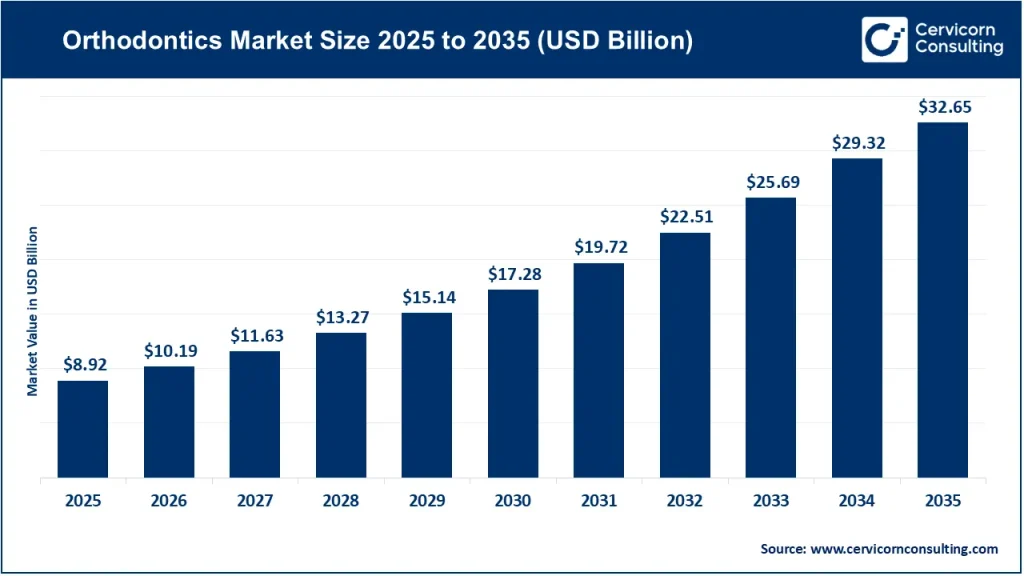
The global orthodontics market was valued at approximately USD 8.92 billion in 2025 and is projected to reach nearly USD 32.65 billion by 2035, growing at a CAGR of 13.85%.
Orthodontics Market Growth Factors
The global orthodontics market is witnessing strong growth due to the increasing prevalence of malocclusion, rising awareness about dental aesthetics, growing demand for minimally invasive and clear aligner treatments, rapid technological advancements in digital dentistry, expanding adoption of CAD/CAM systems and 3D printing, increasing disposable incomes in emerging economies, greater availability of orthodontic care through specialized dental clinics, rising investments in AI-powered treatment planning, growing acceptance of adult orthodontic procedures, favorable reimbursement policies in selected developed countries, expanding dental tourism, continuous product innovation by leading manufacturers, and government initiatives focused on improving oral healthcare infrastructure. The integration of intraoral scanners, digital imaging, customized braces, remote patient monitoring, and tele-dentistry platforms is further accelerating market expansion by improving treatment precision, reducing treatment time, and enhancing patient satisfaction.
Get a Free Sample: https://www.cervicornconsulting.com/sample/2689
What is the Orthodontics Market?
The orthodontics market consists of products, technologies, and services used to diagnose, prevent, and correct irregularities in teeth alignment and jaw positioning. It includes traditional metal braces, ceramic braces, lingual braces, clear aligners, orthodontic wires, brackets, retainers, temporary anchorage devices (TADs), intraoral scanners, digital treatment planning software, and associated clinical services.
Orthodontic treatment has evolved significantly over the past decade. While conventional braces remain an effective treatment option, modern digital orthodontics has introduced highly customized, nearly invisible clear aligners that improve comfort, convenience, and aesthetics. The widespread use of AI, machine learning, and digital imaging has transformed orthodontic diagnosis and treatment planning, making procedures faster, more predictable, and more personalized.
Today, orthodontics serves patients of all age groups, from children requiring early intervention to adults seeking cosmetic smile correction.
Why is the Orthodontics Market Important?
Orthodontics extends well beyond cosmetic enhancement. Proper tooth alignment contributes significantly to overall oral health by reducing the risk of tooth decay, gum disease, temporomandibular joint (TMJ) disorders, abnormal tooth wear, and chewing difficulties.
Key reasons why orthodontics is important include:
- Improves oral hygiene by making teeth easier to clean
- Prevents long-term dental complications
- Enhances facial aesthetics and patient confidence
- Improves speech and chewing function
- Reduces future restorative dental costs
- Supports healthy jaw development in children
- Increases quality of life through better oral function
- Encourages preventive dental care
- Promotes digital dentistry innovation
- Creates opportunities for personalized healthcare
Growing awareness of smile aesthetics among adults, combined with social media influence and technological innovation, continues to expand the global orthodontics patient base.
Major Companies Driving the Orthodontics Market
| Company | Specialization | Key Focus Areas | Notable Features | 2025 Revenue | Market Share* | Global Presence |
|---|---|---|---|---|---|---|
| 3M Company | Orthodontic appliances and dental products | Brackets, adhesives, digital solutions | Extensive orthodontic product portfolio | US$24.9 Billion (company revenue) | Strong presence in orthodontic materials | Operations in over 70 countries |
| Align Technology, Inc. | Clear aligners and digital orthodontics | Invisalign, iTero scanners | Global leader in clear aligners | US$4.0 Billion | Leading share in clear aligners | Presence in more than 100 countries |
| American Orthodontics | Orthodontic appliances | Brackets, wires, tubes, digital orthodontics | Family-owned manufacturer with broad clinical portfolio | Privately held | Significant in specialist orthodontics | Global distributor network |
| Danaher Corporation | Dental technologies | Imaging, diagnostics, orthodontic systems | Strong dental technology ecosystem | Approximately US$24–25 Billion (company revenue) | Major dental equipment supplier | Worldwide operations |
| Dentaurum GmbH & Co. KG | Orthodontic and dental products | Orthodontic appliances, implants, CAD/CAM | One of the world’s oldest dental manufacturers | Privately held | Strong European market presence | Distribution in more than 130 countries |
*Market share values vary by product segment (clear aligners, brackets, imaging, orthodontic materials, etc.) rather than the overall orthodontics market.
Company Overview
1. 3M Company
3M is among the world’s leading suppliers of orthodontic materials and appliances. Its orthodontic portfolio includes brackets, adhesives, bonding systems, bands, wires, and digital solutions that improve treatment efficiency.
Its strengths include:
- Reliable orthodontic bonding systems
- High-quality ceramic and metal brackets
- Strong R&D investments
- Global distribution network
- Integration with digital dentistry
2. Align Technology, Inc.
Align Technology revolutionized orthodontics through the Invisalign clear aligner system. Today, Invisalign has become one of the most recognized orthodontic treatment options worldwide.
Key strengths include:
- AI-assisted treatment planning
- iTero intraoral scanners
- Cloud-based digital workflow
- Customized aligners
- Continuous product innovation
Align Technology continues expanding into younger patient populations while improving treatment predictability using digital platforms. In fiscal 2025, the company reported record annual revenue of approximately US$4.0 billion.
3. American Orthodontics
American Orthodontics specializes exclusively in orthodontic products and serves thousands of orthodontists globally.
Its portfolio includes:
- Conventional braces
- Self-ligating brackets
- Orthodontic wires
- Elastomerics
- Buccal tubes
- Digital orthodontic solutions
The company’s focus on quality manufacturing and clinician support has helped maintain its strong reputation among orthodontic specialists.
4. Danaher Corporation
Danaher plays an important role in orthodontics through its dental technology businesses, offering imaging systems, diagnostics, and digital workflow solutions.
Its strengths include:
- Digital imaging
- Intraoral scanners
- Dental diagnostics
- Clinical workflow software
- Connected dental technologies
Danaher’s innovation ecosystem supports orthodontists with highly integrated digital treatment planning tools.
5. Dentaurum GmbH & Co. KG
Founded in Germany, Dentaurum is among the oldest dental manufacturers worldwide.
Its orthodontic solutions include:
- Metal brackets
- Ceramic brackets
- Orthodontic wires
- CAD/CAM systems
- Retainers
- Expansion appliances
Dentaurum is recognized for precision engineering and premium-quality orthodontic products.
Leading Trends Shaping the Orthodontics Market
1. Clear Aligners Becoming the Preferred Choice
Clear aligners continue replacing traditional braces, particularly among adults seeking discreet treatment options.
Impact:
- Improved patient comfort
- Better aesthetics
- Higher treatment acceptance
- Increased adult orthodontic demand
2. Artificial Intelligence in Treatment Planning
AI algorithms now analyze dental scans and automatically generate treatment simulations.
Benefits include:
- Improved accuracy
- Faster planning
- Predictable outcomes
- Personalized treatment
3. Digital Dentistry Integration
Modern orthodontic clinics increasingly use:
- Intraoral scanners
- Digital impressions
- CAD/CAM systems
- Cloud-based treatment planning
- Digital patient records
These technologies eliminate conventional impressions while improving workflow efficiency.
4. Growth of 3D Printing
3D printing enables rapid production of:
- Dental models
- Clear aligners
- Surgical guides
- Retainers
- Customized orthodontic appliances
The technology significantly reduces manufacturing time and costs.
5. Remote Orthodontic Monitoring
Smartphone-based monitoring allows orthodontists to evaluate treatment progress remotely.
Advantages include:
- Fewer clinic visits
- Improved patient compliance
- Better treatment tracking
- Enhanced convenience
6. Customized Orthodontic Solutions
Modern orthodontics increasingly focuses on personalized treatment.
Examples include:
- Customized brackets
- Patient-specific aligners
- Digital smile design
- Precision treatment planning
7. Growing Adult Orthodontics
Adults now represent one of the fastest-growing orthodontic patient groups due to:
- Increased aesthetic awareness
- Career-related appearance concerns
- Improved treatment comfort
- Nearly invisible aligners
Impact of Emerging Trends
These technological developments are transforming orthodontic care in several ways:
- Shorter treatment duration
- Better clinical outcomes
- Greater patient satisfaction
- Higher treatment acceptance
- Reduced chair time
- Improved practice efficiency
- Lower manufacturing costs
- Greater scalability for orthodontic providers
Digital transformation is also enabling orthodontists to deliver more personalized, data-driven care while expanding access to patients in remote areas.
Successful Examples of the Orthodontics Market Around the World
Invisalign Global Success
Align Technology’s Invisalign system has become one of the most successful innovations in orthodontics. Millions of patients worldwide have undergone treatment using clear aligners, supported by digital scanning, AI-assisted treatment planning, and customized manufacturing. By the end of 2025, the company reported treating more than 22 million patients globally.
Digital Orthodontics in the United States
The United States leads in adopting digital orthodontics through:
- AI-assisted treatment planning
- Intraoral scanners
- 3D printed appliances
- Digital patient monitoring
The presence of advanced dental clinics and high consumer awareness continues driving innovation.
Germany’s Precision Orthodontic Manufacturing
Germany remains a global hub for orthodontic manufacturing.
Companies such as Dentaurum have built international reputations by producing high-quality orthodontic products with advanced engineering and strict quality standards.
Japan’s Advanced Orthodontic Technologies
Japan has embraced digital imaging, robotic manufacturing, and precision orthodontic appliances.
The country’s emphasis on technological innovation has improved treatment quality while reducing clinical errors.
South Korea’s Cosmetic Dentistry Boom
South Korea’s cosmetic dentistry industry has fueled demand for:
- Clear aligners
- Ceramic braces
- Digital smile design
- Premium orthodontic treatments
High consumer awareness and advanced dental clinics make the country a regional leader.
Global Regional Analysis
North America
North America dominates the orthodontics market.
Growth Drivers
- High healthcare expenditure
- Advanced dental infrastructure
- Strong adoption of clear aligners
- Growing adult orthodontic demand
- Digital dentistry leadership
Government Initiatives and Policies
Government-supported oral health programs and public insurance initiatives for eligible children improve access to orthodontic evaluations. Regulatory oversight by agencies such as the U.S. Food and Drug Administration (FDA) encourages the adoption of safe and effective orthodontic devices, while Canada supports preventive oral healthcare through federal and provincial programs.
Europe
Europe represents one of the largest orthodontics markets globally.
Market Drivers
- Universal healthcare systems
- Strong dental education
- Advanced manufacturing
- High awareness of preventive dentistry
Government Initiatives
European governments support preventive dental care through public health systems, while the EU Medical Device Regulation (MDR) strengthens quality, safety, and post-market surveillance for orthodontic and dental devices. Many countries also reimburse orthodontic treatment for children with clinically significant malocclusion.
Asia-Pacific
Asia-Pacific is expected to experience the fastest growth.
Key Growth Factors
- Rising disposable income
- Urbanization
- Expanding middle class
- Increasing cosmetic dentistry
- Growing dental tourism
Government Policies
Countries including China, India, Japan, South Korea, and Australia are investing in oral healthcare infrastructure, expanding dental education, and promoting digital healthcare initiatives. Policies supporting medical device innovation, domestic manufacturing, and telehealth are also encouraging wider adoption of modern orthodontic technologies.
Latin America
Latin America continues experiencing steady growth.
Major contributing factors include:
- Increasing private dental clinics
- Rising cosmetic awareness
- Growing middle-income population
- Improved healthcare accessibility
Government Support
Several governments are expanding preventive oral health campaigns, school-based dental screening programs, and broader access to public dental services, helping identify orthodontic needs earlier in life.
Middle East & Africa
The Middle East and Africa represent emerging opportunities.
Growth Drivers
- Healthcare modernization
- Medical tourism
- Rising private healthcare investments
- Increasing orthodontic awareness
Government Initiatives
Countries such as Saudi Arabia and the United Arab Emirates are investing heavily in healthcare infrastructure as part of broader national development strategies. Investments in digital health, specialist dental services, and workforce development are supporting the adoption of advanced orthodontic treatments across the region.
To Get Detailed Overview, Contact Us: https://www.cervicornconsulting.com/contact-us
Read Report: Beauty and Personal Care Products Market Revenue, Trends, and Strategic Insights by 2035