


Organic Electronics Market: 6 Decisions Companies Should Make to Capture Growth and Improve Commercial Viability
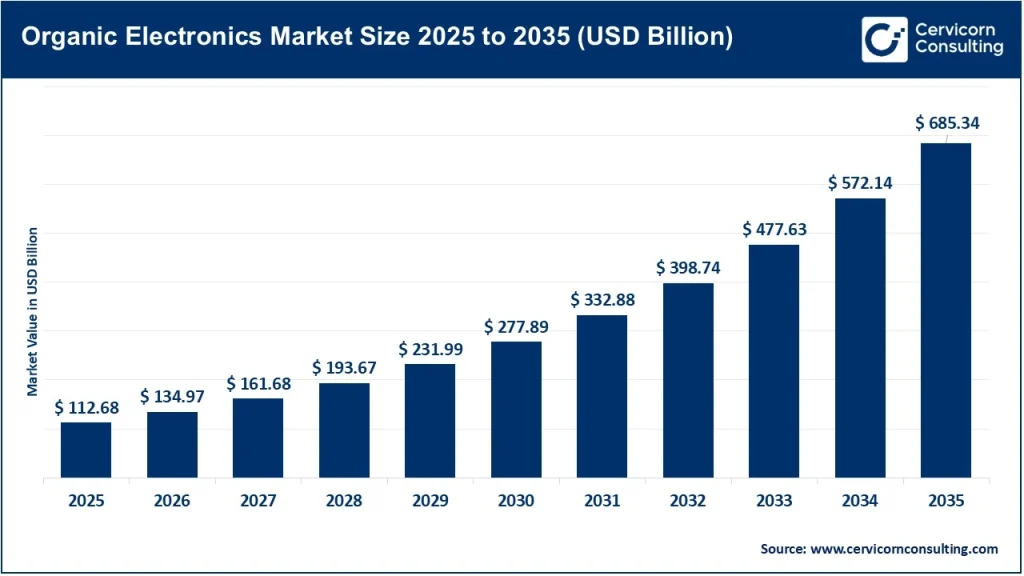
The global organic electronics market was valued at USD 112.68 billion in 2025 and is projected to reach approximately USD 685.34 billion by 2035, expanding at a compound annual growth rate (CAGR) of 19.8% from 2026 to 2035. Growth is being supported by increasing OLED adoption, demand for flexible and lightweight electronic components, advances in printed electronics, and emerging applications in healthcare, automotive systems, and renewable energy.
However, the expansion of organic electronics does not mean every application offers the same commercial opportunity. OLED displays already benefit from established manufacturing ecosystems and consumer demand, while organic photovoltaics (OPVs), flexible sensors, and printed electronic components have different requirements for reliability, production scale, and customer adoption.
For manufacturers, materials suppliers, component developers, and investors, the central challenge is deciding where organic electronics can deliver a measurable advantage over conventional technologies. Companies that align application selection, material performance, manufacturing economics, and customer requirements will be better positioned to turn market growth into sustainable revenue.
1. Which Application Should Companies Prioritize for Commercial Growth?
Organic electronics covers several applications, including displays, OLED lighting, organic photovoltaics, sensors, and transistors or system components. Each application has a different level of technological maturity, customer demand, and commercialization risk.
According to Cervicorn Consulting’s market estimates, displays accounted for 52.7% of organic electronics market revenue in 2025, making them the largest application segment. Their established use in smartphones, televisions, laptops, wearables, and automotive displays provides a substantial commercial foundation. Meanwhile, OPVs and flexible sensors offer opportunities in emerging applications, but their economics depend more heavily on specific use cases and performance requirements.
Companies should evaluate applications based on their existing technical capabilities and access to customers rather than pursuing the fastest-growing segment automatically.
- Display manufacturers and materials suppliers: Prioritize OLED efficiency, material consistency, color performance, production yield, and longer operating life.
- Printed electronics companies: Assess demand for printed sensors, RFID components, smart labels, and flexible circuits where conventional rigid components may be less suitable.
- Energy technology developers: Evaluate OPVs for lightweight, flexible, or semi-transparent installations where conventional photovoltaic systems may not meet design requirements.
- Healthcare technology companies: Investigate flexible biosensors and wearable monitoring devices, accounting for accuracy, biocompatibility, device stability, and applicable regulatory requirements.
Business decision: Build an application portfolio that balances established demand with carefully selected emerging opportunities. Commercial readiness, customer willingness to pay, and technical differentiation should determine investment priority.
Get a Free Sample: https://www.cervicornconsulting.com/sample/2970
2. Should Companies Invest in Organic Semiconductors or Conductive Materials?
Material selection directly influences device efficiency, production costs, durability, and compatibility with manufacturing processes. Organic semiconductors are essential for active electronic functions, including light emission and charge transport, while conductive materials support electrodes, interconnections, printed circuits, and other electronic structures.
Cervicorn Consulting identifies semiconductor materials as the leading material category in the market. Their established role in OLED displays, sensors, organic photovoltaics, and transistors creates opportunities for suppliers with strong material-performance capabilities.
However, material leadership by revenue does not automatically make every semiconductor investment attractive. Competition, customer qualification requirements, intellectual property, production consistency, and the cost of achieving required purity can affect profitability.
Companies should assess three strategic options:
- Develop specialized semiconductor materials: Appropriate for businesses with advanced chemistry capabilities, intellectual property, and the resources to support lengthy customer qualification cycles.
- Expand conductive inks and printable materials: Worth evaluating when customers need flexible circuits, printed sensors, or lightweight electronic components that can be manufactured using scalable deposition techniques.
- Supply complementary materials and substrates: Potentially attractive for companies serving several applications, particularly where barrier films, dielectric layers, encapsulation materials, or flexible substrates address recurring manufacturing problems.
Before committing capital, businesses should compare achievable selling prices, material yields, qualification timelines, customer concentration, and the costs of scaling production.
Business decision: Invest in materials that solve a clearly defined customer problem and create defensible differentiation, rather than competing solely on volume or price.
3. How Should Companies Reduce the Cost and Risk of Manufacturing Scale-Up?
Organic electronics is frequently associated with printing-based production, flexible substrates, and potentially lower-cost manufacturing. Yet laboratory performance does not guarantee commercially viable mass production. Yield losses, material degradation, inconsistent deposition, environmental sensitivity, and encapsulation requirements can offset anticipated cost advantages.
For companies moving from pilot production to industrial manufacturing, the priority should be to establish repeatable performance under realistic operating conditions.
A disciplined scale-up strategy should include:
- Validate production yield: Measure defect rates and usable output across multiple production runs, not just during successful pilot demonstrations.
- Compare manufacturing processes: Assess printing, coating, vacuum deposition, and hybrid processes according to the application, material system, equipment investment, throughput, and quality requirements.
- Control degradation: Test exposure to oxygen, moisture, heat, light, and mechanical stress under conditions representative of the intended operating environment.
- Calculate unit economics: Include materials, energy, labor, equipment depreciation, quality control, encapsulation, rejected units, and warranty costs.
- Secure process repeatability: Establish specifications for material purity, layer thickness, electrical performance, and finished-device reliability.
Manufacturers should also avoid building capacity ahead of verified demand. Pilot lines, contract manufacturing, strategic partnerships, and phased capacity additions can help reduce upfront exposure while customer qualification progresses.
Business decision: Approve large-scale investment only after pilot data demonstrates acceptable yield, reliability, throughput, and cost per saleable unit.
4. Which End-Use Industries Offer the Best Customer Opportunities?
Organic electronics serves multiple industries, but the purchasing criteria differ substantially. Consumer electronics companies typically emphasize display quality, product differentiation, reliability, and cost at scale. Automotive manufacturers place significant weight on durability, environmental performance, safety requirements, and long qualification cycles. Healthcare developers need reliable sensing, user comfort, and application-specific validation.
Cervicorn Consulting estimates that consumer electronics accounted for 46.9% of the market in 2025, supported by OLED displays, wearable devices, and other electronic products. Automotive applications represent another important opportunity through digital displays, advanced lighting, and sensing technologies. Healthcare applications create potential for flexible biosensors, electronic skin patches, and wearable monitoring devices.
Companies should evaluate customer segments using a commercial scorecard that considers:
- Addressable demand: How many qualified customers could realistically adopt the technology?
- Technical fit: Does organic electronics provide a meaningful advantage in flexibility, weight, transparency, sensing, or display performance?
- Qualification requirements: How long will it take to validate the product and approve it for use?
- Revenue potential: What are the expected order size, purchasing frequency, and achievable margins?
- Sales concentration: Would dependence on a small number of large customers expose the business to excessive commercial risk?
For smaller suppliers, entering through a focused application or a specialized component can be more practical than competing directly with established electronics manufacturers across multiple product categories.
Business decision: Select target industries according to customer access, product-market fit, qualification costs, and realistic revenue potential—not market size alone.
5. How Should Companies Build Competitive Advantage Through Reliability and Intellectual Property?
Organic electronics competes with established technologies such as silicon-based semiconductors, inorganic LEDs, and conventional photovoltaic systems. In applications where traditional technologies already meet performance and cost requirements, organic alternatives need a clear advantage to justify adoption.
That advantage may come from flexible form factors, low-temperature processing, lightweight construction, transparency, or compatibility with unconventional surfaces. But these benefits must be demonstrated in the finished product.
Companies should focus on developing capabilities that competitors cannot easily replicate:
- Improve operational stability: Extend device life and reduce sensitivity to heat, moisture, oxygen, and ultraviolet exposure.
- Strengthen encapsulation and packaging: Protect sensitive materials while preserving flexibility and device performance.
- Protect material and process innovations: Evaluate patents, proprietary formulations, deposition techniques, and application-specific designs.
- Build application-level partnerships: Work with device manufacturers to develop products around actual engineering and customer requirements.
- Demonstrate measurable performance: Provide evidence on lifetime, energy efficiency, production consistency, and total cost of ownership.
Partnerships can be particularly valuable where an organic-material supplier has strong chemistry expertise but lacks device-manufacturing capabilities, or where an electronics manufacturer needs specialized materials to meet new design requirements.
Business decision: Compete on verified performance and application-specific value rather than relying on the general promise of flexible or sustainable electronics.
6. How Should Companies Allocate Investment Between Established and Emerging Technologies?
The organic electronics market includes commercially established technologies and applications that still require substantial technical development. A sound investment strategy should reflect those differences rather than treating the entire market as a single opportunity.
OLED displays offer access to existing demand and established supply chains, although competition and manufacturing investment can be significant. Organic photovoltaics may offer differentiation in lightweight, flexible, or semi-transparent energy applications, but commercialization depends on efficiency, durability, project economics, and the suitability of the installation. Flexible healthcare sensors and printed electronics can provide specialized opportunities where conventional components are difficult to integrate.
Companies can structure investment decisions around three priorities:
Near-term revenue: Improve existing OLED materials, display components, manufacturing processes, or products serving customers with established purchasing requirements.
Medium-term expansion: Develop adjacent capabilities such as printed sensors, flexible circuits, automotive electronics, or specialized conductive materials where existing expertise provides a competitive advantage.
Long-term innovation: Fund selected opportunities in organic photovoltaics, advanced biosensors, and next-generation organic transistors through staged research programs, pilot projects, and partnerships.
Every investment should have defined milestones, including customer validation, technical performance, manufacturing yield, unit economics, and a credible route to commercialization. Management should also establish clear criteria for continuing, expanding, or terminating projects that fail to meet those milestones.
Business decision: Allocate capital across different maturity stages, using established business lines to support growth while limiting exposure to technologies that have yet to demonstrate commercial viability.
What Should Companies Do Next?
The organic electronics market presents opportunities across materials, displays, printed components, healthcare devices, automotive systems, and energy applications. Yet the commercial value of these opportunities depends on how well companies match their capabilities to specific customer requirements.
Before committing to a new product line, production facility, or technology partnership, decision-makers should answer six questions:
- Which application offers the strongest combination of customer demand and technical fit?
- Which material or component capability can provide defensible differentiation?
- Can the product achieve reliable performance and acceptable unit economics at scale?
- Which end-use industries offer realistic customer access and manageable qualification requirements?
- What technical, intellectual-property, or manufacturing advantage can protect margins?
- How should capital be divided between current revenue opportunities and emerging technologies?
The answers should be supported by application-level demand estimates, competitor positioning, material and process requirements, customer qualification timelines, and investment scenarios.
The central strategic priority is to identify where organic electronics creates an advantage that customers will pay for—and then establish a repeatable, scalable way to deliver it. Companies that make these decisions early can focus research and development, manufacturing capacity, and commercial resources on opportunities with stronger prospects for sustainable growth.
To Get Detailed Overview, Contact Us: https://www.cervicornconsulting.com/contact-us