


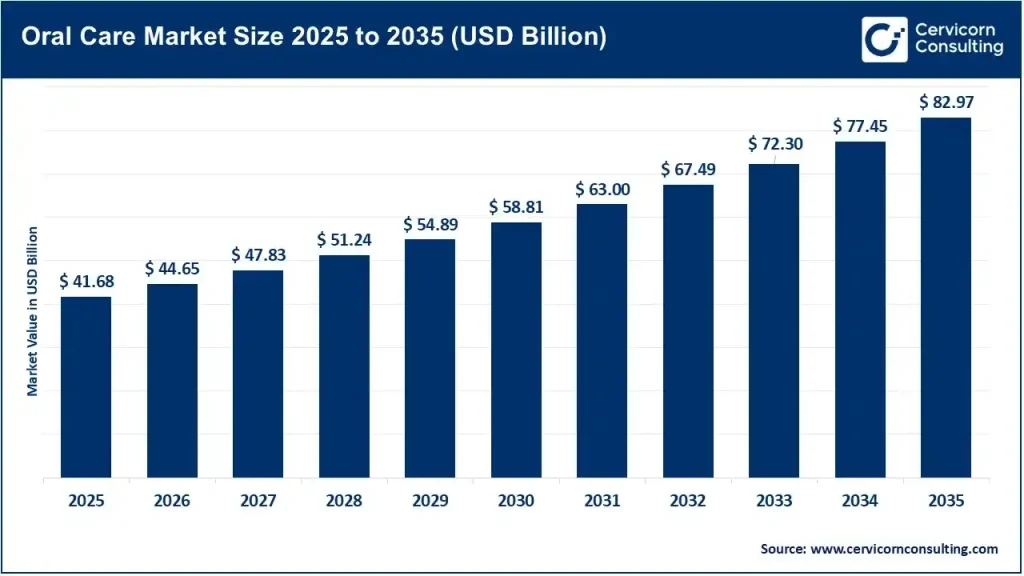
Oral Care Market Size
The global oral care market was valued at approximately USD 41.68 billion in 2025 and is projected to reach around USD 82.97 billion by 2035, expanding at a CAGR of approximately 7.1% during the forecast period.
Oral Care Market Growth Factors
The global oral care market is expanding as consumers become increasingly aware of the connection between oral hygiene and overall health, while the rising prevalence of dental caries, periodontal disease, tooth loss, oral infections, and other preventable conditions continues to create demand for preventive products and professional services. According to the World Health Organization (WHO), oral diseases affect nearly 3.7 billion people globally, with untreated dental caries in permanent teeth remaining the most common health condition identified by the Global Burden of Disease 2021 study.
Market growth is further supported by increasing disposable incomes, urbanization, aging populations, growing consumption of premium toothpaste and mouthwash products, rising demand for electric and smart toothbrushes, greater interest in teeth whitening and sensitivity management, expanding e-commerce channels, and increased adoption of preventive dental care. Product innovation is also broadening the addressable market through fluoride-free and natural formulations, probiotics, enamel-repair products, interdental cleaning solutions, specialized gum-care products, and AI-enabled dental technologies.
Government and international public-health programs are simultaneously encouraging earlier diagnosis, preventive oral hygiene, school-based dental education, fluoride use, tobacco-control measures, and integration of oral health into primary healthcare. These structural factors are creating a market that increasingly combines everyday consumer healthcare with professional dentistry, digital health, diagnostics, and personalized preventive care.
Get a Free Sample: https://www.cervicornconsulting.com/sample/3007
What Is the Oral Care Market?
The oral care market encompasses products, services, technologies, and solutions designed to maintain oral hygiene, prevent oral diseases, diagnose dental conditions, and support treatment and recovery. It covers both consumer-facing oral hygiene products and professional dental care.
Major product categories include toothpaste, toothbrushes, mouthwash, dental floss, interdental cleaners, whitening products, dental accessories, oral irrigators, denture-care products, and specialized therapeutic products. Professional oral care includes preventive dental examinations, professional cleaning, restorative dentistry, orthodontics, periodontics, endodontics, prosthodontics, oral surgery, cosmetic dentistry, and other specialized services.
The market is increasingly moving beyond conventional daily-use products. Consumers now seek products with specific functional benefits, such as sensitivity relief, gum protection, enamel strengthening, whitening, plaque control, cavity prevention, and long-lasting freshness. Digital dentistry is also becoming an important component of the broader oral care ecosystem through teledentistry, AI-assisted diagnostics, digital imaging, connected toothbrushes, remote monitoring, and digitally designed dental restorations.
Why Is the Oral Care Market Important?
Oral care is important because oral diseases can affect quality of life, productivity, nutrition, communication, confidence, and broader health outcomes. WHO estimates that oral diseases affect billions of people worldwide and emphasizes that most oral conditions are largely preventable and treatable when detected early.
The importance of the market therefore extends beyond the sale of toothpaste or toothbrushes. Preventive oral care can reduce the need for more expensive restorative interventions later in life. Regular brushing, interdental cleaning, professional dental examinations, fluoride use, and early diagnosis can help control dental caries and periodontal disease.
Oral health is also increasingly being considered within the broader noncommunicable disease agenda. Shared risk factors such as high sugar consumption, tobacco use, alcohol consumption, and inadequate hygiene overlap with other chronic diseases. WHO’s global oral health strategy calls for stronger integration of oral healthcare into universal health coverage and primary healthcare systems.
For businesses, this creates opportunities across consumer healthcare, professional dentistry, digital health, diagnostics, medical devices, specialty formulations, and preventive healthcare.
Major Healthcare Organizations and Their Relevance to Oral Care
The companies and healthcare organizations below are important healthcare players, but they should not be interpreted as the five largest companies by oral care market share. UnitedHealth Group, HCA Healthcare, Mayo Clinic, Cleveland Clinic, and Kaiser Permanente operate primarily across health insurance, hospitals, integrated healthcare, specialty medicine, research, and care delivery rather than consumer oral-hygiene products. Consequently, a standalone oral-care market share is generally not publicly reported for these organizations. Their total 2025 revenues are included for scale and context rather than as oral-care revenue.
| Company | Specialization | Key Focus Areas | Notable Features | 2025 Revenue | Oral Care Market Share | Global Presence |
|---|---|---|---|---|---|---|
| UnitedHealth Group Incorporated | Integrated healthcare and health insurance | Healthcare coverage, care delivery, pharmacy services, data and technology | UnitedHealthcare and Optum ecosystem | USD 447.6B | Not separately disclosed | Primarily U.S., with global capabilities |
| HCA Healthcare, Inc. | Hospital and healthcare services | Hospitals, surgery, emergency care, outpatient care | One of the largest U.S. hospital operators | USD 75.6B | Not separately disclosed | Primarily U.S. and UK |
| Mayo Clinic | Academic medical care | Specialty medicine, research, education, diagnostics | Integrated clinical, research and education model | USD 21.5B operating revenue | Not separately disclosed | U.S. with international patient and clinical relationships |
| Cleveland Clinic | Academic medical and specialty care | Cardiovascular, cancer, neurological, surgical and specialty medicine | Internationally recognized integrated healthcare system | USD 18.27B operating revenue | Not separately disclosed | U.S. and international locations |
| Kaiser Permanente | Integrated managed care | Health insurance, hospitals, primary and specialty care | Value-based, integrated care model | USD 127.7B combined operating revenue with Risant Health | Not separately disclosed | Primarily U.S. |
UnitedHealth Group reported USD 447.6 billion in consolidated 2025 revenue, while its UnitedHealthcare business served approximately 49.8 million people. HCA Healthcare reported USD 75.6 billion in 2025 revenue, supported by growth in equivalent admissions and revenue per equivalent admission.
Mayo Clinic generated approximately USD 21.5 billion in total operating revenue in 2025, including USD 18.1 billion in net medical service revenue. Cleveland Clinic reported USD 18.27 billion in 2025 operating revenue and nearly 16 million patient encounters. Kaiser Permanente and Risant Health reported combined operating revenues of USD 127.7 billion in 2025.
These organizations can influence oral healthcare through insurance coverage, hospital-based dentistry, specialty referrals, preventive healthcare, research, digital health, and integrated care models even though they are not direct proxies for consumer oral-care market share.
Leading Trends in the Oral Care Market and Their Impact
1. Premiumization of Oral Hygiene Products
Consumers are increasingly willing to pay more for products positioned around specific oral-health benefits. Premium toothpaste, advanced mouthwash, electric toothbrushes, whitening solutions, oral irrigators, and specialty products for sensitive teeth and gum health are gaining attention.
This trend is shifting competition from basic hygiene toward clinically differentiated products. Companies are increasingly emphasizing scientific ingredients, functional benefits, professional endorsements, and personalized product positioning.
2. Electric and Smart Toothbrush Adoption
Electric toothbrushes are becoming increasingly popular as consumers seek more effective and convenient brushing. Modern devices can incorporate pressure sensors, timers, multiple cleaning modes, smartphone connectivity, brushing analytics, and artificial intelligence.
The impact is significant because toothbrushes are shifting from simple mechanical products toward connected health devices. Manufacturers can use digital connectivity to provide behavioral feedback, encourage consistent brushing, and potentially improve long-term oral hygiene habits.
3. Natural and Clean-Label Oral Care
Demand for natural and clean-label oral-care products is increasing, particularly among consumers concerned about ingredients and sustainability. Brands are developing formulations featuring plant-derived ingredients, essential oils, herbal extracts, biodegradable packaging, and alternative formulations.
This creates opportunities for premium brands but also introduces the need for evidence-based claims. Consumers and regulators are increasingly attentive to whether natural products actually provide equivalent preventive benefits.
4. Teeth Whitening and Cosmetic Dentistry
Aesthetic concerns are expanding demand for whitening toothpaste, whitening strips, professional whitening, aligners, cosmetic restorations, and other appearance-oriented services.
Social media, professional networking, photography, and growing consumer awareness of dental aesthetics have contributed to the normalization of cosmetic oral care. The trend is particularly relevant among younger consumers and urban populations.
5. Digital Dentistry and AI
AI is emerging across dental imaging, caries detection, periodontal assessment, treatment planning, radiographic interpretation, patient communication, and practice management.
AI-enabled systems can help dentists analyze images, identify potential abnormalities, prioritize patients, and improve documentation. Digital scanning, CAD/CAM systems, 3D printing, and remote consultations are also transforming dental workflows.
The long-term impact is likely to be a more data-driven and personalized oral-care ecosystem in which preventive interventions can be recommended earlier.
6. E-Commerce and Direct-to-Consumer Distribution
Online channels are making oral-care products more accessible while enabling companies to offer subscription models, personalized bundles, specialty products, and direct consumer engagement.
E-commerce is particularly important for premium and niche oral-care products that may not receive extensive physical retail shelf space. It also enables brands to collect consumer feedback and understand purchasing behavior more effectively.
7. Preventive Healthcare
The oral-care industry is increasingly shifting from treatment toward prevention. WHO’s global oral health framework emphasizes prevention, integration with primary healthcare, health promotion, and improved access.
This creates opportunities for products and services that support daily self-care, early detection, regular screening, professional cleaning, fluoride use, and patient education.
Successful Examples of Oral Care Market Development Around the World
Japan: The 8020 Campaign
Japan provides one of the strongest examples of a population-level oral health initiative. The country launched its 8020 Campaign in 1989, promoting the goal of retaining at least 20 natural teeth at age 80. Research examining the program highlights the role of stable financing, local-government initiatives, oral-health legislation and ordinances, and preventive approaches.
The broader lesson for the oral care market is that long-term public-health campaigns can stimulate preventive behavior and strengthen demand for professional and consumer oral-care services.
India: National Oral Health Programme
India’s National Oral Health Programme represents an important example of integrating dental care into the broader public-health system. The program was launched during the 2014–15 period to strengthen accessible, affordable, and quality oral healthcare.
India’s program supports dental care units, human resources, equipment, consumables, training, and information and education activities. Government data indicate that 9,587 dental care units had been supported since 2014–15 across states and union territories, including district hospitals, community health centers, primary health centers, and mobile dental units.
This approach creates market opportunities for dental equipment, consumables, diagnostics, professional services, and preventive products while improving access in underserved populations.
Global WHO Oral Health Action Plan
The WHO Global Oral Health Action Plan 2023–2030 is another major development shaping the global market. The plan translates the global oral health strategy into 100 actions and 11 global targets for 2030, with emphasis on prevention, healthcare integration, workforce development, information systems, research, and universal coverage.
Its significance for the industry is substantial because governments are increasingly encouraged to move from fragmented, treatment-oriented dental systems toward prevention and integrated healthcare.
Global Regional Analysis
North America
North America remains one of the most mature oral-care markets, characterized by high consumer awareness, extensive retail distribution, strong dental infrastructure, premium product adoption, and rapid technological innovation.
The United States has a highly developed dental services ecosystem and strong demand for toothpaste, electric toothbrushes, whitening products, mouthwash, dental floss, and specialty oral-care products. Private dental practices, dental service organizations, insurers, hospitals, and technology companies all contribute to the market.
The region is also becoming an important center for AI-enabled dentistry, digital imaging, clear aligners, 3D printing, connected toothbrushes, and personalized dental solutions.
Europe
Europe benefits from strong public-health infrastructure, high awareness of preventive dentistry, aging populations, and stringent product and healthcare regulations. Consumers increasingly seek sustainable packaging, natural ingredients, premium oral-care products, and specialized solutions.
European governments and health systems are also emphasizing preventive healthcare and improved oral-health literacy. The aging population creates additional demand for products addressing dry mouth, periodontal disease, dentures, tooth sensitivity, and other age-related oral-health needs.
Asia Pacific
Asia Pacific represents a particularly important growth region. The market accounted for approximately 37.52% of global oral-care market revenue in 2025, according to one recent market assessment.
The region combines a large population base with increasing disposable income, urbanization, improving healthcare infrastructure, rising awareness, and expanding modern retail and e-commerce.
China, Japan, India, South Korea, and Southeast Asian countries are creating opportunities for both mass-market and premium oral-care products. Japan’s longstanding preventive initiatives provide an established example of public-health-led oral-care development, while India’s National Oral Health Programme is expanding access to dental services.
Latin America
Latin America offers opportunities driven by population growth, urbanization, increasing healthcare awareness, and expansion of modern retail and e-commerce. Brazil and Mexico represent important markets due to their large consumer bases and established healthcare industries.
However, differences in healthcare access and household purchasing power create a highly segmented market. Affordable toothpaste and toothbrushes remain important, while premium whitening, cosmetic dentistry, and specialty products are gradually expanding among higher-income consumers.
Middle East & Africa
The Middle East and Africa represent a developing opportunity for oral-care manufacturers and service providers. Growing healthcare investment, urbanization, younger populations, rising awareness, and government efforts to improve preventive healthcare are supporting market development.
However, affordability, uneven dental workforce distribution, limited rural access, and insufficient preventive-care infrastructure remain important challenges. WHO has emphasized that accessibility and affordability remain major barriers in many regions and that oral healthcare needs to become more integrated with primary healthcare and universal health coverage.
Government Initiatives and Policies Shaping the Oral Care Market
Government policy is becoming an increasingly important market driver because oral diseases are largely preventable but remain widespread.
WHO Global Oral Health Strategy 2022 and Action Plan 2023–2030: WHO’s framework promotes universal access to oral healthcare, stronger prevention, integration with primary healthcare, improved workforce capacity, better information systems, and research.
India’s National Oral Health Programme: India’s program focuses on reducing oral disease burden and improving accessible, affordable, comprehensive oral healthcare. It supports dental infrastructure, personnel, equipment, consumables, training, and health education.
Japan’s 8020 Policy Approach: Japan’s long-running 8020 initiative demonstrates how national and local policy, legislation, financing, and preventive education can influence oral-health behavior over decades.
Southeast Asia Regional Action: WHO’s South-East Asia oral health action plan for 2022–2030 includes targets related to reducing premature mortality from oral cancer and untreated dental caries, while emphasizing integration with primary healthcare and NCD programs.
Universal Health Coverage Integration: WHO is encouraging countries to integrate essential oral health services into broader universal health coverage packages. This policy direction could gradually shift oral healthcare from a predominantly out-of-pocket service toward a more integrated component of national health systems.
Market Opportunities Emerging From These Developments
The combination of rising disease burden, consumer awareness, technological innovation, and public-health investment is creating opportunities across several areas.
Personalized oral care can use consumer data, dental history, lifestyle factors, and connected devices to recommend tailored products and routines.
Preventive diagnostics can help identify caries, gum disease, oral lesions, and other conditions earlier.
AI-enabled dentistry can improve diagnostic efficiency and treatment planning while supporting dental professionals.
Premium therapeutic products can target sensitivity, enamel protection, periodontal health, whitening, and specialized patient requirements.
Affordable oral-care solutions represent a major opportunity in emerging economies where large populations remain underserved.
Subscription and e-commerce models can encourage recurring purchases of toothpaste, replacement toothbrush heads, floss, mouthwash, whitening products, and other consumables.
Sustainable oral care offers opportunities for recyclable packaging, reduced-plastic toothbrushes, refillable products, biodegradable materials, and environmentally conscious formulations.
The market is therefore evolving from a traditional consumer-goods category into a broader oral-health ecosystem connecting personal hygiene, preventive healthcare, professional dentistry, digital technology, diagnostics, and public health. As governments place greater emphasis on prevention and consumers become more informed about the relationship between oral and overall health, companies that combine clinical credibility, product innovation, affordability, personalization, and digital engagement are positioned to capture emerging opportunities across developed and developing markets.
To Get Detailed Overview, Contact Us: https://www.cervicornconsulting.com/contact-us
Read Report: Warehousing Market Revenue, Trends, and Strategic Insights by 2035