


Table of Contents
ToggleOn-Board Charger Market Size
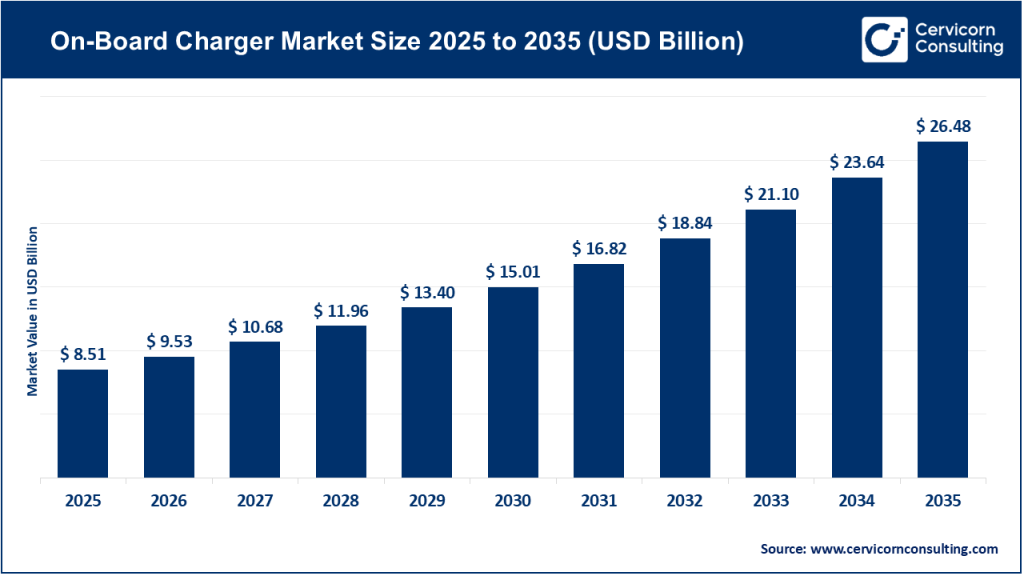
The global on-board charger market size was worth USD 8.51 billion in 2025 and is anticipated to expand to around USD 26.48 billion by 2035, registering a compound annual growth rate (CAGR) of 12.1% from 2026 to 2035.
What is the On-Board Charger Market?
The on-board charger (OBC) market refers to the global industry involved in designing, manufacturing, and supplying charging conversion systems that are installed inside electric vehicles (EVs). An on-board charger is an electronic device integrated into an electric vehicle that converts alternating current (AC) from external power sources—such as residential outlets or public charging stations—into direct current (DC) required to charge the vehicle’s battery pack.
Within an electric vehicle, the on-board charger performs several critical functions, including power conversion, voltage regulation, communication with the charging infrastructure, and safety management. These systems ensure that energy is delivered efficiently and safely to the battery during the charging process. Depending on the vehicle design and charging architecture, onboard chargers typically range from 3.3 kW to over 22 kW in power capacity.
As the global automotive industry transitions toward electrification, the demand for high-performance onboard chargers is rising significantly. These chargers are essential components of electric vehicle powertrain systems and are used across passenger EVs, plug-in hybrid vehicles, commercial electric trucks, buses, and specialty vehicles.
Modern onboard charger systems are increasingly designed with advanced semiconductor technologies and intelligent control systems that enhance efficiency, reduce size and weight, and support new charging functionalities. The development of compact and highly efficient power electronics is helping automotive manufacturers integrate more powerful charging systems into vehicles without increasing vehicle weight or cost significantly.
Get a Free Sample: https://www.cervicornconsulting.com/sample/2910
Why the On-Board Charger Market is Important
The on-board charger plays a fundamental role in enabling electric mobility and supporting the transition toward cleaner transportation systems. Without efficient onboard charging systems, electric vehicles would not be able to recharge safely or efficiently from common AC power infrastructure.
One of the most important advantages of onboard chargers is their ability to allow EVs to charge from standard electrical outlets and widely available AC charging stations. This capability makes home and workplace charging possible, which is one of the most convenient and cost-effective charging methods for EV owners.
Onboard chargers also ensure proper battery management. By controlling current and voltage during charging, these systems help protect battery cells from damage caused by overheating or overcharging. This protection helps extend battery life and maintain overall vehicle performance.
Another key importance of onboard chargers lies in their role in enabling bidirectional energy flow. Advanced chargers can support vehicle-to-grid (V2G) or vehicle-to-home (V2H) systems, which allow electric vehicles to supply electricity back to the grid or to residential buildings. This capability transforms EVs into distributed energy storage systems, supporting renewable energy integration and improving grid stability.
Furthermore, improvements in onboard charger technology contribute to faster charging times, greater energy efficiency, and improved vehicle range. These improvements help address one of the main concerns among potential EV buyers—charging convenience.
On-Board Charger Market Growth Factors
The growth of the onboard charger market is primarily driven by the rapid expansion of the global electric vehicle industry, increasing government incentives for EV adoption, growing investments in charging infrastructure, and continuous technological advancements in power electronics. Governments around the world are implementing stricter emission regulations and providing subsidies, tax benefits, and policy support to accelerate electric vehicle adoption. At the same time, improvements in semiconductor technologies such as silicon carbide and gallium nitride are enabling higher efficiency and more compact onboard charging systems. The demand for faster charging solutions, the development of high-voltage EV platforms, and the growing integration of bidirectional charging capabilities are further boosting the demand for advanced onboard chargers. Additionally, the electrification of commercial transportation—including buses, trucks, and delivery fleets—is creating new opportunities for high-power onboard charging systems, significantly contributing to the market’s growth worldwide.
Key Companies in the On-Board Charger Market
The global onboard charger market includes electric vehicle manufacturers, semiconductor companies, and automotive electronics suppliers that develop charging solutions and power conversion technologies.
| Company | Specialization | Key Focus Areas | Notable Features | 2024 Revenue | Market Share | Global Presence |
|---|---|---|---|---|---|---|
| BYD | Electric vehicles, batteries, EV components | Integrated EV platforms, battery systems, charging technologies | Strong vertical integration across EV supply chain | ~$107 billion | Major EV manufacturer | Asia, Europe, Latin America |
| Nichicon Corporation | Power electronics and capacitors | EV chargers, capacitors, power supplies | Early developer of EV onboard chargers | ~$1.3 billion (approx.) | Niche component supplier | Japan, Europe, North America |
| Tesla, Inc. | Electric vehicles and energy systems | EV powertrains, charging infrastructure, battery systems | Advanced charging technology and integrated EV ecosystem | ~$97.7 billion | Leading EV manufacturer | North America, Europe, Asia |
| Infineon Technologies AG | Semiconductor and power electronics | Automotive semiconductors, silicon carbide chips | High-efficiency power devices for EV charging | ~€15 billion | Major semiconductor supplier | Europe, Asia, Americas |
| Panasonic Corporation | Automotive electronics and batteries | EV batteries, energy storage, power electronics | Strong battery partnerships with global automakers | ~$54 billion+ | Leading EV battery supplier | Global |
These companies play a critical role in shaping the technological evolution of the onboard charger market through innovations in power electronics, battery integration, and electric vehicle architectures.
Leading Trends in the On-Board Charger Market and Their Impact
High-Power Charging Systems
Automotive manufacturers are increasingly adopting higher-power onboard chargers, such as 11 kW and 22 kW systems, which significantly reduce charging time compared to traditional lower-power chargers.
Silicon Carbide and Gallium Nitride Technology
The adoption of wide-bandgap semiconductor materials such as silicon carbide and gallium nitride is improving efficiency, reducing energy losses, and enabling more compact charging systems.
Bidirectional Charging Technology
Bidirectional charging allows electric vehicles to supply electricity back to homes or power grids. This capability supports vehicle-to-grid (V2G) and vehicle-to-home (V2H) applications, turning EVs into mobile energy storage units.
Integrated Power Electronics
Manufacturers are integrating onboard chargers, inverters, and DC-DC converters into unified power electronics systems. This integration reduces system weight, lowers costs, and improves efficiency.
High-Voltage EV Architectures
The development of 800-volt EV platforms enables ultra-fast charging and improved energy efficiency. These architectures require advanced onboard charger systems capable of handling higher voltage levels.
Successful Examples of On-Board Charger Applications Around the World
Tesla Electric Vehicle Charging Systems
Tesla electric vehicles utilize advanced onboard charging systems designed to deliver high efficiency and compatibility with both home charging and public charging infrastructure. These systems support efficient AC charging while maintaining battery safety and performance.
BYD Electric Bus Charging Technology
BYD has developed integrated onboard charging systems for electric buses used in urban public transportation networks worldwide. These buses are deployed in cities across Asia, Europe, and North America.
Nissan LEAF Charging System
The Nissan LEAF electric vehicle includes an onboard charger that enables reliable home charging using AC power. The system supports different charging capacities depending on vehicle configuration.
European Vehicle-to-Grid Projects
Several European energy companies have implemented vehicle-to-grid projects where electric vehicles equipped with bidirectional onboard chargers can send electricity back to the grid during periods of peak demand.
Electric Commercial Fleets
Many logistics companies in North America and Europe are deploying electric delivery fleets equipped with onboard chargers that allow vehicles to charge overnight at depots, ensuring reliable fleet operations.
Global Regional Analysis
North America
North America is a major market for onboard chargers due to strong electric vehicle adoption and advanced automotive technology development. The United States leads the region with large investments in EV infrastructure and battery manufacturing.
Government Initiatives and Policies
Government policies supporting EV adoption include tax credits for electric vehicle purchases, investments in charging infrastructure, and stricter emissions regulations. Several states have also introduced zero-emission vehicle mandates that encourage automakers to increase EV production.
These policies are significantly driving the demand for onboard charging systems across the region.
Europe
Europe represents one of the fastest-growing markets for onboard chargers. The region’s aggressive climate policies and electrification targets are accelerating the transition toward electric mobility.
Government Initiatives and Policies
The European Union has implemented strict carbon emission standards for vehicles and several countries have announced plans to phase out internal combustion engine vehicles in the coming decades. Governments across the region provide incentives for EV purchases and investments in charging infrastructure.
These initiatives are creating strong demand for advanced onboard charger technologies.
Asia-Pacific
Asia-Pacific dominates the global electric vehicle market and is home to some of the world’s largest EV manufacturers and battery producers.
Government Initiatives and Policies
China has introduced large-scale subsidies and incentives for electric vehicle production and adoption. Japan and South Korea are investing heavily in semiconductor technologies and battery development to strengthen their EV supply chains.
The region’s strong manufacturing base and supportive government policies are making it a key hub for onboard charger production and innovation.
Latin America
Latin America is an emerging market for electric vehicles and charging technologies. Countries such as Brazil, Mexico, and Chile are gradually increasing EV adoption through incentives and pilot programs.
Government Initiatives and Policies
Governments are implementing tax reductions for EV imports, supporting electric bus projects in public transportation, and promoting sustainable mobility initiatives.
Although EV adoption is still developing, the region presents strong growth potential for onboard charger technologies.
Middle East and Africa
The Middle East and Africa region is gradually expanding its electric mobility ecosystem as governments explore sustainable transportation solutions.
Government Initiatives and Policies
Several countries are investing in EV charging infrastructure, renewable energy integration, and urban electrification projects. These initiatives aim to reduce carbon emissions and diversify energy systems.
As electric mobility expands in the region, the demand for onboard charging technologies is expected to grow steadily.
To Get Detailed Overview, Contact Us: https://www.cervicornconsulting.com/contact-us
Read Report: Animal Feed Market Revenue, Trends, and Strategic Insights by 2035