


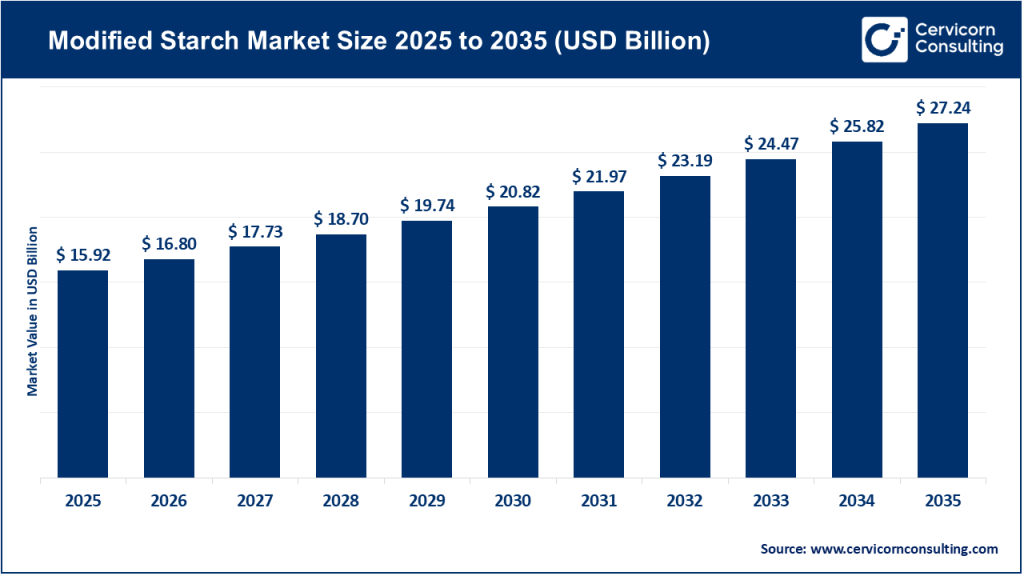
Modified Starch Market Size
The global modified starch market size was worth USD 15.92 billion in 2025 and is anticipated to expand to around USD 27.24 billion by 2035, registering a compound annual growth rate (CAGR) of 5.52% from 2026 to 2035.
What Is the Modified Starch Market?
The modified starch market includes companies engaged in converting native starches—derived from corn, potato, wheat, cassava, and other sources—into enhanced functional forms through chemical, physical, or enzymatic modifications. These modifications alter the structure and properties of starch to deliver improved viscosity, texture, stability, film formation, binding, gelation, clarity, and resistance to heat, shear, or freezing.
Modified starch is used in:
- Processed foods: sauces, soups, dairy, bakery, snacks, confectionery, beverages
- Industrial sectors: paper, textiles, adhesives, construction, packaging
- Pharmaceuticals: capsules, excipients, disintegrants
- Personal care: lotions, detergents, cosmetics
Because of this vast applicability, the modified starch market intersects with multiple global value chains and plays a foundational role in both consumer-facing and industrial applications.
Get a Free Sample: https://www.cervicornconsulting.com/sample/2832
Why the Modified Starch Market Is Important
The importance of modified starch stems from its combination of sustainability, versatility, cost-effectiveness, and performance reliability:
- A Clean-Label Functional Ingredient
Modified starches offer formulators a way to meet clean-label demands while delivering performance that synthetic additives cannot always match. Many physical or enzymatic modifications qualify as “natural” under certain regulations. - Sustainable and Renewable
Starch is plant-derived, renewable, biodegradable, and lower-emission compared to petrochemical polymers. This positions modified starch as a strategic ingredient in the global transition toward bio-based materials. - Technical Versatility Across Industries
Whether in a creamy sauce or a corrugated box adhesive, modified starch delivers critical properties like thickening, binding, stability, and film formation. - Cost-Effective Alternative to Synthetics
Modified starch offers an optimal balance of price and functional performance, allowing industries like paper and construction to lower material costs without compromising quality. - Scalability and Supply Chain Stability
Starch-producing crops are cultivated worldwide, enabling a robust, distributed supply chain less prone to disruption compared to petrochemical inputs.
Modified Starch Market Growth Factors
The modified starch market is growing due to rising demand for processed and convenience foods that require stable, functional texturizers; expanding use in personal care, pharmaceuticals, and industrial applications needing biodegradable alternatives to synthetic polymers; rising clean-label and natural ingredient preferences; technological advancements in enzymatic and physical modification processes; ongoing investments in specialty starches like resistant starch and pre-gelatinized formulations; volatile raw-material pricing that encourages vertical integration and feedstock diversification; increasing adoption of cassava, potato, and corn starch in emerging economies; and proactive government policies supporting bio-based materials, agricultural value addition, and sustainable manufacturing practices across global markets.
Top Companies in the Modified Starch Market
Below are detailed market profiles of the leading companies shaping the global modified starch industry.
1. Archer-Daniels-Midland Company (ADM)
Specialization:
ADM is a global agribusiness and one of the most influential ingredient suppliers in the world. Its starch portfolio includes native, pre-gelatinized, and chemically or enzymatically modified starches used in food, pharmaceutical, and industrial applications.
Key Focus Areas:
- Food and beverage ingredient systems
- Industrial starches for paper, adhesives, and construction
- Innovation labs that support co-development with major consumer brands
- Sustainability and regenerative agriculture programs
Notable Features:
- Extensive corn wet-milling operations
- Advanced R&D centers worldwide
- Deep global distribution and supply-chain strength
2024 Revenue:
Approximately USD 85.5 billion (company-wide global revenue).
Market Share:
ADM is one of the global leaders by capacity and customer reach, commanding significant influence in the starch and broader ingredient markets.
Global Presence:
North America, South America, Europe, Asia-Pacific, Middle East & Africa, with dozens of ingredient innovation centers and manufacturing facilities.
2. AGRANA Beteiligungs-AG
Specialization:
AGRANA is Europe’s leading producer of potato- and corn-based native and modified starches, serving food processing, industrial applications, and paper manufacturing.
Key Focus Areas:
- Potato and corn starch derivatives
- Clean-label and organic starch solutions
- European manufacturing leadership
- Customized starch solutions for regional brands
Notable Features:
- Strong focus on potato starch innovation
- Highly integrated regional agricultural operations
- Emphasis on sustainability and local sourcing
2024 Revenue:
Around €3.5 billion (2024/25 fiscal year company revenue).
Market Share:
AGRANA holds a major share in the European starch market and is a global supplier to multiple sectors.
Global Presence:
Strong presence in Europe with expanding global export networks.
3. Cargill Incorporated
Specialization:
Cargill is one of the largest privately held corporations globally, leading in corn milling and starch ingredient production for both food-grade and industrial markets.
Key Focus Areas:
- Functional and specialty starches
- Customized solutions for major multinational food companies
- Clean-label and non-GMO product innovation
- Sustainable sourcing and regenerative agriculture
Notable Features:
- Massive global supply chain and logistics capability
- Strong partnerships with global FMCG and industrial brands
- Heavy investment in innovation and bio-based product lines
2024 Revenue:
Estimated USD 160 billion in consolidated global revenue.
Market Share:
One of the world’s largest starch producers by volume, diversity, and geographic footprint.
Global Presence:
Operations in over 70 countries with a dense network of manufacturing plants and application labs.
4. Grain Processing Corporation (GPC) — Kent Corporation
Specialization:
GPC is known for its high-quality specialty starches, corn-based derivatives, and pulse ingredients used in food, beverage, nutrition, and industrial applications.
Key Focus Areas:
- Non-GMO starches
- Specialty ingredients for bakery, beverages, personal care
- Tailored technical solutions for mid-sized and niche product developers
Notable Features:
- Strong technical service model
- Focus on premium value-added ingredients
- Longstanding reputation for quality
2024 Revenue:
Estimated to be in the hundreds of millions (roughly $300–350 million) as a private company.
Market Share:
A key player in North American specialty starch markets, especially in higher-value segments.
Global Presence:
Primarily North America with export operations and partnerships internationally.
5. Emsland-Stärke GmbH (Emsland Group)
Specialization:
Europe’s largest potato starch producer, offering a wide variety of modified starches, fibers, and potato-derived specialty ingredients.
Key Focus Areas:
- Clean-label food texturizers
- Industrial starches and fibers
- Potato-based ingredient innovation
- Sustainable potato cultivation networks
Notable Features:
- Industry-defining potato-based functional starches
- Strong presence in European food and industrial sectors
- Focus on environmentally efficient processing technologies
2024 Revenue:
As a private group, revenues are not centrally published; estimates place the company in the upper hundreds of millions to low billions depending on product lines and regional reporting.
Market Share:
One of Europe’s leading potato-starch producers and a major global supplier.
Global Presence:
European manufacturing with global distribution channels across food and industrial markets.
Leading Trends in the Modified Starch Market and Their Impact
1. Clean-Label and Natural Ingredient Movement
Consumers prefer less processed, recognizable ingredients. This boosts physical and enzymatic starch modifications and reduces reliance on chemically altered starches.
Impact:
Manufacturers invest heavily in natural-processing technologies and “label-friendly” starch formulations.
2. Rising Demand for Processed Foods and Convenience Meals
Ready meals, frozen foods, instant soups, and sauces rely heavily on modified starch.
Impact:
Sustained volume growth for pre-gelatinized, cross-linked, and freeze–thaw stable starches.
3. Industrial Shift Toward Biodegradable & Bio-Based Materials
Sectors like packaging, adhesives, and textiles are replacing petrochemical-based binders.
Impact:
Modified starch demand rises in paper sizing, industrial adhesives, and biodegradable materials.
4. Health & Wellness Trends: Resistant Starches and Low-Calorie Formulations
Resistant starches support digestive health, glycemic control, and food fortification.
Impact:
Premium-priced specialty starch categories expand rapidly in global health-conscious markets.
5. Feedstock Diversification (Cassava, Potato, Corn, Wheat)
Supply security is a major concern for manufacturers.
Impact:
Companies diversify globally, investing in cassava-processing plants in Asia and Africa and expanding corn/potato capacity in Europe and North America.
6. Digitalization and R&D-Driven Customization
Food manufacturers want custom performance rather than generic ingredients.
Impact:
Large firms increasingly operate ingredient innovation labs and integrated customer co-development programs.
Successful Examples of Modified Starch Applications Worldwide
1. Clean-Label European Ready Meals Using Potato Modified Starch
European brands have successfully developed clean-label sauces and ready meals using potato-based starches from companies like AGRANA and Emsland, replacing synthetic gums.
2. GPC’s Specialty Starches in North American Bakery and Beverage Brands
Non-GMO and specialty starches have helped many bakery and beverage brands optimize texture, moisture retention, and shelf life.
3. Asian Cassava-Based Modified Starch for Global Paper & Adhesive Markets
Countries like Thailand, Indonesia, and Vietnam have expanded cassava-based modified starch production, supplying global paper mills and corrugated packaging manufacturers.
4. ADM and Cargill’s Co-Development Programs for Global FMCG Companies
These companies help major food producers launch products across multiple regions with consistent starch functionality, significantly accelerating new product development cycles.
Global Regional Analysis, Government Initiatives & Policies
Below is a region-by-region analysis showing how demand varies and how governments shape market development.
North America
Market Characteristics:
- Strong demand for processed foods, bakery, dairy alternatives, beverages
- Wide use in paper, adhesives, pharmaceuticals, and personal care
- Strong innovation and R&D presence
Government Influence:
- Emphasis on food safety and clear labeling
- Support for bio-based industrial materials
- Incentives for sustainable agriculture and renewable feedstocks
Europe
Market Characteristics:
- Highest clean-label and natural ingredient adoption
- Strong potato starch industry
- Mature paper and industrial sector demand
Government Influence:
- Strict food additive regulations
- Policies supporting biodegradability and circular economy
- Subsidies for potato cultivation and regional value chains
Asia-Pacific
Market Characteristics:
- Fastest-growing region for processed foods
- World’s largest cassava cultivation and processing hub
- Expanding paper, textile, and adhesives markets
Government Influence:
- Incentives to expand cassava and potato processing
- Export promotion of value-added agricultural products
- Investments in food security and agro-industrial modernization
Latin America
Market Characteristics:
- Strong raw material base (corn, cassava)
- Growing processed food market
- Industrial applications expanding steadily
Government Influence:
- Incentives for agro-industrial growth
- Programs to enhance export competitiveness
- Emerging policies supporting bio-based materials
Middle East & Africa
Market Characteristics:
- Growing demand for bakery, snacks, convenience foods
- Cassava cultivation growth in African markets
- Early-stage industrial starch applications
Government Influence:
- Support for local processing to reduce import dependency
- Agricultural value chain investments
- Infrastructure and industrial development initiatives
To Get Detailed Overview, Contact Us: https://www.cervicornconsulting.com/contact-us
Read Report: Agrochemicals Market Growth Drivers, Trends, Key Players and Regional Insights by 2035